


Quick Summary: Food delivery app development costs range from $30,000 for a lean MVP to $200,000+ for an enterprise platform, and that covers the build only. Year one adds another 25 to 35% in running costs, plus launch marketing if you are entering a new city. This guide breaks the budget down by business model, app module, development stage, and team location, then adds up what the first year really costs. Use it to decide how much to plan for before you request a single quote.
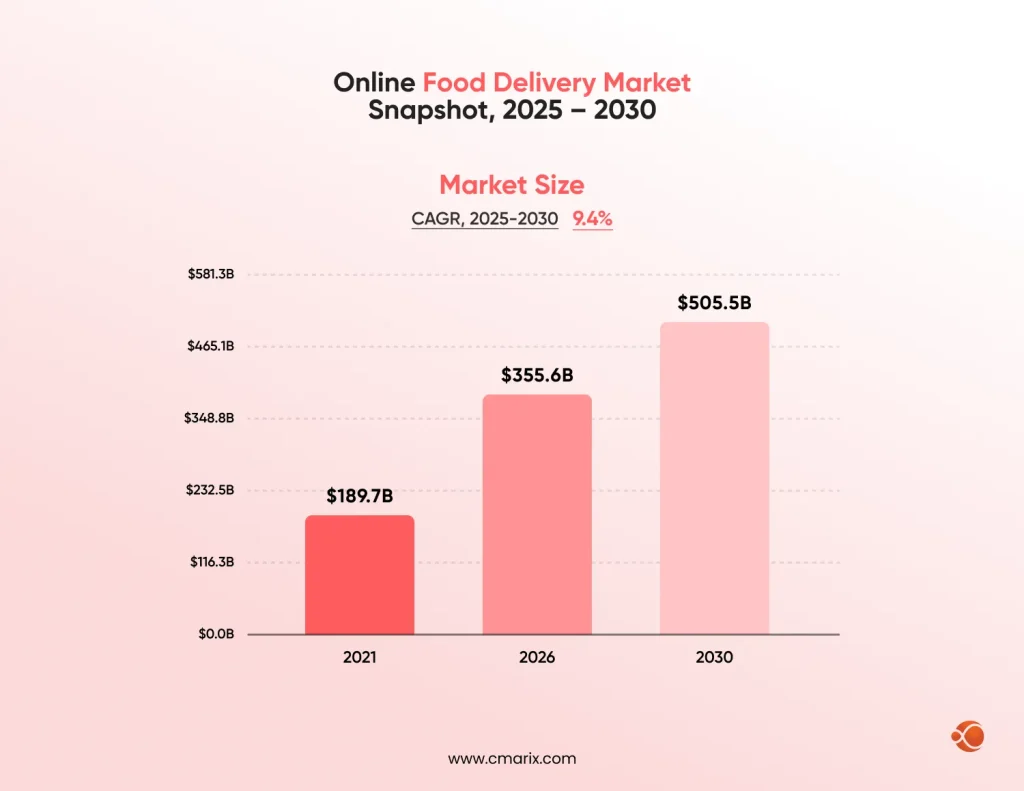
Ordering dinner from a phone is routine now, and the money behind it keeps growing. Grand View Research values the global online food delivery market at USD 288.8 billion in 2024, growing from USD 355.6 billion in 2026 to USD 505.5 billion by 2030, a 9.4% CAGR from 2025. That growth is why restaurant groups, grocery chains, and first-time founders keep asking the same question: what is the real cost to develop a food delivery app?
Most answers quote the build price and stop there. Your actual budget also includes running costs in year one and, if you are entering a new market, the spend it takes to get restaurants, riders, and customers onto the platform. Let’s break it down the way your bank balance will feel.
What Is Food Delivery App Development?
Food delivery app development is the process of designing and building the software that connects hungry customers, restaurants, and delivery riders. Most platforms are four products working as one: a customer app, a restaurant panel, a driver app, and an admin panel that runs the operation. Each has its own screens, logic and testing, so a food delivery quote is never the price of a single app.
The same report shows where the money sits. Platform-to-consumer businesses, the aggregator marketplaces that list many restaurants, held over 71% of global revenue in 2024. Restaurants selling straight through their own apps are the smaller slice, but Grand View expects that segment to grow at a 5.8% CAGR through 2030 as chains build their own apps to keep the customer relationship and skip third-party platform fees. That split is why a marketplace budget looks so different from a single brand app budget. If you want a team to build either one end-to-end, take a look at our custom food delivery app development solution.
What you build depends on how you make money. A single restaurant taking its own orders needs far less than a marketplace running the restaurant aggregator business model, where you list many kitchens and earn a commission on every order.
| Business Model | How It Works | Typical Budget Tier |
| Single restaurant or chain app | One brand takes orders and delivers with its own or hired riders | MVP |
| Restaurant aggregator marketplace | Many restaurants on one platform; you earn on each order | Mid-Market |
| Cloud kitchen or delivery-only brand | Kitchens with no dining room, all sales through the app | MVP to Mid-Market |
| Grocery and quick commerce | Live inventory, substitutions, tight delivery windows | Mid-Market to Enterprise |
| Multi-city platform | Several cities, languages, currencies, and dispatch rules | Enterprise |
Still shaping your concept? Our roundup of food delivery app ideas shows where startups are finding room in a crowded category.
Food Delivery App Development Cost at a Glance
Three tiers cover most projects. Pick the one that matches what you need on day one, not what you hope to have in year three.
| Tier | Cost Range | Timeline | What You Get |
| MVP | $30,000 to $60,000 | 3 to 5 months | One city, core ordering flow, basic map pin tracking, simple restaurant panel, basic courier app, basic admin controls |
| Mid-Market | $60,000 to $120,000 | 5 to 8 months | Live GPS tracking, in-app payments, ratings, push notifications, multi-restaurant support |
| Enterprise | $120,000 to $200,000+ | 9 to 14 months | AI recommendations, dynamic pricing, dispatch logic, multi-language and currency, advanced analytics |
These are planning estimates and assume a team billing roughly $25 to $50 an hour. Final pricing depends on scope, integrations, and the team you hire.
Minimum Viable Product (MVP) development has one job: proving that people in one city will order through your app. It will not have loyalty programs or predictive delivery times, and that is the point. Mid-Market is where most funded startups land once demand is proven. Enterprise is for companies that already know they need smart dispatch and various markets running at once.
One note on scope. Our global mobile app development cost guide lists the wider on-demand and delivery category at $60,000 to $180,000, because it covers every kind of delivery build. This guide narrows in on food delivery and includes lean single-city builds, so its range starts lower and stretches higher.
Send your feature list and get a scoped estimate from our team.
Food Delivery App Cost Breakdown by Module: Customer, Restaurant, Driver, Admin
Here is where the money goes across the four apps, tier by tier.
| Module | MVP | Mid-Market | Enterprise |
| Customer app | $10,500 to $21,000 | $21,000 to $42,000 | $42,000 to $70,000+ |
| Restaurant panel | $7,500 to $15,000 | $15,000 to $30,000 | $30,000 to $50,000+ |
| Driver app | $6,000 to $12,000 | $12,000 to $24,000 | $24,000 to $40,000+ |
| Admin panel | $6,000 to $12,000 | $12,000 to $24,000 | $24,000 to $40,000+ |
| Total | $30,000 to $60,000 | $60,000 to $120,000 | $120,000 to $200,000+ |
The customer app takes about 35% of the budget, the restaurant panel 25%, and the driver and admin apps 20% each. Custom restaurant panel cost climbs when you add POS and inventory sync or multi-location management, which is why it jumps so much between tiers. Delivery driver app features like turn-by-turn navigation, batch routing, and in-app chat do the same for the driver line. You can see a fuller feature list in our guide to on-demand delivery app features.
The admin panel looks boring until you have to onboard vendors, settle payouts, and resolve a disputed order at 9 pm on a Friday. Skimp there, and your operations team pays for it every day. If you want a feature-by-feature price list, our guide to the cost to build an app like UberEats goes module by module.
Food Delivery App Development Cost by Stage
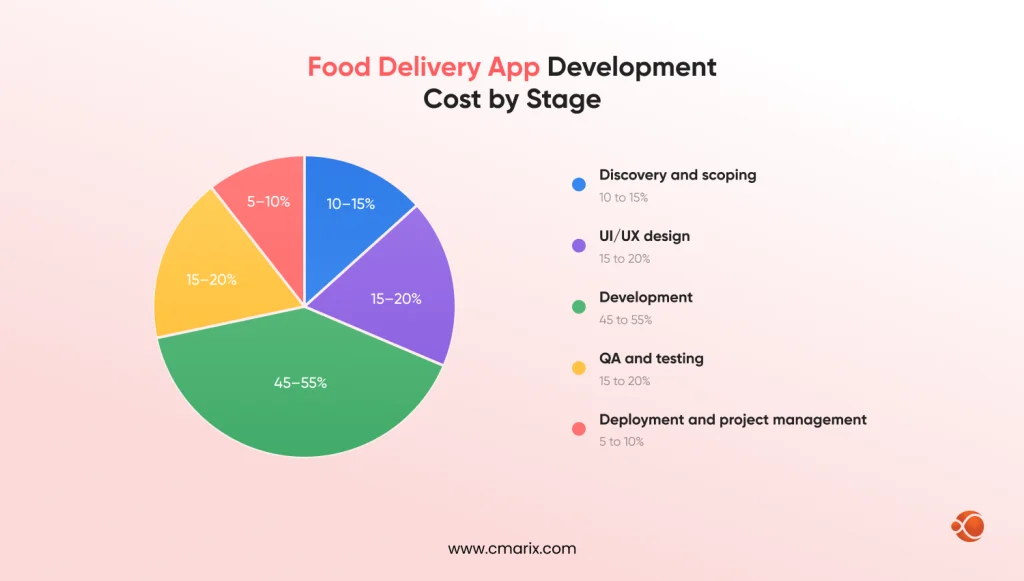
The budget also moves through the project in phases. Knowing the split helps you spot a quote that quietly skips one.
| Stage | Share of Budget | What Happens |
| Discovery and scoping | 10 to 15% | Requirements, architecture, feasibility |
| UI/UX design | 15 to 20% | Wireframes, prototypes, user flows, visual design |
| Development | 45 to 55% | Front end, back end, integrations |
| QA and testing | 15 to 20% | Manual and automated testing, bug fixes |
| Deployment and project management | 5 to 10% | Store submission, release, coordination |
The ranges overlap, so a real quote settles on one figure per stage that adds up to 100%.
UI/UX design for delivery apps is trickier than it looks, because you are designing four separate interfaces. A rider glancing at a phone on a bike has different needs from a restaurant manager clearing a tablet full of orders.
Given the midpoint of the mid-market rate of $90,000, development will be somewhere in the range of $40,500-$49,500 and QA in the range of $13,500-$18,000. If a vendor offers you the same price of $90,000 but with a QA budget far lower than the latter figure, you can be sure of bugs.
Factors Affecting Food Delivery App Development Cost
Team location is the biggest single lever. These are typical hourly rates.
| Region | Typical Hourly Rate |
| North America | $100 to $180 |
| Western Europe | $80 to $150 |
| Eastern Europe | $40 to $80 |
| India | $20 to $50 |
Now put hours behind the rates. Here is what each tier looks like as a build of a given size at a rate within that $25 to $50 band.
| Tier Illustrated | Build Hours | Rate | Result |
| MVP | 1,200 hours | $25 to $50 | $30,000 to $60,000 |
| Mid-Market | 2,400 hours | $25 to $50 | $60,000 to $120,000 |
| Enterprise | 4,000 hours | $30 to $50 | $120,000 to $200,000 |
What this really means is that location can move you a full tier on its own. Those same 1,200 MVP hours at North American rates come to $120,000 to $216,000, which is Enterprise territory. Cheaper is not automatically better, though. A low rate with heavy revision cycles and thin communication can cost more than a higher rate that ships clean the first time.
When you compare vendors, look for professional mobile app development teams that show you their seniority mix, QA hours, and post-launch support up front.
Feature depth is the second thing. A menu list and a checkout are simple; scheduled orders, live tracking orders, and a dispatch engine that matches the nearest rider are heavy-end work, not front end polish, and each one belongs to a higher tier for a reason.
Android vs iOS App Development Cost: Which Platform to Build First
When you launch on one platform, it is 40% to 60% cheaper compared to launching on both platforms (iOS and Android). If your first choice is Android, our Android app development cost guide shows what a single-platform build runs.
Cross-platform mobile app development with Flutter or React Native is the middle path. It brings a dual launch down to roughly 55 to 70% of the cost of building two native apps, and it works well for most delivery apps. The exception is live tracking, which is performance-sensitive and sometimes justifies native code. If your customers and riders skew iPhone, read our iOS app development cost guide before you lock in the plan.
On-Demand Delivery Tech Stack and Integration Costs
The on-demand delivery tech stack shapes both your build cost and your monthly bills. Most platforms use a mix like this.
| Layer | Typical Choices | Budget Effect |
| Mobile apps | Flutter, React Native, or native Swift and Kotlin | Cross-platform lowers build cost |
| Back end and database | Node.js or Python, PostgreSQL or MongoDB | Common skills, easy to hire |
| Real-time layer | WebSockets, Firebase push notifications | Powers live tracking and order status |
| Payments | Stripe, Razorpay, local gateways | Per-transaction fees plus integration work |
| Maps and routing | Google Maps Platform | Usage-based, grows with orders |
| Cloud hosting | AWS or Google Cloud | Scales with order volume |
A real-time order tracking system pulls each rider’s location through the driver app and pushes it to the customer’s map. It is one of the features people notice most, and one of the ones that adds ongoing cost, because every map load and route calculation is billed.
Google’s pricing is worth understanding before you sign a budget.
On Google’s Maps Platform price list, Dynamic Maps loads cost $7 per 1,000 after the first 10,000 free each month, and route calculations cost $5 per 1,000 after their own 10,000 free. The mobile Maps SDKs are free, so the bill mostly comes from web maps in your admin panel and from routing. At 50,000 map loads and 50,000 route calculations a month, that comes to about $480 a month before geocoding and place search.
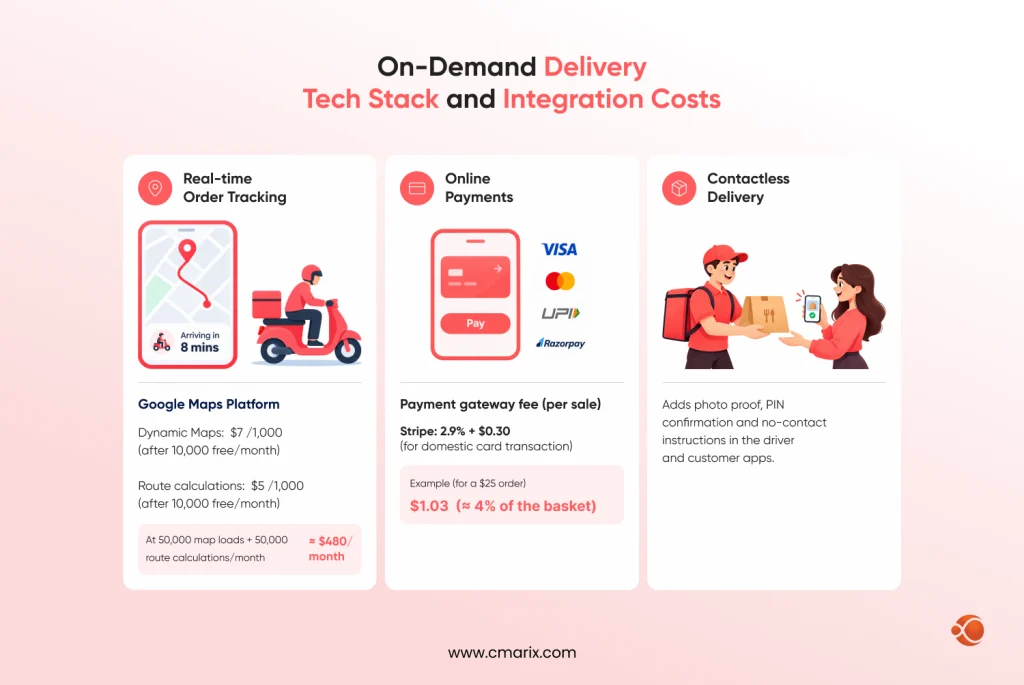
Online payments are the norm today. In 2024, online payments made up over 67% of the total online food delivery revenues worldwide, and thus, your payment gateway cannot be seen as an additional feature. Cash on delivery will continue to grow in some countries in 2024; thus, you should be ready to deal with it if you operate in one such country.
There are 2 kinds of payment gateway fees. One is the building fee related to the integration of the payment gateway into your system, and it is part of the total development cost. The other is the fee paid on each sale; the average cost for Stripe per sale is 2.9%, and 30 cents per domestic card transaction. For a $25 order, it means that your fee is $1.03, or 4% of the basket.
Then there is a handoff at the door. Contactless delivery system design adds photo proof, PIN confirmation, and no-contact instructions to the driver and customer apps. It is mostly status logic and camera work, so it sits inside those two module lines rather than as its own budget item.
Food Delivery Software Pricing: Custom Build, White Label or SaaS
You do not have to build from scratch. Food delivery software pricing comes in three shapes, and the right one depends on how much control you need.
| Model | How You Pay | Typical Upfront Cost | Trade-Off |
| Custom build | One-time build, then yearly maintenance | $30,000 to $200,000+ | Full ownership and control, higher cost |
| White-label licence | Setup fee, often plus recurring fees | Under $5,000 to about $50,000 | Fast launch, limited customization |
| SaaS platform | Monthly subscription | From a few dozen dollars a month | Lowest entry, you rent the roadmap |
White-label food delivery app cost varies widely by vendor. One script vendor advertises white label launches under $5,000, while another puts a licensed platform with your branding at $15,000 to $50,000. Some SaaS restaurant app providers start at $49 a month. Treat all of these as vendor-advertised figures and ask what is included.
At the top of the white label, it intersects the custom MVP cost at $30,000. This is when you start to gain an advantage with custom development, since you own the codebase and can, in the future, build your own dispatch or recommendation algorithm on top of it.
Food Delivery App Maintenance Cost and Your Real First Year Budget
Here is the part most cost guides skip. After launch, your app needs looking after, and a marketplace needs people on it.
| Cost Layer | What It Covers | Typical Amount |
| Build | The app itself, one time | Your tier range |
| Maintenance | Bug fixes, OS updates, security patches, scaling | 15 to 25% of the build per year |
| Hosting, API and store fees | Maps, payments, SMS, push notifications, developer accounts | Grows with order volume |
| Launch marketing | Restaurant and rider onboarding, first customers, one city | $20,000 to $50,000 |
App maintenance and cloud hosting costs are the two lines people forget until the second invoice arrives. Together with API and store fees, they make up your running costs, which typically land at 25 to 35% of the build in year one. Put it all together and the first year looks like this.
| Tier | Build | Year One Running Costs (25 to 35%) | One City Launch Marketing | First Year Total |
| MVP | $30,000 to $60,000 | $7,500 to $21,000 | $20,000 to $50,000 | $57,500 to $131,000 |
| Mid-Market | $60,000 to $120,000 | $15,000 to $42,000 | $20,000 to $50,000 | $95,000 to $212,000 |
Enterprise is left out on purpose because launch spend across several regions varies too much for one planning range. Notice what the table says, though. A $30,000 MVP can cost close to $60,000 by the end of year one once you fill the app with restaurants and riders. That is the number to raise funding against.
Skip the guesswork. Send your idea and get a scoped estimate from our team.
Grocery and Quick Commerce App Development Cost vs Food Delivery
Short answer: yes. On-demand food delivery app development cost climbs when you add a catalog that changes by the hour, and grocery is the clearest example. Meal delivery still made up over 64% of online food delivery revenue in 2024, which makes meals the safer place to start and grocery a natural second phase. Stock levels, substitutions, and scheduled slots add scope to each of the four apps. Our guide to on-demand grocery delivery app development covers the extra features in detail.
Quick commerce goes a step further. It promises delivery of everyday essentials in roughly 10 to 30 minutes, usually from dark stores. That means real-time inventory sync across locations and much tighter dispatch logic, which is why it sits at the top of the Mid-Market to Enterprise range. If that is your model, start with our quick commerce app development guide before you set a budget.
Food Delivery App Development Trends and Costs for 2026-27
Three shifts are moving budgets, and all three are easier to plan for than to fix later.
- Live tracking is now a baseline. Clients benchmark your application against the most reputable players in the space. Live capabilities become part of a minimalist version that traditionally lacked them.
- AI is becoming an add-on. Smart suggestions and dispatch were initially part of the Enterprise edition, where they are already included. Additional implementation of basic recommendations on top of the minimalist version is around $15K-$30K more, which may bump the MVP budget from $45K to $90K into the Mid-Market category. That’s a choice to make, so any price on AI should be taken as a rough estimate.
- Payments and privacy get scrutinized earlier. Market-specific payment solutions, local wallet integration, and data regulations vary for different locations. Account for this from the beginning, and you will not be surprised by a rework when you launch in your first city.
How to Reduce Food Delivery App Development Cost
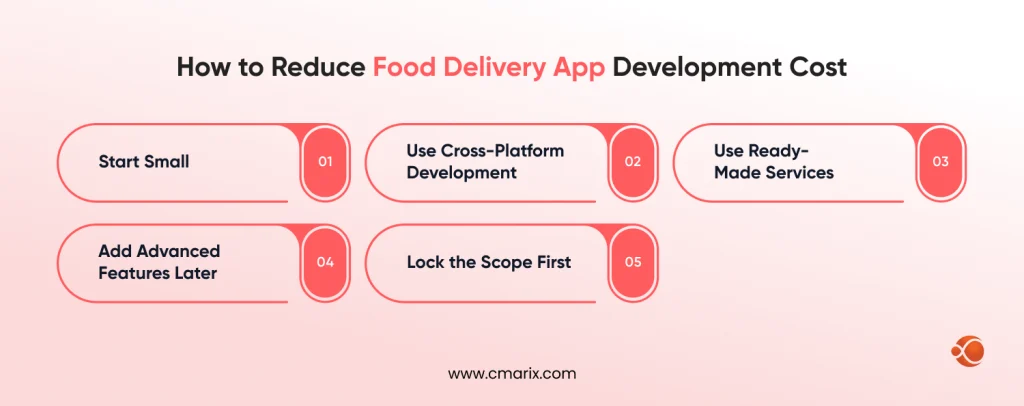
- Launch on one platform in one city. It is the fastest way to get the first bill and know the people who are actually buying.
- Choose cross-platform where you can. It gets you into both stores without doubling the codebase.
- Buy commodity features. Payments, maps, and push notifications all have mature providers. Building them from scratch rarely pays off.
- Delay the clever parts. Dynamic pricing and AI recommendations can be put off until revenue pays for them.
- Fix the scope before you fix the price. Most overruns come from vague requirements, not bad code.
Suggestion: If your quote falls well below the $30,000 minimum viable product (MVP) threshold, chances are that you are purchasing either a demonstration or a license model, not an operational platform.
Send them over, and we will flag what each one leaves out.
Which Food Delivery App Development Cost Tier Fits Your Business?
| Your Situation | Start Here |
| One restaurant or chain testing app orders | MVP |
| Founder validating a marketplace in one city | MVP, with a plan to grow into Mid-Market |
| Funded aggregator with several restaurants live | Mid-Market |
| Cloud kitchen network or grocery seller | Mid-Market |
| Multi-region brand that needs dispatch logic and AI | Enterprise |
Why Choose CMARIX for Food Delivery App Development
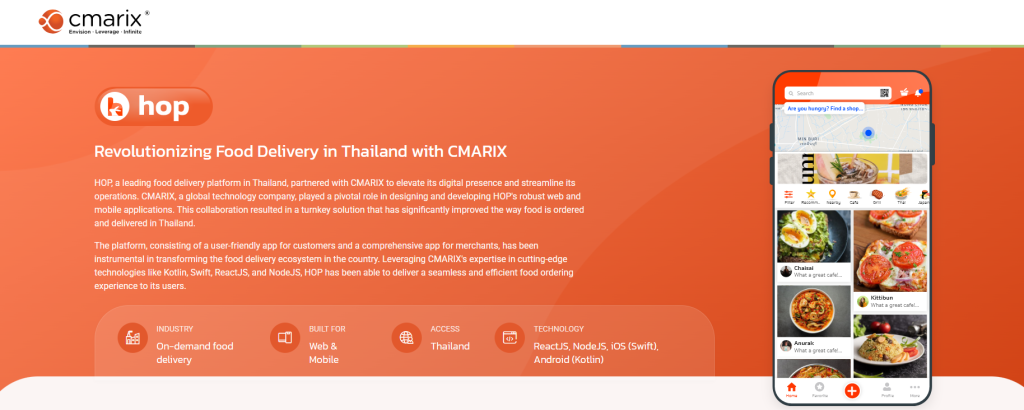
CMARIX has built delivery platforms across markets, and the work goes well beyond a customer app. For HOP, a food delivery platform in Thailand, our team delivered a customer ordering app, a separate merchant app for restaurants, live GPS order tracking, a local payment gateway, and push notifications. That is the same multi-part structure this guide has been pricing.
We scope before we quote, so the number you receive matches the app you actually need. If you already know you want extra hands on your roadmap, you can hire dedicated developers and start from your feature list. If you would rather work with a team that has shipped delivery apps before, our experienced mobile app developers can walk through your market, timeline, and budget first.
Conclusion
Food delivery app development cost begins at $30,000 for a lean MVP and reaches $200,000+ for an enterprise platform. The build is only part of the budget. Year one running costs usually add 25 to 35%, and launching in a new city adds marketing on top. Choose the tier that fits your business model, ask every vendor what is inside their quote, and plan your funding around the first year total instead of the build price.
FAQs on Food Delivery App Development Cost
How much does a food delivery app cost?
Most projects fall between $30,000 and $200,000+. An MVP runs $30,000 to $60,000, Mid-Market $60,000 to $120,000, and Enterprise $120,000 to $200,000+. Add 25 to 35% for year one running costs.
What are the main factors that influence food delivery app development cost?
Depth of features, location of the development team, type of platform, and business model affect the cost significantly. Location is of primary importance because the rate per hour in India varies between $20 and $50, while North America charges from $100 to $180. The two companies could offer the same description but with different QA hours and experience.
How much does it cost to build individual modules (Customer, Courier, Vendor)?
At the MVP tier, the customer app runs $10,500 to $21,000, the restaurant panel $7,500 to $15,000, and the driver app $6,000 to $12,000. The admin panel adds another $6,000 to $12,000. At Enterprise depth, those lines rise to $42,000 to $70,000+, $30,000 to $50,000+, and $24,000 to $40,000+, respectively, with the admin panel also at $24,000 to $40,000+.
What are the hidden costs of running a food delivery app after launch?
Maintenance runs 15 to 25% of the build per year, and hosting, API, and store fees bring total running costs to 25 to 35% in year one. Map and routing calls, payment processing fees on every order, and launch marketing of $20,000 to $50,000 per city come on top.
Does a grocery delivery app cost the same as a food delivery app?
Not usually; grocery adds live inventory, substitutions, and scheduled slots, so it tends to sit one tier higher than a food delivery app with the same feature depth. Quick commerce adds dark store inventory sync and much tighter dispatch, which pushes it toward the top of the range.
How long does it take to develop a food delivery application?
An MVP takes 3 to 5 months, a Mid-Market build 5 to 8 months, and an enterprise platform 9 to 14 months. Discovery and design take up the first portion of that time, and QA runs alongside development.
How does platform choice affect the food delivery app development budget?
A single platform launch typically costs 40 to 60% less than launching on iOS and Android together. Cross-platform frameworks like Flutter and React Native bring a dual launch to roughly 55 to 70% of the cost of two native builds. Native code is sometimes worth it for live tracking performance.
How can I optimize and lower my food delivery app development cost?
Start with one platform in one city, employ cross-platform development, and purchase commoditized components such as payment services and maps. Delay dynamic pricing and AI recommendations to a subsequent version. Rescoping the project prior to agreeing on the price point will prevent 90% of the problems.