




Quick Summary: Discover the cost to build a Food Delivery App like Uber Eats, from MVP to enterprise platforms. Explore pricing by features, app modules, development stages, hidden costs, and practical strategies to plan a scalable, cost-effective food delivery solution.
When you calculate the cost to build a food delivery app, the truth lies somewhere between $30,000, which is just enough to build a minimum viable product (MVP), and $200,000+, which would give you a full-fledged enterprise solution. This wide margin exists due to one reason only: first-time entrepreneurs overlook the fact that you are creating four apps at once.
According to Statista’s online food delivery market forecast, global revenue in this category is projected to reach roughly $1.51 trillion in 2026 and grow to about $2.05 trillion by 2031. That’s not a market that rewards a rushed, undercapitalized build. Competing in it means the food delivery app has to hold up under real load from day one.
Quick answer:
- Minimum Viable Product (MVP): $30,000 – $60,000 ($3 to $5 months) – one city and one core ordering process
- Mid-Market: $60,000–$120,000 (5–8 months), real-time tracking, in-app payments, multi-restaurant support
- Enterprise-Grade: $120,000–$200,000+ (9–14 months), AI recommendations, dynamic pricing, dispatch algorithms
Note: Costs are approximate estimates and may vary based on project scope, features, integrations, and business requirements.
An Uber Eats-style platform needs a customer-facing ordering app, a restaurant or vendor portal, a courier app for drivers, and an admin panel. Each piece has its own screens, logic, and integrations. Quote requests that only mention “an app like UberEats” almost always underestimate this. That’s where budgets get blown six months into development.
This guide breaks down what you’ll actually pay, app by app and feature by feature. It also covers why founders build their own platform instead of just listing on UberEats, and the costs that show up only after launch.
Why Build Your Own App Instead of Just Listing on UberEats?
Before the cost breakdown, it’s worth answering the question underneath it: why not just join UberEats or DoorDash as a restaurant partner?
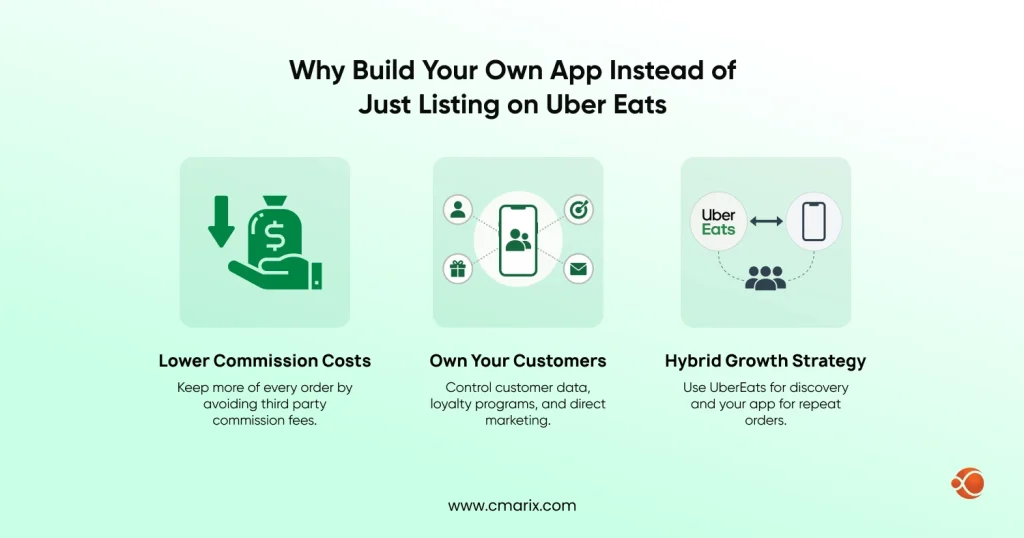
Third-Party Commissions Reduce Long-Term Profitability
The commission fees charged by the third-party platform can be from 5 to 30 percent of each transaction. With a restaurant working under tight profit margins, this will affect your bottom line right from the start, and there is no escape from it, even as your business increases in volume. If you develop your own app, you only have to invest in development once and make money from the transaction without any third party taking a share.
Owning the Customer Relationship Creates Long-Term Value
This is the second reason, and this has nothing to do with money. Instead, it’s about ownership of the customer relationship – the data, retargeting, and loyalty program. With your own app, all of these become yours again – your branding, your marketing, and even the data on returning customers. For a food chain or startup working with different vendors, this can easily prove priceless.
The Best Strategy Is Often a Hybrid Approach
Most established restaurant groups don’t actually choose one or the other. They stay listed on aggregators for discovery, capturing customers who weren’t already looking for them, while building an owned app for repeat customers, loyalty, and margin protection. The two channels serve different jobs: one brings new customers in the door, the other keeps the ones you already have.
Find the right approach to build your food delivery app based on your goals and budget.
UberEats Clone App Structure: Customer, Vendor, Driver, & Admin Cost Breakdown
A true UberEats clone is really an ecosystem of four connected pieces, and each one carries its own price tag.
| App | What It Does | Rough Cost Range (MVP – Enterprise) |
| Customer App (iOS/Android) | Browsing, cart, checkout, live order tracking, ratings | $10,500 – $70,000+ |
| Restaurant/Vendor App & Portal | Menu management, order acceptance, sales reporting | $7,500 – $50,000+ |
| Courier/Driver App | Order pickup, route navigation, earnings dashboard | $6,000 – $40,000+ |
| Admin Panel | Commission management, dispute resolution, analytics, vendor onboarding | $6,000 – $40,000+ |
Add the four rows together, and you land back at the headline numbers: $30,000–$60,000 for an MVP, $120,000–$200,000+ for enterprise. The full feature-by-feature version of this table shows up later in this guide.
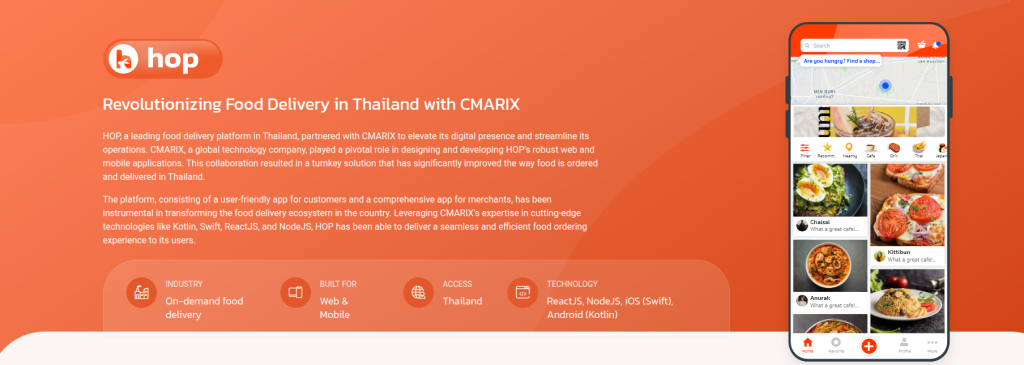
This isn’t theoretical. CMARIX built exactly this structure for HOP, a food delivery platform now operating in Thailand. The build paired a customer-facing ordering app (Kotlin/Swift) with a separate merchant app for restaurant partners, backed by a NodeJS/ReactJS backend, real-time GPS order tracking, a local Thai payment gateway, QR code tools, and push notifications through Firebase. That’s the same four-part structure, customer, vendor, logistics, and backend, that any UberEats clone needs, just adapted to a different market’s payment rails and infrastructure.
UberEats App Development Cost by Type: MVP vs Mid-Scale vs Enterprise
Here’s the direct answer to “how much does it cost to build a food delivery app like UberEats,” broken down by build tier.
| Build Tier | Cost Range | What You Get | Typical Timeline |
| MVP | $30,000 – $60,000 | Core ordering flow, basic restaurant dashboard, simple courier app, essential admin controls | 3–5 months |
| Mid-Market | $60,000 – $120,000 | Real-time GPS tracking, in-app payments, ratings, push notifications, multi-restaurant support | 5–8 months |
| Enterprise-Grade | $120,000 – $200,000+ | AI-driven recommendations, dynamic pricing, dispatch algorithms, multi-language/currency, advanced analytics | 9–14 months |
An MVP validates demand in one city with one core flow: browse, order, track, pay. It won’t have loyalty programs or predictive ETAs, and it shouldn’t. That’s the point. Mid-Market sits between the two; it’s the tier where most funded startups launch once an MVP has proven the model, but before the business needs enterprise-grade dispatch logic.
CMARIX makes a similar case in its broader app development cost guide. A single-platform MVP typically costs 40–60% less than a dual-platform launch. Most successful marketplace apps validate on a single platform before scaling.
Food Delivery App Features and Cost Breakdown by Module
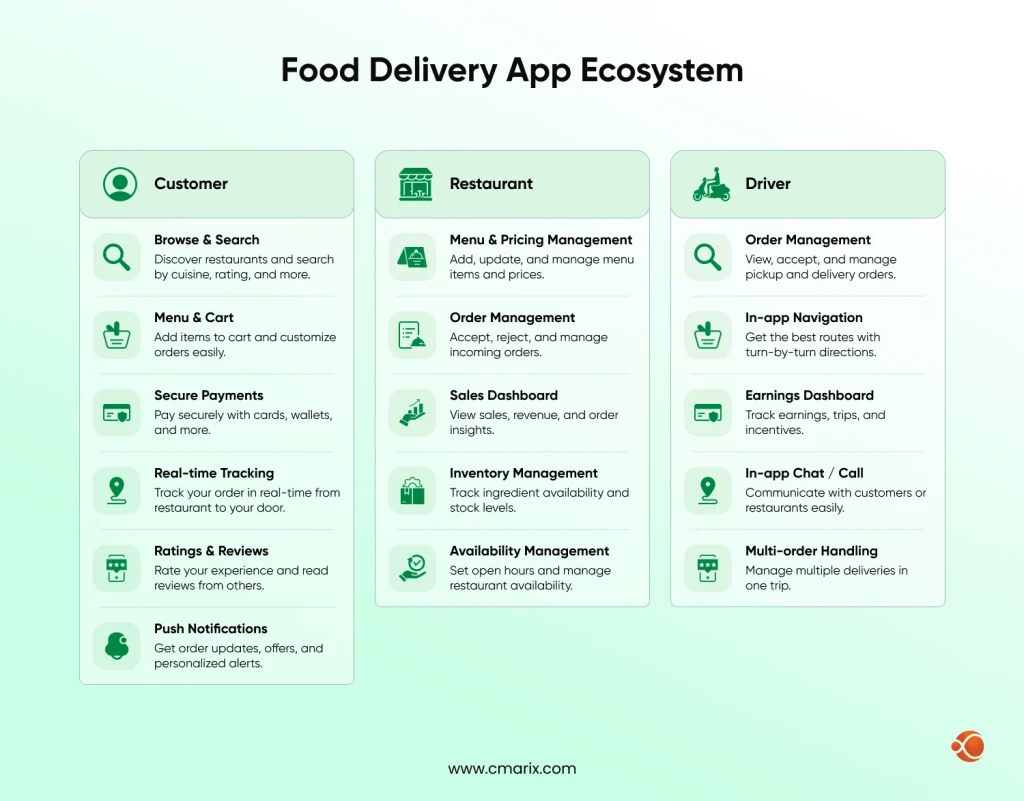
This is where most cost guides go vague. Here’s how a typical budget is split across the four apps, using rough allocation percentages commonly seen in on-demand marketplace builds.
Customer App Development Cost for Food Delivery Platforms
| Feature | MVP | Enterprise-Grade |
| Restaurant browsing & search | Included | Included, with AI-personalized results |
| Menu display & cart | Included | Included, with dietary filters and upsells |
| Payment gateway integration | One method (card) | Multiple methods, wallets, buy-now-pay-later |
| Real-time order tracking | Basic map pin | Live GPS with ETA prediction |
| Push notifications | Order status only | Order status, promos, re-engagement |
| Ratings & reviews | Basic | Basic + photo reviews, sentiment analysis |
| Data privacy & compliance | Basic encryption, PCI-DSS-compliant payment handling | Full PCI-DSS + regional data privacy (GDPR/CCPA-equivalent) compliance program |
| Estimated cost | $10,500 – $21,000 | $42,000 – $70,000+ |
CMARIX’s AI Agent Development work is directly relevant here, AI-personalized restaurant results and sentiment-aware review analysis are agent-based recommendation systems, not simple filters, and are priced and built accordingly.
Restaurant App Development Cost in a Food Delivery System
| Feature | MVP | Enterprise-Grade |
| Menu & pricing management | Included | Included + bulk editing, scheduled menus |
| Order accept/reject workflow | Included | Included + auto-accept rules |
| Sales dashboard | Basic totals | Full analytics, trend reports |
| POS/inventory sync | Not included | Included |
| Multi-location management | Not included | Included |
| Estimated cost | $7,500 – $15,000 | $30,000 – $50,000+ |
Food Delivery Driver App Development Cost Breakdown
| Feature | MVP | Enterprise-Grade |
| Order pickup & delivery flow | Included | Included |
| Navigation | Google Maps link-out | In-app turn-by-turn |
| Earnings dashboard | Basic | Full breakdown + incentive tracking |
| In-app chat/call | Not included | Included |
| Batch/multi-order routing | Not included | Included |
| Automated dispatch algorithm | Manual assignment | AI-driven nearest-driver matching |
| Estimated cost | $6,000 – $12,000 | $24,000 – $40,000+ |
CouchShopr, an on-demand delivery app CMARIX built for household and grocery items, follows the same driver-app logic. A dedicated courier interface directs drivers to local vendors, where they pick up goods and deliver to the customer’s door. The courier app isn’t an afterthought bolted onto the customer app; it’s a separate product with its own UX problems to solve and its own line item in the budget.
The “AI-driven nearest-driver matching” row above is worth pausing on. A dispatch algorithm that scores available drivers against order location, traffic, and delivery load in real time is functionally the same problem CMARIX’s AI Agent Development services solve for other industries; it’s an autonomous decision system, not a lookup table, and it’s priced closer to a custom ML feature than a UI feature.
Admin Dashboard Development Cost for Food Delivery Apps
| Feature | MVP | Enterprise-Grade |
| Vendor & driver onboarding | Manual approval | Automated workflows |
| Commission & payout management | Basic | Automated, multi-currency |
| Dispute resolution tools | Basic ticketing | Full case management |
| Analytics & reporting | Basic totals | Real-time dashboards, exportable reports |
| Multi-region controls | Not included | Included |
| Estimated cost | $6,000 – $12,000 | $24,000 – $40,000+ |
When you add all four of the above figures together, you end up back at the top-line figures, i.e., $30,000 to $60,000 for MVPs, $120,000 to $200,000+ for enterprise-level products.
Get a tailored estimate based on your features and launch goals.
Why Food Delivery App Development Costs Vary Across Companies
Two agencies quoting the same feature list can land $80,000 apart. Three factors explain most of that gap.
1. Development Team Location
Hourly rates are the single biggest lever on total project cost.
| Region | Typical Hourly Rate | Best For |
| North America | $100 – $180 | Same-timezone collaboration, fastest turnaround |
| Western Europe | $80 – $150 | Strong quality standards, moderate timezone overlap |
| Eastern Europe | $40 – $80 | Strong price-to-quality ratio, decent EU/US overlap |
| India / South Asia | $20 – $50 | Lowest hourly rate, large talent pool, needs stronger project management |
| Southeast Asia | $25 – $55 | Growing talent pool, useful for teams already operating in APAC markets |
A 1,200-hour build at North American rates comes in around $180K. The same build at Eastern European, Indian, or Southeast Asian rates comes in below $70K. Neither of these numbers is “wrong,” but there is a trade-off in terms of communication overhead, time zone differences, and the hands-on management you will need to put into it.
The vendor’s pricing model should be another consideration, not just the hourly rate. A fixed price is optimal when the MVP is very narrowly scoped, and its specifications won’t change. A T&M pricing model is well-suited to an enterprise-scale project when features are adjusted during development. A vendor who tries to force a fixed price on an enterprise-scale project, or vice versa, is maximizing their profit.
2. Feature Complexity
GPS tracking in real time, live chat, and dynamic pricing seem like features on a list. But each one actually involves something going on in your backend systems, not your front end. The algorithm to find the closest available driver is a different problem from the simple list of menu options.
3. Platform Choice (iOS, Android, or Both)
The cost of developing natively increases by approximately 2x for both platforms. Cross-platform frameworks such as Flutter and React Native minimize the gap. The live tracking feature, being performance-sensitive, is often better when developed natively. The cost of building the iOS mobile application front end is well explained by CMARIX and is equally applicable to our delivery app user interface.
Hidden Costs Associated With Building a Food Delivery App Like UberEats
Here’s what separates a realistic budget from a guess: the build accounts for only about half of the total first-year investment. The rest shows up after launch, and it’s where most underfunded projects run into trouble.
- Server and infrastructure costs. With real-time order tracking and drivers’ live locations, the server will always be busy. Costs may vary from $500 to $3,000 or more per month, depending on the number of orders.
- Third-party API fees. Services such as Google Maps, payment gateways such as Stripe and Razorpay, and SMS/push notification services charge per transaction/call. Thus, these costs are directly dependent on the number of orders and are great to have while you are growing, and a real expense line while doing a forecast.
- Ongoing maintenance. The industry standard for ongoing maintenance is 15-25% of the initial development cost per year. For the $100,000 project, the maintenance cost would be $15,000- $25,000 per year.
- Marketing and vendor acquisition. A delivery app is a two-sided marketplace – first, you need to acquire restaurants and drivers, then customers, then restaurants are not interested anymore. The budget required for marketing during the launch of the app in one city would be somewhere around $20,000-$50,000.
CMARIX has seen this pattern play out across on-demand and marketplace builds: clients budget carefully for development, only to be surprised by the first-year total. That total often runs 25–35% above the original quote, due solely to these operational line items.
How to Reduce the Cost of Developing an App Like UberEats
Yes, but not by cutting corners on architecture. There are two paths, depending on how much control you need.
Scope discipline (custom build, lower feature count):
- Launch single-platform first (Android usually has the larger addressable market outside North America)
- Start with one city and a limited restaurant roster before building multi-region logic.
- Use pre-built payment and mapping SDKs instead of custom integrations.
- Defer AI-driven recommendations and dynamic pricing to a later release, once revenue funds it.
White-label/pre-built platforms (fast, low differentiation): licensing a pre-existing codebase for an Uber Eats clone and then tailoring the branding, menu, and regional integration can save you half the cost and half the time compared to building from scratch. The downside is that you will have little flexibility since you will be working within a predetermined platform framework, which will put some restrictions on developing your own unique dispatch algorithm/recommendation engine in the future.
Things that should never be cut, regardless of the path taken: real-time tracking, a secure payment gateway, and a user-friendly dashboard for the restaurant. These three things keep the customers and vendors on the platform. The article from CMARIX on grocery delivery app development makes the same point about other marketplaces. The transactional loop remains non-negotiable, no matter what else is done.
Why Cheap Food Delivery Apps Fail to Scale
With $10,000 spent on a freelance build, you may end up with a functional demo application. But you’ll have no application capable of handling 500 simultaneous orders without failing on a busy Friday night. The key to survival is in reliability, which is about architecture, not features.
The very same tripartite complexity exists within all the categories of on-demand services. In developing an app for on-demand services like taxi/ride-sharing, CMARIX has taken into account the same three parties, as well as factors such as dispatching rules, surge pricing, and driver management, which are similar to the cost drivers of courier app development for food delivery.
The same three-sided complexity: customer, service provider, admin, shows up across every on-demand category. CMARIX has built for this pattern in its taxi and ride-hailing app development work, too, where dispatch logic, surge pricing, and driver management mirror the cost drivers of a food delivery courier app. The pattern holds regardless of what’s being delivered — food, groceries, or a passenger seat.
Key Questions Before Hiring a Food Delivery App Development Company
Before you request a quote, answer these three questions. They’ll shape 80% of your final price tag.
- Timeline: Are you validating an idea in 3 months, or launching a market-ready product in 9–12?
- Platform: Single platform to start, or dual-platform from launch?
- Market: One city with a handful of restaurants, or multi-region from day one?
Your answers determine whether you’re looking at a $35,000 MVP or a $150,000 regional launch. A vendor who asks these questions before quoting you a number is one you can trust.
If you’re ready to scope your project, CMARIX’s food delivery app development team can walk through your market, timeline, and budget before you commit to a build.
Conclusion
The cost to build a food delivery app like UberEats depends on far more than the number of features you choose. Your platform scope, business model, technology stack, and long-term growth plans all shape the final investment. Whether you’re launching a lean MVP or a full marketplace ecosystem, investing in the right architecture from the start helps reduce future costs and creates a platform that can scale with your business.
FAQs About App Like UberEats Development Costs
What are the cost factors when building an app like UberEats?
Four things drive most of the price: which of the four apps you’re building (customer, vendor, courier, admin), how many advanced features each one includes, your development team’s location, and whether you launch on one platform or two.
Are there hidden costs involved in launching an app like UberEats?
Yes. Server infrastructure, third-party API fees, app store commissions, and marketing typically add 25–35% to your development quote in year one.
What are the ongoing maintenance costs for an app like UberEats?
Plan for 15–25% of your original build cost every year. That covers bug fixes, OS updates, security patches, and server scaling.
Can I reduce the cost of building an app like UberEats?
Sure. First of all, choose a one-platform MVP in one city and a white-label platform if you value time over customization. Delay the use of AI recommendations and dynamic pricing as additional features for future versions.
How long until an Uber Eats-style app breaks even?
It depends heavily on commission rate, order volume, and city density, but most single-city MVPs targeting break-even look at 12–24 months once marketing and operational costs are included, not just the initial build. Multi-region enterprise builds typically plan for a longer runway given the larger upfront investment.