
LLM Development Services
CMARIX is a trusted LLM development company delivering custom large language model development services from architecture design and pre-training through fine-tuning, RAG integration, safety evaluation, and self-hosted deployment. Whether you need a proprietary model trained on your enterprise data or a fine-tuned open-source LLM capable of serving production-scale workloads, we engineer it for production, not for a demo.
Start a Project
Trusted by 2000+ Happy Clients, Including Fortune 500 Companies


End-to-End Large Language Model Development Services
As a full-service large language model development company, CMARIX delivers LLM development services spanning the complete model lifecycle, from architecture decisions and data curation to training, evaluation, deployment, and ongoing optimization.
-
LLM Consulting and Strategy
Translate your AI goals into a model architecture and delivery roadmap.
Uncertain about building, tuning, or finding models? Our LLM consulting services offer structured discovery workshops to evaluate the strength of your data assets, identify appropriate modeling strategies, decide on build/tune/buy options, and create an action plan complete with milestones, best practices, and success metrics.
Stack: Model Strategy | Data Readiness Audit | Build vs. Buy Framework | Governance Blueprint | Phased Roadmap
-
Custom LLM Development and Pre-Training
Build a proprietary foundation model on your data.
We engineer and train custom large language models for your organization by configuring architecture specifications, tokenizer design, training data selection, computing resources configuration, and distributed training operations. Best for organizations with proprietary datasets that cannot be used by third-party model suppliers.
Stack: Transformer Architecture | Custom Tokenizers | Distributed Training | NVIDIA A100/H100 | DeepSpeed | Megatron-LM | FSDP | NCCL
-
LLM Fine-Tuning and Domain Adaptation
Adapt foundation models to your domain, data, and use case.
Our services include training state-of-the-art models like Llama 3, Mistral, Falcon, Claude , GPT, Gemini and more using SFT, RLHF, DPO, and LoRA/QLoRA methods. We guarantee that all training projects will involve data cleaning, creation of an instruction set, benchmark evaluation, and model deployment.
Stack: LoRA | QLoRA | SFT | RLHF | DPO | Axolotl | HuggingFace Transformers | TRL | PEFT | W&B
-
RAG-Powered Application Development
Extend LLMs with real-time knowledge retrieval.
Retrieval-Augmented Generation removes the risk of hallucination and keeps model outputs grounded in your verified knowledge base. CMARIX builds full-stack RAG pipelines, document ingestion, chunking strategy, embedding model selection, vector store architecture, retrieval evaluation, and LLM response generation. Many LLM deployments first surface as conversational interfaces; see our AI chatbot development services for that delivery layer.
Stack: LangChain | LlamaIndex | Pinecone | Weaviate | pgvector | OpenAI Embeddings | Cohere Embed | FastAPI
-
LLM Application and API Integration
Deploy LLMs into web, mobile, SaaS, and enterprise applications.
We deploy fine-tuned and foundation LLMs into production-ready web, mobile, SaaS, and enterprise applications through secure, scalable APIs. Whether you're building AI copilots, intelligent chatbots, workflow automation, knowledge assistants, or customer-facing products, we ensure seamless integration with your existing technology stack.
Our integration services include API design and development, authentication, orchestration, prompt management, tool and function calling, streaming responses, and support for REST, GraphQL, and FastAPI-based architectures, enabling your teams to consume AI capabilities without managing the underlying infrastructure.
Stack: FastAPI | REST APIs | GraphQL | gRPC | LangServe | Docker | Kubernetes | AWS API Gateway | Kong | NGINX
-
LLM Evaluation, Guardrails and Red-Teaming
Deploy LLMs you can trust in regulated and public-facing environments.
Unprotected LLMs create harmful, biased, and non-conforming content. CMARIX implements multiple layers of security measures, including input/output moderation, constitutional AI alignment, adversarial testing, toxic content detection, PII masking, and human escalation. Required for deployment within the domains of healthcare, banking, law, and all others.
Stack: Guardrails AI | NeMo Guardrails | LLM Guard | Constitutional AI | RLHF Safety Layers | OPA | Audit Logging
-
Open-Source LLM Deployment & Self-Hosting Services
Full control, zero third-party data exposure
We deploy open-source LLMs: Llama 3, Mistral, Mixtral, Falcon, and others — on your own cloud infrastructure or on-premise hardware. Every deployment includes model quantization for cost efficiency, inference server configuration, autoscaling policies, and monitoring dashboards. Ideal for enterprises in regulated industries.
Stack: vLLM | Ollama | NVIDIA Triton | TGI | GGUF/GPTQ Quantization | AWS/GCP/Azure | Kubernetes | Helm
-
LLMOps and Continuous Optimization
Keep your LLMs accurate, efficient, and production-ready over time.
After deployment, CMARIX performs model drift detection, automated model retraining, A/B testing of model versions, and regression testing against your evaluation criteria, ensuring that a fine-tuned or self-hosted model remains as effective as your evolving data and patterns require.
Stack: MLflow | LangSmith | Weights & Biases | Langfuse | Kubeflow | NVIDIA Triton | Docker | Kubernetes | Prometheus | Grafana
Production LLM Architecture and Deployment Approach
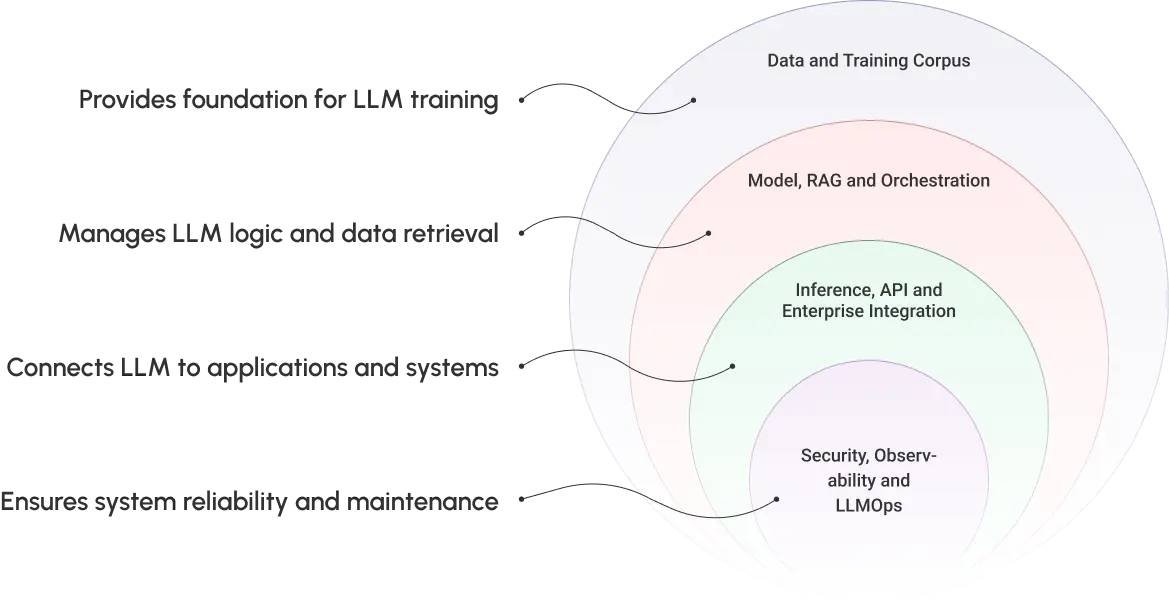
Our LLM Development Process
Our large language model development process uses a milestone-based approach focused on minimizing technical risks, ensuring domain accuracy, and ensuring reliable performance of the developed models in operational settings.
-
Discovery and Use Case Definition
We define the problem the LLM needs to solve, the users it will serve, the data it will use, and the success criteria before any architecture decisions are made.
Timeline: Week 1–2
Deliverables: Use case specification · Task taxonomy · KPI framework · Risk register · Data access map
-
Data Readiness and Corpus Preparation
We review your available data in terms of quantity, quality, domain, labeling, and regulatory posture (GDPR, HIPAA, SOC 2). The quality of LLMs depends on data quality, and that’s where we come in with our data engineering capabilities.
Timeline: Week 2–3
Deliverables: Data readiness report · Gap analysis · Compliance checklist · Corpus preparation plan · Data sourcing strateg
-
Model Strategy and Architecture Design
Evaluating candidate architectures based on a ground-up approach, a fine-tuned approach, RAG, or a mixed approach, and offering formal recommendations on whether to build, buy, or fine-tune are among our responsibilities. Architectural choices are made using scientific reasoning, not vendor preferences.
Timeline: Week 3–4
Deliverables: Model strategy document · Architecture blueprint · Technology selection rationale · Compute cost estimate · POC scope
-
Training, Fine-Tuning, and Alignment
Whether it is supervised fine-tuning, instruction tuning, RLHF, DPO, or adaptation using LoRA/QLoRA on your custom training data, alignment will ensure that what you want to achieve matches your style, tone, and legal constraints.
Timeline: Week 4–10 (varies by scope)
Deliverables: Trained model artifact · Training logs · Evaluation checkpoints · Alignment audit
-
Evaluation, Red-Teaming and Approval
Evaluation is done through specialized testing procedures, attack cases, and user preferences. The measurements that are used include latency, throughput, inference efficiency, and various safety factors. Deployment can only occur once a certain performance threshold has been met.
Timeline: Week 8–11
Deliverables: Evaluation report · Benchmark comparison · Red-team findings · Performance profile · Go/No-Go recommendation
-
Deployment and Inference Optimization
Pipeline setup for CI/CD, configuring inference server (vLLM, Triton, TGI), scaling, quantization of the models to save money, security-related aspects, and rolling out of the product to production.
Timeline: Week 10–14
Deliverables: Deployed model endpoint · Inference server config · Monitoring dashboard · Runbook · Security sign-off · SLA agreement
-
LLMOps and Continuous Improvement
Post-deployment: model drift detection, automated re-training, A/B testing using different models, and regression testing on the criteria for evaluation. Customized language models require proper deployment to train, evaluate, and roll back; our LLMOps consultation can help you with that.
Timeline: Ongoing
Deliverables: Monthly performance reports · Retraining logs · Drift alerts · A/B test results · Roadmap reviews
LLM Security, Governance and Evaluation
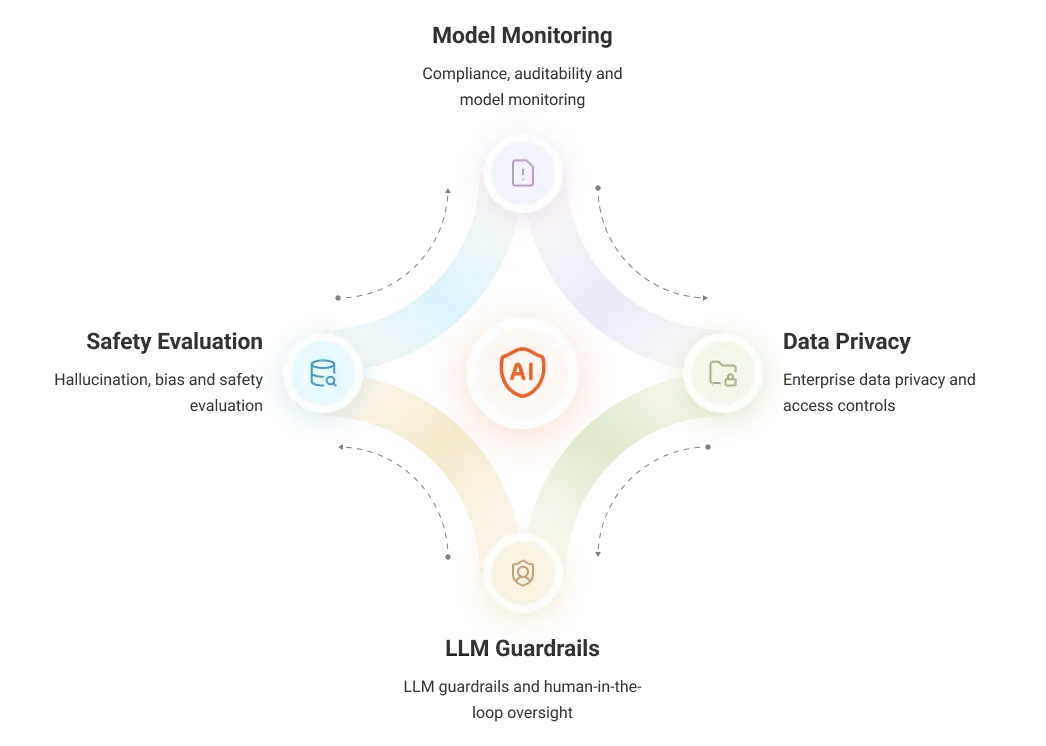
LLM Tech Stack and Infrastructure
As a specialist large language model development company, CMARIX engineers use a rigorously selected stack of model frameworks, training infrastructure, inference tooling, evaluation systems, and LLMOps platforms to deliver production-grade LLMs, not research prototypes.
Foundation Models
Training Frameworks
Fine-Tuning Techniques
RAG and Retrieval Stack
Evaluation & Benchmarking
Inference & Serving
Quantization & Optimization
Safety and Guardrails
LLMOps & Monitoring
Cloud ML Platforms
Infrastructure & DevOps
Data & Feature Engineering
Industries We Build Custom LLMs For
CMARIX creates custom large language models tailored to the data ecosystems, regulations, and processes of each industry, rather than adapting an enterprise model.
Healthcare and Digital Health
Clinicians lose hours to documentation that LLMs can now handle in minutes. CMARIX builds custom large language models for automated clinical documentation, medical coding assistance, patient summary generation, and decision support tools that reference verified medical knowledge rather than generic training data. Every model we deploy in healthcare is engineered against HIPAA, HL7/FHIR, and FDA AI/ML guidance, because accuracy and traceability aren't optional when a model's output touches patient care. The result: less charting, more time with patients.
Dive Into More


Why Enterprises Choose CMARIX for LLM Development?
As a specialist LLM development company, CMARIX goes beyond prompt engineering and API wrappers to build custom large language model development solutions backed by end-to-end LLM engineering expertise. Our LLM engineering capabilities include fine-tuning models on proprietary data, private and self-hosted LLM deployment, and evaluating performance against business KPIs through production-grade evaluation and LLMOps practices.

50+
LLMs Fine-Tuned and Deployed

1B+
Tokens Processed Monthly

240+
In-House AI and ML Engineers

95%
Client Retention Rate
LLM Case Studies and Business Outcomes
LLM Development Cost, Timeline, and Engagement Models
LLM development services are tailored to your stage in the AI adoption process, from validating a single use case to scaling up an enterprise-ready language model solution. The scope for each model is set to produce tangible results within a specified time frame and budget.
LLM Proof of Concept Sprint
Validate LLM use cases before full development. Ideal for teams needing feasibility testing, domain data evaluation, and a clear investment roadmap. Includes use case scoping, data audit, model selection, RAG or fine-tuning prototype, and benchmarking.
What you get:
Working prototype · Model accuracy benchmarks · Architecture blueprint · Investment decision framework
Dedicated LLM Development Team
A dedicated LLM team of engineers, ML researchers, data specialists, and LLMOps experts builds and deploys production-ready LLM solutions. Includes infrastructure setup, safety guardrails, evaluation framework, and post-launch support.
What you get:
Production LLM · Inference infrastructure · Evaluation framework · LLMOps pipeline · 90-day support
Enterprise LLM Platform Engagement
Enterprise-grade LLM infrastructure with custom training, fine-tuning, multi-model orchestration, integrations, governance, and long-term LLMOps management. Built for organizations creating proprietary AI capabilities.
What you get:
Proprietary model · Full IP transfer · Enterprise integration layer · Governance documentation · SLA-backed support
LLM Development Insights and Resources
View All Blogs
Mastering LLM Fine-Tuning: Techniques, Data, and Best Practices for Custom LLM Development



LLM Evaluation Framework: Best Practices and Models to Consider
RAG & AI Trust Statistics 2026: From Hallucinations to Reliable AI Systems
Frequently Asked Questions About LLM Development
Answers to the questions product leaders, engineering teams, and AI strategy stakeholders ask most before beginning a large language model development engagement with CMARIX.
- How Much Does LLM Development Cost?
Typically, the engagement costs for an LLM PoC with CMARIX fall within the bracket of USD 12,000-USD 20,000 over 4-8 weeks. The cost for full-fledged LLM development engagements varies between USD 40,000- USD 100,000 in 2-5 months. Enterprise LLM platform engagements typically start at USD 120,000. Every engagement follows milestone-based pricing with fixed budgets and clearly defined deliverables at each stage.
- How Long Does It Take to Develop and Deploy an LLM?
Typically, an LLM PoC Sprint will be available in 4 to 8 weeks. The process for fine-tuning or RAG will take 2 to 5 months. Custom LLMs that involve enterprise-level platforms for training and orchestration will take at least 5 months.
- Should We Use RAG, Fine-Tuning, or Custom Model Training?
The RAG approach uses document retrieval to generate text, reducing hallucinations and maintaining accuracy without retraining. The process of fine-tuning is better suited to developing the tone, format, style, and reasoning skills of a language model. Custom training of language models from scratch can be applied when enterprises have proprietary datasets.
- What is LLM Model Drift?
Drift is a scenario in which an LLM in production experiences a drop in performance due to changes in input patterns compared to those used during training. CMARIX addresses drift through its evaluation pipeline, automated drift notifications, scheduled model retraining triggers, and post-launch A/B testing.
- Can an LLM Be Deployed On-Premises or in a Private Cloud?
Yes. We specialize in deploying self-hosted LLMs for businesses operating in highly regulated environments or seeking to cost-optimize their inference expenses. This includes handling model quantization, configuring the inference server using vLLM, NVIDIA Triton, or TGI, scaling, monitoring configuration, and providing comprehensive documentation for the deployment on AWS, GCP, Azure, or on-premises GPUs.
- How Is Proprietary Enterprise Data Protected?
CMARIX protects proprietary enterprise data through secure deployment architectures, encryption, access controls, private model hosting, audit logging, PII masking, and compliance with GDPR, HIPAA, and SOC 2. When fine-tuning is required, your data remains within your controlled environment and is never used to train public foundation models.
- Who Owns the Model Weights, Training Data, and Source Code?
The client holds the rights to all products, such as model weights, training datasets, pipeline tuning processes, evaluation systems, and documentation. The company operates on an IP transfer basis, without any licensing restrictions, proprietary constraints, or IP retention.
- What Support Is Required After an LLM Is Deployed?
CMARIX supports deployment with SLA-backed post-deployment services, including model performance tracking, drift detection and alerts, model re-training pipeline management, security upgrades, scaling of inference engines, and periodic performance reports. Post-deployment support is delivered as an LLMOps engagement backed by SLAs and engineering bandwidth.
Partner with a Trusted LLM Development Company
Build, fine-tune, and deploy custom LLM solutions with CMARIX, from strategy and fine-tuning to deployment, safety, and LLMOps.Let's Launch Your Business.
Your unique conceptual workflows will be cleanly crafted into an elite digital system by our specialized engineers.