
Computer Vision Development Services
CMARIX delivers end-to-end computer vision development services that turn image and video data into intelligent business systems. We build AI-powered solutions for object detection, OCR, visual search, defect inspection, and real-time video analytics using domain-specific data, advanced deep learning models, and optimized deployment pipelines. From PoC to enterprise platforms, our computer vision solutions are engineered for production-grade accuracy and measurable outcomes.
Get Started
Trusted by 2000+ Happy Clients, Including Fortune 500 Companies


Custom Computer Vision Development Services We Offer
As a specialist computer vision development company, CMARIX provides solutions that span all aspects of visual intelligence. From object detection pipeline designs to advanced real-time video solutions, everything is designed with enterprise reliability in mind.
-
Computer Vision Consulting and Strategy
CMARIX assesses data readiness, determines the appropriate model architecture, assists in making a build-versus-buy decision, and creates a roadmap for success, including KPIs and governance criteria, for vision projects.
Approach: Use Case Mapping · Data Readiness Audit · Model Selection Framework · Annotation Strategy · Phased Roadmap
-
Object Detection, Classification, and Segmentation
We develop custom computer vision systems for object detection, image classification, and semantic segmentation using proprietary training data from your industry, outperforming commercial vision APIs for your specific use cases.
Stack: YOLOv11 | Detectron2 | PyTorch | TensorFlow | OpenCV | ONNX Runtime | FastAPI
-
Real-Time Video Analytics and Object Tracking
Beyond image processing, CMARIX develops real-time video analytics pipelines with frame-to-frame object tracking and human tracking for warehouse surveillance, customer flow analytics, and dock door safety systems.
Stack: FFmpeg | GStreamer | DeepStream | ByteTrack | DeepSORT | RTSP / ONVIF
-
OCR and Document Intelligence
OCR, layout analysis, and computer vision models are combined to extract structured data from scans of forms, invoices, ID documents, and product images for downstream use.
Stack: Tesseract | AWS Textract | Azure Form Recognizer | LayoutLM | Surya OCR
-
Visual Search and Image Recognition
CMARIX builds visual search systems that let users find products or assets by image rather than keyword, and are trained on your own catalog imagery for accuracy with the specific items your business sells or manages.
Stack: CLIP | Vision Transformer (ViT) | FAISS | Milvus | OpenSearch | PyTorch
-
Defect Detection and Quality Inspection
In manufacturing and assembly lines, CMARIX provides defect detection and quality inspection solutions that identify defects and non-conformities instantly for specific product lines, rather than general anomaly detection solutions.
Stack: YOLOv11 | Detectron2 | OpenCV | PyTorch | TensorRT | NVIDIA DeepStream
-
Computer Vision Data Annotation and Synthetic Data
Labeled visual datasets are critical for building CV models, and high-quality labeled datasets are essential for accurate computer vision models. Our data engineering services include annotation, pipeline construction, quality control, synthetic data creation, and augmentation of minority classes.
Stack: Label Studio | CVAT | Scale AI | Roboflow | Albumentations
-
Edge AI and Computer Vision Model Optimization
We optimize vision models through quantization, pruning, and distillation for edge and real-time applications by monitoring latency in production to ensure we meet our frames-per-second requirements.
Stack: TensorRT | OpenVINO | ONNX | TFLite | NVIDIA Jetson | Edge TPU
-
Computer Vision Integration and MLOps
We integrate computer vision models with production APIs, streaming pipelines, cameras, ERP, MES, CRM, and data warehouses. Beyond model deployment, we build the complete inference pipeline, monitor model drift, automate retraining, and manage model versioning.
Stack: RTSP / ONVIF | Kafka | gRPC | FastAPI | Redis | Docker | Kubernetes
Computer Vision as a Service vs Custom Computer Vision Development
Most teams start with an off-the-shelf computer vision API and hit its ceiling within months. Here's an honest comparison of what generic vision APIs give you versus what CMARIX's custom computer vision solutions deliver.
Off-the-Shelf Computer Vision APIs / Generic APIs
Generic Imagery Limitations
Pre-trained on generic stock imagery, missing application-specific objects and real-world conditions.
Fixed Object Classes
No Lifecycle Control
Footage Privacy Risks
Vendor-Bound Accuracy
Black-Box Outputs
Unpredictable Per-Frame Costs
Custom Computer Vision Development by CMARIX
Domain-Specific Training
Trained on domain-specific imagery covering real cameras, angles, environments, and operating conditions.
Custom Object Schemas
Complete Weights Ownership
Certified Infrastructure
Continuous MLOps Pipelines
Explainable Decision Insights
Optimized Deployment Architectures
How to Choose the Right Approach
Generic Vision APIs: Best for typical lighting and angles where fast setup is preferred over custom domain modeling.
Custom Computer Vision: Required when environments, objects, or regulatory compliance demand specialized solutions.
Custom Development Benefits: Delivers higher accuracy, lower cost per frame, and complete model ownership.
Expert Consultation: CMARIX provides dedicated computer vision consultation services tailored for these advanced needs.

Production Computer Vision Architecture and Deployment
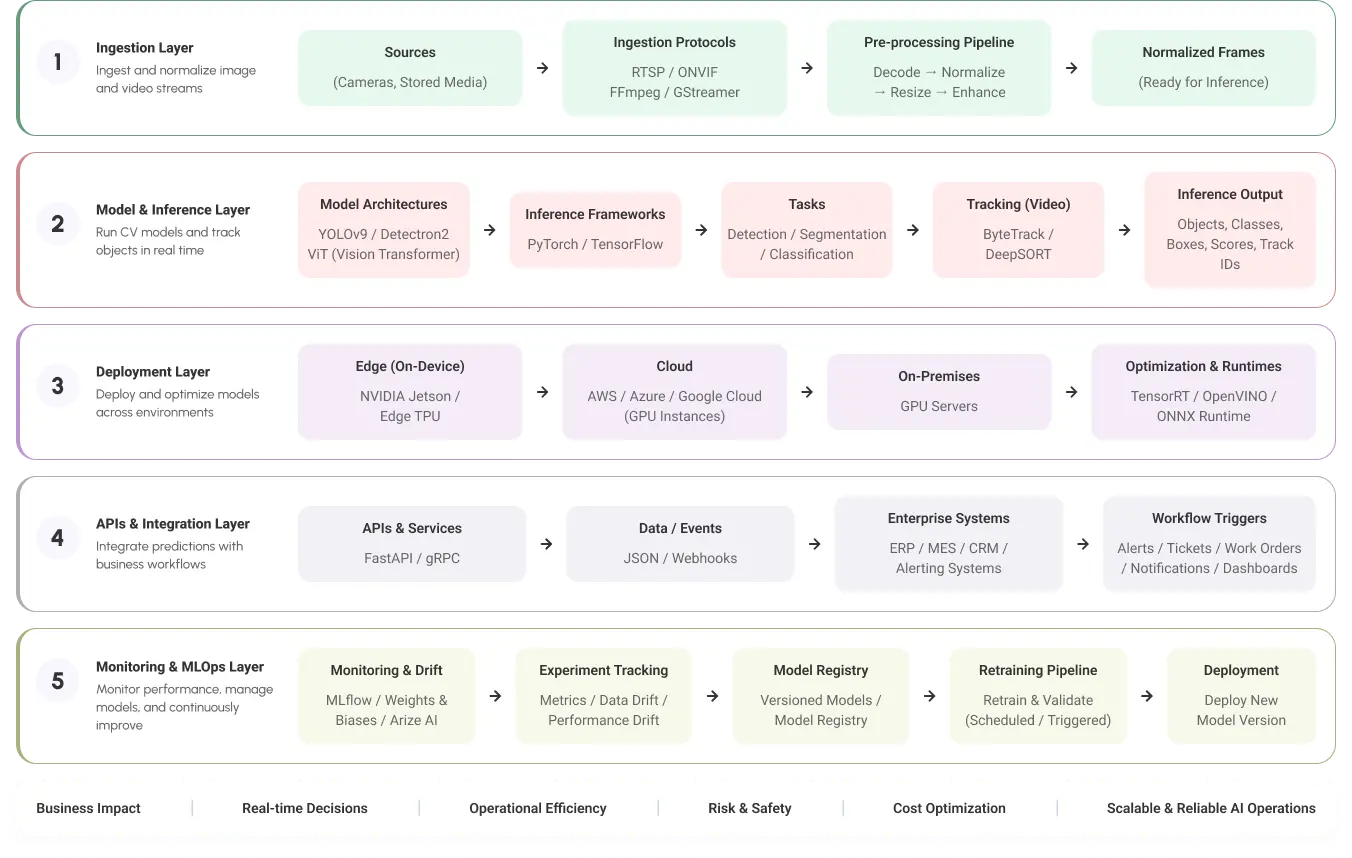
Our Computer Vision Development Process
CMARIX follows a structured, milestone-driven computer vision development process that moves from use case validation to a production-deployed pipeline, with verifiable deliverables at every stage and no black-box handoffs.
-
Discovery and Performance KPI Definition
We define what the vision system should detect, classify, or track, identify camera input requirements, and establish the KPIs that determine deployment success. Architecture choices follow benchmarking of use cases.
Timeline: Week 1-2
Deliverables: Use case document, task taxonomy, performance baseline, integration map, risk register.
-
Visual Data Audit and Annotation Planning
CMARIX audits the image and video dataset provided to evaluate its size, resolution, lighting variability, and compliance. We also propose solutions for annotations and/or synthetic/augmented data generation to cover any gaps.
Timeline: Week 3-4
Deliverables: Data quality assessment, corpus readiness report, labeling strategy, compliance checklist, augmentation plan.
-
Model Selection, Training, and Fine-Tuning
We consider model architectures for detection, segmentation, and classification, taking into account the build-versus-buy strategy and ai model fine-tuning approach based on the amount of data you have, latency requirements, and the accuracy threshold. Then we agree on the labeling process through Label Studio/CVAT, train and fine-tune models with your domain video data, and measure the results against the accuracy threshold.
Timeline: Week 3-10
Deliverables: Model selection matrix, architecture blueprint, pre-train vs. fine-tune recommendation, compute estimate, annotated dataset, training logs, evaluation checkpoints, and accuracy benchmarks.
-
Evaluation and Domain Benchmarking
We evaluate precision, recall, mAP, robustness under occlusion and lighting variation, and production performance.
Timeline: Week 8-12
Deliverables: Evaluation report, precision/recall/mAP breakdown, edge case analysis, and go/no-go sign-off.
-
Inference Optimization and Deployment
Models are quantized and optimized for the target deployment- edge device, on-premises GPU server, or cloud- to hit required frames-per-second and latency budgets.
Timeline: Week 10-12
Deliverables: An optimized model artifact, a latency benchmark report, and a hardware sizing recommendation.
-
System Integration and Production Testing
We provide the service infrastructure, FastAPI/gRPC APIs, authentication, streaming ingestion, and interfacing with your CRM, MES, ERP, or alerting services. We perform load testing for sustained throughput.
Timeline: Week 12-16
Deliverables: Production API, integration connectors, load test results, security review, runbook.
-
Monitoring and Continuous Retraining
Vision models drift depending on lighting conditions, seasons, and usage. Our MLOps AI consulting services help keep your vision models production-ready through drift detection, auto-retraining, and versioning.
Timeline: Ongoing
Deliverables: Monthly performance reports, drift alerts, retraining logs, and model version registry.
Computer Vision Frameworks and Technologies We Use
The Dedicated developers at CMARIX specialize in computer vision software development; thus, they choose frameworks based on specific needs, latency requirements, and deployment environments rather than default preferences.
Detection, Classification and Segmentation Models
OCR, Video and Image Processing Technologies
Annotation & Data Labeling
Edge and Inference Optimization Technologies
Cloud, API and Computer Vision MLOps Infrastructure
Industries We Serve with Computer Vision Solutions
CMARIX builds computer vision solutions tailored to the camera environments, regulatory requirements, and workflow contexts of each industry, not generic pipelines adapted to a brief.
Healthcare and Medical Imaging
Radiologists reviewing hundreds of scans a week benefit enormously from a second set of eyes that never gets tired. CMARIX builds computer vision systems for medical image processing, radiology anomaly detection, surgical video analysis, and vision-based patient monitoring, engineered to FDA and HIPAA AI/ML standards. These systems flag areas of concern for clinician review rather than replacing diagnostic judgment, catching subtle patterns faster. For healthcare providers, that means earlier detection and monitoring that scales without adding headcount.
Dive Into More


Why Engineering Teams Choose CMARIX as Their Computer Vision Software Development Company?
As a specialist computer vision software development company, CMARIX delivers end-to-end computer vision services backed by industry-specific computer vision expertise, production-grade model evaluation, and advanced edge, cloud, and enterprise integration capabilities. Our solutions are built for real-world business environments with continuous post-deployment monitoring and support to ensure reliable performance, scalability, and long-term value.

12M+
Frames Processed Daily

240+
In-House AI & Computer Vision Engineers

95%
Client Retention Rate

16+
Years in Product Engineering
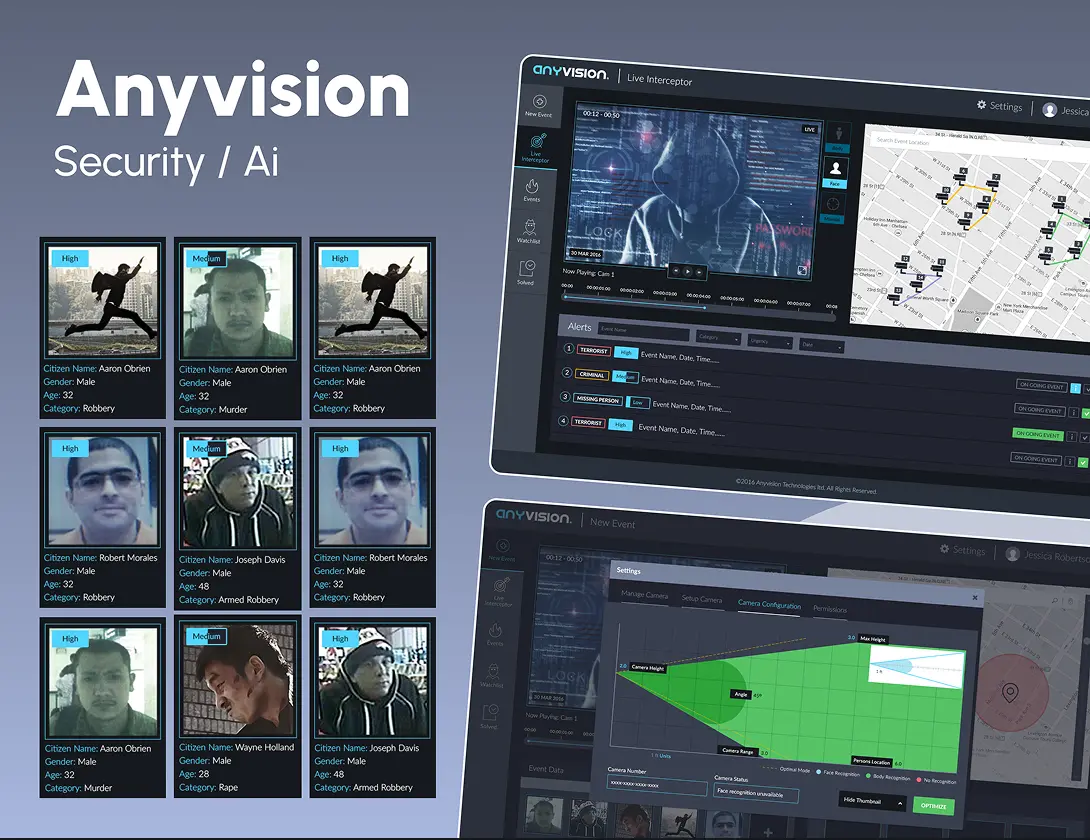
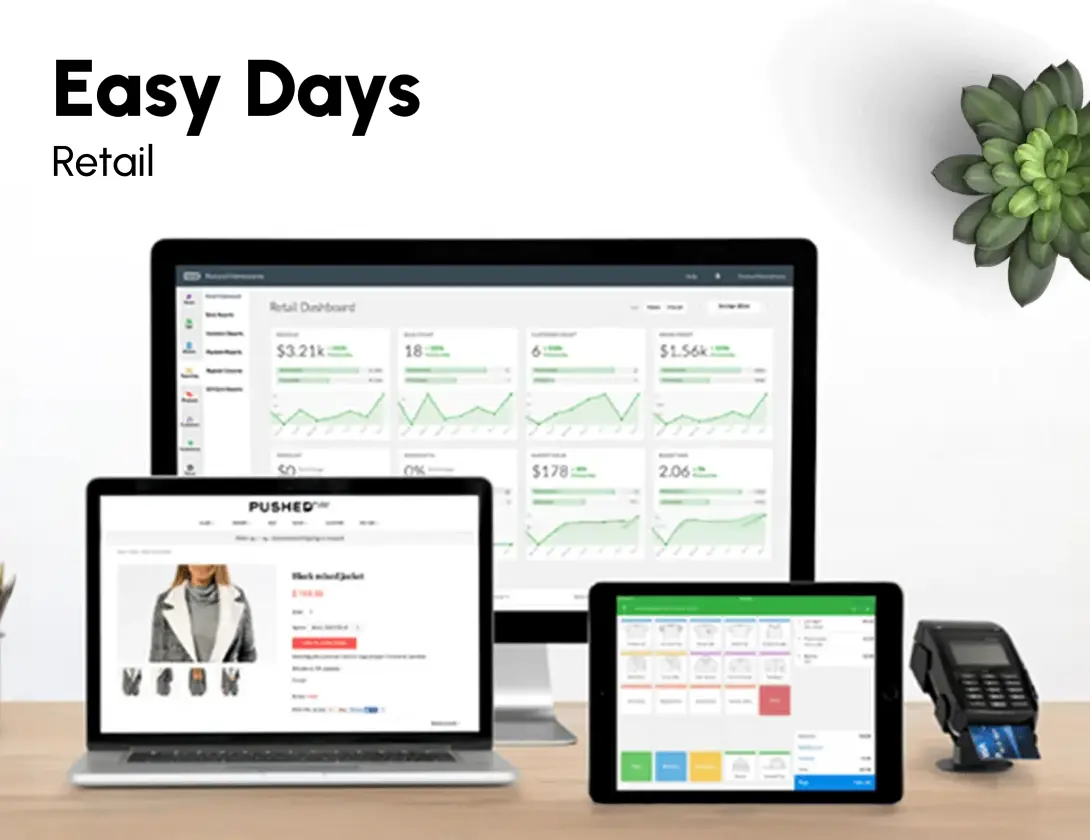
Computer Vision Case Studies and Business Outcomes

Computer Vision Development Cost, Timeline, and Engagement Models
CMARIX structures computer vision engagements to match your stage of adoption, from a focused computer vision PoC to a full-scale vision platform deployed across enterprise workflows.

Computer Vision Proof of Concept Sprint
Validate a computer vision use case before full development. CMARIX scopes one CV task, assesses imagery readiness, trains a baseline model, and provides an investment recommendation.
Deliverables:
Baseline CV model• Domain accuracy benchmark• Data readiness report• Architecture recommendation• Investment decision framework
Dedicated Computer Vision Development Team
A dedicated computer vision team builds, evaluates, and deploys production CV pipelines end-to-end, including model development, API integration, and monitoring setup.
Deliverables:
Production CV pipeline• Domain-trained model• Integration APIs• Evaluation framework• MLOps setup• 90-day post-launch support

Enterprise Computer Vision Platform
A multi-task, multi-camera vision platform with custom model training, annotation infrastructure, model registry, and enterprise MLOps support.
Deliverables:
Multi-task CV platform• Custom model suite• Annotation infrastructure• Model registry• Governance documentation• SLA-backed ongoing support
Computer Vision Insights and Resources
View All Blogs
Driver Fatigue Detection System Using Computer Vision and AI: A Complete Guide
How Computer Vision in Healthcare is Revolutionizing Patient Care and Clinical Workflows?
AI Surveillance Software Development for a Safer Environment in 2026 and Beyond

How to Integrate Custom AI Models into a Browser-based AI Application

AI in Retail: Visual Recognition for Inventory Accuracy and Shrinkage Control
Frequently Asked Questions About Computer Vision Development
Answers to the questions engineering leads, product managers, and data science teams ask most before beginning a computer vision development engagement with CMARIX.
- How Much Does Computer Vision Development Cost?
The cost for a CV PoC Sprint is between USD 8,000 and USD18,000 within three to five weeks. Developing a production CV pipeline costs between USD 30,000 and USD 90,000 for two to five months. The cost of an enterprise vision platform starts at USD 100,000 for four months and beyond.
- How Long Does It Take to Build a Computer Vision Solution?
A narrow scope proof of concept (CV PoC) for a CV project may take three to five weeks, while a full production release may take two to five months. An enterprise computer vision platform with various cameras and MLOps will take 4 months or more.
- Should We Use a Vision API or a Custom Computer Vision Model?
CV-as-a-Service tools like AWS Rekognition or Google Vision API offer pre-trained models for general tasks. Custom computer vision development trains or fine-tunes models on your own imagery to recognize the specific objects, defects, or conditions your business needs. CMARIX recommends the right approach based on your data and accuracy requirements.
- Can Computer Vision Models Be Trained on Proprietary Images and Video?
Yes. CMARIX fine-tunes detection and classification models on proprietary imagery and video through data preparation, annotation, training, evaluation, and deployment, while you retain control over the model and training environment.
- How Is Computer Vision Model Accuracy Measured?
The models are assessed based on precision, recall, mAP, and IoU by applying them to real-world validation video data and application-specific edge case scenarios, not generic benchmark datasets, thereby ensuring the accuracy of their performance in the actual environment.
- Can Computer Vision Run on Edge Devices or On-Premises?
Yes. CMARIX quantizes and optimizes models for edge hardware like NVIDIA Jetson and Edge TPU using TensorRT, OpenVINO, and TFLite, as well as on-premises GPU servers, so inference can run without sending footage to the cloud.
- How Are Computer Vision Models Maintained After Deployment?
CMARIX maintains deployed models through drift detection, regression testing, periodic retraining, and version management as lighting, camera placement, products, and operating conditions change.
- Can Computer Vision Integrate With ERP, MES, and Existing Camera Systems?
Yes. CMARIX integrates CV outputs with CRM, MES, ERP, and alerting systems through APIs and custom connectors, and connects directly to existing RTSP/ONVIF camera infrastructure, turning detections and classifications into operational workflow triggers.
Build Your Computer Vision Solution with CMARIX
Turn your visual data into a production-ready computer vision system built around your business use case, data, and deployment needs.Let's Launch Your Business.
Your unique conceptual workflows will be cleanly crafted into an elite digital system by our specialized engineers.