
Trusted by 2000+ Happy Clients, Including Fortune 500 Companies


MEAN Stack Development Services Our Developers Provide
Our MEAN Stack developers enable businesses to build and modernize full-stack applications using Angular, Node.js, Express.js, MongoDB, and surrounding cloud technologies.
MEAN Stack Consulting
Make well-informed choices regarding architecture, technology choice, scalability, and modernization. Our consulting services cover critical areas such as architecture review, technology planning, application modernization roadmaps, optimal MongoDB schema design, Angular architecture, Node.js back-end development, cloud strategy planning, and performance reviews to identify bottlenecks.
Custom MEAN Stack Web Application Development
Build customized web applications suited to your work processes and your needs. We develop highly customized internal business applications, multi-tenant SaaS applications, secure customer portals, administrative dashboard applications, marketplace transaction platforms, workflow applications, and data-intensive applications that support your fundamental business operations.
Enterprise MEAN Stack Application Development
Develop enterprise-level platforms built on the foundation of security, maintainability, integration, and scalability. Enterprise features include fine-grained role-based access control, enterprise-level authentication, multi-module system architecture, enterprise API integrations, business report generation, automatic workflow processing, cloud deployment support, system monitoring, and audit logging.
MEAN Stack SaaS Development
Create subscription-based, multi-user SaaS offerings built on scalable MEAN architecture. Basic SaaS features may include multi-tenant data isolation, subscription management, precise role-based access control, dynamic user dashboards, third-party billing integration, fine-grained analytics, real-time multi-channel notifications, documented APIs, and scalable cloud deployment pipelines.
MEAN Stack Migration & Modernization
Convert your legacy or fragmented application into a modern JavaScript and TypeScript architecture. Our migration services include migrating legacy front-ends to modern Angular, migrating backends to Node.js, migrating databases to MongoDB, migrating APIs, refactoring monoliths into modular services, cloud migration, dependency upgrades, and architecture refactoring. In our migration strategy, we prioritize data integrity, business continuity, regression testing, and canary deployment.
REST API Development & Integration
Build secure APIs using Node.js and Express.js. Our core API engineering capabilities include designing high-performance RESTful APIs, secure authentication APIs, domain-specific business APIs, frictionless payment gateway integrations, bidirectional CRM integrations, robust ERP integrations, third-party API connectivity layers, and automated interactive API documentation.
GraphQL API Development
Use GraphQL when you need flexible, effective data-fetching capabilities. Our professional developers will develop type-safe GraphQL schemas, database resolvers, authentication and authorization, optimized cursor-based pagination, data-loading batches to avoid N+1 query issues, intelligent edge-caching techniques, and API authorization policies.
Real-Time Application Development
Build real-time applications that need immediate updates and two-way communication. Real-time application examples include chat applications, real-time operation dashboards, collaboration tools, tracking systems, push notifications, activity feeds, and monitoring systems. Common technologies for real-time applications include WebSockets, Socket.IO, Redis Publish/Subscribe, Apache Kafka, and Firebase.
MEAN Stack eCommerce Development
Develop eCommerce applications and commerce platforms. Provide store functionality optimized for conversion, including performance-optimized product catalogs, advanced search and filters, an efficient shopping cart and checkout process, secure payment methods, self-service account management, order processing, administration, and real-time inventory management.
MEAN Stack CMS Development
Develop flexible content management solutions that meet internal team and publication needs. Essential operational features include content creation workflows, role-based access for publications, a centralized digital asset management solution, dynamic content modeling, administrative dashboards, and a headless content delivery solution through APIs.
MEAN Stack Progressive Web Applications
Develop PWAs using Angular and web technologies. PWAs are designed to maximize audience reach. Some features include a responsive user interface, device installation, offline capability, push notifications, caching, and synchronization.
AI & ML Integration with MEAN Stack
Enhance your MEAN stack applications with AI features. Real-world applications include smart assistants, cognitive search, automated document processing, recommendation engines, content creation, automatic data classification, automated workflows, and business analytics. Integration tools include OpenAI API, TensorFlow.js, Hugging Face Models, Google Vertex AI, and others.
MEAN Stack Cloud Integration
Deployment of applications with ease through cloud platforms. Our developers have experience working on popular ecosystems such as AWS, Microsoft Azure, Google Cloud, Firebase, and DigitalOcean. Expertise includes secure cloud hosting setup, scalable object storage, serverless function invocation, database management, central identity management, infrastructure monitoring, and horizontal scaling.
MEAN Stack Microservices Development
Use the microservices architecture pattern when independent scalability, deployment, or isolation of domains adds complexity. This pattern includes service decomposition, inter-service communication using REST/gRPC, API gateways, message brokers for asynchronous communication, Kafka event streams, Docker containers, and Kubernetes orchestration.
MEAN Stack Maintenance & Support
Protect your applications by securing them, keeping them stable, and ensuring they stay aligned with your changing needs. Our application support services can include quick bug fixes, major Angular upgrades, stable Node.js runtime upgrades, MongoDB version upgrades, dependency management, performance tuning, security patches, and feature additions.
Top MEAN Stack Developers For Hire Ready To Join Your In-House Team
Handpicked, pre-vetted MEAN Stack developer profiles matched to the exact stack and seniority your project needs.
MEAN Stack Developer
Tech Stack:
MongoDB, Express.js, Angular, Node.js, JavaScript, TypeScript, RxJS, REST APIs, Git.
Best-Fit Use Case:
Building responsive Angular interfaces, secure CRUD applications, frontend dashboards, authentication modules, MongoDB schemas, and core MVP features.
Senior MEAN Stack Developer
Tech Stack:
Angular, TypeScript, Node.js, Express.js, MongoDB, Redis, GraphQL, WebSockets, Docker, AWS, CI/CD.
Best-Fit Use Case:
Architecting cloud-ready SaaS products, enterprise full-stack systems, high-throughput backend APIs, real-time data sync engines, and legacy system modernizations.
Lead MEAN Stack Architect
Tech Stack:
Microservices, Angular Monorepos, NestJS/Node.js, Advanced MongoDB Sharding, Kubernetes, AWS Cloud Infrastructure, DevOps Pipelines.
Best-Fit Use Case:
Leading large-scale digital transformations, structuring secure multi-tenant cloud platforms, enforcing enterprise coding standards, and optimizing end-to-end full-stack performance.
Hire MEAN Stack Developers on Flexible Engagement Models
Full Time Monthly Hire
Hours: 180 hours / 4 weeks
Minimum Duration: 1 Month
Methodology: Agile/ SCRUM
Communication: eMail, Chat, Phone
Hourly Hire
Hours: Flexible (Customizable based on project needs)
Minimum Duration: 1 Month
Methodology: Agile/ SCRUM
Communication: eMail, Chat, Phone
Benefits of Hiring MEAN Stack Developers from CMARIX
- Top 3% MEAN Talent
- Full-Stack Expertise
- Unified Codebase
- Clean Angular Architecture
- Scalable Node.js APIs
- Optimized MongoDB
- Real-Time Applications
- REST, GraphQL & gRPC
- Docker & Kubernetes
- Up to 70% Cost Savings
- Direct Developer Access
- Free Project Management
- Flexible Team Scaling
- Rapid Development
- Reusable Components
- High-Performance Applications
- Secure Development
- Seamless API Integration
- Agile Development
- Transparent Communication
- Long-Term Technical Support
Why Hire Dedicated MEAN Stack Developers from CMARIX?
Hiring dedicated MEAN Stack developers from CMARIX accelerates development while reducing costs, backed by expertise across cloud, DevOps, QA, AI, data, UI/UX, and enterprise application engineering.
Top 3% MEAN Stack Developers
We find the right MEAN Stack developers who have proven themselves in working with MongoDB, Express.js, Angular, Node.js, TypeScript, APIs, Cloud technology, and Automated Testing. We conduct a tech assessment to reduce the effort of finding the right talent.
Full-Stack JavaScript & TypeScript Expertise
Combining JavaScript and TypeScript across the frontend and backend makes it easier for application layers to communicate. This means our MEAN developers can easily connect Angular frontend, Node.js backend, Express APIs, MongoDB, security, real-time services, and cloud deployments.
Up to 70% Development Cost Savings
CMARIX’s existing dedicated-resource positioning cites potential savings of up to 70% compared with building and retaining equivalent in-house capacity. Potential savings can come from reducing recruitment expenses, payroll overhead, employee benefits, training costs, infrastructure costs, and retention overhead. The actual savings depend on geography, developer seniority, engagement duration, and internal employment costs.
Scalable Architecture for Long-Term Growth
Our MEAN Stack developers design architectures with future growth in mind. Depending on the application, the architecture can incorporate horizontal scaling, Redis caching, database indexing, load balancing, microservices, containers, Kubernetes, CDN integration, and cloud autoscaling. For high-growth applications, the architecture can be planned for scenarios involving 10x to 100x increases in traffic or workload, depending on infrastructure, load characteristics, architecture, and capacity testing.
Technical Project Manager at No Additional Charge
Technical Project Manager service without an additional project management fee is one of the CMARIX dedicated services that are relevant here. Project managers coordinate sprints, ensure clear communication, manage requirements, provide delivery visibility, manage risks proactively, and keep the team aligned.
100% Transparent Collaboration
Stay fully aware of the implementation process through direct communication with developers, sprint monitoring, source code repository management, pull requests, development updates, and project management tools.
Flexible Team Scaling
Scale your development team gradually to meet your product's changing needs. It is easy for you to incorporate expertise like MEAN Stack developers, Angular developers, Node.js developers, DevOps engineers, QA engineers, UI/UX designers, AI developers, and cloud engineers into your team as and when needed by you.
Security-Focused Development
Our developers will follow security protocols based on the application's risk level. Security protocols can range from authentication and role-based authorization to data encryption, API security, secure HTTP headers, dependency checks, strict validation, MongoDB security, and audit logging. For regulated applications, development must meet any specific project needs related to regulatory requirements like GDPR, HIPAA, etc.
Post-Development Support
Maintain a healthy technical environment post-deployment for stability and a healthy lifecycle. We do this by providing maintenance services for software/system updates, bug fixes, performance tuning, security, feature additions, and architecture scaling.
How CMARIX Vets MEAN Stack Developers Before You Interview Them
To maintain an elite technical standard, all in-house resources undergo a multi-stage filtering process before we add them to active client shortlists.
-
Role & MEAN Stack Fit
We will first assess whether the developer’s experience meets the role requirements. This analysis would cover MongoDB, Express.js, Angular, Node.js, JavaScript, TypeScript, REST API, and Git.
Deliverables: Role-aligned shortlisted developer profile.
-
Angular & Frontend Engineering Assessment
We judge developers based on practical Angular knowledge, including components, Services, Dependency Injection, Routing, Reactive Forms, RxJS, Observables, TypeScript, Lazy Loading, Angular Architecture, State Management, and Consuming APIs. Senior-level developers are also evaluated on front-end scalability, maintainability, and performance.
Deliverables: Angular core proficiency score · Reactive programming evaluation · Frontend layout architecture report
-
Node.js & Express.js Backend Assessment
The backend assessment covers Node.js basics, event-loop understanding, asynchronous programming, Express middleware, API building, error handling, authentication, authorization, logging, API validation, background jobs, and application performance.
Deliverables: Live backend coding score · Asynchronous logic evaluation · Middleware & API architecture defense
-
MongoDB & Data Engineering Assessment
Developers are assessed on: MongoDB Schema design, Document Modeling, Indexing, Aggregation Pipelines, Mongoose, transactions, Query Optimization, Data Validation, replication concepts, and database security.
Deliverables: Database schema layout audit · Aggregation pipeline efficiency report · Query performance metrics
-
Architecture, Security & Scalability
Senior and lead developers are evaluated on architecture decisions involving: Modular monoliths, Microservices, Event-driven systems, API gateways, Redis caching, Message queues, Docker, Kubernetes, Cloud infrastructure, Observability, and Application security.
Deliverables: Systems architecture design defense · Infrastructure scalability audit · Full-stack security compliance checklist
-
Communication & Client Interview
Shortlisted developers are assessed for: Requirement understanding, Technical communication, Ownership, Problem-solving, Agile collaboration, and Remote teamwork. You can then interview suitable candidates directly before final selection.
Deliverables: Communication assessment · Collaboration & ownership evaluation · Workflow alignment report
Hire Professional MEAN Stack Developers in 4 Quick Steps
-
1. Share Your Requirements
Specify your product goals, technology, functionality, timeframes, and developer-level requirements.
-
2. Review Matched MEAN Stack Developers
We interview pre-screened applicants who match your technical needs.
-
3. Interview & Select Developers
Consider a short list of candidates for interview, assessing their programming skills and suitability within your organization’s culture.
-
4. Onboard & Start Development
Grant repository access, sync communication tools, set sprint goals, and start development immediately.

How Our MEAN Stack Developers Apply Production Best Practices
Coding Best Practices
- The team strictly follows TypeScript standards across the entire application.
- ESLint and Prettier ensure consistent formatting across team files.
- Modular Angular components and services improve frontend structures.
- Separation of concerns keeps the logic organized.
- Reusable application modules reduce development time and redundant code.
- Structured Express.js middleware cleanly isolates request processing.
- Predictable error-handling patterns intercept backend runtime flaws.
- Structured Git branching and pull requests guide secure code entry.
Angular Code Quality
- Modular architecture design isolates functional features efficiently.
- Reusable components establish uniform design patterns across screens.
- RxJS management safeguards application data memory against leaks.
- Lazy loading configurations optimize initial bundle load speeds.
- Route guards secure individual application states from intruders.
- Change-detection optimization speeds up screen rendering times.
- Typed services ensure safe data flow across the frontend.
- Dependency injection maps services smoothly across the component tree.
- Structured forms ensure strict validation of user-submitted data.
Node.js & Express.js Code Quality
- Modular routes isolate individual business endpoints cleanly.
- Service layers decouple complex business logic from raw API routes.
- Middleware handlers manage request validation and logging steps.
- Centralized error handling catches runtime failures safely.
- Validation mechanisms check incoming payloads before execution.
- Logging engines trace active traffic paths for easier debugging.
- Async error management keeps the backend event loop running smoothly.
- Secure headers protect application responses from malicious injection.
- API documentation gives developers real-time blueprints for tests.
Automated Testing
- Jasmine and Karma run structural unit tests on frontend elements.
- Jest and Mocha execute backend checks quickly with low resource bloat.
- Chai provides clear assertions to verify complex algorithmic logic.
- Cypress and Playwright simulate precise multi-page user routines.
- Postman validates API endpoint statuses and functional payload returns.
- Component and Service testing checks isolated system pieces daily.
- Integration flows test database logic alongside server controllers.
- End-to-end workflows ensure complete critical paths operate as expected.
Unlock the potential of your project with our skilled MEAN Stack team.
End-to-end MEAN Stack services under one roof.Our Stellar Projects
A Glimpse of Our Work


Our Client-Centric Principles That Drive MEAN Stack Development Success
At CMARIX, we combine technical expertise with a business-first mindset to build high-performance JavaScript applications. By partnering with our dedicated MEAN stack developers, you ensure your software is engineered from day one for massive scale, ironclad data protection, and predictable, sprint-based delivery.
Scalable Architecture for Long-Term Growth
We design applications with future growth in mind. Architecture decisions consider expected users, request volume, database growth, integrations, feature expansion, infrastructure, and the deployment model. Where appropriate, we design and test applications against significant growth scenarios rather than relying on short-term architecture decisions. We build scalable, future-proof architectures designed to handle 10x to 100x growth, ensuring long-term performance and adaptability.
Security-First Development Approach
We consider security practices across the frontend, backend, APIs, authentication, databases, cloud, and CI/CD pipelines. For regulated projects, our teams can support applicable security and technical requirements related to standards and regulations such as GDPR and HIPAA, subject to the organization's and solution's full compliance responsibilities. Get security assurance with our 100% compliance with GDPR, HIPAA, and other industry standards policy. We keep your data and systems protected at all times.
Result-Driven Execution
Our team implements the following execution methodology: an Agile, sprint-based approach with established priorities, sprint milestones, development progress tracking, code reviews, and testing. We ensure timely, on-budget delivery of our commitments through sprint-based milestones and development progress tracking.
Client References

Terri Villafana Digital Development Manager - Nutranext, LLC
We are Clorox- an American global manufacturer and marketer of consumer and professional products. I hired CMARIX in 2015 to assist our in-house team in our first migration to Magento 1. After that, we migrated all sites to Magento 1, and we launched a B2B portal. Since then, we have migrated all sites to Magento 2, and CMARIX continues to be a strong daily contributor of our projects and day-to-day tasks. The team has been extremely accommodating, patient, and has always remained professional and reliable.

Guillaume Bleau Chief Executive Officer at UPentreprise
I am the president of a consulting and business solutions company. CMARIX has proven to be a reliable vendor that consistently offers practical website solutions. The team communicates well across multiple time zones and is flexible with existing practices.
Full-Cycle MEAN Stack Development Services.
Transform Your Web Applications!Technologies Used by Our MEAN Stack Developers
Our certified MEAN Stack Developers utilize an elite suite of industry-standard frameworks, libraries, runtime environments, and ecosystem tools to match your product parameters.
Core MEAN Stack
Programming Languages
Angular & Frontend
Node.js Backend
Databases & Data Stores
APIs & Communication
AI & Machine Learning
Cloud Platforms
DevOps & Containerization
CI/CD
State Management
Testing Tools
Authentication & Security
Version Control
Libraries & Utilities
Project Management
Search & Analytics Integrations
Project Management
Popular MEAN Stack Integrations Our Developers' Expertise In
Hire expert MEAN Stack developers from CMARIX to build enterprise-grade, scalable, and resilient full-stack web applications. Our dedicated developers leverage JavaScript and TypeScript across the entire ecosystem to integrate the MEAN Stack with modern cloud-native architectures:
Hire MEAN Stack Developers for Enterprise & Product Applications
At CMARIX, we deploy elite MEAN stack development teams to engineer cohesive, full-stack JavaScript architectures for high-performance enterprise applications and scalable digital products. Our engineers leverage the unified power of MongoDB, Express, Angular, and Node.js to deliver high-throughput, low-latency web ecosystems customized to your business rules.
-
SaaS Applications
The MEAN stack lets developers build highly scalable, multi-tenant SaaS applications from scratch. With MongoDB's flexibility and Node.js's asynchronous capabilities, developers can easily build complex user account systems, role-based access controls, and dynamic dashboards. These developers incorporate subscription management engines, powerful APIs for third-party integrations, and data pipelines to track user and application growth.
-
Enterprise Applications
Creating enterprise-level systems requires Angular architecture paired with the back-end performance of Express and Node.js. MEAN stack developers create internal systems for businesses to automate the approval process and provide operational reports. They also offer customer portals and employee mobile apps.
-
Real-Time Applications
The MEAN Stack is well suited for event- and real-time-dependent applications because Node.js can manage multiple WebSocket connections in parallel. Examples include instant messaging apps, live-tracking map apps, and collaboration apps. Developers use the MEAN Stack to develop real-time notifications and monitoring systems.
-
eCommerce Marketplace Platforms
MEAN developers create sophisticated market platforms that assist in matching buyers, sellers, service providers, and many other business actors. Using MongoDB, they can handle different user accounts, complex ratings, and multiple transactions between parties, scaling the application smoothly as user interactions increase.
-
Analytics Dashboards
One of the primary advantages of using MEAN for dashboard development is its strong features for building data-driven analytics dashboards. The MEAN stack enables pixel-perfect UIs linked to custom APIs with complex charts and graphs.
-
CMS & Admin Portals
Digital ecosystems depend on tailor-made CMSs and admin sites to address each organization's unique business rules. MEAN stack developers build systems that give administrators full control over user profiles, digitized information, processes, reporting, and secure data access rules.
-
AI-Powered Applications
AI has become common in modern web interfaces. The MEAN stack is a great solution for implementing AI on a website. You can implement AI through machine learning algorithms and vector databases.
Other Dedicated Developer Profiles We Offer
Extend your product engineering team with additional expertise.
MEAN Stack Development Insights & Resources

Frequently Asked Questions About Hiring MEAN Stack Developers
- What is a MEAN Stack developer?
A MEAN Stack developer is a full-stack software developer who works primarily with MongoDB, Express.js, Angular, and Node.js. A MEAN developer contribute to frontend interfaces, backend APIs, databases, integrations, authentication, testing, and deployment.
- What technologies does a MEAN Stack developer use?
Some of the technologies used within the MEAN stack include:
- MongoDB - Used for database management purposes.
- Express.js - Used to build web applications.
- Angular - Used to build client-side applications.
- Node.js - Used to run JavaScript on the server side.
- How do I hire a MEAN Stack developer from CMARIX?
The process includes sharing your requirements, reviewing suitable developer profiles, interviewing shortlisted developers, and selecting and onboarding your preferred developer.
- What skills should I look for when hiring a MEAN Stack developer?
Evaluate expertise in JavaScript, TypeScript, Angular, Node.js, Express.js, MongoDB, APIs, authentication, testing, and Git. Senior developers should also understand architecture, security, performance, cloud deployment, CI/CD, and scalability.
- How much does it cost to hire a MEAN Stack developer?
Hiring cost depends on developer seniority, engagement model, project complexity, architecture requirements, required integrations, duration, and working-hour overlap. Contact CMARIX with your requirements for a customized estimate.
- Can I hire a MEAN Stack developer on an hourly basis?
Yes. CMARIX supports flexible engagement options including hourly hiring, full-time monthly hiring, and project-based development.
- Can I interview MEAN Stack developers before hiring?
Sure. You have the option to interview the selected candidates and assess their knowledge, communication skills, experience, and compatibility with your process of software development.
- Can MEAN Stack developers work with my existing team?
Yes. Dedicated MEAN Stack developers can integrate with an existing engineering team and participate in sprint planning, stand-ups, code reviews, pull requests, technical discussions, and release planning.
- Is MEAN Stack suitable for enterprise software?
Yes, when the technology stack meets the application's demands, MEAN can handle enterprise-level applications with intricate workflows, roles, APIs, real-time capabilities, cloud hosting, large Angular front-ends, and scalable Node.js services.
- Is MEAN Stack suitable for SaaS development?
Yes, because MEAN can meet SaaS needs for multiple users, authentication, subscriptions, dashboarding, APIs, notifications, analytics, and cloud hosting.
- What is the difference between MEAN and MERN Stack?
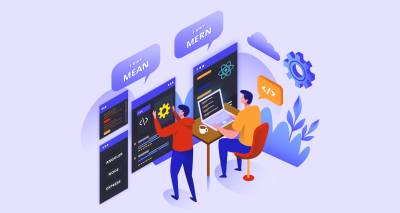
MEAN uses Angular for frontend development, while MERN uses React. Both typically use MongoDB, Express.js, and Node.js for the rest of the stack.
- Is MEAN Stack good for real-time applications?
Yes. Node.js, along with WebSockets, Socket.IO, Redis, and messaging platforms, enables real-time applications like chat, location tracking, notifications, collaboration, and live dashboards.
Let's Launch Your Business.
Your unique conceptual workflows will be cleanly crafted into an elite digital system by our specialized engineers.