


Quick Summary: Mobile app development cost in 2026 ranges from $15,000 for a basic single-platform build to $500,000+ for a complex, industry-regulated product. That range is wide because most guides average every app type into one number. What actually moves the needle is what kind of app you’re building and which industry it serves. This guide breaks that number down by app type, industry, complexity, platform, and region, so the figure you walk away with actually fits your project.
If you’re reading this, you’ve probably already gotten a quote or two, and neither one matched what you googled last week. That’s normal. Most people asking how much it costs to build a mobile app already know they need one. What they don’t have yet is a way to tell whether $40,000 or $140,000 is the right mobile app development cost for their idea specifically.
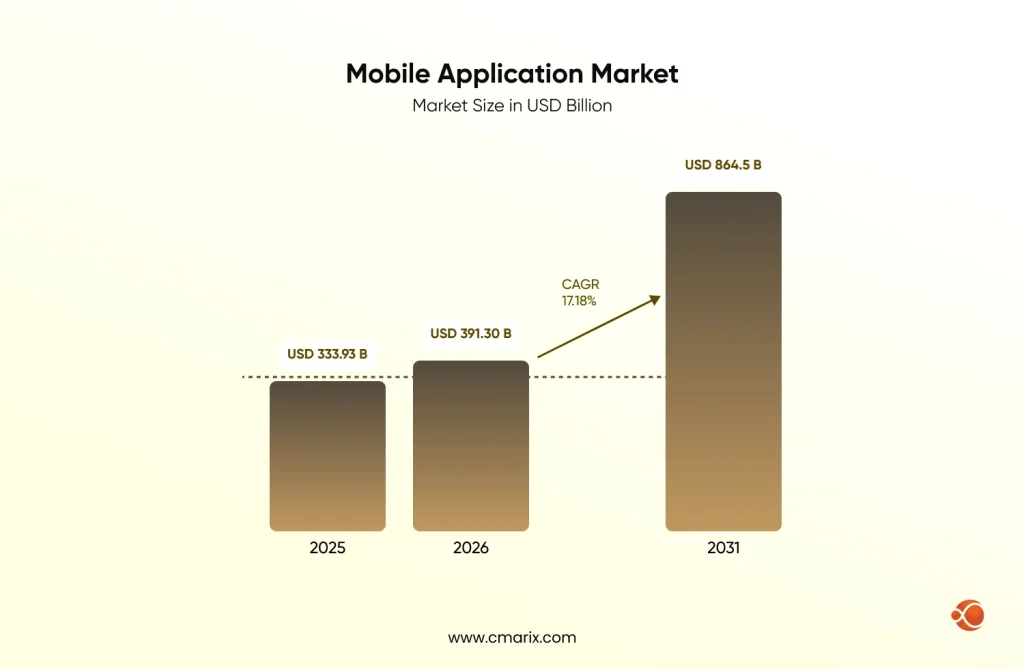
The mobile application market size is expected to grow from USD 333.93 billion in 2025 to USD 391.3 billion in 2026 and is forecast to reach USD 864.5 billion by 2031 at 17.18% CAGR over 2026-2031.
Mobile first channels already command 64.55 percent of the digital commerce share. That growth explains why vendor competition for your project is fierce right now, and why getting that number right matters more than picking the first quote that lands in your inbox.
Complexity scores and vague tiers like basic, medium, and complex only tell part of the story. A medium complexity fintech app and a medium complexity loyalty card app are not the same investment, even though a generic pricing chart would slap the same label on both. The real driver of mobile app development cost is what your app does, who it serves, and what industry rules it has to follow. That’s the lens this guide uses.
Cost Breakdown of Mobile App Development: What You’re Actually Paying For
When a vendor provides an estimate for your project, that price represents many cost centers, not just one single lump sum for coding. The development cost of a mobile app does not neatly fit into one billable line item, and assuming it does is why projects become budget disasters.
| Cost Center | What It Covers | Share of Total Budget |
| Discovery & Scoping | Requirements gathering, architecture planning, and feasibility analysis | 10–15% |
| UI/UX Design | Wireframes, prototypes, user flows, visual design | 15–20% |
| Development | Front-end development, back-end development, third-party integrations | 45–55% |
| QA & Testing | Manual testing, automated testing, quality assurance, bug fixes | 15–20% |
| Deployment & Project Management | App store submission, deployment, project coordination, oversight | 5–10% |
Most first-time buyers price in the coding and forget the rest. QA alone typically runs 20 to 25 percent of total development hours, which on a mid-complexity build can mean $10,000 to $37,500 just for testing.
The mistake worth avoiding isn’t underestimating any one line item. It’s assuming two quotes covering the same app are actually covering the same scope. A $40,000 quote and a $120,000 quote for what looks like an identical brief almost never include the same kind of assumptions about integrations, team seniority, or team seniority. Before comparing numbers, compare what’s inside them.
Mobile App Development Cost by App Type
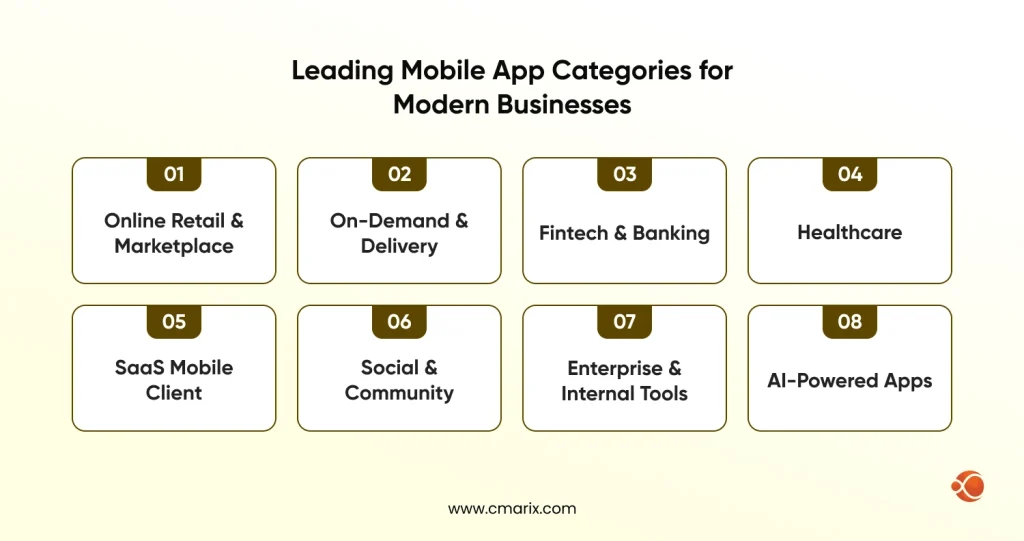
This is where most pricing guides fall short. They’ll tell you complexity drives mobile application development cost, then hand you a generic basic, medium, complex table that could apply to any app on earth. In reality, the kind of application you are going to develop will determine the maximum and minimum budget for you, even before talking about complexity.
| App Type | Typical Cost Range | What Drives the Price |
| Online Retail & Marketplace | $40,000–$150,000 | Shopping cart and checkout functionality, payment gateway integration, inventory synchronization, and two-sided user onboarding |
| On-Demand & Delivery | $60,000–$180,000 | Real-time GPS tracking, order status updates, and separate apps for customers, service providers, and administrators |
| Fintech & Banking | $80,000–$300,000+ | Advanced security architecture, multi-factor authentication (MFA), regulatory compliance, and audit requirements |
| Healthcare | $50,000–$200,000 | HIPAA compliance, encrypted patient data storage, and EHR/EMR integrations |
| SaaS Mobile Client | $25,000–$80,000 | API-driven data synchronization and integration with existing backend systems |
| Social & Community | $40,000–$150,000 | News feeds, real-time messaging, media uploads, storage, and content moderation |
| Enterprise & Internal Tools | $30,000–$120,000 | ERP/CRM integrations, workflow automation, and role-based access controls |
| AI-Powered Apps | +20–50% on top of the base build cost | LLM integrations, recommendation engines, AI assistants, and agentic workflows |
A few of these are worth unpacking further.
Fintech and banking apps carry the widest range on this list because security and the mobile application development price of ongoing compliance work scale with how much money the app actually moves.
AI-powered apps deserve a table of their own, since adding AI isn’t a single line item.
| AI Feature | Added Cost | Notes |
| Basic recommendations | $15,000–$30,000 | Pre-trained models, API-based |
| Chatbot / conversational AI | $20,000–$50,000 | Depends on training data volume |
| Custom LLM integration | $40,000–$80,000+ | Fine-tuning, vector databases, RAG pipelines |
These numbers shift fast because the underlying model landscape shifts fast. Pricing an API call to a foundation model looked completely different a year ago than it does now, and it’ll likely look different a year from now too. For a full breakdown of what this layer costs on top of standard mobile development, our guide on AI app development cost goes deeper than we can here.
If you’re weighing whether to build AI capability in-house, buy a pre-trained solution, or land somewhere in between, that decision deserves more space than a pricing table can give it. Our CTO decision framework for Build vs Buy AI walks through that call step by step, and it’s worth reading before you lock in a budget line for AI features.
Mobile App Development Cost by Industry
App type tells you what the app does. Industry tells you what rules it has to follow while doing it, and those rules carry a real price tag.
| Industry | Cost Premium vs. Unregulated App | Primary Driver |
| Fintech | 30–80% | PCI DSS, KYC/AML, fraud prevention |
| Healthcare | 30–80% | HIPAA, encrypted PHI, audit trails |
| Real Estate | 10–25% | MLS/property database integration |
| Logistics | 15–30% | ERP integration, real-time tracking accuracy |
| Retail | Baseline | Fewer compliance layers |
Two apps with identical feature lists can land in completely different budgets if one serves retail and the other serves healthcare or finance. Take fintech as an example. CMARIX built Eddbee, a GDPR-compliant trading platform for a Swedish financial firm, and the compliance and security work on that project shaped the timeline as much as the actual trading features did. Real estate apps depend heavily on whether you need live MLS integration, that one feature alone can swing cost by $10,000 to $30,000. Healthcare tells a similar story.
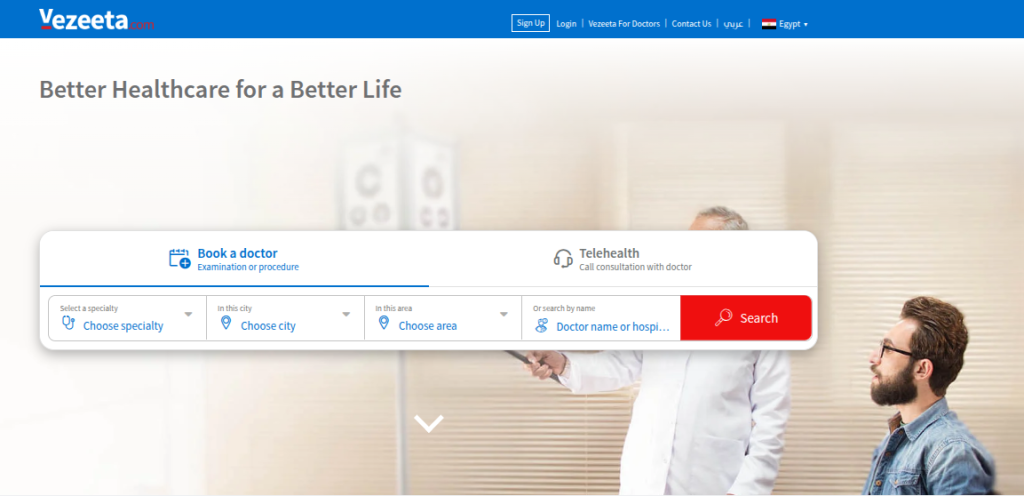
Our work on Vezeeta, an online healthcare platform built for patient booking and provider management, needed HIPAA-aligned data handling built into the architecture from day one, not bolted on after launch. If your industry has its own compliance layer, budget for it as a separate line item, not something absorbed quietly into the base development quote.
Cost of Mobile App development based on Complexity Tier
Once you’ve narrowed down app type and industry, complexity tier gives you a quick sanity check on where your mobile app development price should land.
| Tier | What’s Included | Cost Estimates for App Development |
| Basic | Single-purpose function, minimal screens, BaaS backend (e.g., Firebase) | $15,000–$40,000 |
| Medium | API integrations, user accounts, push notifications, custom UI | $40,000–$100,000 |
| Complex | Real-time features, multiple integrations, custom backend, advanced security | $100,000–$300,000+ |
A simple app with offline sync, or a medium complexity app serving a regulated market, can jump a full tier before a single line of code gets written. Use this table as a starting point, not a final answer.
Mobile App Development Cost by Platform: iOS vs Android vs Cross-Platform
Platform choice is one of the more controllable levers in your budget.
| Platform Approach | Cost vs. Dual Native | Best Fit |
| Native iOS Only | Baseline (single platform) | Apple-only audience, deep OS access needed |
| Native Android Only | Baseline (single platform) | Android-only audience, hardware-specific features |
| Native iOS + Android | 100% (full cost, two codebases) | High-performance apps, AR/VR, gaming |
| Cross-Platform (Flutter/React Native) | 55–70% of dual native cost | Most business apps in 2026 |
Having to build different native applications for both Android and iOS is basically doubling the effort required for front-end development, as you’ll have two code bases and two different teams. But using cross-platform technologies such as Flutter and React native enables you to develop once and deploy twice, saving up to 30-45 percent.
For projects that specifically need deep OS-level access or high-performance graphics, native still makes sense.
If you’re scoping a native build, our guides on cost to build an iOS app and Android app development cost break down platform-specific pricing in more depth than a comparison table can.
Teams building on blockchain rails run into a different cost structure entirely. Smart contracts, consensus mechanisms, and audit requirements mean those blockchain app development cost variables don’t fit neatly into a standard mobile budget, so treat that as a separate scoping conversation rather than an add-on line item.
Teams building on blockchain rails run into a different cost structure entirely. Smart contracts, consensus mechanisms, and audit requirements mean those blockchain app development cost variables don’t fit neatly into a standard mobile budget, so treat that as a separate scoping conversation rather than an add-on line item.
Our team can review your feature list and tell you which platform actually fits.
Cost of Developing a Mobile App by Region: Hourly Rates Compared
Where your development team sits changes your hourly rate more than almost any other single factor. Mobile app development rates vary by a factor of five or more depending on geography alone.
| Region | Hourly Rate Range | Typical Savings vs. North America |
| North America | $120–$250 | Baseline |
| Western Europe | $80–$180 | 15–30% |
| Eastern Europe | $40–$90 | 45–65% |
| India | $22–$55 | 65–80% |
| Southeast Asia | $20–$50 | 70–85% |
Offshoring can cut total project cost by 40 to 70 percent, but only if the offshore team runs real delivery processes, communicates clearly, and has actual sector experience. A cheap rate with heavy revision cycles ends up costing more than a higher rate that ships clean the first time.
Mobile App Development Costs Nobody Warns You About
These are the line items that routinely push first-year costs 15 to 35 percent above the original development quote, not because vendors hide them, but because they’re easy to overlook during initial planning. Anyone budgeting the cost to develop mobile app products for the first time tends to miss these until the second invoice shows up.
| Hidden Cost | Typical Amount | When It Hits |
| App Store Developer Accounts | $99/year (Apple), $25 one-time (Google) | Before launch, then annually |
| App Store Commission | 15–30% of in-app revenue | Ongoing |
| Annual Maintenance | 15–25% of the build cost | Every year post-launch |
| Third-Party API Usage Fees | Scales with volume | Ongoing, grows with success |
| Compliance Audits | $8,000–$25,000 per cycle | Regulated apps only |
A $100,000 app needs at least $20,000 a year just to stay secure and compatible with new OS releases. That’s not optional spending, it’s the cost of keeping the thing you built from breaking.
How to Reduce Mobile App Development Cost Without Cutting Corners
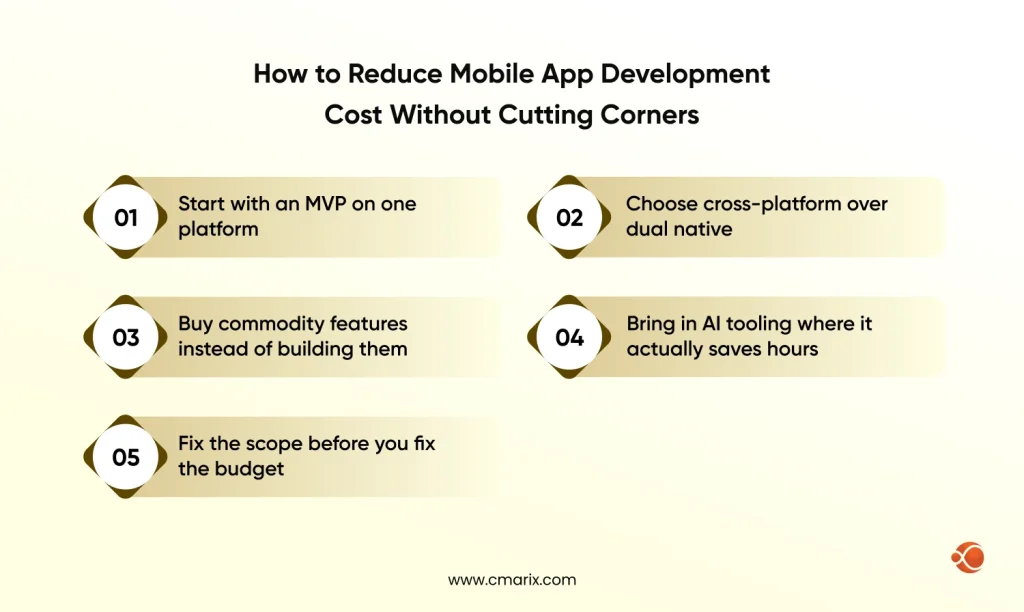
1. Start with an MVP on one platform. Starting on one platform first normally costs 40-60% less than starting on two platforms at once, and allows for the testing of the concept before spending more.
2. Choose cross-platform over dual native. Unless you need deep OS-specific access, Flutter or React Native gets you to both app stores at 60 to 70 percent of the cost of building twice.
3. Buy commodity features instead of building them. Authentication, payments, and analytics all have mature third-party options. Building these from scratch rarely pays off unless they’re core to what makes your app different.
4. Bring in AI tooling where it actually saves hours. Code generation, automated testing, and AI-assisted QA can cut real time off repetitive work. Our guide on leveraging AI tooling for software cost reduction breaks down where this pays off and where it doesn’t.
5. Fix the scope before you fix the budget. Cost overrun is usually because of vague specifications identified during the process, and not poor programming. A quick discovery phase that takes 10 to 15% of the entire budget prevents this problem from occurring.
Get a clear breakdown from a team that’s shipped this exact category of app before.
How to Compare Mobile App Development Quotes From Different Vendors
If you’re staring at two or three quotes right now with wildly different numbers, here’s how to actually compare them.
| Question to Ask | Why It Matters |
| What’s included in QA hours? | A quote that skips detailed QA looks cheaper and costs more in post-launch bug fixes. |
| What’s the team’s seniority mix? | A lower blended rate often means more junior hours and more revision cycles. |
| Fixed-scope or time-and-materials? | Fixed-scope runs 10–25% higher upfront but avoids the 30–80% overage that T&M projects often hit by the final invoice. |
| What happens after launch? | No mention of a maintenance retainer means a second bill is coming in month two. |
The vendor offering the lowest number isn’t always offering the lowest total cost. Run every quote through these four questions before you decide.
Why Choose CMARIX for Mobile App Development
CMARIX has delivered 250+ mobile projects across healthcare, fintech, online retail, and enterprise SaaS, so the ranges in this guide aren’t pulled from a spreadsheet. They’re grounded in what we’ve actually built and priced. Our development center gives clients access to senior engineers and QA specialists at rates well below North American agencies, without the communication gaps that usually come with offshore work.
We scope the project before we price it, which is exactly the discipline this guide has been walking you through. If you already know you want a dedicated mobile app developers team on your project, that conversation starts with your feature list, not a rate card.
For teams leaning toward a cross-platform build specifically, a dedicated Flutter app developer can usually get you to both app stores faster than staffing separate iOS and Android teams. And if you’re still deciding what shape your project should take, our full range of custom mobile app development services covers how we approach projects across industries.
Conclusion
Mobile app development cost isn’t one number. It’s the output of app type, industry, complexity, platform, and where your team sits. A generic $10,000 to $500,000 range is technically true and practically useless. Once you know what kind of app you’re building and what industry rules it has to follow, you can price your project with real confidence instead of hoping the vendor’s number happens to match reality. And with AI reshaping both feature expectations and the top technology trends buyers are asking for in 2026, that scoping work matters more than ever before you sign anything.
FAQs on Mobile App Development Cost
What is the average cost to build a mobile app in 2026?
Costs for most business applications range from $40,000 to $150,000. A minimum viable product can start from $15,000, and more complicated apps, like a fintech application, may cost $300,000 and higher.
What are the main factors driving app development costs?
App type, industry compliance requirements, feature complexity, platform choice, and developer location are the five biggest drivers of mobile application cost. App type and industry usually matter more than raw feature count.
Is cross-platform app development cheaper than native in 2026?
Yes, React Native and Flutter usually cost 30 to 45 percent less than building separate native Android and iOS apps, while still delivering near-native performance for most business use cases.
How much does app maintenance cost after launch?
Budget 15 to 25 percent of your actual development cost annually. This covers OS compatibility updates, bug fixes, security patches, and minor feature improvements over the app’s lifetime.
How does AI integration impact the app development budget?
AI features like recommendations or LLM-driven functionality typically add 20 to 50 percent to development cost, plus $15,000 to $80,000, depending on how complex the AI layer itself gets.
What is the fastest way to reduce app development costs?
Launch an MVP on a single platform first, use cross-platform frameworks, and buy third-party integrations for commodity features like authentication and payments instead of building them from scratch.