


Quick Summary: This blog provides a complete overview of healthcare app development costs in 2026, helping founders understand realistic budgets, compliance expenses, feature-based pricing, hidden costs, and cost-saving strategies. It also explains what drives pricing across different healthcare app types, build tiers, and development approaches to support informed planning.
Healthcare apps have many cost factors that other industries don’t know about. These include patient data compliance, EHR compatibility, and access for patients, nurses, doctors, and administrative staff to the app itself.
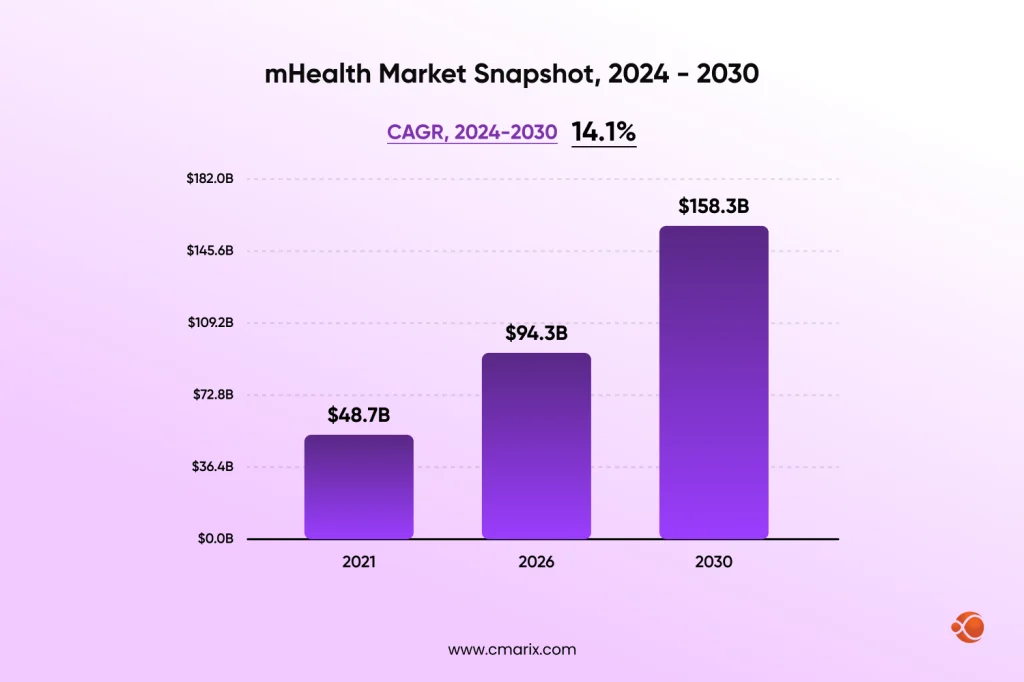
Grand View Research forecasts the global mHealth market to grow at a compound annual rate of 14.1% between 2024 and 2030, reaching approximately $158.3 billion; in such a market, apps that can withstand real usage are highly rewarded.
This guide breaks down exactly what a healthcare app costs: by category, by build tier, and by the patient, provider, and admin components that make up a real platform. It also covers the hidden costs most first-time budgets miss, and where CMARIX has already solved these exact problems for real clients.
- A basic healthcare app can be developed at the cost of $25,000 – $65,000
- A mid-complexity app with telemedicine or EHR integration costs $65,000 to $160,000.
- An enterprise-grade platform with AI, compliance layers, and multi-role dashboards costs $160,000 to $450,000+.
- HIPAA and GDPR compliance alone can add 15% to 30% to a project budget.
- Native apps cost 20% to 40% more than cross-platform builds using Flutter or React Native.
- Annual maintenance typically runs 15% to 20% of the base build cost.
- Grand View Research projects the global mHealth market to grow at a 14.1% compound annual rate from 2024 through 2030, reaching roughly $158.3 billion.
Note: Costs are approximate estimates and vary based on project scope, features, integrations, and regulatory requirements.
The wide range mentioned above has only one reason behind it that most new founders overlook: a genuine healthcare application isn’t merely one application. Rather, it is a patient-facing application, a provider/clinician portal, and an administrative dashboard, which are all built on a compliance layer that needs to withstand audits. The budget estimates quoted on merely “healthcare applications” are almost always too low.
Why Build Your Own Healthcare App Instead of Licensing an Existing Platform?
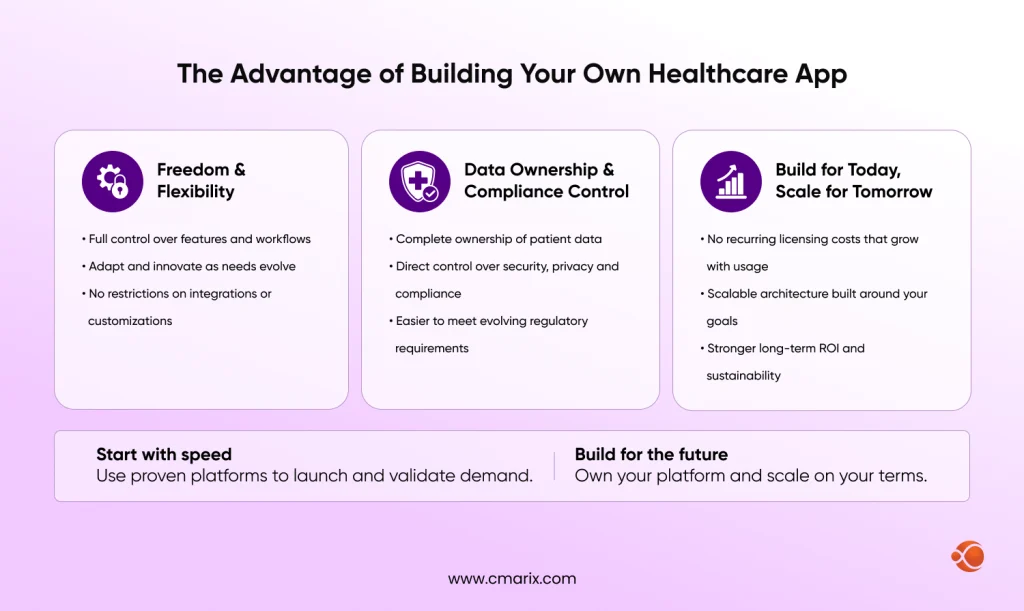
Before the cost analysis, it’s worth answering the question underneath it: why not just license an existing EHR-in-a-box or white-label telehealth platform?
Vendor Lock-In Limits Long-Term Flexibility
Commercial healthcare systems require continual licensing fees, which restrict what you can add to the system. The higher your patient numbers and the greater your demands become, the more expensive these limitations become compared to developing your own solution.
Owning Patient Data and Compliance Posture Has Long-Term Value
When you have an authorized platform, your compliance capability is contingent on the vendor’s. When you have your own custom build, all those features are controlled by you – and that will become significant the minute someone from the hospital systems or insurance company wants to see it.
The Best Strategy Is Often a Hybrid Approach
Healthcare start-ups are built on a certified white-label solution first to test demand before moving on to building their platform in-house after validating the concept. Aggregator-type solutions are good for speed. Custom solutions are your future.
Talk through your compliance scope and budget with the CMARIX team before you commit to a path.
Healthcare App Ecosystem: Patient App, Provider Portal, and Admin Dashboard Cost Analysis
A true healthcare platform is really three connected pieces, and each one carries its own price tag.
| App/Portal | What It Does | Rough Cost Range (MVP – Enterprise) |
| Patient/Consumer App (iOS/Android) | Appointment booking, video consults, records access, medication reminders | $12,000 – $80,000+ |
| Provider/Clinician Portal | Patient charting, scheduling, e-prescriptions, care coordination | $15,000 – $90,000+ |
| Admin Dashboard | User management, compliance reporting, billing, analytics | $8,000 – $50,000+ |
Add the three rows together, and you land back near the headline numbers: $25,000–$65,000 for an MVP, $160,000–$450,000+ for enterprise. The feature-by-feature version of this table follows below.
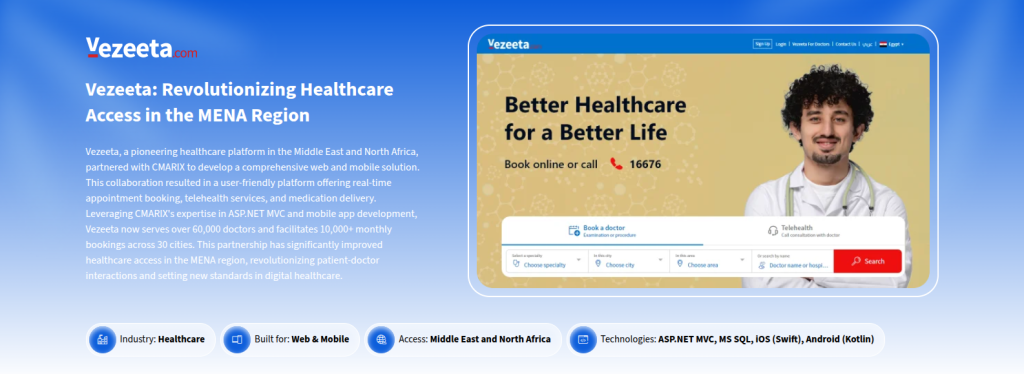
This isn’t theoretical. CMARIX built exactly this three-part structure for Vezeeta, a smart health solution serving the Middle East and North Africa. The build paired a patient-facing consultation app with a provider-facing scheduling and records system, backed by an ASP.NET MVC platform with native iOS (Swift) and Android (Kotlin) apps. That’s the same patient, provider, and admin structure any healthcare platform needs, adapted to a regional payment and compliance environment.
Healthcare App Development Cost by Build Tier: MVP vs Mid-Market vs Enterprise
| Build Tier | Cost Range | What You Get | Typical Timeline |
| MVP | $25,000 – $65,000 | Core booking or consultation flow, basic provider dashboard, essential admin controls | 3–5 months |
| Mid-Market | $65,000 – $160,000 | Telemedicine video, EHR sync, in-app payments, multi-provider support | 5–9 months |
| Enterprise-Grade | $160,000 – $450,000+ | AI-driven diagnostics support, predictive analytics, multi-region compliance, advanced dispatch/triage logic | 9–18 months |
A minimum viable product (MVP) is tested in one fundamental process, which includes booking, consulting, and following up. The MVP should not involve any predictive analytics or artificial intelligence triage yet. Mid-Market is the place where most healthcare startups that receive funding emerge after the MVP has been validated.
CMARIX makes a similar case in its more comprehensive app development cost guide. A single-platform MVP typically costs 40% to 60% less than a dual-platform launch, and most successful healthcare apps validate on one platform prior to scaling to both.
Healthcare App Features and Cost Breakdown by Module
This is where most cost manuals get fuzzy. This is how a typical telehealth budget is broken down according to the three major elements, with allocation ratios that I have seen.
Patient App Development Cost
| Feature | MVP | Enterprise-Grade |
| Appointment booking & search | Included | Included, with AI-matched provider recommendations |
| Video consultation | Basic 1:1 call | Multi-party calls, screen share, recording with consent logging |
| Payment & insurance billing | One method (card) | Multiple methods, insurance claims submission |
| Records access | Basic document view | Full longitudinal record with lab/imaging integration |
| Push notifications | Appointment reminders only | Reminders, medication alerts, re-engagement |
| Data privacy & compliance | Basic encryption, secure login | Full HIPAA/GDPR-equivalent compliance program, audit logging |
| Estimated cost | $12,000 – $28,000 | $50,000 – $80,000+ |
AI agent development efforts at CMARIX are pertinent in this regard. AI-matched provider suggestions and symptom-based triage recommendations are decision-making systems of agents, not filters, and hence are appropriately priced and designed.
Provider/Clinician Portal Development Cost
| Feature | MVP | Enterprise-Grade |
| Scheduling & availability management | Included | Included + auto-fill rules, waitlist automation |
| Patient charting | Basic notes | Structured charting with template libraries |
| E-prescriptions | Not included | Included, with pharmacy network integration |
| EHR/EMR sync | Not included | Included, bi-directional with major EHR vendors |
| Multi-location management | Not included | Included |
| Estimated cost | $15,000 – $32,000 | $55,000 – $90,000+ |
Admin Dashboard Development Cost
| Feature | MVP | Enterprise-Grade |
| Provider & staff onboarding | Manual approval | Automated workflows with credential verification |
| Billing & payout management | Basic | Automated, multi-currency, insurance reconciliation |
| Compliance reporting | Basic logs | Full audit trail, exportable compliance reports |
| Analytics & reporting | Basic totals | Real-time dashboards, population health insights |
| Multi-region controls | Not included | Included |
| Estimated cost | $8,000 – $18,000 | $30,000 – $50,000+ |
CMARIX’s work on CRUSH for Stryker, a global clinical trial management platform, and PBR Insight, an advanced healthcare data analytics platform for the United Kingdom market, both sit at the enterprise-admin end of this table. Trial data auditing and population-level analytics aren’t a checkbox feature; they’re the reason those two platforms carry enterprise-tier compliance and reporting budgets.
When you add all three of the above figures together, you land back at the top-line numbers: $25,000 to $65,000 for MVPs, $160,000 to $450,000+ for enterprise-grade platforms.

Healthcare App Development Cost by Category
Here’s the direct answer to “how much does my type of healthcare app cost,” broken down by category.
| App Category | Cost Range | Typical Complexity Driver |
| On-Demand Doctor App | $40,000 – $90,000 | Video calling, scheduling, payments |
| Telemedicine App | $70,000 – $180,000 | Video infra, e-prescriptions, EHR sync |
| Medicine Delivery App | $45,000 – $100,000 | Order tracking, pharmacy inventory sync |
| Remote Patient Monitoring | $80,000 – $200,000 | Wearable/IoT integration, real-time alerting |
| Hospital/Clinic Management System | $100,000 – $300,000 | Multi-role access, facility-wide records |
| Health Insurance/Claims App | $90,000 – $250,000 | Fraud detection, claims workflow, compliance |
| Chronic Disease Management App | $70,000 – $160,000 | Device sync, longitudinal tracking |
| Mental Health/Therapy App | $50,000 – $130,000 | Video sessions, mood tracking, scheduling |
| Fitness & Wellness App | $35,000 – $85,000 | Coaching logic, wearable sync |
| Clinical Trial Management Platform | $150,000 – $400,000+ | Regulatory reporting, audit trail depth |
On-Demand Doctor Apps
On-demand doctor apps connect people with doctors for quick consultations. The cost remains low for the app because the major activities involve making video calls, booking appointments, and connecting through the payment gateway.
Telemedicine Apps
Telemedicine apps sit higher up the table because video consultation, e-prescriptions, and EHR syncing all add engineering hours on top of the basic consultation flow. Demand for this category isn’t slowing down either, as the CDC telemedicine-adoption data cited earlier in this guide shows. CHeck out our in-depth guide on telemedicine app development cost for better estimates.
Medicine Delivery Apps
Medicine delivery app development has a similar structure to food delivery services but includes synchronization with pharmacy stock and prescription validation, in addition to order and delivery tracking.
Remote Patient Monitoring Apps
They relate to wearable devices and IoT devices that track vitals. They rank at the top of the list since integrating the devices and testing for accuracy takes time, and any misinterpretation of vitals can be dangerous.
Hospital and Clinic Management Systems
This kind of system manages patient information, billing processes, staff scheduling, and inventory in a whole hospital facility. Multi-role access control is one factor that makes this category of software more advanced; that is, one sign-on for physicians, nurses, and administrative personnel.
Health Insurance and Claims Apps
Applications responsible for managing policies, submitting claims, and detecting fraud also lie on the same higher end, owing to the efforts required on compliance and data security rather than features.
Chronic Disease Management Apps
The apps monitor chronic illnesses such as diabetes or high blood pressure, and they connect to one or more wearables. The cost is highly dependent on how many devices it supports at launch.
Mental Health and Therapy Apps
Mental health platforms combine chat, mood tracking, and therapist booking. Video therapy sessions are what push a build from the lower end of this category’s range toward the higher end.
Fitness and Wellness Apps
Fitness and wellness platforms sit lowest on the complexity scale in this table, unless AI-based coaching or wearable sync is added.
- The fitness and wellness management platform CMARIX built supports gym owners, trainers, and clients across web, mobile, and tablet, and sits comfortably in this range.
- AIMO, an AI-driven fitness platform built for the German market using TensorFlow, shows how adding AI coaching logic pushes a fitness app toward the higher end of the same range.
Clinical Trial Management Platforms
Enterprise platforms that manage trial data, patient recruitment, and regulatory reporting sit at the very top of the table. These are among the most intricate healthcare builds because audit requirements are so strict, a pattern CMARIX has seen firsthand while building CRUSH, a global clinical trial management platform for Stryker.
Why The Cost to Develop a Healthcare App Vary Across Companies
Two agencies quoting the same feature list can land $80,000 apart. Three factors explain most of that gap.
1. Development Team Location
Hourly rates are the single biggest lever on total project cost.
| Region | Typical Hourly Rate | Best For |
| North America | $100 – $180 | Same-timezone collaboration, fastest turnaround |
| Western Europe | $80 – $150 | Strong regulatory expertise (GDPR), moderate timezone overlap |
| Eastern Europe | $40 – $80 | Strong price-to-quality ratio, decent EU/US overlap |
| India / South Asia | $20 – $50 | Lowest hourly rate, large talent pool, needs stronger project management |
| Southeast Asia | $25 – $55 | Growing talent pool, useful for teams already operating in APAC markets |
A 1,200-hour build at North American rates comes in around $180K. The same build at Eastern European, Indian, or Southeast Asian rates comes in below $70K. Neither number is “wrong,” but there’s a trade-off in communication overhead and the hands-on management the project will need.
The vendor’s pricing model is just as important as the hourly rate. The fixed pricing model is best when there is little variance in the MVP scope and the specifications will remain constant. Time and materials pricing is good for an enterprise-level build where features will change during development.
2. Feature Complexity
Real-time vital sign monitoring, electronic prescriptions, and artificial intelligence triaging seem like features from a list. However, each of them is a backend issue rather than a frontend issue. Matching a patient’s symptoms with triage recommendations is a completely different engineering task than making a static FAQ page.
3. Platform Choice (iOS, Android, or Both)
Developing the application for both platforms separately costs twice as much in native development. Cross-platform solutions such as Flutter and React Native help bridge the difference. Average Flutter app development cost comes lower than native app development cost, providing a cost benefit for multi-platform reach. However, things like biometric authentication and synchronization with a wearable device are usually best to implement through native development.
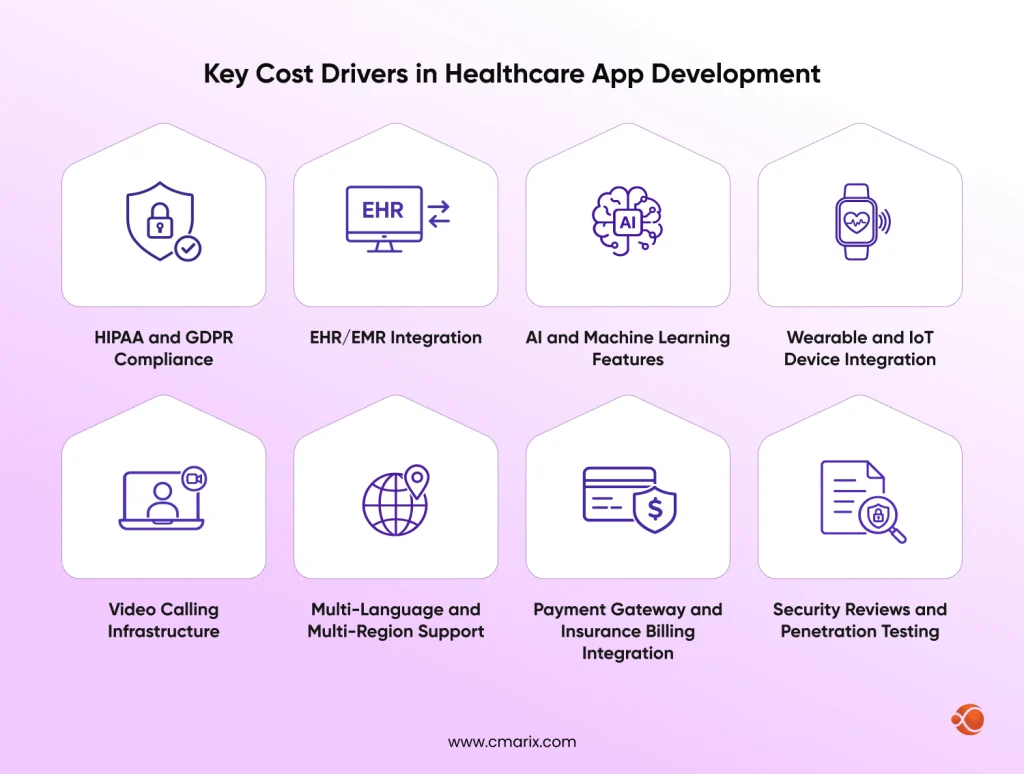
Key Cost Drivers Beyond Basic Healthcare App Development
HIPAA and GDPR Compliance
Data compliance is mandatory for apps that deal with patient information in the health care sector. It generally costs between 15% and 30% of the total expense. The development team must have the HIPAA Security Rule Guide issued by the U.S. Department of Health and Human Services when developing their architecture.
EHR/EMR Integration
Connection to EHR systems such as Epic and Cerner introduces complications and costs, ranging from $15,000 to $40,000, depending on how many integrations are needed and how old the legacy system is.
AI and Machine Learning Features
Features like an AI-based symptom checker, chatbot, or prediction of diagnosis will cost anywhere from $20,000 to $60,000, depending on the model’s complexity and the need for regular model retraining.
Wearable and IoT Device Integration
Linking with devices like glucose monitors, smartwatches, or blood pressure cuffs adds $10,000 to $35,000 per device category, since each manufacturer has its own SDK and data format.
Video Calling Infrastructure
A reliable and HIPAA-compliant video network from companies such as Twilio or Vonage costs an additional $8,000-$25,000 in set-up charges, in addition to a fee for each minute used. The need for this will not abate; the CDC’s National Center for Health Statistics reported in 2024 that 80% of U.S. office-based physicians used telemedicine, down from the 86.5% who used it in 2021.
Multi-Language and Multi-Region Support
When an application is aimed at several countries, it should include localization, regional verification, and possibly different data centers, which will cost between $10,000 and $30,000.
Payment Gateway and Insurance Billing Integration
Secure payment and insurance billing integration costs between $8,000 and $20,000, even more if you plan to integrate several insurance providers from the very beginning.
Security Reviews and Penetration Testing
It is important to conduct third-party security reviews before release, and the cost is $5,000-$20,000 depending on the number of third parties.
Hidden Costs of Building a Healthcare App
This is the difference between practical budgeting and guessing: the build makes up only about half of the first-year total investment cost. Everything else follows post-launch, and this is where under-funded projects fall short.
- Server and infrastructure costs. With real-time video and continuous device data, servers stay busy. Costs run $500 to $3,000+ per month, depending on patient volume.
- Third-party API fees. Video SDKs, payment gateways, and pharmacy or lab integrations charge per call or per transaction, so these costs scale directly with usage.
- Continuous compliance audits. Annual re-certification and audit work typically costs $5,000 to $15,000 per year, on top of routine maintenance.
- Ongoing maintenance.Industry-standard maintenance runs 15% to 20% of the initial development cost per year.For a $100,000 project, that’s $15,000 to $20,000 annually.
- Patient and provider acquisition. A two-sided health platform needs providers onboarded before patients arrive, then marketing to reach patients. Budget $20,000 to $50,000 for a single-region launch
- Staff training. Clinics and hospital staff adopting a new system need onboarding time and materials, which is easy to underbudget.
How to Reduce Healthcare App Development Cost
Yes, but not by cutting corners on architecture. There are two paths, depending on how much control you need.
Option 1: Scope Optimization (Custom Development)
- First build a single-platform version, followed by expansion after validation
- Start with one care specialty or one region before building multi-region compliance logic
- Use pre-built video and payment SDKs instead of custom integrations
- Defer AI-driven triage and predictive analytics to a later release, once revenue funds it
Option 2: White-Label or Pre-Built Healthcare Platforms
Using a HIPAA-compliant telehealth or EHR platform and adapting it with your branding and regional requirements would cut your costs and development time by about half. Of course, there is a loss of flexibility in this approach, as the platform architecture cannot be modified later for custom triage logic and workflows for providers.
Some aspects that must remain in every case: encryption that meets the highest security standards, user authentication, and a friendly dashboard for clinicians.
Why Underbuilt Healthcare Apps Fail Compliance and Scale
With $10,000 spent on a freelance build, a founder may end up with a functional demo. But a demo won’t hold up to a HIPAA audit, and it won’t handle 500 concurrent patient sessions on a busy Monday morning. The difference between surviving and failing an audit is architecture, not feature count.
The same tripartite complexity- patient, provider, admin- shows up across different types of healthcare software. CMARIX has built for this pattern across telemedicine, clinical trials, and health analytics platforms, where compliance logging, access control, and provider workflows mirror the cost drivers of a patient-facing consumer app. The pattern holds regardless of the specialty, whether it’s primary care, mental health, or chronic disease management. We also follow the latest healthcare technology trends to make sure your app feels refreshing and apt to the users at all times.
Key Questions Before Hiring a Healthcare App Development Company
Before requesting a quote, answer these three questions. They shape most of the final price tag.
- Timeline: Are you validating an idea in 3 months, or launching a compliance-ready product in 9 to 12?
- Platform: Single platform to start, or dual-platform from launch?
- Compliance scope: One region under one regulatory framework, or multi-region from day one?
The answers determine whether the project lands closer to a $35,000 MVP or a $180,000 regional launch. A vendor who asks these questions before quoting a number is one worth trusting.
If you’re ready to scope your project, CMARIX’s healthcare software development team can walk through your compliance needs, timeline, and budget before you commit to a build. CMARIX also offers access to dedicated Full Stack Developers and custom software development services for healthcare-specific engagements, backed by delivery experience on systems such as DKSH, a global healthcare and life sciences corporate web platform built on .NET Core, Angular, and Azure.
Move beyond prototypes with a secure, compliant, and scalable healthcare application.
Final Thoughts
The cost of building a healthcare app depends upon the scope of the project, rather than assumptions. List out features for your patient, provider, and administrative interfaces; address compliance issues beforehand; select the right team and location; and allocate a buffer for overlooked costs.
The advantage of working with a professional healthcare software development company such as CMARIX, who have already delivered telemedicine, clinical trials, healthcare analytics, and wellness solutions in multiple continents, is that you save yourself from expensive rework later.
FAQs About Cost of Building a Healthcare App
How much does it cost to build a health app?
Most health apps cost between $25,000 and $160,000, depending on features and compliance scope. Enterprise clinical platforms can exceed $400,000.
How much does HIPAA and GDPR compliance add to development costs?
Compliance work usually adds 15%-30% on top of the basic cost of app development for items such as encryption, auditing logs, and access control.
What are the major hidden costs of healthcare app development?
Costs such as server setup, API costs, compliance audits, employee training, and user acquisition usually increase the basic cost by 25%-35% in year one.
How much does it cost to implement AI into a medical application?
AI features like symptom checkers or predictive analytics usually add $20,000 to $60,000, depending on model sophistication.
Should I build a native or a cross-platform healthcare app?
The cross-platform development framework, Flutter, decreases development time and cost, but the native development approach fits better for applications requiring high hardware-level integration (such as biometrics).
Why do telemedicine apps cost more than standard fitness tracking apps?
Because they need video capabilities, an e-prescription system, and EHR synchronization, which are not usually required in fitness apps.
How can I keep my health app development costs within budget?
Start with a focused MVP, reuse proven SDKs, and phase in compliance-heavy features over later releases instead of at launch.
How do healthcare apps generate revenue to earn a high ROI?
Through subscriptions, per-consultation fees, insurance partnerships, and B2B licensing to hospitals or clinics.
How can I estimate ROI for my healthcare app investment?
Track retention and per-user lifetime value rather than downloads alone, since compliance-heavy apps monetize over longer cycles.
How long does it take to build a healthcare app?
A basic app takes 3 to 5 months. Mid-complexity apps take 5 to 9 months. Enterprise platforms usually take 9 to 18 months.
Does maintenance cost more for healthcare apps than other industries?
Yes. Continuous compliance monitoring and security patching are non-negotiable, so maintenance often runs 15% to 20% of build cost annually, higher than typical consumer apps.