




Quick Summary: Telemedicine app development cost usually ranges from $40,000 to $300,000+, depending on app type, complexity, and HIPAA compliance depth. A basic MVP with video and scheduling sits at the lower end, while an enterprise platform with EHR integration and AI diagnostics sits at the higher end.
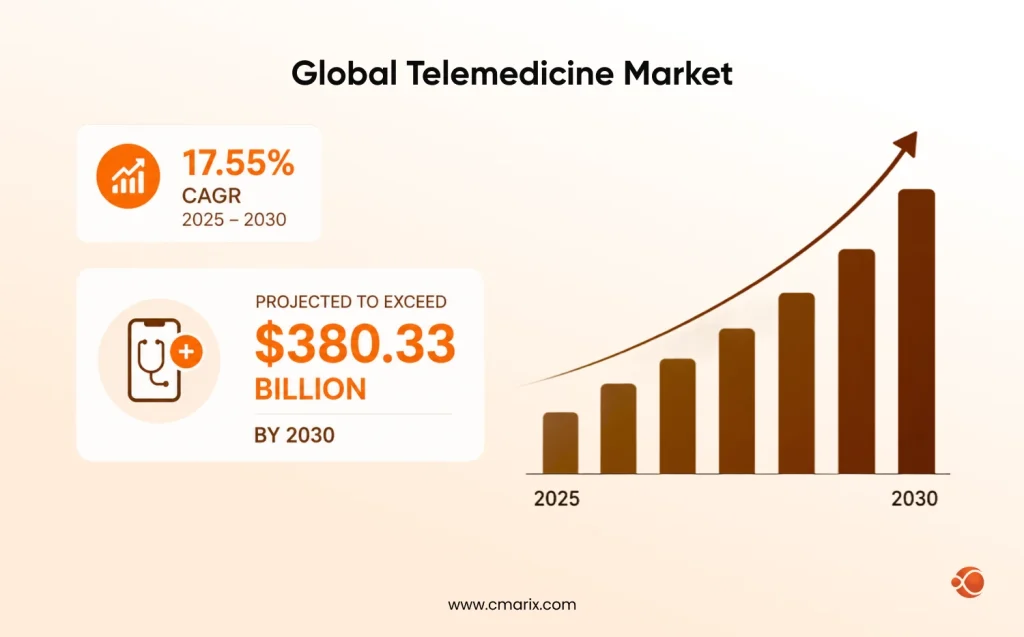
Telehealth stopped being just a nice-to-have a while ago. It’s now the default first step for a huge share of patient interactions. Mental health check-ins, specialist consultations that would otherwise mean a two-hour drive, all of it moved online. The global telemedicine market is projected to exceed $380.33 billion by 2030, with a CAGR of 17.55% from 2025 to 2030. Providers who haven’t built a serious digital front door are already behind.
What Is a Telemedicine App?
A telemedicine app is a digital platform that allows patients and providers to connect remotely for consultations, diagnosis, monitoring, and follow-up care, without requiring a physical visit. This falls under the broader umbrella of telemedicine software development, which includes everything from simple video-call apps to full remote care ecosystems tied into hospital records systems.
Telemedicine apps usually fall into three categories. Synchronous apps handle real-time video or audio consultations. Asynchronous or store-and-forward apps allow patients to submit information for a provider to review later. Remote patient monitoring apps track vitals through connected devices and flag providers when something needs attention. Most serious platforms end up combining at least two of these as they grow, which is part of why cost estimates vary so widely.
Telemedicine App Development Cost by Complexity
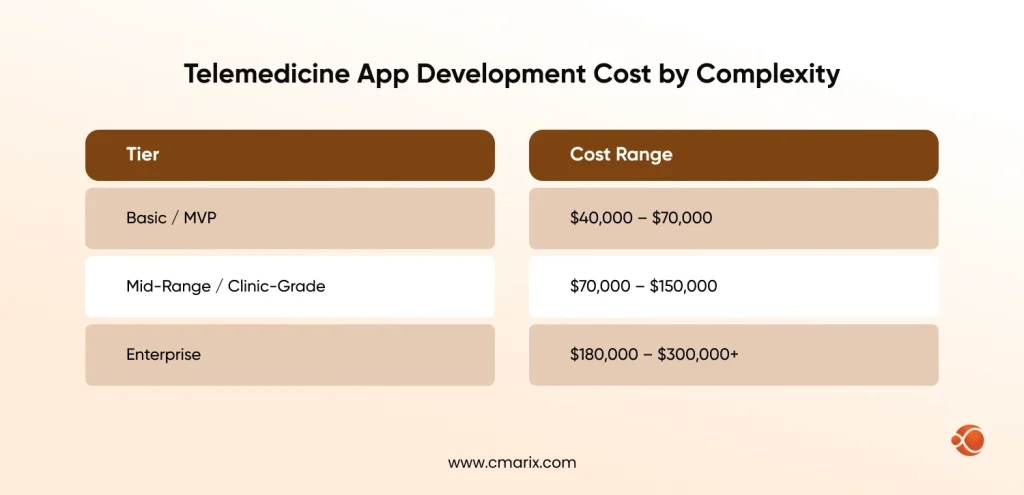
The single biggest driver of cost is how much the app actually does. Here’s how the three common tiers break down:
| Tier | Cost Range | Timeline | What’s Included |
| Basic / MVP | $40,000 – $70,000 | 3–5 months | Patient/doctor profiles, appointment scheduling, video consultations, basic payments |
| Mid-Range / Clinic-Grade | $70,000 – $150,000 | 5–7 months | Multi-provider support, role-based access, prescription management, richer scheduling logic, notifications, secure messaging |
| Enterprise | $180,000 – $300,000+ | 9–12+ months | AI diagnostics, EHR/EMR integration, multi-location support, advanced analytics, full compliance architecture |
Most first-time founders and single-clinic providers land in the MVP tier to validate demand before committing to a larger build. Established healthcare groups and multi-provider practices tend to start in the mid-range tier, since they already know the workflows they need to support.
How Developer Location Affects Telemedicine App Development Cost
This is because of the location where your development team is located, and the costs vary greatly from one provider to another, but generally speaking, the following numbers can be taken as a guide:
| Development Team Location | Cost Impact vs Base Range |
| India | 40-60% lower |
| Eastern Europe | 30-50% lower |
| Western Europe | Baseline to +30% |
| United States | +60-80% |
Not sure which tier fits your use case? Talk to our healthcare team and get a scope-based estimate instead of a generic range.
Telemedicine App Cost by Type
Complexity tier isn’t the only lens. The type of telemedicine app you’re building also shifts the number:
| App Type | Cost Range | Best For |
| Store-and-Forward | $40,000 – $50,000 | Dermatology, radiology, and second-opinion services |
| Real-Time Video Consultation | $75,000 – $150,000+ | General consultations, urgent care, therapy sessions |
| Remote Patient Monitoring | $55,000 – $200,000+ | Chronic disease management, post-surgical follow-up, and elderly care |
The real-time video applications are more expensive than the store-and-forward solutions since they require a robust and low-latency infrastructure that works even under bad network conditions, rather than just a robust application working on a good WiFi connection. The remote monitoring applications have the most extensive coverage since their pricing is very dependent on the number of device integrations needed by the platform.
Telemedicine App Development Cost by Use Case
The tables above cover cost by complexity and by app type, but the same app type can still cost more or less depending on who’s actually using it. Here’s how specific use cases shift the number:
| Use Case | Cost Range | What Pushes the Price |
| Single-provider consultation app | $40,000 – $80,000 | Closest to a standard MVP, minimal coordination logic |
| Multi-provider / clinic platform | $90,000 – $180,000 | Overlapping calendars, patient-to-provider routing, and admin dashboards |
| Mental health and coaching platform | $70,000 – $150,000 | Session continuity features: private messaging, session history, recurring reminders, subscription billing |
| Corporate or insurance-backed telehealth | $150,000 – $300,000+ | Scale, multi-party billing, and compliance reporting across large user bases |
- Multi-provider and clinic platforms cost more than a single-doctor app mainly because of coordination logic. Once more than one provider is on the platform, you need overlapping calendar management, patient-to-provider routing, and admin dashboards to manage it all, and that layer alone can add several weeks to the build even without any advanced medical integrations.
- Mental health and coaching platforms cost more than a one-off consultation app because they’re built around continuity rather than single visits. Private messaging, session history, recurring appointment reminders, and subscription billing tend to be core features rather than nice-to-haves here, since the entire care model depends on an ongoing relationship between patient and provider. If you’re building specifically in this space, our guide on mental health app development covers the feature set in more depth.
Get a scope-based estimate tailored to your care model and compliance needs
HIPAA Compliance Features and Their Cost Impact
This is the section most cost guides gloss over, and it’s usually where budgets get blown. If you’re building for the US market, HIPAA compliance isn’t optional, and it isn’t cheap to bolt on after the fact.
What HIPAA compliance actually requires:
- Encryption from end-to-end for information while transmitting and in its resting place
- (BAA)Business associates agreement with all third-party vendors handling patient information, including your cloud service provider and video conferencing vendor
- Detailed audit logs tracking who accessed what patient data and when
- Role-based access control so staff only see the data relevant to their job
- Secure, HIPAA-compliant messaging (standard chat SDKs generally don’t qualify)
- Data breach notification protocols are built into the system, not handled manually
Feature-level cost add for compliance
Building these requirements in from the start costs less than retrofitting them later, since encryption, audit logging, and access control touch nearly every part of the codebase once bolted on after launch.
| Compliance Element | Estimated Cost Add | When Built In |
| Encryption (transit + at rest) | $2,000 – $6,000 | From the start |
| Audit logging and access control | $3,000 – $8,000 | From the start |
| HIPAA-compliant messaging | $2,000 – $5,000 | From the start |
| BAAs and legal review | $1,500 – $4,000 | From the start |
| Full compliance retrofit | $25,000 – $60,000+ | After launch |
This is one of the clearest arguments for building HIPAA-compliant telemedicine apps from the ground up rather than treating compliance as a later phase.
How to Build a Telemedicine App in 7 Steps
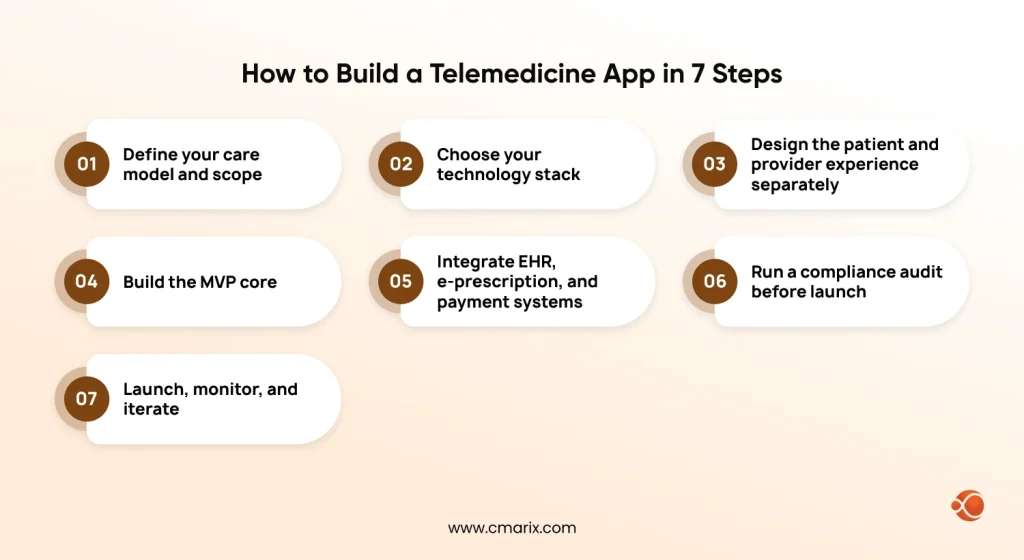
Step 1: Define your care model and scope
Choose between building a system for one-on-one consultations, remote monitoring, or both. It will influence your development process in many aspects, including the architecture of your database and video system. Be more specific about it as well. What a “telemedicine application” should be for a single psychiatrist will differ greatly from what a telemedicine application should be for an urgent care chain.
Being too vague about the scope of work at this stage is the main reason why budgets overrun. Speak with doctors and patients who will use your solution.
Step 2: Choose your technology stack
Pick your backend language, frontend framework, video infrastructure, and HIPAA-compliant cloud provider before design work starts. This decision locks in a lot of what comes after it, so it’s worth spending real time here rather than defaulting to whatever your dev team used on the last project.
Cross-platform frameworks such as Flutter and React Native can be considered for the development of almost all telemedicine apps since development time is saved by about half when compared to having different native codes for Android and iOS. However, using native may be an option if your app relies heavily on the device’s camera or sensors.
Step 3: Design the patient and provider experience separately
Patients need speed and simplicity. They’re often anxious, sometimes unwell, and want to get from “I need to see a doctor” to “I’m in a video call” in as few taps as possible. Providers need something different entirely: scheduling control, dashboards, documentation tools, and quick access to patient history mid-consultation.
Designing both from the same template usually produces a worse experience for one side. In most cases, it’s the provider experience that suffers, and that shows up as low adoption on the clinical side, even if patients love the app.
Step 4: Build the MVP core
Start with profile, scheduling, video visit, and payment functionality. Do not fall for the temptation of including everything in your first iteration, especially if a competing product has that capability or some clients insist on having it included in the app. MVP should be used to validate if the core loop really works in the real world or not.
Do that before you spend money building on top of it. Features like AI diagnostics, remote monitoring, and multi-language support can all wait for phase two.
Step 5: Integrate EHR, e-prescription, and payment systems
This is typically the most technically demanding phase. Every hospital and EHR vendor uses a different system, Epic and Cerner being the two most common, but far from the only ones, and each integration needs its own testing cycle.
E-prescription integration adds its own layer of regulatory requirements around controlled substances. Payment processing for healthcare has compliance considerations beyond standard PCI-DSS. Budget more time here than you think you need.
Step 6: Run a compliance audit before launch
Access logs, encryption, BAAs, and role-based access controls need to be verified against real HIPAA requirements. Don’t assume they’re handled because “the cloud provider takes care of it.” Your cloud host being HIPAA-eligible doesn’t automatically make your app HIPAA-compliant.
How you configure and use that infrastructure matters just as much. This is the step most rushed builds skip, and it’s the one that causes the most expensive problems after launch.
Step 7: Launch, monitor, and iterate
Track usage patterns, fix friction points fast, and plan your maintenance budget from day one rather than after the first support ticket comes in. Pay close attention to where patients or providers drop off in the flow during the first few weeks.
The early churn almost always comes from an identifiable and solvable problem in the form of an awkward booking process or a delayed video call connection. Early churn prevention is much more economical than recovering the users who gave up on the app.
Build compliance from day one instead of paying for a costly retrofit later.
Telemedicine App Features and Cost Checklist
| Panel | Estimated Cost | Core Features |
| Patient Panel | $15,000 – $25,000 | Registration, profile management, appointment booking, video consultations, prescription access, secure messaging, payment history |
| Provider Panel | $12,000 – $20,000 | Schedule management, patient records access, prescription writing, consultation notes, and earnings dashboard |
| Admin Panel | $10,000 – $18,000 | User management, analytics and reporting, payment oversight, content management, support tools |
| Video and Communication Layer | $8,000 – $15,000 | Real-time video (WebRTC or Twilio-based), HIPAA-compliant chat, appointment reminders, and notifications |
Tech Stack for Telemedicine Apps in 2026
- Mobile Framework – React Native or Flutter for cross-platform apps
- Backend – Node.js or Python
- Video Infrastructure – WebRTC or Twilio
- Cloud Hosting – HIPAA-compliant provider such as AWS or Google Cloud
- Web Portal / Admin Dashboard – Needed alongside the mobile build if providers or admins require a browser-based interface; this typically means additional healthcare web development work, since clinical dashboards rarely hold up well as an afterthought on a mobile-first codebase
Hidden Telemedicine App Development Costs to Budget For
| Hidden Cost | Typical Range | Why It Gets Missed |
| Annual maintenance | 15-20% of initial dev cost | Treated as optional instead of being budgeted upfront |
| EHR integration | $10,000 – $40,000+ per system | Assumed to be plug-and-play; it isn’t |
| Ongoing compliance audits | $5,000 – $15,000/year | Seen as a one-time certification instead of recurring |
| Marketing and distribution | Varies widely by market | Budgeted for the build, not for adoption |
A $100,000 app, for example, typically needs $15,000-$20,000 a year in maintenance alone just to stay current, and every hospital system runs different EHR software (Epic, Cerner, and others), so each integration is effectively custom work rather than a plug-and-play connector.
Some of these hidden costs shrink when features are built to interoperate with adjacent healthcare services from the start. For example, platforms that plan for medicine delivery app development integration early avoid a costly rebuild later when patients start asking for prescription fulfillment inside the same app.
Why Choose CMARIX for Telemedicine App Development
| Factor | CMARIX | Typical Competitors |
| Pricing Model | Transparent, scope-based quotes | Often, generic ranges without a scoped breakdown |
| HIPAA/Healthcare Depth | Dedicated healthcare software development practice, GDPR/HIPAA/PIPEDA experience | Varies widely; many treat compliance as an add-on service |
| Engagement Model | Dedicated team with a technical project manager, SCRUM-based delivery | Ranges from freelance-style to large agency overhead |
| Track Record | Built a telemedicine platform that handled 100,000+ consultations in its first month | Case studies often lack specific outcome data |
Most companies publishing telemedicine cost guides are selling a generic estimate. CMARIX has actually shipped telemedicine platforms at scale, including AI-driven diagnostics integration and Conversational AI in healthcare solutions that improve patient engagement and automate routine clinical interactions. HIPAA-aligned builds for international markets. That combination of healthcare domain knowledge and proven delivery is what separates a cost estimate from a working product. Our work extends into adjacent areas, too, including AI telemedicine chatbot development for providers who want to reduce front-line support load, and broader types of healthcare software for organizations planning beyond a single app.
Want a build partner who’s done this before, not just written about it? Explore our mobile app development solutions.
Conclusion
The telemedicine app development cost isn’t a single number. It’s a range shaped by app type, complexity tier, use case, and how seriously you take HIPAA compliance from day one. Budgeting $40,000 for an MVP and $300,000+ for an enterprise platform provides you a starting point. The real planning work is matching that number to your actual care model and compliance requirements before you commit to a build partner. Get the scope right upfront, and the cost stops being a mystery.
FAQs About Telemedicine App Development Cost
What is the average telemedicine app development cost?
The average price for telemedicine software varies from $40,000 to over $300,000. A simple MVP solution that allows conducting video consultations and scheduling starts at $40,000, and an advanced enterprise solution with EHR integration and AI capabilities exceeds $300,000.
What features drive the telemedicine app development cost?
EHR integration, video consultation infrastructure, AI diagnostics, remote monitoring device support, and HIPAA compliance features are the biggest cost drivers. Each additional integration or compliance requirement adds development hours and testing scope.
Does telemedicine app development require compliance?
Yes, if you’re working in the US. HIPAA Compliance is mandatory for any application dealing with patient health information. This includes encryption, auditing, access control, and signing of BAAs with third-party vendors. Building applications for other jurisdictions may require GDPR or PIPEDA compliance.
How long does telemedicine app development take?
The development of MVP takes 3 to 5 months, the mid-range solution will take 5 to 7 months, and the enterprise-level solution can take 9 to 12 months or even more.
How does a developer’s location affect telemedicine app development cost?
Offshore development teams generally cost 40-60% less than US or Western European teams for the same scope of work. Hiring domestically typically adds 60-80% to the cost ranges. Quality depends on the specific vendor rather than location alone.
What ongoing costs should be included in the telemedicine app development cost?
Plan for 15-20% of your initial development cost annually for maintenance, security patches, and server costs. Add ongoing compliance audits, EHR integration updates, and marketing budget, since these recur well beyond the initial launch.