



Quick Summary: The cost to develop an app depends on six main factors: the app’s complexity, the platform used to build it, UI/UX design, the location of the developers, the type of team working on the project, and post-release maintenance.
If you have spent any time looking up how much it costs to build a mobile app, you have already seen everything from $10,000 to $500,000. Both numbers are technically accurate. Neither one is useful without context.
The real cost to develop an app in 2026 is not a fixed price. It is the outcome of six key variables: what your app needs to do, which platform it runs on, how complex the design is, where your developers are located, how your team is structured, and what ongoing obligations the product carries after launch.
At CMARIX, we have built apps across healthcare, fintech, eCommerce, on-demand, and logistics sectors. After delivering 250+ mobile projects globally, the most important thing we have learned is this: projects that get scope right from the start almost always land within budget. Projects that skip discovery almost never do.
This guide is built on that real-world experience, supported by credible market data. It is also designed to sit alongside our dedicated blog on AI app development cost, which covers the additional pricing layer that machine learning, NLP, and generative AI features add on top of standard mobile development. If your project involves AI functionality, start there first and come back here for the foundational build costs.
What Actually Drives App Development Costs in 2026
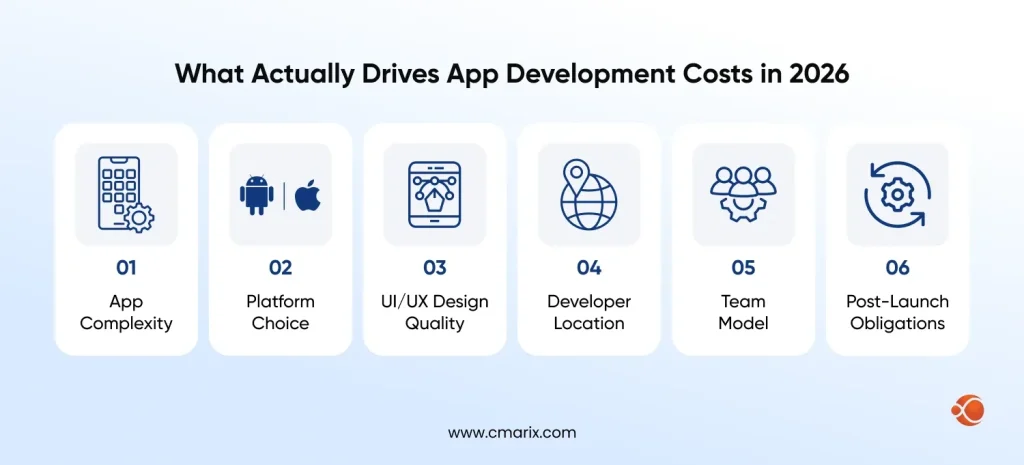
Before looking at any numbers, it helps to understand the levers that every vendor quote is built from. These six factors explain why two apps with the same feature list can have budgets that differ by 300%.
App Complexity
This is the biggest cost driver on its own. The number is irrelevant compared to how technically advanced they are. Building a basic app that lets you log in, view content, and receive push notifications takes 300-500 hours to develop. Building a platform with real-time synchronization, multiple roles, offline support, and integrations may take 2,500-5,000 hours or more.
Platform Choice
Building natively for iOS and Android is essentially two separate projects. Cross-platform frameworks allow a single codebase to serve both at a significantly lower cost.
UI/UX Design Quality
The UI/UX design cost for apps is one of the most misunderstood line items in a development budget. According to research from the Nielsen Norman Group on design ROI, poor UX costs companies far more in retention losses than the premium paid for thoughtful design upfront. Template design versus a fully custom, brand-aligned experience carries a cost spread of $30,000 to $100,000. The cost to design a mobile app falls within that range, depending on animation complexity, the number of unique screens, and whether accessibility compliance is required.
Developer Location
Hourly rates for mobile application development will vary by a factor of 5 or more in 2026, depending on the geography. The senior engineers in North America will charge between $120 and $250 per hour. The same level of expertise in India will charge between $22 and $55 per hour. This geographical difference is one of the strongest budget drivers around.
Team Model
Freelancers, in-house teams, and agencies have costs beyond the hourly rate.
Post-Launch Obligations
The industry standard for annual app maintenance runs at 15 to 25 percent of the original build cost. That figure compounds over the product’s lifetime and is the most commonly ignored budget line.
Get a tailored estimate based on your features and business goals.
App Development Cost by Complexity: 2026 Benchmarks
Below are the ranges derived from experience at CMARIX and validated by market research, including Clutch’s developer pricing range and benchmarks from Statista’s mobile development reports.
| Complexity Level | Typical Features | Build Timeline | App Cost Range |
| Basic App | Login, static content, push notifications, simple backend | 3 to 6 months | $15,000 to $40,000 |
| Mid-Level App | Custom UI, payment gateway, APIs, real-time data, analytics | 6 to 9 months | $40,000 to $120,000 |
| Advanced App | Multi-role users, real-time chat, ML-powered features, complex dashboards | 9 to 12 months | $100,000 to $250,000+ |
| Enterprise App | Cloud-native architecture, GDPR/HIPAA compliance, ERP/CRM integrations, DevOps | 12 to 18+ months | $250,000 to $500,000+ |
It is often the case that the jump from mid-level to advanced comes at an extra cost of about 2x-3x. However, this is due to the introduction of real-time systems, elaborate data architectures, and multi-role permissions, not just the addition of more screens.
Pattern consistently seen at CMARIX: clients usually present a “mid-level” scope that, upon detailed analysis and development of a requirements sheet, turns out to have “advanced” complexity. In 30 minutes of discovery, previously unseen requirements emerge that completely change the budget. For that reason, we make discovery a mandatory initial step instead of a complementary one.
Platform Costs: iOS vs. Android vs. Cross-Platform
iOS App Development Cost
The development cost of an iOS native application written in Swift usually ranges from $30,000 to $250,000. The QA process is quicker on iOS due to Apple Inc.’s unified device ecosystem. There are fewer screen sizes and fewer operating system versions to test.
Nonetheless, there is an actual compliance cost involved with Apple’s App Review Guidelines. The application needs to be natively implemented on all available form factors. Inactive code, dummy functions, or inactive functions will result in the app being rejected. This means additional costs for resubmission rounds.
For businesses considering custom iPhone app development, this review overhead is the most common source of timeline surprises. A first submission that is rejected due to a UI form factor issue typically costs one to two additional weeks and the corresponding developer hours.
To gain a more detailed understanding of what drives iOS prices, the following iOS application development cost analysis provides all the necessary details.
Android App Development Cost
The cost of developing a Kotlin-built Android native app typically ranges from $35,000 to $280,000. Android’s open ecosystem gives more design flexibility, but the platform’s device fragmentation is a real QA cost driver. Testing across the full spectrum of Android device types, screen sizes, and OS versions adds 15-20% more QA hours than iOS for the same feature set.
According to Google’s official Android App Architecture Guidelines, an Android app should include a well-decoupled data layer, a Jetpack Compose-based UI layer, and a domain layer to ensure production quality.
When comparing iOS vs Android development costs directly, Android typically runs 10 to 15 percent higher for a comparable feature set, primarily due to testing and device compatibility overhead. Custom Android app development for regulated industries like healthcare or fintech adds another layer of compliance on top. Our Android app development cost guide breaks this down with specifics on Kotlin versus Java choices and how they affect timeline and budget.
Cross-Platform App Development Pricing: Flutter and React Native
Cross-platform frameworks have become the default choice for most business app projects in 2026. Flutter, developed by Google, and React Native, developed by Meta, both enable a single codebase to run on iOS and Android simultaneously. This cuts frontend engineering hours by 30 to 45 percent compared to maintaining two native codebases.
The cost of cross-platform app development typically ranges from $25,000 to $200,000, making it a more cost-efficient choice than others for MVPs and budget-oriented projects.
Flutter app development cost typically ranges from $30,000 to $180,000, depending on UI complexity, backend integrations, and whether the project requires platform-specific native modules. Flutter has emerged as the dominant framework for projects requiring polished, animation-heavy UIs. BMW Group, eBay Motors, and Google Pay all run production Flutter apps. React Native suits teams with existing JavaScript expertise and web-mobile shared logic needs.
Neither framework is universally better. The right choice depends on your product’s specific requirements. Our team at CMARIX has written a detailed comparison in our cost of Flutter app development guide, covering when each framework makes financial and technical sense.
One key metric worth understanding: properly implemented cross-platform app development solutions can achieve roughly 90 percent of native operational performance at approximately 40 percent of the upfront development cost compared to building separate native apps. That ratio is what makes cross-platform the smart default for most 2026 projects.
Cost to Develop App As Per Development Phase: Where the Money Actually Goes
Budget surprises almost always come from two sources: underestimating backend complexity, or completely ignoring post-launch costs. Breaking the project into phases removes both surprises.
| Development Phase | Budget Share | Approximate App Dev Costs |
| Discovery and Planning | 5 to 10% | $2,500 to $25,000 |
| UI/UX Design | 10 to 20% | $5,000 to $50,000 |
| Frontend Development | 25 to 35% | $10,000 to $125,000 |
| Backend Development | 25 to 35% | $10,000 to $150,000 |
| QA and Testing | 10 to 15% | $5,000 to $50,000 |
| Deployment and Launch | 5 to 10% | $5,000 to $25,000 |
| Year 1 Maintenance | 15 to 25% of build cost annually | $1,500 to $150,000/year |
A surprise for many first-time customers: although the cost of UI/UX design may seem higher because it is visible and costly-looking, in reality, it usually takes less of the total budget than backend development. The average cost of a UI/UX design for a mid-range application is $8,000-$25,000, whereas a complex animation process and accessibility design might cost you $50,000. And it doesn’t matter how beautiful your frontend looks, the backend is where complexity grows quickly.
Quality Assurance is also an area that deserves a call-out in its own right. According to the IEEE Software Engineering Body of Knowledge, QA accounts for 20-25% of total development time. At a combined agency rate of $100- $150 per hour, QA costs between $10,000 and $37,500 for an average-complexity project build.
How Developer Location Affects Your Total App Budget
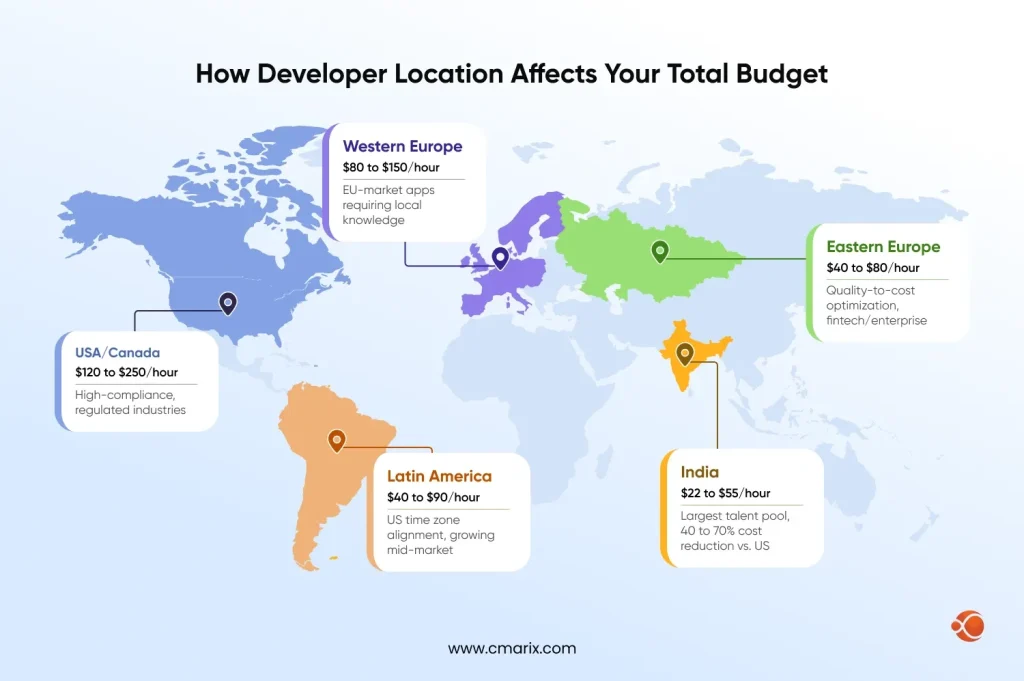
Geographic rate differences are among the most actionable budget levers in app development. The table below shows mobile app development hourly rates in 2026 by region, based on Clutch’s published developer rate data and our own hiring experience at CMARIX:
| Region | Hourly Rate Range App Developers | Best Suited For |
| USA / Canada | $120 to $250/hour | High-compliance, regulated industries |
| Western Europe | $80 to $150/hour | EU-market apps requiring local knowledge |
| Eastern Europe | $40 to $80/hour | Quality-to-cost optimization, fintech/enterprise |
| India | $22 to $55/hour | Largest talent pool, 40 to 70% cost reduction vs. US |
| Latin America | $40 to $90/hour | US time zone alignment, growing mid-market |
Offshoring can reduce the total project cost by 40% to 70%. If a US agency proposes to do the same work for $150,000, the cost in India will be between $55,000 and $80,000.
The key differentiator is the partner’s quality. Cost reductions become a reality only when the offshore team has delivery mechanisms in place, effective communications, and experience in your business sector. Without these factors, the cost reductions disappear due to rework and delays.
At CMARIX, our development center in India gives clients access to senior engineers, architects, and QA specialists at competitive rates, with the delivery standards and communication transparency that global clients expect. Our blog on offshore app development covers what to look for in an offshore partner and how to avoid the common pitfalls.
The Costs Nobody Budgets For
These are the line items that routinely push first-year app costs 25 to 35 percent above the development quote. They are not intentionally hidden by vendors. They are simply easy to overlook during planning.
App Store Registration and Commission Fees
The cost of using developer accounts is set at $99 per annum by Apple and $25 once-off by Google. The platforms charge a commission rate between 15 percent and 30 percent of all in-app payments. Subscription app creation costs go beyond the build cost, as there is an additional income cut that needs to be considered when planning a pricing strategy prior to launch, not when the first payment is made. The monthly subscription of $9.99 becomes in reality $7 to $8.49 after the commission.
App Maintenance and Hosting Costs
Early-stage app infrastructure on AWS, Azure, or Google Cloud starts at $50 to $300 per month. As the user base scales, app maintenance and hosting costs move to $2,000 to $10,000 per month or more. Most initial budgets underestimate this by a factor of three to five. Our cloud application development guide covers how to architect for cost-efficient scaling from the start.
Compliance and Regulatory Costs
Healthcare apps need HIPAA compliance verification. The Health Insurance Portability and Accountability Act remarks that implementing the necessary technical security controls would cost between $20,000 and $100,000 annually. GDPR compliance for apps used in the EU market entails $5,000 to $15,000 per year in consent management infrastructure costs. Financial apps need PCI DSS certification.
Third-Party API and Service Costs
All payment processing, maps, SMS verification, push notifications, and analytics have usage-based pricing directly related to the number of users. Mobile applications are usually started on free APIs and reach premium limits sooner than expected.
Scope Change Buffer
In a survey conducted by the Project Management Institute, roughly 52% of projects experience scope changes once development begins. It is quite normal for seasoned professionals to allow a 20 to 25 percent buffer when formulating an initial budget.
What You Pay After Launch: Annual Maintenance Costs
App development doesn’t stop at release to production; app maintenance is another area that is grossly underappreciated in budgets.
The industry standard runs at 15 to 25 percent of the original development budget annually. For a $100,000 app, that is $15,000 to $25,000 per year just to keep the product functional, secure, and up to date. IBM’s Cost of a Data Breach Report 2025 estimates the average global cost of a data breach at $4.4 million, making security maintenance one of the highest-ROI investments a product team can make.
Here is what that annual maintenance budget covers:
- Bug Fixes and Crash Resolution. Real-world usage surfaces edge cases that pre-launch testing misses. A meaningful portion of Year 1 maintenance budget goes to resolving production issues that simply could not be anticipated before actual users interacted with the app at scale.
- OS Compatibility Updates. Apple and Google each release major OS versions annually. Apps that are not updated for compatibility begin to malfunction and lose visibility in the App Store. This is not optional maintenance.
- Security Patches. External libraries, authentication services, and data layer components need to be maintained. Patching always proves to be cheaper than being breached.
- Feature Iteration. User feedback, competitive changes, and business model shifts generate a steady stream of small feature additions. This is not scope creep. It is the normal lifecycle of a product that is actually being used.
By app type, annual maintenance costs break down roughly as follows:
| App Type | Estimated Annual Maintenance Costs |
| Simple utility app | $5,000 to $10,000/year |
| Mid-complexity app (eCommerce, on-demand) | $10,000 to $50,000/year |
| Enterprise or compliance-heavy app | $50,000 to $150,000+/year |
Cost by App Category: Real-World Benchmarks
Different industries carry predictably different price tags due to their regulatory requirements, integration complexity, and user experience expectations.
| App Category | Estimated Cost to Build App By Category |
| Utility / tool app | $15,000 to $40,000 |
| eCommerce app | $40,000 to $250,000 |
| On-demand delivery app | $50,000 to $150,000 |
| Healthcare / telemedicine app | $80,000 to $300,000+ |
| Fintech / payments app | $100,000 to $500,000+ |
| Social / community app | $60,000 to $250,000 |
| SaaS platform (web + mobile) | $50,000 to $300,000+ |
| Enterprise app with ERP/CRM | $150,000 to $500,000+ |
Both fintech and healthcare always lead these numbers. Not due to their size, but simply due to compliance frameworks such as PCI DSS and HIPAA, which entail additional engineering, documentation, and verification efforts not present in commodity applications.
Four Strategies That Actually Reduce Costs Without Cutting Quality
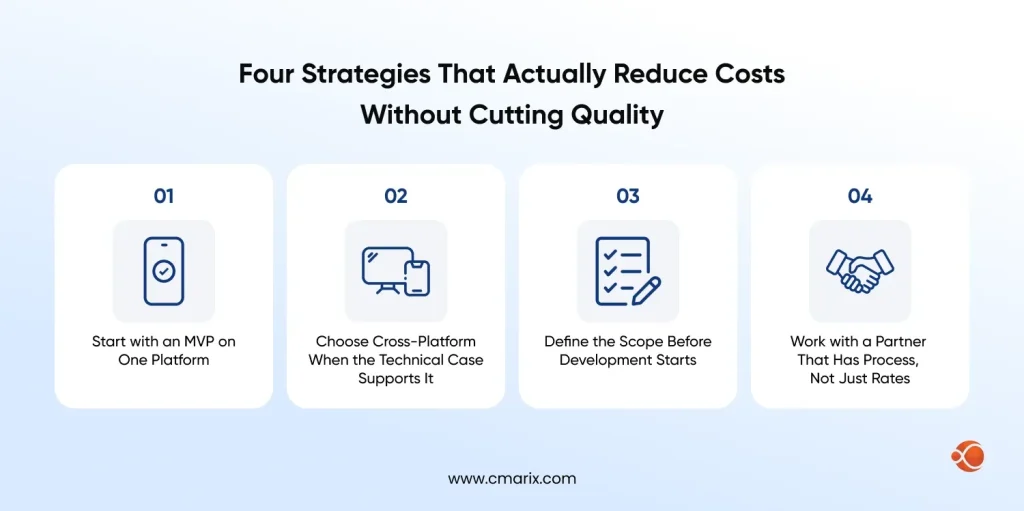
These approaches are not theoretical. They are what CMARIX recommends based on project outcomes across hundreds of mobile builds.
- Start with an MVP on One Platform. The cost to build a mobile MVP on a single platform typically runs 40 to 60 percent less than a full dual-platform launch. Validating core assumptions on one platform before expanding is the most consistent path to budget efficiency. Building for iOS and Android simultaneously doubles early-stage risk. Most successful apps launch on one platform, gather real usage data, and scale from evidence rather than assumptions. Our blog on hybrid MVP app development explains why this approach is particularly effective for startups.
- Choose Cross-Platform When the Technical Case Supports It. If you’re not developing a hardware-heavy app using ARKit, secure enclaves for biometrics, or integrating deeply with IoT devices, going cross-platform can reduce frontend costs for 80% of applications by up to 45%. The critical factor is “if the technical case is right.” There will always be some hardware-heavy apps that need to be native in 2026.
- Define the scope before development starts. Scope Creep is the surest way to make a $60,000 project worth $120,000. Having a clearly defined feature list with accepted requirements and change orders to add new requirements keeps all estimates honest. It serves both the client and the developers.
- Work with a Partner That Has Process, Not Just Rates. The true rate gap of 40%-70% between developers from the United States and those in India is real. However, such savings become visible only if there is a process that facilitates effective communication and monitoring of projects. Otherwise, the gap disappears instantly due to rework.
Discuss your idea with our experts and receive a transparent project estimate.
How CMARIX Approaches App Development Budgets
We provide mobile app development services in all types of apps on iOS, Android, and cross-platform platforms, ranging from MVPs to enterprise solutions. Our customers are companies in healthcare, financial technology, e-commerce, logistics, and education sectors, in which accurate estimates of cost and scope are vital for more reasons than just budgeting.
Our approach to budget conversations is transparent by default. We do not provide a number until we have done a proper discovery. That is not a delay tactic. It is the only honest way to scope mobile development. A scoped discovery session typically halves the uncertainty range in a client’s budget estimate.

The Bottom Line
Building a mobile app in 2026 is not as opaque as many pricing guides make it seem. The cost to develop an app comes down to six variables that any credible vendor quote is built from: complexity, platform, design, developer location, team model, and post-launch obligations.
This is a great starting point for analyzing quotes, setting budget expectations, and making an informed choice about the platform you use. A good software vendor will always be open to explaining the logic behind their quotation line by line.
FAQ About App Development Costs
What is the average price range to build a mobile app?
The realistic range in 2026 is $15,000 for a basic single-platform MVP to $500,000 or more for a complex enterprise application. Most business apps with user accounts, payment processing, and API integrations land between $40,000 and $120,000.
How do platform choices affect the budget?
Building natively for both platforms, iOS and Android, is effectively two parallel projects, costing 60 to 70 percent more than a single cross-platform build. Flutter and React Native reduce total cost by 30 to 45 percent and are the recommended starting point for most new 2026 apps.
What are the primary cost drivers during development?
These four are the most important factors. The complexity of the backend – APIs, databases, real-time data-handling systems – usually accounts for 25% to 35% of the overall development cost.
How does developer location impact cost?
Great. Highly qualified engineers from the US have an hourly rate of $120-$250. In India, one would pay between $22 and $55 for similar skill sets. Offshoring could reduce total project costs by 40% to 70%. It depends on the partner how effectively these cost savings are achieved.
Are there ongoing costs after launch?
Yes, and they are considerable. Plan on paying 15% to 25% of your original development budget each year in maintenance costs, plus anywhere from $50 up to $5,000 each month in hosting costs, which is dependent on the number of users, App Store costs, etc. Maintenance in the first year could be as high as 50% of the original development cost.
How can I lower costs without sacrificing quality?
Release of the product using the MVP shall be done on a single platform. This will be done unless there are any special reasons to consider cross-platform development. It is necessary to define the scope before embarking on development. The offshore partner who is known to complete projects shall be selected.