



Key Takeaways
- FinTech app development costs in 2026 range from $25,000 for an MVP to $600,000+ for enterprise banking platforms.
- App type, features, compliance, development team, and third-party integrations are the biggest cost drivers.
- Building a compliant FinTech app typically takes 3–14 months, depending on project complexity.
- Maintenance, security updates, and regulatory compliance add ongoing costs beyond the initial development budget.
- Strategic planning, cross-platform development, and experienced FinTech partners help optimize costs without compromising quality.
Every fintech founder begins their journey with one major query: how much money will they have to spend developing a fintech application? According to a report released by Mordor Intelligence, the global FinTech market size is expected to reach US$652.80 billion by 2030, rising at a CAGR of 15.27% during the forecast period (starting from 2025).
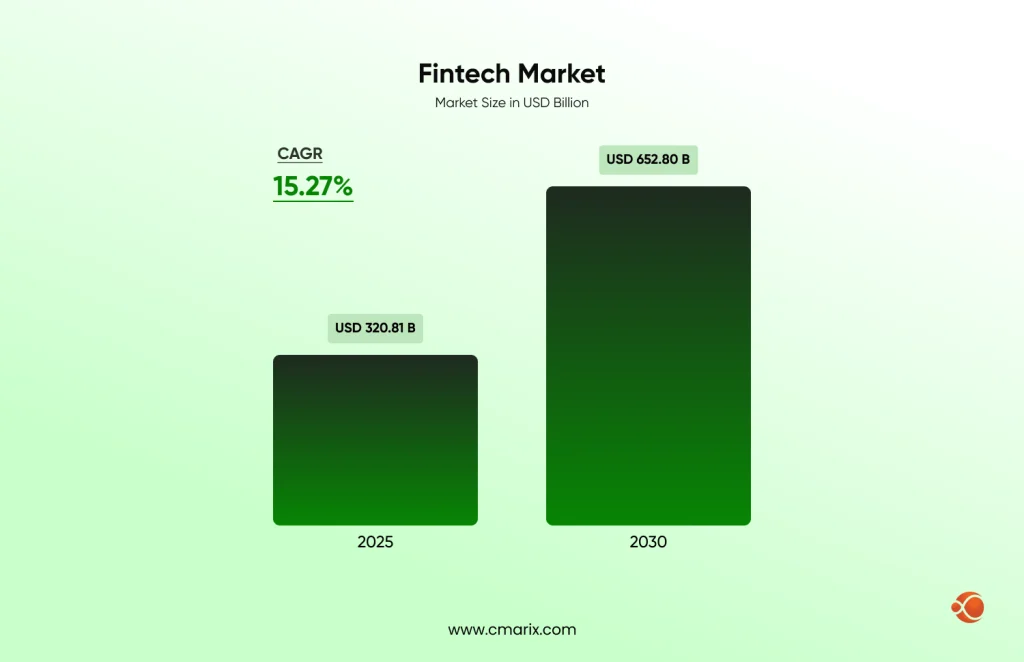
The digital payment segment holds the highest share in this growth rate, accounting for 46.2%. This fintech app development cost guide is designed to provide you with all you need to know on this topic.
What Determines Fintech App Development Cost
The cost required for developing a fintech application is influenced by six major factors. Application type plays a primary role here, because a personal finance manager requires much less investment compared to a full-fledged bank solution. Features complexity becomes the next biggest factor in this regard. AI-driven fraud detection and payment processing solutions require more resources than plain dashboard applications.
Compliance with regulatory requirements, such as PCI DSS and KYC/AML, requires additional effort from software engineers, which non-fintech applications do not require. Team location influences the rate per hour, and technology stack choice affects the development process and future maintenance. To get a bigger picture of these factors, you can refer to CMARIX’s comprehensive app development cost benchmarks covering the same six factors.
Evidence from public markets supports the significance of the variables discussed above in the current context. Listed FinTech companies such as Adyen, Nubank, and Robinhood have taken the industry’s total market capitalization to an all-time high of $850 billion. Later rounds of financing are being focused on incorporating AI technology and digital assets. Emerging applications need to demonstrate deep technologies to even get venture funding.
Get a tailored development estimate based on your business goals.
Fintech App Development Cost As Per Type of Application
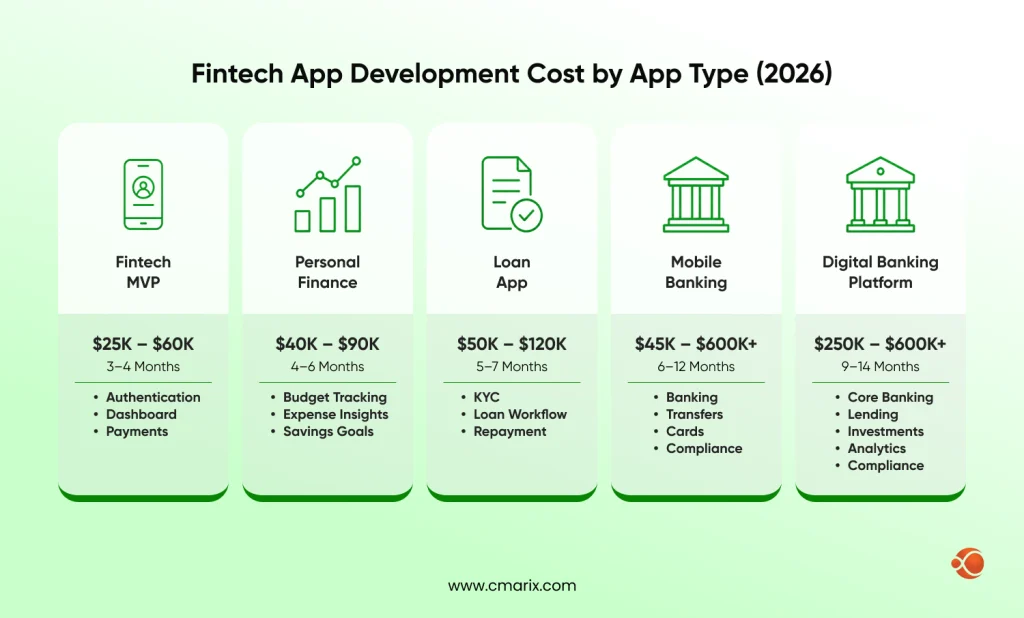
Fintech app development cost varies widely depending on what you are building. The table below breaks down typical ranges for 2026.
| App Type | Typical Cost Range (USD) | Timeline | What You Get |
| Fintech MVP | $25,000 – $60,000 | 3–4 months | Core user authentication, onboarding, account dashboard, basic transactions, payment integration, and an MVP-ready architecture. |
| Personal Finance App | $40,000 – $90,000 | 4–6 months | Budget tracking, expense categorization, bank account aggregation, savings goals, spending insights, and personalized notifications. |
| Loan App | $50,000 – $120,000 | 5–7 months | User onboarding, KYC, loan applications, eligibility checks, document uploads, repayment schedules, and payment gateway integration. |
| Mobile Banking App | $45,000 – $600,000+ | 6–12 months | Secure banking features, account management, fund transfers, bill payments, card controls, biometric authentication, alerts, and regulatory compliance. |
| Full Digital Banking Platform | $250,000 – $600,000+ | 9–14 months | End-to-end digital banking ecosystem with customer onboarding, core banking integration, lending, payments, cards, investment services, admin portal, analytics, security, and compliance. |
The cost of developing a personal finance application is on the lower side due to its lack of significant compliance requirements. The cost of a banking application will start increasing significantly once KYC, fraud detection, and multi-currency support are added to the list of features. A detailed guide on how to develop a mobile banking application is provided in the CMARIX cost calculator section.
Fintech App Development Cost Breakdown As Per Development Phase
Every fintech app development cost estimate breaks down into distinct phases, and each phase carries its own share of the total budget. Understanding this split helps you spot a lowball quote before you sign a contract.
| Development Phase | Share of Total Budget | What It Covers |
| Discovery & Planning | 5–10% | Requirements, compliance scoping |
| UI/UX Design | 10–15% | Wireframes, prototypes, testing |
| Backend Development | 30–40% | APIs, databases, security layer |
| Frontend & Mobile Development | 25–35% | iOS, Android, web interfaces |
| QA & Security Testing | 15–20% | Functional, penetration, compliance testing |
| Deployment & DevOps | 5–10% | Cloud setup, CI/CD, launch support |
Notice that QA and security testing take a larger share here than in a typical consumer app build. Financial applications cannot ship with the same bug tolerance as a social app, and that stricter bar shows up directly in the invoice.
Average Developer Hourly Rates by Region
The team’s location affects the total cost of of fintech app development is more than most other factors. The following table provides information about the average blended hourly rate charged by experienced fintech teams in 2026.
| Region | Hourly Rate (USD) | Best For |
| United States | $100 – $200 | Regulated builds |
| United Kingdom & Western Europe | $70 – $150 | EU compliance |
| Eastern Europe | $40 – $80 | Mid-budget builds |
| India & Southeast Asia | $25 – $50 | Cost-efficient MVPs |
| Latin America | $35 – $70 | US timezone overlap |
Just the rate cannot dictate the overall cost of developing a fintech application. A lower hourly rate,, coupled with no PCI DSS and KYC knowledge,, can end up being expensive because there will be extra hours due to errors.
Team Roles You Need to Budget For
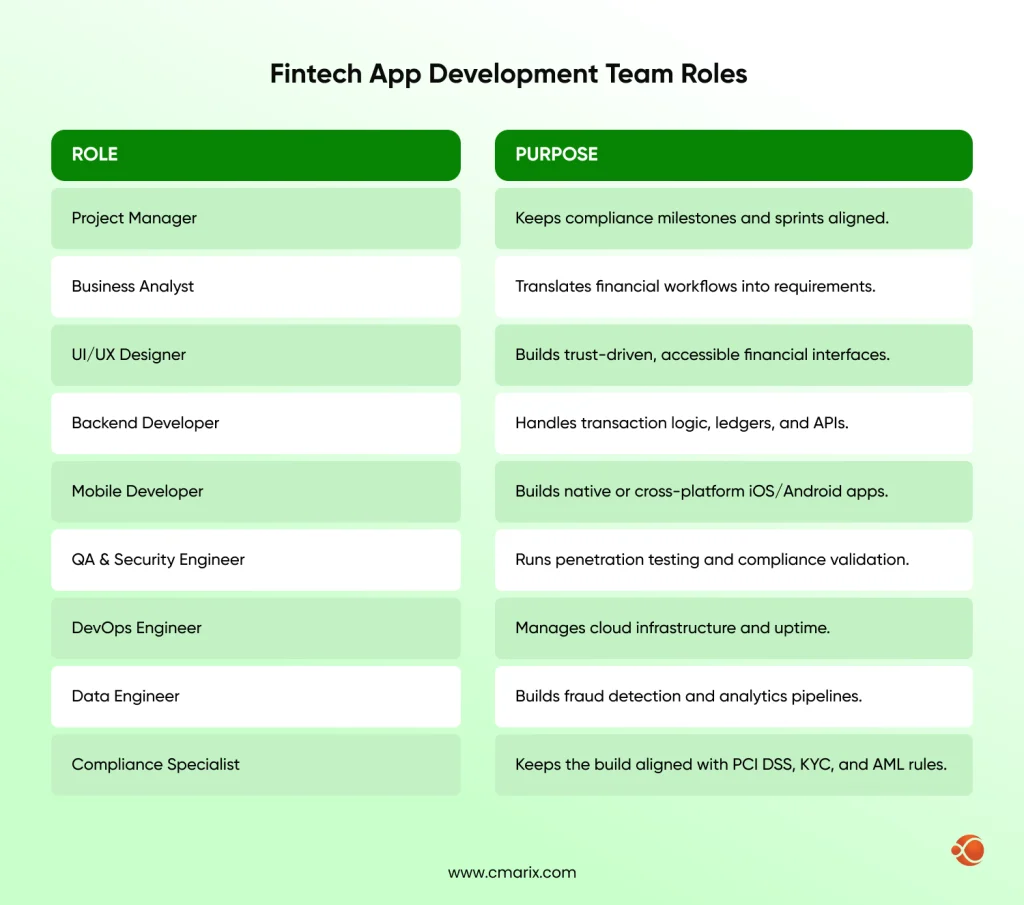
A compliant fintech build needs more than developers. Budgeting only for engineers is one of the fastest ways to underestimate financial app development cost.
| Role | Estimated Cost Range (USD) | Why the Budget Needs It |
| Project Manager | $8,000 – $20,000 | Keeps compliance milestones and sprints aligned |
| Business Analyst | $6,000 – $18,000 | Translates financial workflows into requirements |
| UI/UX Designer | $8,000 – $20,000 | Builds trust-driven, accessible financial interfaces |
| Backend Developer | $25,000 – $80,000 | Handles transaction logic, ledgers, and APIs |
| Mobile Developer | $20,000 – $70,000 | Builds native or cross-platform iOS/Android apps |
| QA & Security Engineer | $10,000 – $30,000 | Runs penetration testing and compliance validation |
| DevOps Engineer | $8,000 – $25,000 | Manages cloud infrastructure and uptime |
| Data Engineer | $12,000 – $40,000 | Builds fraud detection and analytics pipelines |
| Compliance Specialist | $8,000 – $30,000 | Keeps the build aligned with PCI DSS, KYC, and AML rules |
Feature-by-Feature Fintech App Development Cost Breakdown
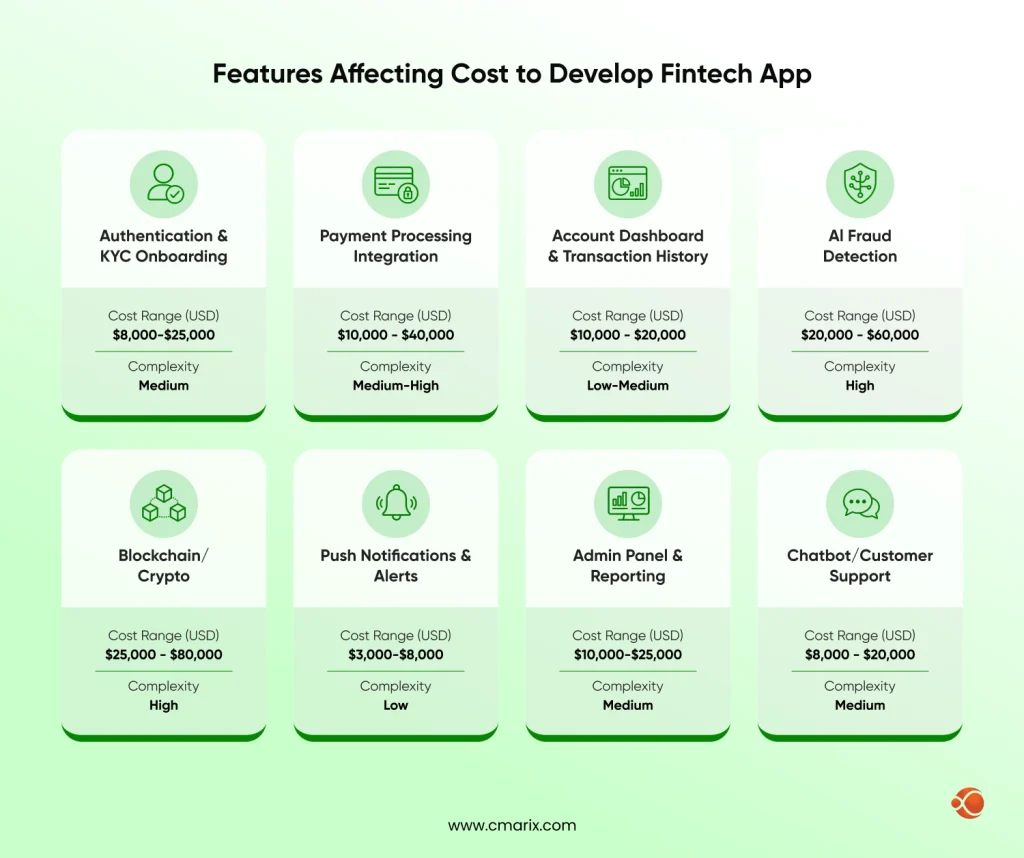
Core features like user authentication, account dashboards, and basic transaction history make up the baseline of any fintech mobile app development cost estimate. Advanced features change the number substantially. The table below breaks down individual feature costs so you can build your own estimate line by line.
| Feature | Cost Range (USD) | Complexity |
| Authentication & KYC Onboarding | $8,000 – $25,000 | Medium |
| Payment Processing Integration | $10,000 – $40,000 | Medium-High |
| Account Dashboard & Transaction History | $10,000 – $20,000 | Low-Medium |
| AI Fraud Detection | $20,000 – $60,000 | High |
| Blockchain / Crypto Wallet | $25,000 – $80,000 | High |
| Push Notifications & Alerts | $3,000 – $8,000 | Low |
| Admin Panel & Reporting | $10,000 – $25,000 | Medium |
| Chatbot / Customer Support | $8,000 – $20,000 | Medium |
The use of AI and Machine Learning is currently present in almost all aspects of the competitive fintech application. These include fraud detection, personal spending pattern analysis, and automation of the document-checking process for Know Your Customer. CMARIX’s manual on AI application in banking talks about these uses of AI and how they are usually defined, while the technical manual on ML implementation discusses where ML costs the most engineering effort.
Blockchain inclusion is yet another major cost factor. The creation of tokenized assets, smart contracts, and stablecoin rails necessitates specialized development. Stablecoin rails for global settlements have increased to $970 billion per month, and that’s a sure indicator that blockchain rails are no longer optional but essential to the future of financial technology. It’s imperative to evaluate blockchain application development costs before making the final budget for this set of features.
The framework selection also influences the bill. For cross-platform frameworks such as Flutter, the build process is faster because the framework uses a common codebase for iOS and Android builds, something that CMARIX has observed while working with Flutter for fintech startups that need to move fast without doubling their engineering team size.
Third-Party Integrations and API Costs
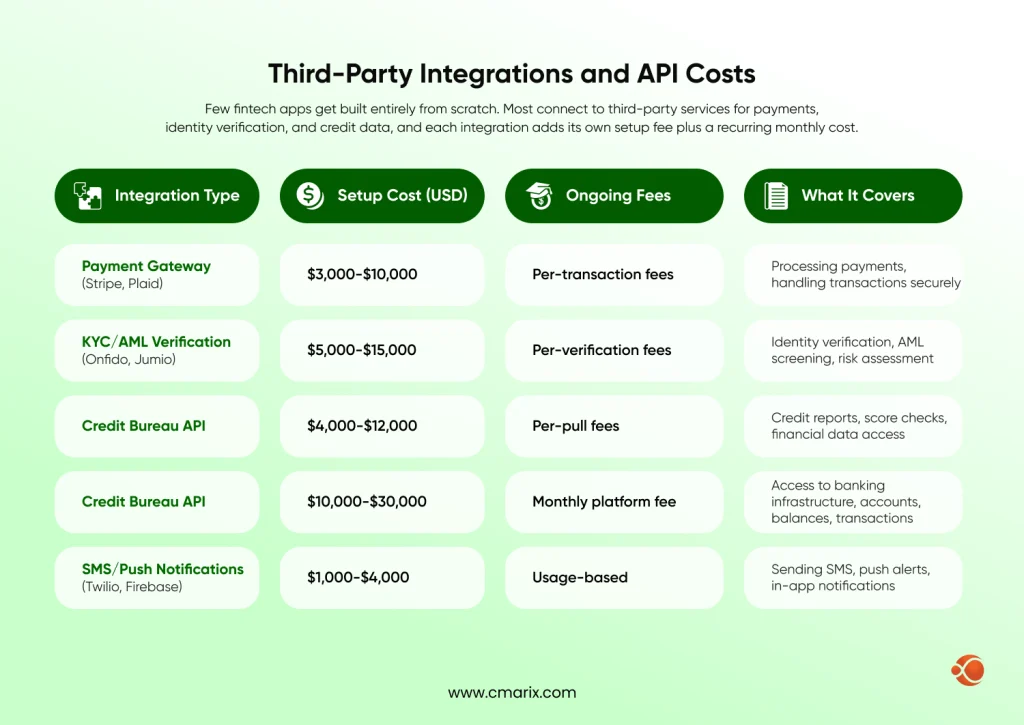
Few fintech apps get built entirely from scratch. Most connect to third-party services for payments, identity verification, and credit data, and each integration adds its own setup fee plus a recurring monthly cost.
| Integration Type | Setup Cost (USD) | Ongoing Fees |
| Payment Gateway (Stripe, Plaid) | $3,000 – $10,000 | Per-transaction fees |
| KYC/AML Verification (Onfido, Jumio) | $5,000 – $15,000 | Per-verification fees |
| Credit Bureau API | $4,000 – $12,000 | Per-pull fees |
| Core Banking API | $10,000 – $30,000 | Monthly platform fee |
| SMS/Push Notifications (Twilio, Firebase) | $1,000 – $4,000 | Usage-based |
These fees rarely appear in an initial development quote, which is why the final invoice often surprises first-time fintech founders. Scoping every integration up front keeps the fintech app development cost estimate honest.
Regulatory Compliance and Its Cost Impact
Compliance is the number one silent factor that determines the cost of developing a fintech app. The PCI DSS compliance app cost is normally estimated at a markup of between 10-20% of the baseline build cost, depending on how much direct access cardholder data the app uses.
| Compliance Requirement | Typical Cost (USD) | Recurrence |
| PCI DSS Certification | $15,000 – $50,000 | Annual audit |
| SOC 2 Type II Audit | $20,000 – $60,000 | Annual |
| GDPR / CCPA / DPDP Compliance | $10,000 – $30,000 | One-time + updates |
| State Money Transmitter License (US) | $5,000 – $500,000+ | Per state, annual renewal |
| Penetration Testing | $8,000 – $25,000 | Semi-annual |
The World Bank’s Fintech and the Future of Finance research documents how fintech regulation varies across nearly 200 jurisdictions worldwide. That variance is exactly why compliance scoping needs to happen before development starts, not after. Skipping this step is the most common reason fintech budgets blow past their original estimate. Money transmitter licensing deserves particular attention, since costs scale directly with how many US states your app plans to operate in.
In-House vs Outsourced vs Dedicated Team
How you staff the build changes fintech app development cost as much as any feature decision. Three models dominate the market, and each carries a different cost and risk profile.
| Model | Cost Impact | Best Fit For |
| In-House Team | Highest fixed cost, salaries plus benefits | Well-funded enterprises |
| Freelance Contractors | Lowest upfront cost, highest risk | Small, non-critical features |
| Dedicated Agency Team | Mid-range cost, compliance experience included | Most fintech MVPs and platforms |
The dedicated team approach seems to have an advantage when developing a regulated fintech solution. This approach does not require hiring full-time staff and provides a founder with immediate access to developers familiar with PCI DSS and KYC processes.
Hidden Costs: Fintech App Maintenance
Fintech application maintenance costs are not always appropriately considered in the planning stage. According to industry standards, the annual cost of maintenance is 15-25% of the cost of building it, while fintech applications tend to be located on the upper side of the scale due to continuous compliance renewals.
| Maintenance Item | Annual Cost (USD) | Frequency |
| Cloud Hosting & Scaling | $6,000 – $40,000 | Ongoing |
| Security Patching & Monitoring | $8,000 – $25,000 | Ongoing |
| Compliance Renewals | $10,000 – $40,000 | Annual |
| Third-Party API Fees | $5,000 – $30,000 | Ongoing |
| Customer Support | $10,000 – $50,000 | Ongoing |
| App Store Compliance Reviews | $1,000 – $5,000 | Per release |
A founder who budgets only for launch, without planning for year-two maintenance, makes the most common fintech budgeting mistake CMARIX sees.
Sample Budget Breakdown of Fintech MVP App Dev Project
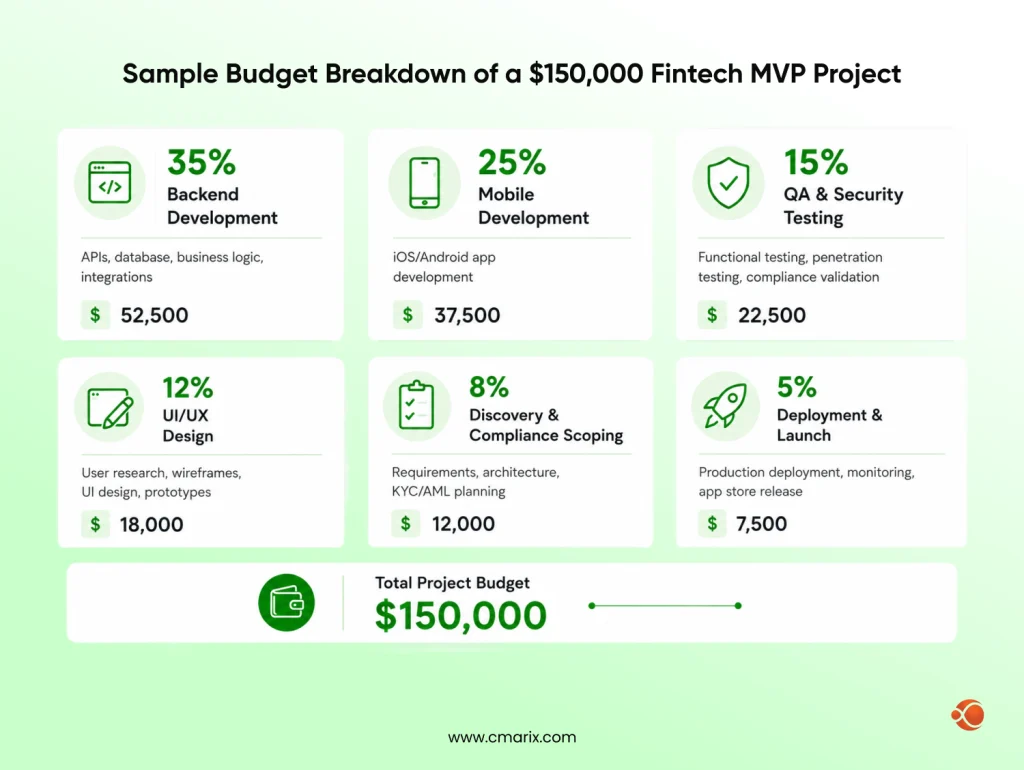
Numbers land better with a real scenario. Here is how a $150,000 fintech MVP budget typically splits across categories.
| Budget Category | Allocation | Approximate Cost (USD) |
| Discovery & Compliance Scoping | 8% | $12,000 |
| UI/UX Design | 12% | $18,000 |
| Backend Development | 35% | $52,500 |
| Mobile Development | 25% | $37,500 |
| QA & Security Testing | 15% | $22,500 |
| Deployment & Launch | 5% | $7,500 |
This split assumes a mid-range team split between Eastern Europe and India rates, with PCI DSS scoped in from day one. Shifting entirely to US-based talent could push the same scope past $350,000.
How Long Does Fintech App Development Take
The timeframes for creating a fintech mobile application vary from three months for an MVP version to more than one year for a full-fledged banking solution. Compliance efforts prolong most project timetables because audits and approvals cannot be done hurriedly, risking a failed rollout in the end. Teams that start working on their compliance requirements in advance manage to meet their deadlines much more easily.
How to Reduce Fintech App Development Cost Without Cutting Corners
- Cutting corners on security or compliance always costs more later. These strategies lower fintech app development cost without touching either one.
- Launch with a minimalist MVP addressing one particular financial issue, then expand once the concept is validated by real users.
- Develop a cross-platform app using Flutter rather than designing separate iOS and Android apps from scratch.
- Adopt a third-party KYC and payments platform rather than develop your own fraud detection and identity verification tools.
- Determine compliance needs during the discovery stage rather than after conducting a security audit, which will require a re-build.
- Select a dedicated development team operating in a medium-cost location rather than paying premium prices to Western developers.
Every one of these choices trades cost for a specific tradeoff. A good technical partner will walk through each tradeoff with you before you commit a budget.
Why Choose CMARIX for Fintech App Development
CMARIX has spent years building compliant, scalable fintech applications for founders who need a technical partner that already understands banking-grade security.
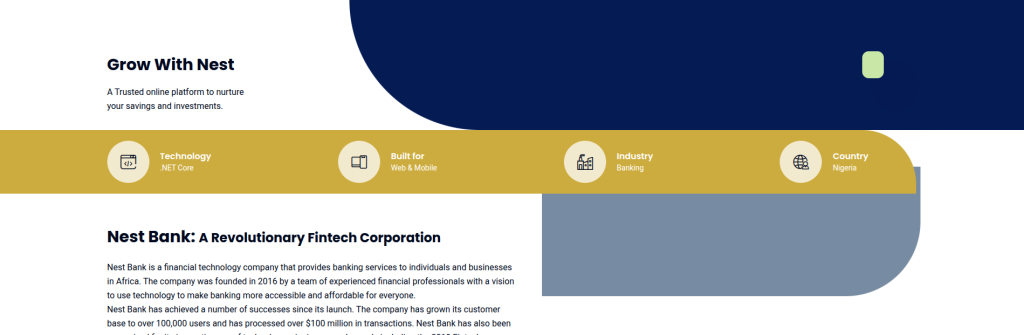
Nest Bank – an online banking portal developed by CMARIX for web and mobile – is just one of the tangible proofs of their capabilities: real account creation, money transfer, and investment services deployed for a real bank.
The team consists of dedicated app developers skilled in Flutter, React Native, and native iOS and Android, as well as data engineers who create the pipeline for fraud detection and analytics required by today’s financial apps.
CMARIX offers custom banking software development services as well as a specialized FinTech software development service that encompasses all aspects of banking from architecture to compliance sign-off.
Founders exploring feature ideas before scoping a budget can also browse CMARIX’s fintech app ideas to launch, and teams that already know they want a full build can revisit the step-by-step build a fintech app guide for the end-to-end process.
From MVPs to enterprise banking platforms, CMARIX delivers secure, scalable fintech software.
Final Thoughts
Fintech app development costs will rise further with the integration of AI and blockchain capabilities. Fintech founders who plan ahead for compliance requirements, team structure, and third-party integrations won’t be caught by surprise by unforeseen costs that hit other fintech startups. Speak with CMARIX about getting a comprehensive cost breakdown of your fintech app concept.
FAQs on Cost to Build a Fintech Application
How much does it cost to build a FinTech app?
Most fintech apps cost between $25,000 for a lean MVP and $600,000+ for a full digital banking platform. The exact number depends on feature complexity, compliance scope, and team location.
What major factors influence overall financial app development costs?
App type, feature complexity, regulatory compliance, team location, and technology stack are the five biggest cost drivers behind any financial app development cost estimate.
How much does it cost to build a personal finance app versus a banking app?
A personal finance app development cost typically runs $40,000 to $90,000. A banking app development cost climbs to $45,000-$600,000+ once compliance and security requirements enter the scope.
How long does the fintech mobile app development process take?
Fintech mobile app development typically takes three to four months for an MVP and nine to fourteen months for a full banking platform, largely due to compliance and security work.
Why does regulatory compliance increase fintech budgeting?
The cost of complying with PCI DSS, compliance app development, KYC modules, and AML monitoring is all based on specific software engineering efforts that would not be necessary for any other app.
What hidden expenses are part of fintech app maintenance costs?
fees, and server scaling. These typically run 15-25% of the original build cost every year, and CMARIX’s comprehensive app development cost benchmarks show how that ratio compares across other app categories.
How does developer location change your overall engineering budget?
Fees charged by software developers differ by geographic location greatly. Development teams from inexpensive regions can build the same compliance-level fintech solution for a fraction of what Western agencies will charge.
What are the must-have features of a high-performing FinTech app?
Secure login, live transaction processing, fraud detection, onboarding with KYC, and a scalable API layer are the basic features that any successful fintech app should have.
What is the cheapest way to build a fintech MVP?
The most inexpensive way to create a fintech MVP is to combine a minimum number of features, use cross-platform technologies such as Flutter, purchase a KYC solution, and hire an outsourced team in a moderate-cost country.
Should I outsource fintech app development or hire in-house?
Most founders get the best cost-to-risk ratio from a dedicated outsourced team. In-house teams make sense once transaction volume justifies full-time compliance and security headcount.
Does a fintech app need a money transmitter license?
Any app that moves or holds customer funds directly typically needs a money transmitter license in every US state where it operates, which can add $5,000 to $500,000+ to the budget.