




Quick Summary: Africa’s fintech race is moving at full speed, and the startups winning are the ones shipping secure, fast, and mobile-first payment apps that users can trust instantly. This blog breaks down why Flutter has become the framework powering Africa’s next fintech wave, from digital banks and BNPL apps to cross-border payments and super apps handling millions of day-to-day transactions.
The market is huge, constraints are real, and the users cannot tolerate any delays or failures within the app. African fintechs span 40+ nations and provide services through budget Android handsets over spotty 3G internet, yet must process fast, secure transactions. To do this effectively without a large engineering workforce means making good technical choices early on.
This is exactly where Flutter enters the picture. Across Africa’s fastest-growing fintech startups, Flutter has become the default framework for payment app development. A single codebase running on Android and iOS, near-native performance, and a development cycle that cuts time-to-market significantly make it the practical choice for resource-constrained teams. This analysis unpacks why fintech startups in Africa are making this choice and what it means for anyone building in this space.
Overview of Africa’s Fintech Ecosystem in 2026
- Africa’s digital payments market is projected to exceed $40 billion by 2026, with 500M+ active mobile money accounts processing $830 billion annually (GSMA).
- Flutter’s single codebase development cuts mobile build time by up to 40%, a direct advantage for startups competing on rapid time-to-market.
- Android holds 80%+ smartphone market share across Sub-Saharan Africa, making Flutter’s Android-first performance a natural fit.
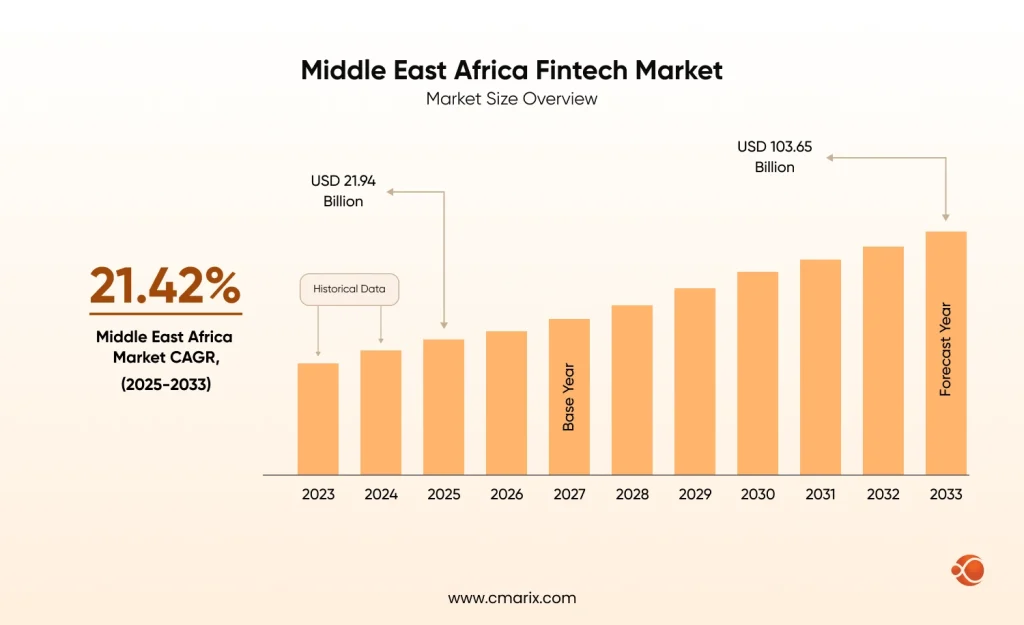
- The Middle East and Africa fintech sector is forecast to reach $103.65 billion by 2033 at a CAGR of 21.42%.
Fastest-Growing Fintech Markets Across Africa
| Market | Notable Players | Growth Focus |
| Nigeria | Flutterwave, OPay, Moniepoint | Consumer banking, B2B payments, lending |
| Kenya | M-KOPA, Tala, Pezesha | Microcredit, digital lending, agrifintech |
| South Africa | TymeBank, Capitec Digital, SnapScan | Insurtech, digital wallets, BNPL |
| Egypt | MNT-Halan, Paymob, Khazna | Embedded finance ecosystems, BNPL |
| Ghana | Zeepay, Hubtel | Remittances, mobile money interoperability |
| Morocco | CashPlus | Digital banking, cross-border payment infrastructure |
Leading South African Fintech Startups Transforming Digital Finance
Who Is Driving the Disruption
South Africa’s fintech disruption is less about reaching the unbanked and more about doing what banks do, but faster and from a smartphone. Key players include TymeBank (Africa’s first cloud-native bank), Capitec Digital (a UX benchmark combining payments, savings, and credit), SnapScan (an early QR payment pioneer), Jumo (mobile-data-driven SME credit), Peach Payments (API-first pan-African gateway), and Franc (micro-investment from R10). Most run specialized fintech software development at scale, building infrastructure that other startups build on.
What Connects Them
The common thread running through both approaches is an API-first and mobile-first design philosophy. With the advancement of open banking policies in South Africa, the development of payment-related services for developers to access will help to ensure that the best conditions are created for building Flutter apps developed by specialized software development teams.
Role of Smartphone Penetration and Financial Inclusion in African Fintech
Android Dominance Shapes Every Technical Decision
Frameworks that fail to perform consistently on moderately powerful hardware are going to be problematic. Flutter renders its own UI components without relying on any functionality of the underlying operating system, thereby performing consistently regardless of Android version, whereas developers working on React Native find themselves unable to do so.
Mobile-First Is Not a Strategy, It Is the Reality
The common denominator in all of these success stories is that they embrace the idea of designing with speed to market in mind. In that respect, Flutter comes into its own because it is designed specifically for mobile, practical enough to build speedy financial applications even on low-end devices, and suited for the embedded finance environment being created in Africa.
We have Flutter fintech experts who know African markets.
How Fintech Apps Improve Access to Digital Banking
Replacing the Bank Branch With a Smartphone
With digital wallets such as OPay (between 40 and 50 million registered users) and PalmPay (35 million users, 15 million transactions per day), a smartphone can now manage the entire process, from receiving money to paying bills, making transfers, saving, and borrowing, all without stepping into any branch. The quality of apps is definitely not for show, because if the user faces any glitches while making payments or during onboarding, they will simply switch to another app.
Data Privacy and Regulatory Compliance at the App Layer
With growing restrictions in data regulations in Nigeria, Kenya, and South Africa, the concepts of privacy-first mobile AI apps have influenced how fintech companies in Africa approach their user’s data when it comes to application-level design. The integration of privacy into the system architecture has become more of a necessity in the competition arena than a regulatory one.
Embedded Lending and Multi-Feature Product Design
Lending apps such as Moniepoint and Pezesha lend money to small businesses with transaction history acting as a replacement for collateral; the loan application process takes a few minutes, there is no collateral, and repayments occur as a percentage of revenue generated each day. Build a P2P payment app while also incorporating the functionalities of a loan and buy now, pay later system, not to mention savings, is the exact type of multi-functional app that benefits from the Flutter single-codebase approach.
Onboarding as the First Trust Signal
In Sub-Saharan Africa, many users use the fintech application as their first-ever encounter with a proper finance application. Hence, the process of onboarding is quite important here, more so than in more developed banking applications. The onboarding experience, consisting of three KYC checks completed within less than two minutes through camera-based document scanning and instant account opening, is not some kind of additional benefit; this is the application itself.
The ability to develop such an onboarding experience with Flutter’s widgets and platform channels using camera and biometric sensors is easier and faster than developing native implementations separately.
Real-Time Notifications That Drive Retention
Passive users don’t earn money. Fintech applications targeting Africa with good retention ratios leverage push notifications, in-app notifications, and SMS reminders to entice their users back through spending notifications, loan payment notifications, savings reminders, and reminders of peer transfers. It is feasible to implement a comprehensive, intelligent notification system in Flutter through its support for Firebase Cloud Messaging and notifications through packages due to platform agnosticism.
Flutter’s Emergence as a Preferred Payment App Framework
From Experiment to Default Choice
Around the time of 2023/2024, Flutter passed a point where no internal justification was needed; it just was the obvious technology choice to adopt for new product builds at growing African fintechs. This can be seen from recruitment patterns, GitHub engagement, and technology selections cited by funded firms in Lagos, Nairobi, and Cape Town. Why? Because teams within Africa’s fintechs tend to be relatively small, with four to eight mobile engineers in Series A, and duplicate work only wastes time and energy.
The Single Codebase Efficiency Argument
By virtue of Flutter’s approach to building products from a single codebase, the amount of engineering effort that goes into development is greatly reduced, allowing developers to concentrate on what makes their products unique. The development process in Flutter usually saves about 30% to 40% of the time required for cross-platform builds compared to native iOS and Android builds.
Production-Grade Maturity in 2026
Flutter’s ongoing development efforts have resulted in its becoming production-ready, providing support for 120 fps animation, internationalization, and platform channel support to access hardware capabilities such as NFC for NFC payment apps, as well as biometric KYC document validation. On a continent where the speed of time-to-market will determine whether a startup is able to establish itself before a bigger player, this is definitely an edge.
A Talent Pool That Has Reached Critical Mass
Three years ago, if one had to hire Flutter developers in Lagos or Nairobi, one would need to fight for their attention among a very limited number of early adopters. Things have changed since then. The GDGs (Google Developer Groups) of West, East, and Southern Africa have been consistently doing Flutter programming over the past two years, and Dart being easy to learn, those who know JavaScript and Kotlin can contribute effectively after a few weeks. This is an added advantage when it comes to fintech companies looking to grow from MVP to Series A rounds.
Hot Reload Closes the Gap Between Design and Delivery
One of the aspects that is rarely mentioned when discussing the benefits of Flutter within the African fintech landscape is the way hot reload influences the speed of iterations of the product. It is incredible for the designer and the developer to work together to modify the design of the product, see those modifications implemented on the actual mobile device within two seconds, and receive feedback on the results instantly. In a fintech application, the speed of iterations is directly related to the success of the product because certain user actions affect the bottom line of the business.
Flutter fintech apps built for African markets. Production-ready. Day one.
Why Flutter Fits Modern African Payment Applications
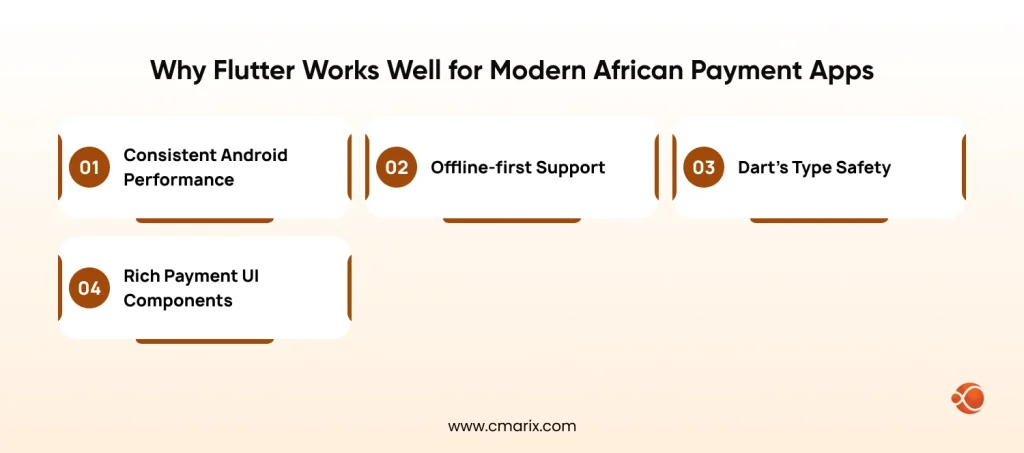
Flutter’s compatibility is not just about cross-platform ease. Flutter has a number of features that make it particularly well-suited for this industry:
- Android predictability: Customization renders will make frame rates predictable in the diverse hardware ecosystem in Africa.
- Offline-first approach: By integrating SQLite and Hive, it works independently of whether the internet is available.
- Dart’s strong type safety: This ensures that financial information is correct before compiling rather than during execution.
- Native feeling payment UI elements: everything from pin pads, card forms, and receipts can be made native to any device.
Flutter vs. React Native vs. Native App Development
| Criteria | Flutter | React Native | Native (Android/iOS) |
| Codebase | Single | Single | Separate |
| Performance | Near-native | Good (Hermes) | Native |
| Android optimization | Strong | Moderate | Full |
| UI consistency across devices | Excellent | Variable | N/A |
| Time-to-market | Fast | Fast | Slow |
| Developer talent pool (Africa) | Growing rapidly | Large | Large |
| Super-app architecture fit | Yes | Partial | Yes |
Easy Integration With African Payment Gateways and APIs
SDK Coverage That Has Caught Up With Demand
The past debate on Flutter being behind in payment SDKs no longer holds water since many African payment processors have come online using Flutter:
- Flutterwave (official SDK; more than 30 markets)
- Paystack (card, USSD, mobile money)
- M-Pesa Daraja API (STK push, C2B, B2C)
- DPO Group (19 African markets)
- Ozow (South African EFT with mobile money interoperability)
- Chipper Cash API (cross-border payment infrastructure via REST)
An expert payment gateway integration team working in Flutter can connect to multiple regional providers from a single codebase, including multi-provider fallback logic, without platform-specific duplication.
How Flutter Handles Security, AI, and Scale in Fintech Applications
Built for Financial-Grade Security
Security is not up for debate when talking about finance apps. Flutter uses Android Keystore and iOS Secure Enclave for biometric authentication and secure storage. Certificate pinning, encryption through Flutter_secure_storage, and null safety provided by Dart all work together to minimize run-time issues, which would cause potential security holes. When implementing Flutter AI integration for scenarios such as fraud detection, alternative data-based scoring, and optical character recognition for KYC documentation, the security code will remain asynchronous and won’t block the UI thread.
Where AI Actually Earns Its Place
From an analysis published by Forbes in April 2026, it was found that 80 percent of mobile banking chatbots failed to meet customer expectations, which shows the importance of AI applications being genuinely useful. Areas where AI can find its rightful place in the African financial technology ecosystem include real-time fraud scoring, thin-file lending, and voice-based interfaces in local dialects such as Yoruba, Hausa, and Pidgin, thus reducing the digital-literacy barrier.
Embedded Finance and BNPL: The Next Growth Layer for African Fintech
Embedded Finance Is Reshaping the Product Layer
Embedded finance, which combines credit, insurance, and payments in non-financial applications, represents the biggest shift in the African fintech ecosystem currently. In Egypt, for example, MNT-Halan runs an embedded BNPL offering through over 4,000 partnered merchants, while Carbon and FairMoney are offering lending services at the point-of-sale in West Africa. Remittances to Africa exceed $50 billion per year (IMF), and new fintech companies such as NALA and Wave are battling hard for cross-border payments infrastructure.
Investment Is Stabilizing Around Real Revenue
Investment has stabilized at a higher quality after the 2020–2023 boom-bust cycle. African startup funding recovered to $2.2 billion in 2024, with fintech holding 40%+ of all startup VC. Harvard Business School research found that reducing African cross-border payment frictions by 50% could create up to 1.1 million remote jobs framing fintech app solutions as an economic development priority, not just a commercial one.
Real-World Examples of Flutter-Based Fintech Applications
| App | Market | Flutter Use Case | Scale |
| PalmPay | Nigeria, Ghana | Super app: payments, savings, lending | 35M users, 15M daily transactions |
| Kuda Bank | Nigeria, UK | Digital bank: zero-fee accounts, instant loans | 8M+ users |
| Chipper Cash | Pan-Africa | Cross-border payments, virtual cards | 5M+ users, 7 countries |
| Carbon (Paylater) | Nigeria, Kenya | Personal loans, payments, investments | 3M+ users |
| FairMoney | Nigeria, India | Digital microlending, bill payments | 4M+ users |
| Zeepay | Ghana, 17 countries | Remittances, mobile money interoperability | Regional licensed operator |
Why Businesses Choose CMARIX for Flutter Fintech Development
Deep Market and Technical Expertise
Building a payment app that works across African markets requires more than framework knowledge. It demands experience with regional payment infrastructure, regulatory context, and user behavior patterns that define success in this space. CMARIX brings all three as a top-rated Flutter development company with top Flutter developers who have production experience across payment, lending, and digital banking applications.
What CMARIX Delivers
- Quick time-to-market: sprint development to deliver a production-ready MVP without incurring any technical debt.
- Scalable architecture: built for scaling from its initial launch to super-app levels in embedded finance ecosystems.
- Full execution: all the way from onboarding/KYC process and biometric authentication to cross-border payments in multiple currencies.
Conclusion
Fintech startups in Africa that succeed in 2026 will ship fast, earn the trust of users transacting digitally for the first time, and maintain product quality at scale. Flutter addresses the particular constraints these teams face: single codebase development delivering consistent iOS and Android experiences, a mature payment gateway ecosystem, and development velocity that lets small teams compete with better-funded competitors.
Building on the right foundation, with a top-rated Flutter development company that understands African payment infrastructure, turns that technical choice into a durable product advantage.
FAQs on Fintech Startups in Africa: Choosing Flutter
Why is Flutter preferred over native development for new African payment apps in 2026?
Flutter lets developers maintain a single codebase running on both Android and iOS at near-native performance. Most African fintech teams are small, so eliminating parallel development tracks is a meaningful efficiency gain. Flutter’s consistent rendering on budget Android devices, which dominate African markets, solves a key compatibility challenge, resulting in faster delivery and lower maintenance costs without sacrificing quality.
How does Flutter simplify integration with multiple African payment providers?
The clean HTTP client support that Flutter offers allows for simple connections to any GraphQL or REST payment APIs. All the regional integrations are done through a single codebase by the development team.
Is Flutter secure enough for handling sensitive financial transactions?
Yes, Flutter integrates with Android Keystore and iOS Secure Enclave for key storage and biometric authentication. Encrypted local storage, certificate pinning, jailbreak detection, and Dart’s null safety all reduce exploitable vulnerabilities. Security quality depends on architectural decisions, which is why working with experienced, specialized fintech software development teams matters as much as the framework itself.
Can Flutter support scalable fintech super-app development?
The module-based architecture of Flutter and its ability to separate the UI from the logic make the development of super applications possible. Additional modules such as insurance, lending, and BNPL can be developed without changing the architecture at all.
How does Flutter enable faster time-to-market for startups?
Speed of hot reload reduces the time for iterations. One single codebase reduces engineering effort by 30-40% compared to multiple native versions. Having one QA process and multi-platform deployment saves the time that can be crucial for significant African fintech companies, in which each engineering week costs money.