




Quick Summary: The cost of developing a blockchain app in 2026 varies between $15,000 to be used for creating a simple MVP and $300,000 or even more in case of developing an enterprise-level platform. The latter figure depends on many factors, including the complexity of the app, the need for a security audit, the chosen blockchain platform, etc. This guide post will explain the cost of blockchain app development.
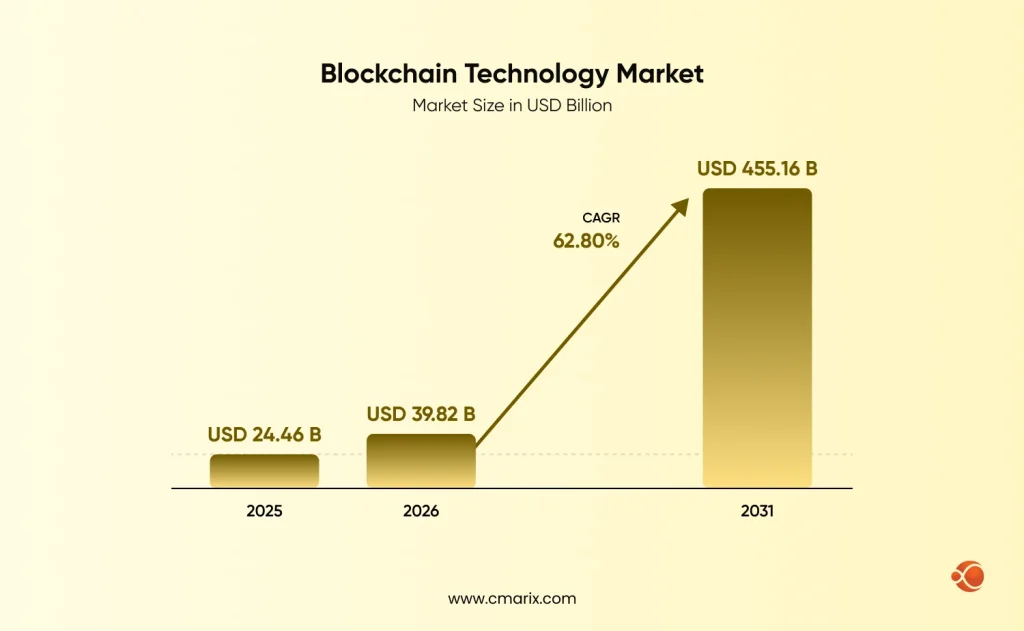
The worldwide blockchain industry stands at $39.82 billion, while Web3 development services have risen from $4.27 billion to $5.09 billion. It translates to more pricing models, more vendors, and more opportunities to come up with a price that may seem realistic when drafting a proposal, but will not be so once the development process begins. Each company investigating the issue in 2026 finds itself facing the same challenge: ten different ranges, ten different guidelines, but no clue which ones to apply.
The real problem is not finding a price range. Every vendor site has one. The problem is that most of those ranges only cover the build phase. Node infrastructure, smart contract audits, compliance tooling, and continuous maintenance rarely show up until the invoice does, and by then, the budget has already been approved based on an incomplete number.
This guide covers the full picture:
- What drives the cost of blockchain app development
- How it breaks down by complexity, team model, and use cases
- What to expect at each phase of the build
- What to budget for after launch
So, the number you plan around is the number you actually pay.
What Is Blockchain App Development? (Quick Overview)
Blockchain-based application development is the process of creating applications that operate on a decentralized ledger rather than a centralized database, with the help of consensus mechanisms, smart contracts, and distributed nodes to manage logic and data that needs to be trusted by more than one party.
Does Your Business Actually Need Blockchain?
Blockchain adds cost and complexity compared to a standard database, and it’s worth that cost only when your use case genuinely needs one or more of these things: trustless transactions between parties who don’t know each other, an immutable audit trail, or tokenized ownership of an asset.
If your problem is really about internal workflow efficiency or data storage, a traditional system will get you there faster and cheaper. Where blockchain earns its cost is in cross-border payments, supply chain provenance, digital identity, and tokenized assets, exactly where the rise of cryptocurrency has already pushed enterprise budgets to make room for it.
Blockchain App Development Cost by Complexity (MVP to Enterprise)
| Complexity Tier | Estimated Cost (USD) | Typical Timeline | What’s Included |
| MVP / Basic App | $15,000 – $50,000 | 4–8 weeks | Single wallet integration, minimal UI, and a basic smart contract. |
| Mid-Level App | $50,000 – $150,000 | 10–16 weeks | Interactive dashboards, token logic, API integrations, and multi-user workflows. |
| Enterprise / Multi-Chain Platform | $150,000 – $500,000+ | 20–30+ weeks | Custom consensus mechanisms, multi-chain support, a full compliance layer, and formal smart contract audits. |
Send us your requirements and get a real cost estimate.
Cost to Build a Blockchain App as Per Development Phases
Complexity tiers give you a ceiling and a floor. Phase-by-phase costs tell you where the money actually goes, which matters when you’re deciding what to cut if the budget gets tight.
| Development Phase | % of Total Budget | What Happens Here |
| Discovery & Planning | 5–10% | Market research, technical architecture planning, and compliance scoping. |
| UI/UX Design | 10–15% | Wireframes, wallet flow design, interactive prototypes, and user testing. |
| Core Development | 40–50% | Smart contract development, backend and frontend implementation, and third-party integrations. |
| Testing & QA | 10–15% | Functional testing, performance/load testing, bug fixes, and pre-audit validation. |
| Security Audit | 5–15% | Formal smart contract audits, penetration testing, and security reviews. |
| Deployment & Launch | 5–10% | Mainnet or Layer 2 deployment, infrastructure configuration, monitoring, and post-launch support. |
Discovery is the phase most businesses try to shortcut, and it’s usually the wrong place to cut. A rushed architecture decision at week one turns into a much more expensive fix by week twelve, particularly if it means migrating a smart contract that’s already handling live transactions.
7 Factors That Drive Up Blockchain App Development Cost
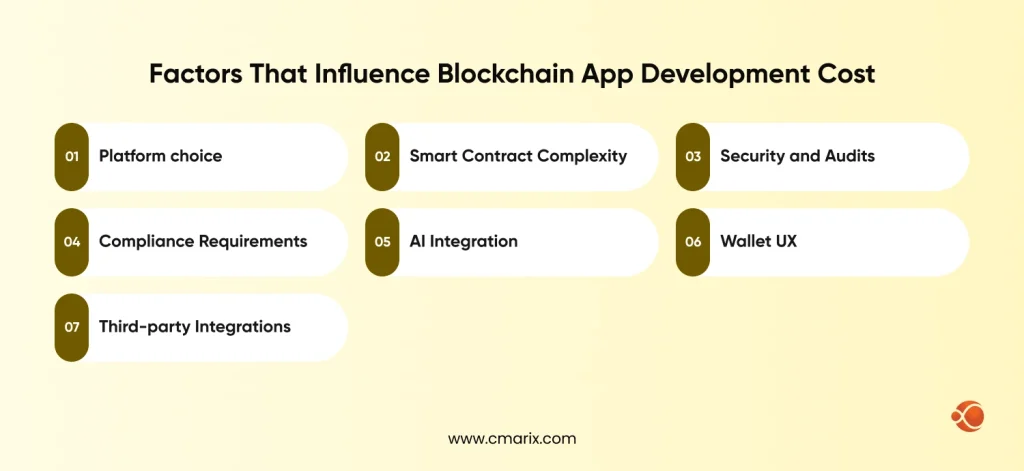
Platform choice
Ethereum has the deepest developer ecosystem but the highest gas fees, which makes it the most expensive chain to build and operate on. Solana, Polygon, and Base cut transaction costs significantly while still supporting production-grade apps, and each comes with its own tooling maturity and talent pool, which affects hourly rates as much as the chain’s own transaction fees do.
Smart contract complexity
A simple token transfer costs little to build and audit. Multi-step governance logic, staking mechanisms, or advanced DeFi flows require more development time, more edge-case testing, and a more thorough audit, and together that can add up to 30% to the total budget. This is usually where first-time estimates go wrong, since the difference between “a smart contract” and “a secure, tested, production smart contract” is a lot more than it looks on a spec sheet.
Security and audits
Any contract handling real financial value needs a formal audit before deployment, since code on-chain can’t be patched after the fact the way a traditional app can be hotfixed. This is one of the largest single line items in blockchain app development cost, and it scales with contract complexity rather than app size, so even a small DeFi feature can carry a disproportionately large audit bill.
Compliance requirements
GDPR, KYC/AML, and sectoral requirements such as HIPAA-compliant handling of data may raise costs by about 15 to 30 percent, especially for fintech and healthcare solutions, where regulatory approval requires not only functioning software but also documentation. It is better to factor in legal expenses along with development efforts to prevent unpleasant surprises.
AI integration
Combining AI with blockchain, for predictive analytics on-chain, automated compliance checks, or intelligent contract monitoring, is becoming standard in 2026 builds and adds its own development layer. Businesses exploring this combination are effectively looking to build smarter enterprises with AI on top of a blockchain foundation, and scoping the AI layer early avoids rebuilding data pipelines later to accommodate it.
Wallet UX
If your users aren’t crypto-native, embedded wallet solutions that abstract private key management improve onboarding but add 3–5 weeks of integration work. Skipping this to save time is one of the more common false economies in blockchain builds, since a confusing wallet flow can quietly kill adoption, no matter how solid the backend is.
Third-party integrations
The cost of integrating into existing systems, either through a payment processing system, ERP system, or identity management system, increases proportionally to the number of services your application depends on from other parties. Additionally, each new integration point is one more area to be tested and compliantly reviewed.
In-House vs Outsourcing vs Freelance: Which Costs Less Long-Term?
| Development Model | Typical Cost | Control | Risk | Best For |
| In-house Team | $150,000–$400,000+ per year | Highest, full IP ownership | Low delivery risk, but high operational overhead | Enterprises building blockchain as a core, long-term product line |
| Outsourced Agency | 30–50% lower than U.S. in-house rates | Moderate; managed development process | Low to moderate, depending on the vendor’s track record | Most businesses are developing their first blockchain application |
| Freelancers | Lowest hourly rates, though scope creep can reduce savings | Low; inconsistent documentation and processes | High, especially for unaudited smart contracts | Small, narrowly scoped tasks only |
For most businesses outside big tech, working with a team that offers the option to hire expert blockchain developers or hire dedicated developers on a project basis strikes the right balance between cost control and delivery risk, without the long-term overhead of an in-house team or the security exposure of an unvetted freelancer.
Team Composition & Hiring Cost Breakdown
| Role | Approx. Hourly Rate (Agency) | Involvement |
| Blockchain Architect | $80–$150/hr | Complete project, the heaviest load comes during planning and review phases. |
| Smart Contract Developer | $70–$130/hr | Core Development phase |
| Backend/Frontend Developer | $40–$90/hr | Full project |
| QA/Security Tester | $50–$100/hr | Testing and pre-launch phases |
| Smart Contract Auditor | $100–$200/hr (or flat fee of $5,000–$50,000+) | Pre-deployment |
Blockchain app development hourly rates run higher than standard web development because the talent pool with real smart contract and consensus mechanism experience is smaller, and the margin for error is lower.
Blockchain App Development Cost by Use Case
| Use Case | Estimated Cost Range | Key Cost Drivers |
| DeFi Apps | $80,000 – $400,000+ | Staking logic, liquidity pools, security audits |
| NFT Marketplaces | $40,000 – $150,000 | Smart contracts, storage, marketplace UX |
| Supply Chain Platforms | $60,000 – $250,000 | Multi-party integrations, IoT data feeds |
| Fintech/Payments Apps | $70,000 – $300,000 | Compliance, KYC/AML, transaction security |
| Healthcare/Identity Apps | $80,000 – $280,000 | Data privacy compliance, permissioned access |
Fintech remains one of the highest-cost use cases because compliance and security requirements stack on top of standard development. If you’re scoping a build in this space, our fintech app development breakdown covers the cost drivers specific to that vertical in more depth.
Compliance-heavy builds need scoping before pricing means anything.
Ethereum vs Polygon vs Solana vs Hyperledger: Which Costs Less to Build On?
| Platform | Cost Profile | Best For |
| Ethereum | Highest gas fees, deepest tooling ecosystem | Apps needing maximum composability and liquidity access |
| Polygon | Low fees, Ethereum-compatible | Cost-sensitive apps that still want EVM tooling |
| Solana | Low fees, high throughput, different programming model (Rust) | High-transaction-volume apps |
| Hyperledger | No gas fees, but you run your own infrastructure | Private/permissioned enterprise networks |
Shifting from Ethereum mainnet to a Layer 2 network can cut transaction fees by up to 80%, which is why most 2026 production apps default to L2 rather than mainnet deployment. Layer 2 scaling integration pricing typically adds a modest setup cost upfront, but pays for itself quickly in reduced transaction fees.
Blockchain App Maintenance Costs After Launch
Most quotes stop at launch. The real budget doesn’t.
- Smart contract audits: $5,000-$50,000, and non-negotiable for any contract holding real value. Large enterprise contracts with governance or stacking logic sit at the higher end, and a second audit is standard practice after major upgrades.
- Infrastructure: Hosting RPC, Node, and indexing usually costs around $5,000+/month at the production level, but increases with transactional activity instead of being a constant.
- Web3 app maintenance fees: Around 15-20% of the initial cost of development annually, related to protocol upgrade, user experience upgrade as a part of wallet standard, and proxy contract updates as chain standards change.
- Compliance tools: Continuous KYC/AML regulation and monitoring, especially in the case of fintech or healthcare apps building, when compliance needs don’t stop once the product is launched, but stay until its life ends.
- Cost of integration crypto wallets: Usually charged by wallet providers per active user or as an extra SaaS fee along with the initial integration process cost, hence growing as the number of users increases.
- Blockchain data indexing cost: Blockchain queries are slow and expensive in large volumes, thus a majority of the production-level projects require an indexing layer, which can be a SaaS solution or a custom indexer, adding both a development cost and a subscription cost.
Budgeting for these upfront, rather than discovering them post-launch, is the single biggest difference between an accurate blockchain development cost estimate and an optimistic one. A vendor who walks you through these costs during the proposal stage, instead of leaving you to find them later, is usually the one worth signing with.
Blockchain App Development Cost by Region
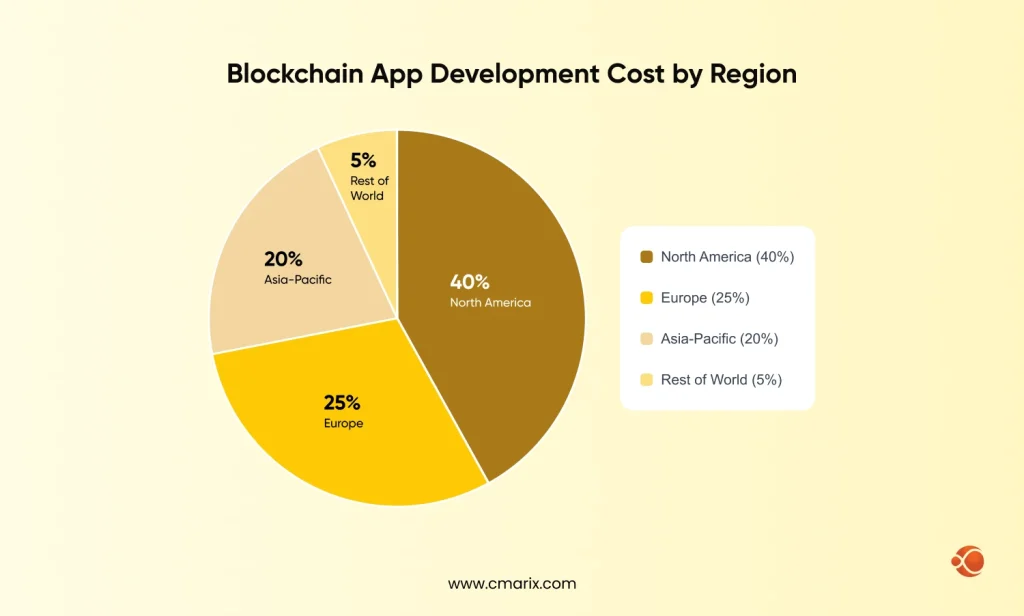
| Region | Market Share | Key Characteristics |
| North America | 40% | Highest hourly rates, deepest talent pool |
| Europe | 25% | Mid-to-high hourly rates, deep compliance skills |
| Asia-Pacific | 20% | Lower hourly rates, emerging enterprise-grade capability |
| Rest of World | 5% | Variable, project-dependent |
North America holds the largest share of the Web3 market, which also means the highest development rates. Businesses working with Asia-Pacific-based teams often see substantial cost savings without a meaningful drop in delivery quality, provided the vendor has a verifiable enterprise track record.
How to Reduce Blockchain App Development Cost in 6 Steps
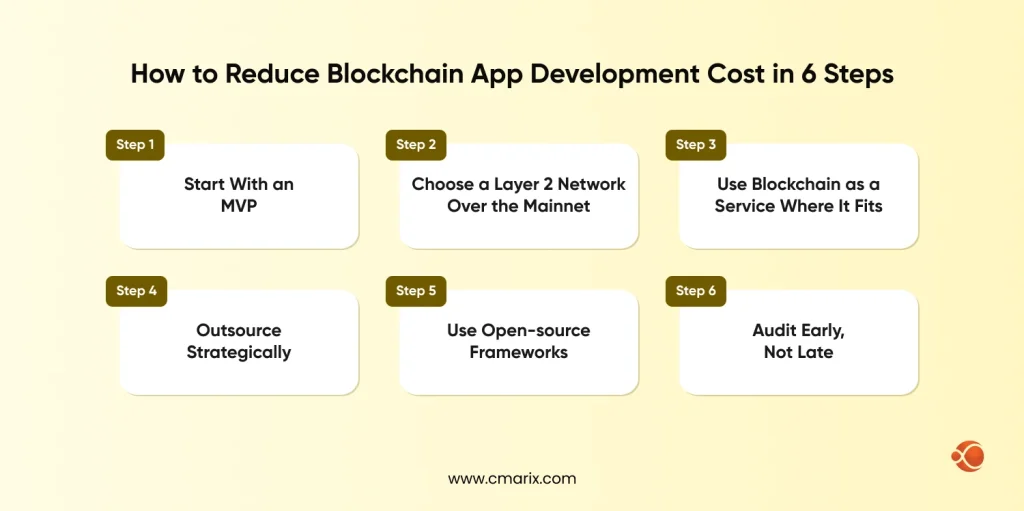
Step 1: Start with an MVP.
Launching with main features only can reduce initial development costs by 30-40% and get you real user data before you scale. Trying to build every feature you can imagine into version one is the single most common reason blockchain budgets run over.
Step 2: Choose a Layer 2 network over the mainnet.
The gas fee savings alone can offset a meaningful share of your development budget, and most 2026 production apps default to L2 for exactly this reason unless there’s a specific reason to need mainnet’s liquidity or composability.
Step 3: Use Blockchain-as-a-Service where it fits.
Microsoft, AWS, and IBM’s SaaS offerings cut infrastructure setup costs for teams that don’t need a fully custom architecture, letting you focus development spend on your actual business logic instead of rebuilding node infrastructure from scratch.
Step 4: Outsource strategically.
Outsourcing to an expert outsourced team, rather than creating an in-house team from scratch, is estimated to save between 30-50% on costs without compromising on delivery standards. So long as the team has proven delivery of audited contracts before prototypes.
Step 5: Use open-source frameworks.
Hardhat, Foundry, and established wallet connection standards remove the need to build core tooling from scratch, which was standard practice in blockchain’s early years and is largely unnecessary today.
Step 6: Audit early, not late.
Discovering any weaknesses that arise when developing is much less costly than fixing them or moving to another contract once it contains funds. One of the most costly blunders that can be made by the team is treating the auditing process as the last step in development.
How to Choose a Blockchain App Development Company
- The choice of vendor is just as important to your blockchain development costs as any technical consideration. You should consider a track record of tested contracts, not just theoretical examples.
- Ask directly about their experience with your specific chain, whether that’s Polygon, Ethereum, Solana, or a permissioned network like Hyperledger.
- Confirm they include security audits and compliance planning in their process by default, not as an add-on you have to request.
- And check what post-launch support looks like, since a vendor that disappears after deployment leaves you covering maintenance costs with no institutional knowledge of the codebase.
Red Flags in a Blockchain Development Quote
A few warning signs are worth watching for before you sign anything.
- No line item for a security audit.
- A number well below every other estimate you’ve gotten.
- No live, audited contract in their portfolio.
- Vague answers on post-launch support.
- No compliance discussion for regulated use cases.
- Pressure to sign before a technical scoping call.
Why Choose CMARIX for Blockchain App Development
CMARIX brings custom software, AI, and cloud expertise together for blockchain builds that hold up past launch, not just through the demo. Our custom software development services include the full lifecycle, from smart contract architecture through compliance planning and post-launch maintenance, so you’re not stitching together separate vendors for each phase.
For teams building in regulated industries, we bring the same security and compliance discipline we apply to mobile security work, including the evolution of mobile security with blockchain, directly into how we scope and build.

Conclusion
The cost of developing a blockchain application in 2026 is not a secret, but rather an equation that depends on the platform used, the degree of difficulty, compliance requirements, and how realistic your vendor’s scoping for the post-deployment phase is. It is only the companies that budget realistically that inquire about auditing and maintenance ahead of time.
FAQ on Blockchain App Development Cost
What is the average cost to build a blockchain app in 2026?
Most blockchain apps cost between $15,000 for a basic MVP and $300,000 or more for an enterprise-grade platform. The exact number depends on app complexity, blockchain platform, and whether your use case requires compliance work like KYC/AML.
What factors impact the overall cost of blockchain development the most?
The intricacy of smart contracts, compliance concerns, and security audit processes will almost certainly outweigh everything else in terms of influence on the number. Choice of platform will be important here too, because Ethereum mainnet development is more expensive than other platforms.
Which blockchain use cases are the most expensive?
It is seen that DeFi applications and fintech platforms have the highest costs owing to factors such as staking, liquidity, and compliance considerations for dealing with financial assets. Enterprise supply chain platforms that integrate at multiple points are also costly.
Are smart contract security audits necessary, and how much do they cost?
Yes, for any contract, managing real value. Audits usually run $5,000 to $50,000 or more, depending on contract complexity, and they catch vulnerabilities like reentracy or access control flaws before deployment, when they can no longer be patched.
Does integrating AI or other emerging tech increase the cost of blockchain development?
Yes, but at the same time, it provides a real functional value through features such as automatic compliance monitoring or predictive analytics embedded in the chain. AI for blockchain development becomes a must for projects in 2026, not a nice-to-have, so better be ready to invest from the start.