


Quick Summary: Enterprises are struggling with data spread across on-prem, cloud, and edge environments, and regulators are no longer patient. This blog breaks down the top 11 data governance tools of 2026, what makes an enterprise platform different from mid-market or open-source products, and the evaluation criteria that actually predict success once AI agents start pulling from production data.
The majority of enterprise data leaders have the same story right now: data continues to grow in size and volume, it is stored across many systems that are not owned by anyone in particular, and the company seeks to implement AI solutions, which would require high-quality, reliable data. Data governance platforms aim to bridge this gap, allowing enterprises to consolidate their efforts into one place and control what, how, and when happens with data.
The problem is that the market of data governance tools has become very crowded, with vendors being extremely similar when it comes to feature lists, while prices range from free to millions of dollars per year. For example, a perfectly good solution for the environment built around Databricks won’t necessarily fit Microsoft’s needs. One should look under the hood rather than rely only on marketing pages.
What Are Data Governance Tools? Definition and Core Capabilities
Data governance software is a platform that assists an organization in managing its data assets through categorizing, securing, monitoring, and auditing so that the data can be kept accurate and compliant. Most platforms are usually structured around 5 main pillars:
- Data cataloging – cataloging of datasets, tables, and reports within the enterprise
- Data lineage and traceability – tracking of source and transformation of data during its downstream flow
- Policy management and enforcement – automated controls for access and approvals
- Data quality management – monitoring, profiling, and flagging accuracy or consistency issues
- Compliance and audit support – automated PII detection, audit trails, and regulatory reporting
This is worth separating from data management, which is the operational layer where data actually moves (pipelines, storage, processing). Data governance tools operate above the functional level and define ownership, definition, and access rights to the data. Some data platforms combine cataloging, data quality, and data stewardship in one tool; others keep these responsibilities separate based on your architectural needs.
A quick note on scope: data governance and AI governance overlap but aren’t the same thing. Data governance covers data ownership, access, lineage, and quality; AI governance covers model risk, agent accountability, and policies for the AI systems themselves. In this guide, “machine and agent access” means how well a data governance platform extends its access and classification rules to AI systems, not AI governance itself. For model risk and agent accountability, see our guide to AI governance tools.
Why Data Governance Tools Matter More in 2026
Data governance is no longer seen as just an obligatory task and has become a priority for boards of directors, and there are three reasons for this trend in 2026.
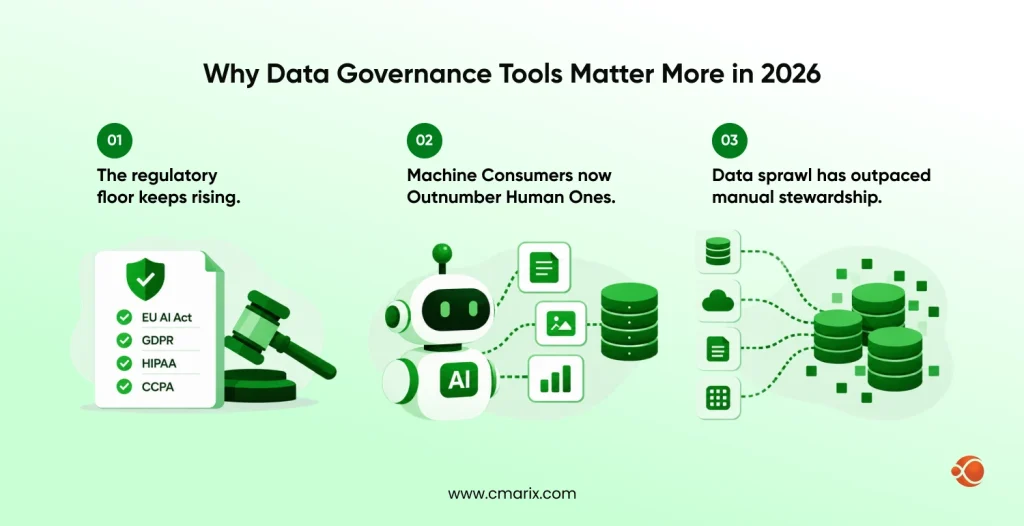
The Regulatory Floor Keeps Rising.
The regulatory bar will continue to rise. While the EU AI Act’s general applicability and transparency provisions remain effective from August 2, 2026, the more stringent provisions dealing with high-risk requirements have been delayed until December 2027 as part of the Digital Omnibus deal signed mid-2026. Such delay will provide enterprises with breathing room, but not a pass, as the risk categorization, documentation, and human oversight records required by such provisions will rely on data which will already need to be cataloged and classified in the first place. It is a data governance task long before it becomes an AI compliance task, one that an EU AI Act compliance checklist is now commonplace.
Machine Consumers now Outnumber Human Ones.
Traditional governance tools were designed around human users running queries and reading dashboards. That assumption breaks down when autonomous agents are pulling from production systems to make decisions or generate outputs in real time. A catalog that governs what a human analyst sees but has no mechanism to govern what an AI agent retrieves is a real blind spot in the data layer itself, and it’s forcing vendors to extend policy enforcement to machine consumers rather than build AI governance features. This is closely tied to a broader set of AI security concerns that enterprise teams are only now building formal processes around.
Data sprawl has outpaced Manual Stewardship.
The EDM Association’s 2026 Global Data Management Benchmark Report, based on responses from more than 435 organizations across 50+ countries, found that only about 31% report advanced data strategy capability, leaving most without the foundation their AI ambitions actually need. When one adds decentralization of data ownership represented by, for example, data mesh architecture, it becomes apparent why static manual catalogs do not suffice.
Underneath all three trends is a simpler point: data readiness for AI is now the real business case for governance tooling. Organizations that can’t trust their data can’t safely scale AI, full stop.
We can quickly assess your data stack and flag the biggest risks first.
How to Evaluate Data Governance Tools: 7 Criteria That Matter
Before comparing feature checklists, score any candidate against these seven criteria. They matter more than brand recognition and hold up regardless of which vendor you’re looking at.
| Criterion | What to Check |
| Scalability | Can it handle format scalability too, governing structured and unstructured data together, including open table formats like Delta Lake, Iceberg, and Parquet? |
| Integration | Does it connect natively to your existing stack, or will you need custom connectors on day one? |
| Usability | Can both technical users and business stakeholders actually use it without heavy training? |
| Policy enforcement granularity | Can it enforce access rules at the row, column, or field level, not just at the dataset level? |
| Machine and agent access governance | Does it enforce the same classification and access rules on AI agents and models pulling data as it does on human users? |
| Total cost of ownership | What does it cost across a 3–5 year horizon, including implementation, training, and add-on modules? |
| Vendor support | What’s the implementation timeline, and how deep is the professional services bench if you hit a wall? |
There are other perspectives you should consider when evaluating the tool. Architecture in governance tools changes as much as their features; from standalone catalogs to native platform solutions, aligning the category with your current data stack avoids duplication of metadata. If you’ve already invested in CRM data integrity initiatives, check whether the platform integrates cleanly with your CRM’s native data model rather than treating it as just another external source. And if your roadmap includes generative AI use cases, look specifically at how the tool handles governance for enterprise RAG architecture deployments, since retrieval pipelines pull from governed and ungoverned sources alike.
Data Governance Tools Comparison: Top Platforms at a Glance
| Tool | Category | Best For | Deployment | Pricing Tier |
| Collibra | Enterprise workflow governance | Large enterprises needing formal stewardship workflows | Cloud/hybrid | Enterprise |
| Alation | Data catalog & discovery | Organizations prioritizing data literacy and search | Cloud/hybrid | Enterprise |
| Atlan | Active metadata platform | Modern, engineering-led data teams | Cloud | Enterprise |
| Microsoft Purview | Platform-native governance | Azure-centric organizations | Cloud (bundled) | Bundled with Azure spend |
| Informatica | Enterprise data management suite | Large orgs needing governance tied to data quality/MDM | Cloud/hybrid/on-prem | Enterprise |
| Ataccama One | Unified quality + governance | Teams wanting quality and governance in one platform | Cloud/hybrid | Enterprise |
| OneTrust | Privacy & regulatory compliance | Compliance-first programs (GDPR, CCPA, HIPAA) | Cloud | Mid-market to enterprise |
| BigID | Data discovery & privacy risk | Organizations focused on sensitive data discovery | Cloud/hybrid | Mid-market to enterprise |
| Data.world | Collaborative AI-ready catalog | Mid-market teams wanting fast time-to-value | Cloud | Mid-market |
| OvalEdge | Budget-friendly governance | Mid-market teams with limited governance budgets | Cloud/on-prem | Mid-market |
| OpenMetadata | Open source governance | Teams with engineering bandwidth to self-host | Self-hosted | Free (engineering cost) |
Top 11 Data Governance Tools for 2026
1. Collibra

Collibra is one of the most recognized names in enterprise data governance tools, built around advanced workflow management for data ownership, policy enforcement, and a centralized business glossary. It’s strongest in large organizations that need formal stewardship processes with clear approval chains and accountability trails.
- Best for: Enterprises with complex stewardship hierarchies and formal governance councils.
- Watch for: The process of installation and setup needs either internal manpower or a system integrator.
2. Alation

Alation emphasizes data cataloging and discovery and is highly oriented toward data literacy and collaboration. Governance functionality is placed on top of the discovery-based experience, and that helps to make Alation easy to use for business users looking for data, not just for data engineers.
- Best for: Organizations where the primary goal is getting business users to actually find and use governed data.
- Watch for: Often works best paired with a separate tool for deeper enforcement and operational controls.
3. Atlan

Atlan presents itself as a dynamic metadata platform tailored to meet the needs of engineering data teams. It is clearly more engineer-friendly than traditional governance software solutions because of its excellent support of open table formats and a more intuitive user interface similar to SaaS platforms.
- Best for: Dedicated teams that have implemented the modern data stack and want governance without feeling like an afterthought.
- Watch for: More recent platform compared to Collibra or Informatica, thus having less mature enterprise-level customer references.
4. Microsoft Purview

Purview was once a metadata scanning tool alone; it has transformed into an end-to-end service encompassing data governance, data security, and compliance. By utilizing the Unified Catalog from Purview, one can now discover data in Azure, AWS, GCP, and on-prem environments, which then allows you to leverage it to create data products and business glossaries with automated approvals.
- Best for: Companies that are well entrenched in the Microsoft ecosystem and looking to have governance as part of their cloud expenditure.
- Watch for: Multi-cloud coverage exists but is naturally strongest when Azure is your primary environment.
5. Informatica

Informatica is well-versed in enterprise-level data management, linking governance directly with data quality and master data management. It is best fit for companies that consider governance, quality, and MDM as one single domain rather than different domains altogether.
- Best for: Large companies looking for governance features fully incorporated into their existing data quality and master data management solutions.
- Watch for: The learning curve and longer implementation times associated with feature depth.
6. Ataccama One

Ataccama One brings together data management, data quality, and governance all in one suite to enhance the precision, consistency, and reliability from one interface rather than trying to integrate point products.
- Best for: Teams who want quality monitoring and governance enforcement without managing two separate vendors.
- Watch for: The more comprehensive nature of the solution implies that it will take longer to evaluate than the catalog application alone.
7. OneTrust

OneTrust is designed with compliance in mind. In addition to offering excellent out-of-the-box templates for regulatory frameworks like GDPR, CCPA, and HIPAA, OneTrust is not built to be a generalized cataloging tool but rather a compliance tool.
- Best for: Legal/governance programs where the need for regulatory reporting is the main challenge
- Watch for: Not a substitute for a full metadata catalog if broader data discovery is also a priority.
8. BigID

BigID shines in the areas of data discovery and privacy risk management, especially as it relates to automatic detection of sensitive and personal data. This product would be a good choice where the main priority is sensitive data discovery as opposed to general data cataloging.
- Best for: Businesses prioritizing personal data discovery and privacy risk reduction.
- Watch for: Best complemented with an overall catalog in case business glossary and stewardship capabilities are required.
9. Data.world

Data.world provides an easy-to-use, AI-friendly catalog designed to be adopted by mid-sized companies that need quick value from an alternative to enterprise solutions.
- Best for: Mid-sized firms that are looking for a modern catalog without an extended implementation timeline.
- Watch for: Workflow capabilities not as extensive as Collibra or Informatica for formalized stewardship workflows.
10. OvalEdge

OvalEdge is a cost-efficient mid-market governance solution providing catalog, lineage, and policies functionality without being an enterprise-level application. It is widely used by companies that are implementing their first governance initiative.
- Best for: Mid-market organizations looking for basic governance functionality without breaking the bank.
- Watch for: It lacks more sophisticated governance functionality that some other applications designed for agentic governance provide.
11. OpenMetadata

OpenMetadata provides cataloging, lineage, and metadata management capabilities without any licensing cost to teams that have bandwidth to support engineering. OpenMetadata has become popular because of its contemporary architecture and community.
- Best for: Engineering-heavy organizations comfortable owning setup, hosting, and ongoing maintenance in exchange for zero license cost.
- Watch for: The lack of vendor support hotlines means that all questions will have to be answered by the community or internally.
If your roadmap includes broader automation beyond governance, it’s worth reviewing this along with a wider look at AI tools for business, so governance decisions and tooling get made together instead of in isolation.

Data Governance Tools Pricing: What Enterprises Should Expect
The price of data governance tools varies immensely depending on the number of connectors, deployment size, and number of users, which is why tier-based pricing is always a good thing.
- Open source: Free to download, but factor in real engineering time for setup, hosting, and maintenance.
- Mid-market: This category of platforms (OvalEdge, data.world) usually starts at the ten-thousand-dollar mark per year.
- Enterprise: Full-scale platforms like Atlan, Collibra, Informatica, and Alation usually range well into six figures annually, scaling with data volume and user count.
- Platform-native: Tools like Microsoft Purview come bundled into current cloud spend rather than a separate line item, which can make them look cheaper until you factor in the limits of single-cloud coverage.
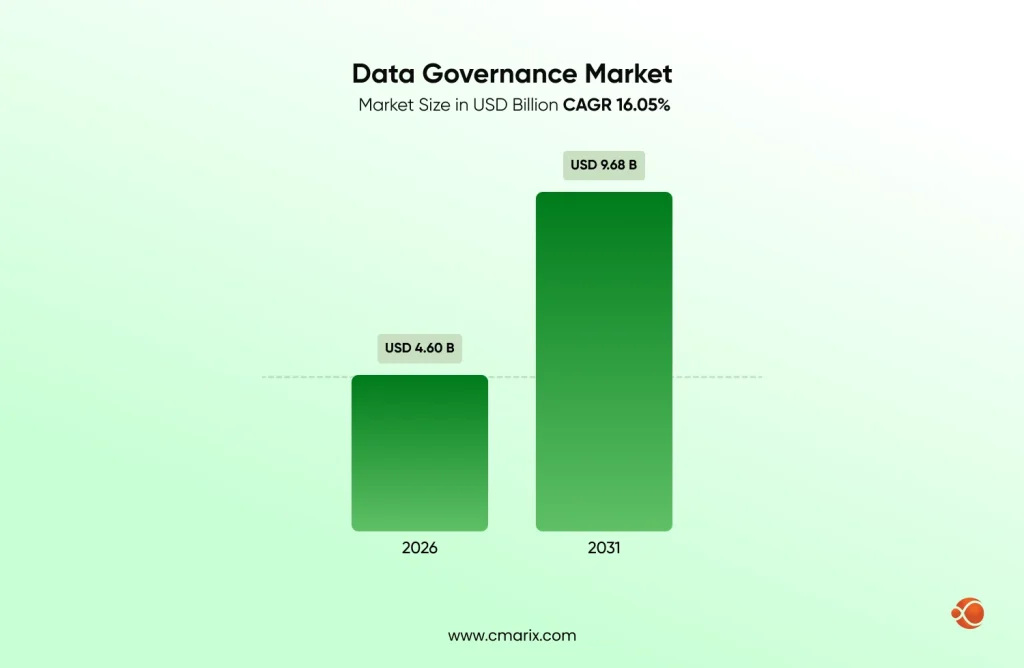
The market itself is growing fast enough that this spending isn’t slowing down. According to Mordor Intelligence, the global data governance market stood at roughly USD 4.60 billion in 2026 and is forecasted to reach USD 9.68 billion by 2031, a CAGR of about 16.05% over that window. That growth is a reasonable proxy for how seriously enterprises are now treating this category, and it’s worth factoring into any build-versus-buy conversation.
Common Mistakes Enterprises Make When Choosing Data Governance Tools
- Buying against a feature checklist instead of an actual governance framework. A tool can expose issues and enforce rules, but it can’t force teams to follow processes that were never defined in the first place.
- Treating AI agents as ungoverned users of your data. It is much more disruptive to add policy enforcement after the fact, once the agents have already been querying production data without oversight.
- Underestimating total cost of ownership. License cost is only part of the picture once you add implementation, training, and the ongoing stewardship effort required to keep a catalog current.
- Ignoring architecture fit. A tool designed specifically for the Databricks stack will not work in the same way if attached to an environment dominated by Microsoft or an on-prem environment, and duplicated metadata layers only serve to increase complexity.
Teams budgeting for FinTech app development costs run into a similar decision curve, since governance and compliance tooling often get added mid-project instead of scoped in from the start.
We help enterprises scope compliance and governance tooling before costs spiral.
Why Choose CMARIX for Data Governance Tools
Choosing the right data governance tools is only half the challenge. Most rollouts stall when they fail to integrate properly into existing systems, data pipelines, and compliance workflows. CMARIX works with enterprises building AI-ready data infrastructure, from mapping governance requirements into system architecture to building the custom integrations that off-the-shelf platforms don’t cover out of the box. Our data engineering services cover this integration work directly, and if you need dedicated capacity to run it, you can also hire data engineers from our team.
Conclusion
It is not about the tool that beats all other alternatives; it is about the tool that is right for your particular architecture, risk profile, and investment in its development. In terms of enterprise vendors, Collibra, Alation, and Informatica offer a range of solid capabilities and workflow features; when it comes to platform-specific providers, Purview can ease your way if you’ve already settled on one cloud vendor; and, finally, if you need to save money, open source solutions like OpenMetadata might come in handy. You know what to look for but do not know who to consider.
FAQs About Data Governance Tools
What are the best data governance tools?
The right choice will depend on what is important for you. If enterprise-level workflow and stewardship are the criteria, then Collibra, Alation, and Informatica should be your top picks. If you are already an Azure shop, go with Microsoft Purview. For compliance and privacy, look to BigID and OneTrust. OpenMetadata is the best open-source option.
What is the difference between a data catalog and data governance tools?
Data cataloging is part of the governance process but with an emphasis on inventory and discoverability of the data. In comparison to data catalogs, data governance tools add features such as policy enforcement, access control, data quality, and reporting. Most data governance tools used in enterprises today include data cataloging in their functionality suite.
How do I choose the right data governance tool for my organization?
Begin by thinking about your architecture and compliance needs first, not features. Measure potential suppliers on their capabilities in terms of scalability, integration into your technology stack, level of policy enforcement, artificial intelligence governance preparedness, cost of ownership, and vendor capabilities. Then select a few and conduct a pilot with actual data.
How do I know if a governance program is working? What should I measure?
Consider the practical examples: how quickly stewards are able to categorize and approve new data sets, how frequently problems with data quality are detected before hitting the dashboard, audit preparedness (lineage and record access on demand), and business adoption, not just by data professionals.
What are the most important features to look for in enterprise data governance tools?
Consider such areas as data cataloging, lineage and traceability, fine-grained policy enforcement, data quality management, automated data classification, and compliance and audit reporting. For 2026 specifically, also weigh machine and agent access readiness, since that’s where most legacy tools have the biggest gaps.
What should I look for in a governance tool if I care about compliance with regulations?
Find out if there are built-in regulatory template frameworks for GDPR, CCPA, and HIPAA; built-in PII detection; and audit trail generation without manual compilation. This functionality is available on tools like OneTrust and BigID, although more general-purpose enterprise software also includes compliance modules today.
What are the benefits of using open-source data governance tools?
The obvious one is cost. There’s no license fee, so budget goes toward implementation and engineering time instead. Open source tools like OpenMetadata also offer more flexibility to customize the platform to your exact stack, though that comes with the trade-off of owning support and maintenance internally rather than relying on a vendor.