



Quick Summary: AI governance tools are becoming essential for organizations managing AI risk, compliance, data privacy, model performance, and responsible AI adoption. This guide compares leading platforms and key capabilities for selecting the right governance solution in 2026.
As artificial intelligence progresses from experimental pilots to an integral part of production processes, the key challenge for contemporary organizations in implementing their AI solutions becomes one of control, compliance, and trust rather than technical capacity.
From being just theoretical plans, regulatory frameworks like the EU AI Act have now progressed to enforcement frameworks, under which failure to comply will result in fines by 2026. Standardization frameworks such as the ISO/IEC 42001 and NIST AI RMF have increasingly become common frameworks for managing AI in enterprises.
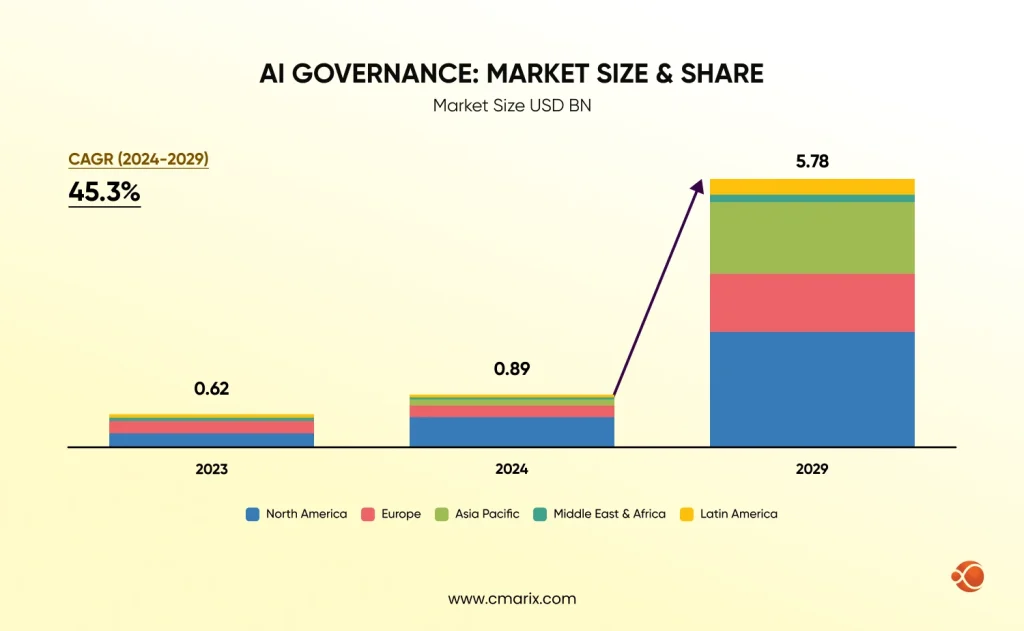
The global AI governance market is projected to grow from USD 0.89 billion in 2024 to USD 5.78 billion by 2029, expanding at a CAGR of 45.3%.
Best AI governance tools for corporate decision-makers like CIOs, CTOs, Risk, and Legal are now emerging as an important project. This is because fragmented risk management processes, unknown data inputs, and the use of generative AI without any regulations can put companies in trouble.
This comprehensive enterprise buyer’s guide examines the major AI governance categories, essential platform capabilities, and leading AI governance tools available in 2026.
The 2026 AI Governance Landscape: Why Traditional Controls Fall Short
Companies working to scale AI solutions, LLMs, and agentic automation will find that current software security strategies do not address the specific risks posed by generative AI.
Employees may enter confidential customer information, financial records, proprietary source code, or protected health information into third-party AI tools. Without appropriate governance controls, this information may pass through systems outside the organization’s direct security and compliance perimeter.
The LLM vendor can store prompts for abuse detection or process them using the underlying infrastructure.
Key AI Governance Risks
| Risk Area | Enterprise Exposure | Governance Requirement |
| Sensitive data exposure | Confidential information entering public AI tools | Real-time data detection and masking |
| Shadow AI | Employees using unauthorized AI applications | AI usage discovery and centralized controls |
| Regulatory non-compliance | Violations of applicable AI, privacy, or sector regulations | Regulatory mapping and compliance monitoring |
| Model bias | Discriminatory or unfair model outcomes | Bias testing and continuous monitoring |
| Model drift | Production model performance deteriorating over time | Automated drift detection |
| Lack of explainability | Difficulty understanding AI decisions | Explainability and model documentation |
| Inadequate auditability | Missing evidence during compliance reviews | Immutable audit trails |
| Third-party AI risk | Unknown security and privacy practices of AI vendors | Vendor and model risk assessment |
There is research evidence that enterprise users tend to feed sensitive corporate data to open AI platforms, which is problematic from a regulatory standpoint, particularly with respect to GDPR, HIPAA, and the EU AI Act.
To remedy these vulnerabilities without stifling innovation, enterprises have turned to specific AI model governance solutions and comprehensive enterprise platforms.
Core Categories of Enterprise AI Governance Solutions
The AI governance market can broadly be divided into three major categories.
| AI Governance Category | Primary Purpose | Typical Users | Key Capabilities |
| AI Model Governance & MLOps Platforms | Govern machine learning model lifecycles | Data science, ML, engineering teams | Model tracking, versioning, drift monitoring, bias detection |
| Workforce AI Enablement Platforms | Govern employee usage of third-party AI | IT, security, compliance teams | Data protection, shadow AI discovery, access controls |
| Automated AI Auditing & Compliance Software | Automate regulatory and governance processes | Legal, risk, compliance teams | Framework mapping, assessments, documentation, audit trails |
1. AI Model Governance & MLOps Platforms
These tools are designed for internal use in machine learning. These tools help in managing experimentation of models, version control, deployment pipeline management, performance measurement, and risk management.
2. Workforce AI Enablement Platforms
These tools help in enabling controlled access to third-party LLMs and AI generation tools. These tools are designed to keep sensitive information private from external AI service providers and to provide organizations with visibility into AI usage.
3. Automated AI Auditing & Compliance Software
Last but not least, we have dedicated AI governance platforms that primarily focus on governance documentation, ensuring regulatory compliance, assessing risk map frameworking, and audit readiness across all AI systems.
Build a governance strategy aligned with AI risks, compliance, security, and workflows.
Top Enterprise AI Governance Tools Compared
The choice of platform depends on whether the organization is overseeing its internal machine learning pipeline, the workforce’s use of generative AI, or a multi-model architecture.
| Best AI Governance Tools List | Primary Focus | Key Strength | Best Suited For |
| Domo AI Governance | AI + data governance | AI asset inventory and governed analytics | Organizations combining BI, data, and AI governance |
| IBM watsonx.governance | Model risk + lifecycle governance | Model monitoring and compliance documentation | Large and regulated enterprises |
| OneTrust AI Governance | AI risk + privacy + GRC | Regulatory and privacy integration | Legal, privacy, and compliance teams |
| Credo AI | Responsible AI governance | Policy management and framework alignment | Organizations managing diverse AI systems |
| Monitaur | AI assurance + monitoring | Auditability and model performance governance | Finance, insurance, and healthcare |
Domo AI Governance

Domo incorporates AI governance into its business intelligence and data management offerings, thus making it one of the best choices for businesses interested in integrated governance of analytics, data, and AI processes.
Key Strengths
- Formal intake and approval process for new AI use cases
- Centralized listing of AI assets
- Governed self-service analytics
- Certified datasets
- Integration of data and AI management
Best Suited For
Organizations looking to combine data governance, business intelligence, and AI asset management within a unified environment./p>
IBM watsonx.governance

IBM watsonx.governance focuses heavily on model risk management and end-to-end lifecycle governance for enterprise machine learning and generative AI deployments.
Key Strengths
- Lifecycle monitoring of models from development to production
- Automated detection of drift and bias
- Exceptional set of AI risk management solutions
- Model documentation that meets audit standards
- Impact assessments
- Governance of machine learning and generative AI workloads
Best Suited For
For large corporations and highly regulated businesses with complicated machine learning systems that need technical risk management./p>
OneTrust AI Governance
OneTrust incorporates its proven privacy and governance, risk, and compliance solutions for AI governance. The solution links AI risk management to the privacy and regulation processes.
Key Strengths
- AI System and Components List
- AI Bill of Materials
- Regulations Mapping
- EU AI Act and GDPR Compliance
- Privacy Management
- AI Risk Management
Best Suited For
Compliance personnel, legal teams, privacy officers, and firms wanting to establish AI governance in the context of GRC and privacy projects./p>
Credo AI

Credo AI is renowned for its governance solutions for responsible AI, focusing on trust, compliance, and risk management.
Key Strengths
- Policy management
- Multi-framework alignment
- NIST AI RMF support
- ISO/IEC 42001 alignment
- Developer-oriented integrations
- Continuous compliance tracking
Best Suited For
Companies expanding across various AI systems that need to enforce policies and coordinate between technical and risk management teams./p>
Credo AI
Credo AI is renowned for its governance solutions for responsible AI, focusing on trust, compliance, and risk management.
Key Strengths
- Policy management
- Multi-framework alignment
- NIST AI RMF support
- ISO/IEC 42001 alignment
- Developer-oriented integrations
- Continuous compliance tracking
Best Suited For
Companies expanding across various AI systems that need to enforce policies and coordinate between technical and risk management teams./p>
Monitaur

Monitaur is an AI governance solution that provides assurance, auditability, and monitoring of ML models.
Key Strengths
- Automated audit logging
- Model performance tracking
- Governance controls
- Model monitoring
- Sector-focused governance capabilities
Best Suited For
Financial services, insurance, and healthcare organizations seeking detailed audit trails and model performance governance.
Essential Features to Look for in Enterprise AI Governance Tools
When preparing for an RFP or developing a shortlist of AI governance vendors, companies should emphasize features related to security, compliance, model performance, and transparency.
| Feature | What It Does | Why It Matters |
| Real-Time Data Protection | Detects and masks sensitive information in AI inputs and outputs | Reduces data leakage risks |
| Automated AI Auditing | Records AI activity and governance events | Creates compliance evidence |
| Bias Detection | Evaluates models for potentially discriminatory outcomes | Supports responsible AI deployment |
| Explainability | Provides insight into model decisions and outputs | Improves transparency |
| Model Drift Monitoring | Detects changes in production model behavior | Maintains model reliability |
| AI Asset Inventory | Tracks models, applications, datasets, and AI systems | Improves organizational visibility |
| Regulatory Mapping | Maps controls to relevant regulations and frameworks | Simplifies compliance management |
| Policy Management | Establishes and enforces AI usage policies | Standardizes governance |
| Risk Assessments | Identifies and documents AI-related risks | Supports risk-based governance |
| Audit Trails | Maintains timestamped governance records | Improves audit readiness |
Real-Time Data Protection
The AI governance framework should include an analysis of inputs and outputs at the interface level. It should involve automatic detection and scrubbing of personally identifiable data, sensitive business data, intellectual property, and other sensitive data before the input is sent to external APIs.
This capability becomes particularly important when organizations allow employees to use multiple commercial LLM providers.
Automated AI Auditing Software
AI compliance requires more than documented policies. Organizations need evidence showing how those policies are being applied.
Enterprise AI governance tools should therefore record:
- AI system activities
- User activities
- Model activities
- Input and output activities
- Risk assessment results
- Policy violation findings
- Approvals
- Governance decisions
Immutable and time-stamped audit logs provide the necessary evidence for internal review, regulatory assessment, and external audit purposes.
Algorithmic Bias Detection and Explainability
Companies running AI programs in regulated domains or high-impact domains should have ways to detect potential bias in their outcomes.
The governance platform should be able to detect the model’s behavior on protected or relevant groups, while offering mechanisms to explain how these models make decisions.
This becomes particularly important for applications involving:
- Financial decisions
- Insurance underwriting
- Healthcare
- Employment
- Credit
- Customer risk scoring
Model Drift Monitoring
Production AI models can deteriorate as real-world data changes. Model drift monitoring continuously evaluates production behavior and identifies statistically significant changes in model performance or input distributions.
A sophisticated governance framework will allow:
- Continuous model monitoring
- Automated alerts
- Performance thresholds
- Drift detection
- Versioning of models
- Model retraining where necessary
Technical Integration and Custom Engineering Considerations
Pre-built governance solutions can serve many purposes for workforce enablement and compliance. However, companies that are developing their own ML pipelines or custom models would require greater architectural control.
Enterprise-wide AI governance often depends on foundational capabilities such as:
- Data Readiness for AI
- Model Monitoring
- AI security risks mitigation
- Data Lineage
- Identity and Access Management (IAM)
- Secure Model Deployment
- Explainability
- Compliance Automation
- AI ROI evaluation and Measurement
Organizations operating in complex regulatory environments may also require custom middleware, secure model infrastructure, fine-tuned open-source models, and role-based guardrails embedded directly into proprietary applications.
This is particularly relevant when governance needs to cover AI agents that interact with internal systems, customer data, APIs, and multiple model providers. This also makes AI agents for cybersecurity an increasingly relevant governance use case, particularly when agents access security tools or take automated actions.
Where Custom AI Engineering Becomes Important
| Requirement | Off-the-Shelf Governance | Custom Engineering |
| Basic AI inventory | ✓ | x |
| Framework mapping | ✓ | x |
| Standard compliance workflows | ✓ | x |
| Custom LLM integration | x | ✓ |
| Proprietary AI applications | x | ✓ |
| Multi-agent architecture | x | ✓ |
| Custom data masking | x | ✓ |
| Private AI infrastructure | x | ✓ |
| Role-based AI guardrails | x | ✓ |
| Industry-specific workflows | x | ✓ |
| Custom model orchestration | x | ✓ |
For companies that need such capabilities, one could look into developing AI software and models, optimizing them, and exploring generative AI.
Build secure AI systems with custom guardrails, LLM integrations, and governance controls.
Strategic Buyer’s Checklist: How to Choose the Right AI Governance Platform
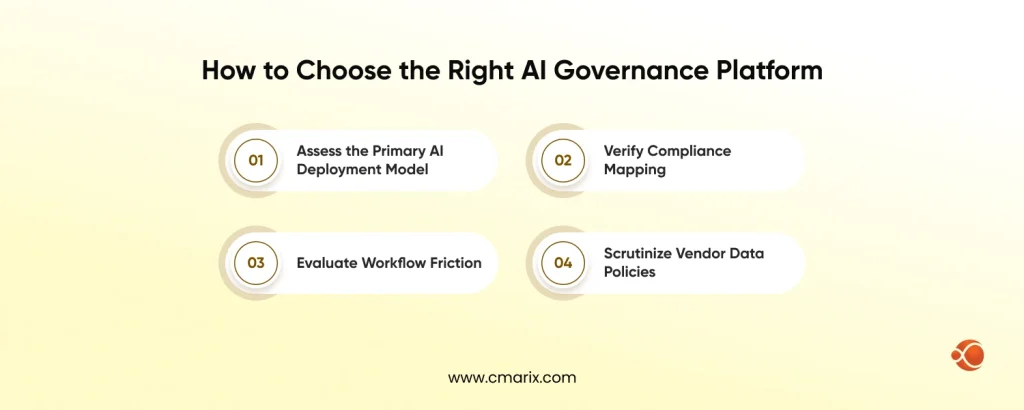
Choosing an appropriate platform for AI governance is more than just listing what that platform can do. It is essential to consider other factors, such as the firm’s AI infrastructure.
1. Assess the Primary AI Deployment Model
First, determine which types of AI activity require governance.
| Deployment Model | Primary Governance Requirement |
| Third-party LLM usage | Data protection and workforce AI governance |
| Internal ML models | Model lifecycle and performance governance |
| Generative AI applications | Prompt, output, security, and compliance controls |
| AI agents | Tool access, identity, permissions, and action monitoring |
| Multi-model architecture | Centralized policy and model governance |
| Highly regulated AI | Risk assessment, explainability, and auditability |
2. Verify Compliance Mapping
The chosen tool must comply with the organization’s legal and technical regulations.
Key frameworks to evaluate include:
- EU AI Act Compliance
- NIST AI RMF
- ISO/IEC 42001
- GDPR
- Industry-specific regulatory requirements
Native framework mapping reduces the amount of manual compliance work required from internal teams.
3. Evaluate Workflow Friction
Security measures that significantly disrupt workflow tend to incentivize people to circumvent authorized solutions.
To achieve this, enterprise AI governance needs to be integrated into current business processes using techniques such as:
- Single Sign-On
- Browser Extensions
- Integration through APIs
- Pre-existing identity services
- Development tools
- Enterprise applications environments
The idea is to have the AI governance process be the most convenient route.
4. Scrutinize Vendor Data Policies
Due diligence by vendors should not be limited to the product’s features. Prior to deciding on an AI governance platform, the organization must ensure that:
- Are prompts stored, and if so, how?
- How long are logs retained?
- Is customer data used for model training?
- Which subprocessors have access to or process customer information?
- What data residency options are available?
- What encryption practices are used to protect customer data?
- What access control mechanisms are in place to protect customer information?
- Is the service SOC 2 Type II certified?
- What procedures are followed in the event of a security incident?
- What are the policies and procedures for deleting customer data?
AI Governance Tool Evaluation Matrix
A weighted evaluation matrix can make vendor selection more objective.
| Evaluation Criterion | Suggested Weight |
| Security and data protection | 20% |
| Regulatory and framework coverage | 20% |
| AI/ML model governance | 15% |
| Monitoring and observability | 15% |
| Integration capabilities | 10% |
| Auditability and reporting | 10% |
| User experience | 5% |
| Vendor security and data policies | 5% |
| Total | 100% |
The relative weights can be tailored to the firm’s use of AI. While a bank will be interested in greater model risk, explainability, and auditability, an organization that manages its employees’ access to LLMs might be interested in data security and shadow AI.
Final Takeaway
With increased adoption of AI through 2026, one of the top AI trends is the transformation of AI governance from an exercise in compliance to a key element of the strategy of enterprises utilizing AI.
The most suitable AI governance tools may not be those that have many features. It is necessary to look at the AI architecture, risks, regulations, worker use, and technology stack within an organization.
In organizations that need to evaluate their AI governance platforms, the following are crucial considerations:
Data privacy; transparency regarding their AI assets; model life-cycle management; detection of bias and drift; explanation; regulation mapping; audit automation; policy enforcement; and integration.
For organizations with their own AI, LLMs, or agentic systems, it is critical to incorporate governance into the system’s architecture.
A mature AI governance strategy therefore combines governance platforms, secure AI engineering, continuous monitoring, regulatory compliance, and organization-wide AI policies to create a scalable foundation for responsible AI adoption.
FAQs on AI Governance Tools
What are AI governance tools?
AI governance tools are software platforms for managing, monitoring, and controlling AI systems throughout their lifecycle. They support risk assessment, compliance, documentation, model monitoring, security, and responsible AI practices.
Why do businesses need to deploy AI governance tools?
Businesses use AI governance tools to control AI-related risks, improve transparency, and maintain regulatory compliance. They also provide centralized oversight of AI models, data, decisions, and operational performance.
What core features should I look for in enterprise AI governance tools?
Key features include AI risk assessment, model inventory, compliance management, audit trails, explainability, bias detection, model monitoring, data governance, and access controls. Integration with existing ML and cloud environments is also important.
How do AI governance tools help with regulations like ISO 42001 and the EU AI Act?
AI governance tools organize policies, risk assessments, controls, documentation, and audit evidence needed for structured AI governance. They support compliance workflows aligned with frameworks such as ISO/IEC 42001 and regulatory requirements such as the EU AI Act.
How do AI governance tools detect and mitigate algorithmic bias?
These tools evaluate model outputs across demographic and other relevant groups to identify disparities in performance or outcomes. Bias mitigation workflows can then support dataset review, model adjustment, fairness testing, and ongoing monitoring.
Do modern AI governance tools support Large Language Models (LLMs)?
Yes. Modern AI governance platforms increasingly support LLMs by monitoring prompts, outputs, hallucination risks, toxicity, data exposure, model behavior, and usage policies. Some also provide evaluation and guardrail capabilities for generative AI applications.
How do automated auditing features work within AI governance tools?
Automated auditing continuously collects evidence about models, data, users, decisions, controls, and policy compliance. This creates traceable audit trails and reduces the manual effort required for governance reviews and regulatory assessments.
How do AI governance tools identify and fix model drift?
AI governance tools compare current model performance and data distributions against established baselines to detect changes over time. When drift is identified, teams can trigger alerts, investigate the cause, retrain models, or adjust deployment strategies.
What are the key cost considerations when purchasing AI governance tools?
Costs typically depend on the number of models, users, data volume, monitoring requirements, integrations, deployment model, and compliance needs. Organizations should also consider implementation, customization, training, maintenance, and scaling costs.
How do you choose the right AI governance tools for a startup vs. an enterprise?
Startups generally benefit from lightweight platforms with essential risk, monitoring, compliance, and documentation capabilities. Enterprises typically require scalable governance, advanced integrations, centralized controls, multi-team workflows, extensive auditability, and support for complex AI environments.
Who within an organization actively uses AI governance tools?
AI governance tools are typically used by AI/ML teams, data scientists, security and compliance teams, legal departments, risk managers, and technology leaders. Business owners and executives may also use governance dashboards to monitor AI risk and compliance.