

Quick Summary: ChatGPT vs Claude vs Gemini is more relevant for enterprises in 2026, since the three companies’ approaches to enterprise AI vary widely. ChatGPT targets large-scale business applications and developer capabilities, Claude focuses more on long-form reasoning and analysis, and Gemini has an advantage because of its deep integration with Google Workspace.
Imagine a team of 12 in a marketing firm having their Monday planning session. One believes that ChatGPT is great for pitching clients. Another one is only comfortable using Claude for contracts and compliance letters. A third secretly moved all the tasks to Gemini because it already exists in her Gmail.
This is what really happened behind the scenes of the ChatGPT vs Claude vs Gemini rivalry in 2026. It was never about choosing a winner. It came down to three companies making three distinctly different investments in business reality, with a large enough market to make all three pay off.
The issue extends beyond the tools any particular group chooses. As per research conducted by the World Economic Forum, language models can automate between 20% and 40% of working hours in the business world. Stanford University’s 2026 AI Index corroborates this: 88% of businesses currently use AI in some aspect of their operations, and generative AI adoption is projected to reach 53% of the global population within three years.
Why the ChatGPT vs Alternatives Debate Got Serious in 2026
ChatGPT vs. alternatives was never a topic worth considering three years ago, as OpenAI had no credible competitors. But that has changed quickly, and so has spending.
Enterprise AI is now, by some measures, the fastest-growing software category on record. Gartner analysts have pegged next year’s enterprise AI spend at roughly $37.5 billion, up from almost nothing in 2022. Anthropic and Google used that window to build models around different priorities: careful reasoning and trust for Claude, distribution and integration for Gemini.
Not even the U.S. government has been able to avoid treating it as a labor issue rather than just a technology issue. According to a note from the Federal Reserve staff, over half of the U.S. working-age population has already used generative AI, and almost 78% of the workforce works for a company that has already adopted it.
That speed is exactly why the National Institute of Standards and Technology built its AI Risk Management Framework, voluntary guidance for any organization designing, deploying, or using AI systems responsibly. If your business hasn’t looked at it yet, it is worth reading before you sign a single enterprise AI contract.
OpenAI vs. Anthropic vs. Google: Three Paths to Enterprise AI
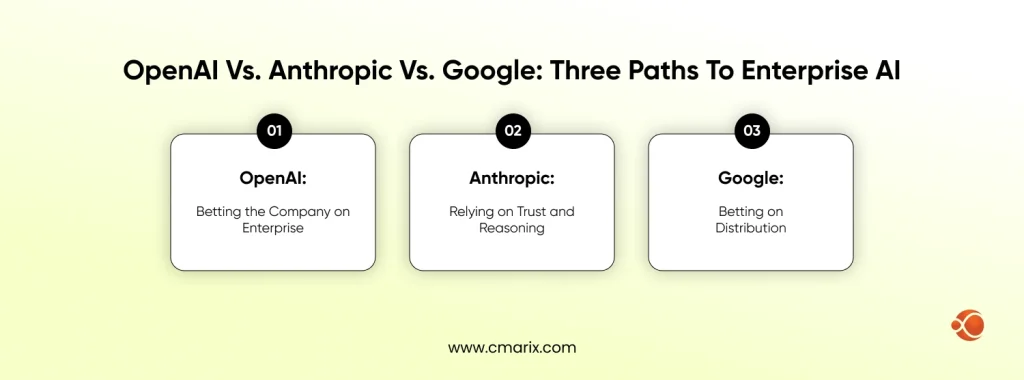
OpenAI: Betting the Company on Enterprise
For years, ChatGPT’s growth story was consumer first. Sam Altman has said plainly that the early models were not robust enough for most enterprise use cases. That has flipped hard.
Altman has called enterprise a “major priority” for OpenAI heading into 2026, and the numbers back him up. ChatGPT Enterprise reportedly serves more than 5 million business users, with SoftBank, Target, and Lowe’s among its named customers, while weekly ChatGPT users are nearing 900 million worldwide.
OpenAI even brought back former executive Barret Zoph specifically to run the enterprise sales push. That is a company chasing every business currently weighing ChatGPT alternatives, not one content to sit on consumer momentum.
Anthropic: Relying on Trust and Reasoning
Anthropic has opted for nearly the opposite path in addressing this challenge. Rather than concentrating first on reaching consumers in numbers from the outset, Claude was conceived with an emphasis on robust reasoning, reliability, and commercial trust from day one.
Another fascinating aspect of Anthropic is how quickly it is growing. The CEO of Anthropic (Dario Amodei) spoke at a conference organized in April 2026 regarding the safety of AI and the annual revenue run rate of Anthropic. He said the organization has grown to $30 billion, meaning the company has grown 80 times compared with last year. The majority of this growth is attributed to the introduction of Claude Code.
Google: Betting on Distribution
Gemini’s edge was never about topping a leaderboard for a week. It is about being everywhere a business already works.
At Google Cloud Next 2026, Pichai said Gemini Enterprise was “the mission control center for the agentic enterprise.” This is no exaggeration either. For instance, Google claimed that “90% of the Fortune 100 are running Gemini Enterprise”. In addition, Google Cloud saw a 48% increase in its revenues along with a backlog of over $240 billion. The Gemini app alone grew from 750 million to 900 million monthly users in a quarter, while Google Model APIs surpassed 19 billion tokens per minute.
That is a distribution advantage neither OpenAI nor Anthropic can match today, because Gemini ships bundled inside Docs, Gmail, and Search, tools most businesses already pay for.
ChatGPT vs Claude vs Gemini: A Head-to-Head Look
Enough context. Here is how the three compare across the factors that matter most day to day.
| Factor | ChatGPT | Claude | Gemini |
| Core strength | Broad general-purpose use, plugins, largest existing user base | Long-form reasoning, careful writing, structured analysis | Deep Google Workspace integration, search-grounded answers |
| Context handling | Strong for most business documents and chats | Built for extended, document-heavy reasoning | Very large context window across Docs, Gmail, Vids |
| Ecosystem fit | Best for teams using OpenAI’s developer tools | Best for teams prioritizing well-reasoned output | Best for teams already living inside Workspace |
| 2026 momentum | ~900M weekly users, enterprise now a top priority | $30B ARR run rate, 80x growth in Q1 | ~90% of Fortune 100 use Gemini Enterprise |
None of the three is best suited for everything. Each serves a purpose. And that needs emphasis, because choosing one AI to run all work processes is the number one mistake companies can make.
Compare ChatGPT, Claude, and Gemini against your workflows before choosing a platform.
Where Copilot, Perplexity, and Open-Source Models Fit In
ChatGPT, Claude, and Gemini aren’t the whole conversation, and any honest breakdown of ChatGPT ‘alternatives’ pros and cons has to mention what sits around them.
Microsoft Copilot uses the Office and Teams interfaces companies already pay for, making it the easiest choice for IT departments looking to avoid friction. On the other hand, Perplexity AI has managed to find its niche in being a research-oriented conversational AI tool with lots of citations, which is almost like a search engine with an accompanying language model.
Open-source AI models, from Meta’s Llama family to smaller fine-tuned models, matter for a different reason entirely: cost control and data residency. A business that cannot legally send customer data to any external API sometimes has no real choice but to self-host. It is a genuine trade-off. Open-source models usually trail the frontier labs on raw capability but win outright on control.
Which AI Wins for Specific Business Needs
Content Creation and Long-Form Writing
Long-form writing thrives on how you structure prompts. Firms looking for AI tools to generate content and conduct research find out that it is not the tool but the prompt that makes all the difference. Our AI Prompt Engineering guide explains the concepts that will help you generate better results from these three tools. Claude can maintain structure well in longer texts.
Coding, DevOps, and Technical Automation
Technical teams use AI differently than marketing teams. DevOps teams use it to detect risky configuration changes before deployment. Our ChatGPT DevOps Automation Guide features use cases such as scripting CI/CD and creating incident responses, among others. While Claude and Gemini both conduct effective code reviews, ChatGPT wins hands down in its plugin system.
Research That Needs to Be Accurate and Citable
Every general-purpose large language model can fabricate a source. This is called hallucination, and it is far from rare. Our breakdown of AI chatbot hallucinations explains why LLMs fabricate answers and how choices like retrieval-augmented generation fix it. If a team needs cited, verifiable research, none of these three generative AI tools should be trusted without a validation layer in front of them.
Customer-Facing Conversational AI and Commerce
But if a company wants to build a chatbot for its customers, whether for support or guided buying, the calculation shifts again. Conversational AI for commerce is all about the quality of natural language processing and the chatbot’s ability to handle edge cases gracefully without creating new answers. This is exactly what our AI chatbot development services team engineers do day to day.
Workplace Productivity and Ecosystem Fit
Gemini’s strength here isn’t its intelligence. Its strength lies in its proximity to where work happens, embedded in Docs, Gmail, and Vids. If you’re considering a technical integration for any of these models, check out our page on generative AI integration services.
Data Privacy, Security, and Compliance: The Enterprise Litmus Test
For any company that deals with regulated and sensitive data, data privacy and security can’t be treated as an optional cost. This is how the three platforms differ regarding enterprise-level security.
| Compliance Type | Standards Supported | Data Training Policy | Reference |
| Enterprise Privacy | SOC 2 Type II, ISO 27001 | No training on business data by default | OpenAI Trust Portal |
| Security Layering | Defense-in-depth, Zero Trust | Inherits Enterprise Data Protection (EDP) | Microsoft Trust Center |
| Regulated Data | HIPAA eligible (with BAA) | BAA available for Enterprise and API tiers | Anthropic Trust Center |
| Cloud Governance | FedRAMP High, GDPR, HIPAA | Managed via Google Cloud Security | Google Cloud AI Security |
Full details on each program are public: OpenAI Trust Portal, Microsoft Trust Center, and the Anthropic Trust Center each publish current certifications directly, and it is worth checking them yourself rather than taking a vendor’s word for it.
The financial stakes are high. According to the McKinsey Global Institute, implementing generative AI could add an estimated $2.6 trillion to $4.4 trillion annually to the global economy. The consequences of non-compliance go beyond just paying fines.
A Vertical Example: Choosing AI for a Regulated Industry
Consider a scenario where a doctor uses a chatbot to serve his clients. In this scenario, accuracy is not a given. According to research conducted at Stanford HAI, it is normal for hallucination to occur in such critical scenarios.
AI consulting services team analyzes failure modes before suggesting a stack. Secondly, the AI Chatbot Development team develops guardrails such as retrieval pipelines and human validation for the prevention of hallucinations.
Pricing and Free Tiers: What You Actually Get
These programs have similar free variants, which offer restricted use, a limited context window, and no access to the latest versions. You can use them for testing, but not for commercial use.
Paid tiers differ because they include different packages and services. ChatGPT’s paid tiers include admin controls and usage limits. Claude’s paid tiers offer long context windows and data management packages. Gemini’s enterprise tier is included in a Google Workspace account, which makes it cheaper than others in practice.
Talk to CMARIX about evaluating AI tools, integrations, and business workflows.
How CMARIX Helps You Choose and Integrate the Right AI Stack
Most businesses do not need to pick just one of these three tools. They need the right one for each workflow, wired together correctly. CMARIX has guided enterprise and SMB clients through exactly this decision, from evaluating AI software development partners to scoping full AI integration services projects. If a team needs dedicated AI talent to execute the build, our hire AI developers page outlines how that engagement works.
Whichever model a business ultimately chooses, the integration work around it decides whether the investment pays off. Talk to the CMARIX team before committing a budget to the wrong stack.
Final Words
ChatGPT, Claude, and Gemini each approach business AI differently. The right choice depends on your workflows, existing software ecosystem, data requirements, security needs, and technical goals.
Instead of standardizing every workflow on one model, businesses can evaluate each platform against specific use cases and integrate the tools that fit those requirements. A workflow-based approach also makes it easier to manage privacy, validation, and enterprise integration requirements.
For organizations planning AI adoption in 2026, the key question is not simply which model is better. It is which AI capabilities align with the way your business actually works.
FAQs About ChatGPT vs Claude vs Gemini
What is the main reason to choose an alternative over ChatGPT?
Companies will switch if they need something ChatGPT doesn’t provide: stronger compliance, better integration with their existing software, or more reliable reasoning. The reason for the change is seldom based on intelligence.
Which AI is best for creative and long-form writing?
While Claude can retain better structure and tone in lengthy documents, its performance depends heavily on prompt quality. The AI prompt engineering guide describes how to write prompts that work best in general.
How do the free versions of these AI tools compare?
The free tiers on all three platforms have usage limits, limited context length, and limited access to more advanced language models. You can use them only to see whether they fit your needs, not for business.
Which AI tool is better for workplace productivity?
Gemini has an advantage for organizations within the Google Workspace environment, thanks to its integration with Docs, Gmail, and Vids. Both ChatGPT and Claude excel at functioning independently of any ecosystem.
Is there a better AI alternative for coding and technical tasks?
All three handle code review and generation competently. ChatGPT’s plugin and API ecosystem currently gives it an edge for direct DevOps tool integrations, a topic our ChatGPT for DevOps Automation guide covers in detail.
Which AI should I use if I need accurate, cited research?
You shouldn’t trust any of them for citations without a verification step. Our guide to AI Chatbot Hallucinations explains why fabricated citations happen and what architecture actually prevents them.