




Key Highlights
- AI in web development is not a trend, but how professional groups work more efficiently, save on budgets, and think intelligently.
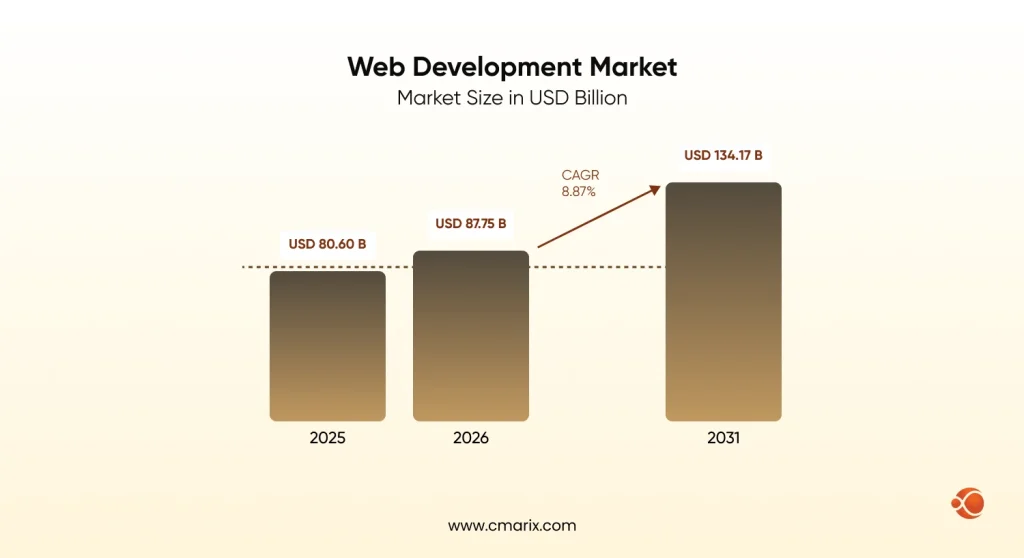
- The global web development market stands at an estimated of around $87.75 billion, which will cross above $134 billion by 2031.
- AI website builder platforms are projected to hit $3.24 billion, climbing toward $17.43 billion by 2035 at a 20.55% CAGR, as per Precedence Research.
- From AI-powered code generation to automated testing and intelligent chatbots, every layer of the dev stack is changing.
- Human creativity still matters; AI amplifies it, it doesn’t replace it.
Something fundamental has shifted in how websites and web applications get built. AI has inserted itself into every stage of the development lifecycle from the first wireframe to the final performance audit, and teams that embrace this are delivering in weeks what used to take months.
This guide breaks down what AI in web development looks like in practice: which tools matter, where the ROI shows up, what the real limitations are, and where things are headed. Whether you’re a developer, a product lead, or a business owner, figuring out whether to build vs buy AI software, this is the full picture.
What Is AI in Web Development?
AI in web development means using large language models, machine learning models and intelligent automation at various stages of building, maintaining and optimizing web products, generating code from natural language, personalizing content in real time, predicting user behavior, generating code from natural language, catching bugs before they ship, and building interfaces without writing a single line of code. What this really means is that AI doesn’t just speed things up; it changes what’s possible for a team of a given size.
Market Trends and Statistics: AI in Web Development
The international web development market is currently estimated at around $87.75 billion, and is expected to grow to as much as $134 billion by 2031, driven mainly by AI. The AI-powered website builders are growing at a rate of 20.55% CAGR. As per GitHub, developers who use Copilot can get their jobs done up to 55% faster. Among the key adopters are the e-commerce, fintech, health care, and SaaS sectors.
How AI Is Changing Traditional Web Development
Web development through traditional processes is resource-intensive and linear. The programmer codes. The designer designs mock-ups. The tester conducts tests. The content team adds text. Time passes as hand-offs happen. AI comes into the equation to disrupt the sequence. Copilot-like solutions churn out functioning components in seconds.
There are AI solutions for creating UI designs by providing text input. There are automated testing pipelines that test thousands of test cases overnight. Cycles shrink as development becomes more efficient. Teams that used to require six people for rolling out a new feature can now get it done in three without overburdening those people, since the process becomes less about human effort.As teams learn to optimize the AI software development process, they’re building internal playbooks: which tools to use at which stage, how to review AI output, and where human judgment is non-negotiable.
Key Ways AI Is Transforming Web Development
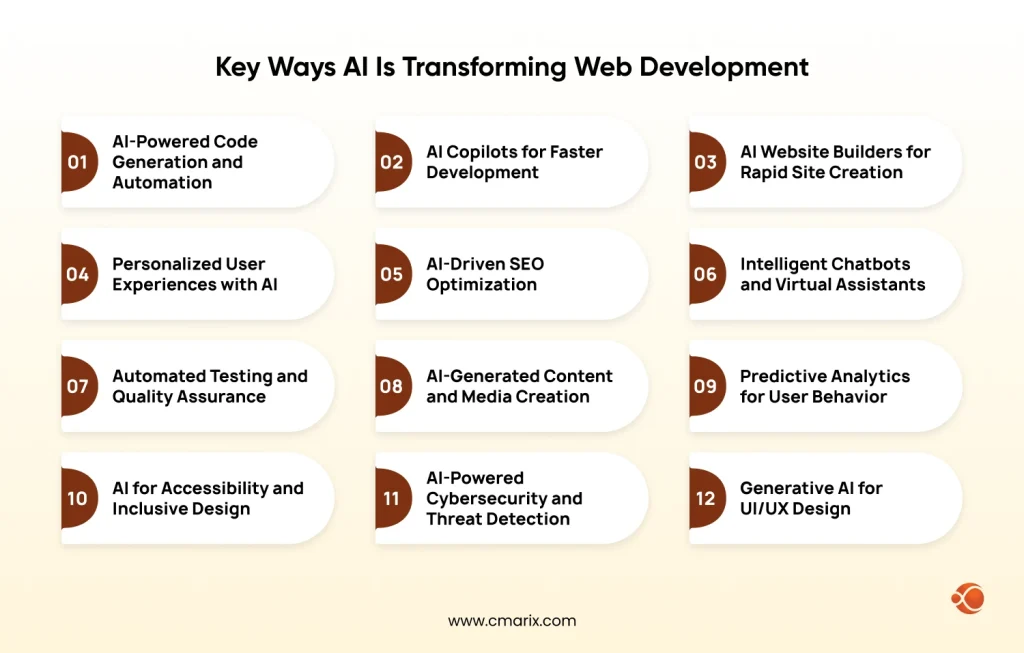
1. AI-Powered Code Generation and Automation
These tools, such as GitHub Copilot, Amazon CodeWhisperer, and Cursor, analyze the code and make recommendations based on it, not just code snippets but whole functions. This makes it much easier to develop the code for boilerplates, where you spend more time writing the same things over and over again.
This becomes particularly relevant when developing code on the MERN Stack with AI. It understands the pattern behind React components, Express routes, and MongoDB schemas and creates ready-to-use code within a few seconds.
2. AI Copilots for Faster Development
Copilots work alongside you inside the editor, learning from your writing style. The more context available, the better the suggestions will be. This is the basis of Agile development for AI-first SaaS, which operates faster due to the cognitive load being transferred.
3. AI Website Builders for Rapid Site Creation
Sites such as Wix ADI, Framer AI, and Durable allow non-programmers to launch a full site within hours. While not a replacement for customized solutions when developing a complex software application, they do cut down considerably on the time it takes to get an MVP live or build out a basic landing page. The AI website creation industry is estimated to be valued at $3.24 billion in revenue by 2035, growing at a CAGR of 20.55%, according to Precedence Research.
4. Personalized User Experiences with AI
Intelligent website personalization analyzes behavioral signals, recommendations, and layouts, and dynamically adjusts content. Amazon’s recommendation engine drives a meaningful share of its revenue. Netflix’s homepage looks different for every user. With the correct infrastructure, any web application can deliver this at scale.
5. AI-Driven SEO Optimization
Tools such as Surfer SEO and Clearscope examine high-ranking content, identify keywords that need to be used, and recommend structuring improvements. With regard to developers working on AI in WordPress development, the tools have now been integrated with the plugins used.
6. Intelligent Chatbots and Virtual Assistants
AI-powered chatbots nowadays can comprehend context throughout the conversation, process thousands of conversations at once, and generate genuine conversions. If you provide customers with precise answers to their queries at 2 am rather than making them wait until office hours, there is a good chance that your sales will increase.
7. Automated Testing and Quality Assurance
Applitools, Mabl, and other companies use artificial intelligence to detect anomalies within your interface, from visual regression problems to accessibility issues and broken flows. Deploy faster with fewer defects because you have overcome the QA bottleneck.
8. AI-Generated Content and Media Creation
From descriptions to hero images, content is being created by AI that used to require entire dev teams. This represents an accelerated content production cycle and the opportunity for web teams to experiment with A/B messaging tests on a massive scale.
9. Predictive Analytics for User Behavior
Optimization techniques help us understand which customers will leave, which items will be trending, and which content will cause people to engage, even before such an event takes place. Proactive decisions, therefore, are made.
10. AI for Accessibility and Inclusive Design
The AI-powered technology audits websites based on the WCAG standards, makes suggestions regarding the improvement of the color contrasts, highlights keyboard navigation problems, and generates alt text, thus making the process of accessibility much more automated.
11. AI-Powered Cybersecurity and Threat Detection
Artificial intelligence systems detect unusual traffic, identify bot activity, flag SQL injection attempts, and respond to DDoS patterns in real time. Once integrations are complete, any dev team can deploy.
12. Generative AI for UI/UX Design
Tools like Uizard, Figma AI, and Galileo AI generate interface layouts from text prompts and convert sketches into wireframes. This accelerates the design phase and provides developers with higher-quality handoffs.
Best AI Web Development Tools in 2026
| Category | Tool | Primary Use Case | Best For |
AI Coding Assistants | Cursor | AI-powered coding and refactoring | Managing large codebases |
| Claude | Code architecture guidance and reviews | Architecture planning and code review | |
| GitHub Copilot | AI-assisted code completion | Everyday coding productivity | |
AI Website Builders | Framer | Visual website creation | Design-oriented marketing websites |
| Webflow | No-code design and CMS workflows | Advanced design + CMS management | |
| Durable | Instant AI-generated websites | Fastest prompt-to-live-site workflow | |
| SEO & Content | Surfer SEO | Content optimization with live SERP data | Real-time analysis |
| Clearscope | Keyword optimization and content grading | Data-driven content strategy | |
| Semrush | SEO and competitive intelligence | Competitor research and SEO insights | |
| Design & Prototyping | Figma | AI-assisted UI/UX design | Collaborative interface design |
| Uizard | Start-to-wireframe generation | Rapid wireframing | |
| Galileo AI | Text-to-UI generation | High-fidelity UI concepts | |
| Testing & Monitoring | Applitools | AI-driven visual testing | UI regression testing |
| Datadog | AI-driven monitoring and alerts | Predictive observability and monitoring |
How to Choose the Right AI Tools for Web Development
Start with the real problem rather than features. If testing holds back your deployment cycles, start here. If you spend hours a day writing code that is just as bad as boilerplate, an assistant for code is going to pay off right away.
Consider how far integration into the IDE will reach, along with how accurate and big a window around the current cursor can be for your specific tech stack. Consider where the data will live; when working in highly regulated environments, enterprise-level tools are essential, or you need to self-host and have your data isolated.
Do the math early on – if the tool saves every developer two hours a week on a 10-person development team, then chances are it will pay for itself very quickly, considering most subscription costs. A solid AI ROI evaluation framework for CFOs accounts for dev time saved, defect reduction, and faster time-to-market, not just the tool’s sticker price.
Benefits of AI in Web Development for Businesses
- Faster development cycles- AI handles the repetitive, rules-based work. Your team focuses on architecture and product decisions.
- Reduced costs- Fewer hours per feature, fewer defects escaping to production, fewer rounds of revision. For agencies, a better margin. For product companies, more output from the same team.
- Better performance- Performance optimization algorithms catch slow queries, unoptimized assets, and rendering inefficiencies before users do.
- Higher conversions- Personalization increases relevance. Relevant experiences reduce bounce rate and improve conversion. The mechanism is simple: users engage more when the experience feels built for them.
- Lower technical friction- Teams without developers are able to develop useful sites without having to wait for their requests to come off the backlog. Actually useful for marketing, startups, and building internal applications.
- Better decision making- AI-powered analytics make patterns visible much faster than humans ever could. Better information leads to better decision-making, which builds on itself over time.
Real-World Examples of AI in Modern Websites
AI-Driven Personalization in E-commerce

Being one of the most popular surfwear brands in Australia, which has been operating on the market for over twenty years, Ghanda partnered with CMARIX to upgrade its online store using Magento 2. As one could expect, the platform was supposed to reflect the principles of inclusivity and sustainability, along with providing individual customer experience for all users regardless of age, size, and gender.
Among some of the improvements made in the website, we can name the ability to customize products, advanced listing pages, and sizing charts, which in turn significantly reduced the number of return orders related to the inability of buyers to find the necessary size. Besides, the Instagram live feed was implemented to update the webpage without any additional content management required.
Automated Customer Support with AI Chatbots
This firm that uses the SaaS model had its first line support system upgraded with a chatbot based on a language model that learned from its own documentation and previous tickets. This solution deals with 67% of queries raised by customers without the need for escalation. Response time was reduced from 4 hours to under 30 seconds.
AI-Based Product Recommendations
In an AI-based product recommendation case, an electronics company used behavioral data to capture in real-time at the cart level with the help of collaborative filtering technology. The abandonment rate reduced by 14%, whereas cross-sell revenues went up by $2.1 million. Recommendation relevancy is recalculated on a daily basis through conversion signals.
AI-Powered Fraud Detection
A Fintech company operating with a large number of transactions incorporated the use of an anomaly detection algorithm in its payment system. This algorithm detects any transaction that differs in behavior based on the user’s activity, such as location, odd timing, device used, or even transaction amount. The fraudulent transaction volume decreased by 71% in Q1 post-implementation.
Ready to build a future-ready web platform? Let’s discuss your AI roadmap.
Challenges and Limitations of AI in Web Development
| Challenge | What It Means in Practice |
| Data Privacy and Security | AI tools often process sensitive codebases or user data. Enterprise agreements with strict data handling are required for regulated industries. |
| Bias and Accuracy | AI-generated code can be subtly wrong. Generated content can reflect training data biases. Human review is non-negotiable. |
| Overdependence on Automation | Teams that stop thinking critically about AI output ship bugs faster than before. AI amplifies both good and bad decisions. |
| Legacy System Integration | Older codebases don’t always play well with modern AI tooling. Significant migration work may be required. |
| Ethical Considerations | AI-driven personalization and behavioral tracking raise real questions about user consent and transparency. |
Future Trends in AI Web Development 2026-2027
Autonomous AI Agents for Web Operations
We’re moving toward agents that take end-to-end ownership of tasks like tracing it to the root cause, receiving a bug report, writing a fix, opening a pull request, and notifying the relevant team. Early versions exist today. The trajectory over the next 2 to 3 years points toward genuinely agentic development workflows.
Voice and Conversational Interfaces
Voice-first web experiences are becoming practical for mainstream applications as LLMs make conversational interfaces far more capable than the rigid voice commands of five years ago.
The Future of No-Code and Low-Code Development
The future of Laravel with AI and other frameworks suggests even code-heavy stacks will gain AI-native layers that let non-developers configure and maintain applications that would have required senior engineering talent a year ago. As developers explore how to build AI Apps with Node.js, emerging patterns will push AI deeper into backend logic.
Let’s build a web solution that works smarter, and grows faster.
Best Practices for Implementing AI in Web Development
- Start with clear business goals: Identify a specific problem — slow testing, high defect rates, poor personalization — and evaluate tools against that. If you can’t articulate the ROI case, you’re not ready to implement.
- Choose tools based on real use cases: A startup building an MVP has different needs than an enterprise migrating a legacy system. Match sophistication to complexity.
- Combine human creativity with AI automation: Use AI for speed, human judgment for quality. Treat AI output as a first draft, not a final answer.
- Continuously monitor AI performance : Models drift. Recommendation engines trained on old data lose relevance. Build re-evaluation into your workflow, not just your launch checklist.
- Document your AI usage policies: Establish clear guidelines about what gets reviewed before shipping and what data can be shared with external AI tools.
Why Choose CMARIX for AI in Web Development?
CMARIX has been building custom digital products for over a decade. We’re not a consultancy that added an AI practice; we’ve been embedding intelligent systems into web applications long before it became a marketing category.
Our custom web development services consist of everything from architecture to deployment. Systems are developed AI-ready by default, not retrofitted as an afterthought. We develop recommendation engines, automated pipelines, intelligent search, and custom model integrations that actually work at scale.
If you’re a business leader figuring out where AI fits, we provide you with concrete recommendations grounded in your industry, your budget, and your stack, not generic frameworks.
Conclusion
Artificial intelligence for web development is the new standard. AI software development companies that do not utilize it are falling behind companies that have incorporated it into their existing processes.
The benefits are tangible, from faster development to reduced cost to better products. Risks abound as well, including the potential for bias and concerns around privacy and automation. Neither is fully capturing the truth of the matter. What it comes down to is execution, using the appropriate tools on the appropriate problems by people who know how to build software.
FAQ on AI in Web Development
How does AI automate the web development lifecycle?
AI handles code generation, automated testing, deployment monitoring, and content creation; freeing developers to focus on architecture and product decisions. It automates the parts that follow patterns, which is a large portion of day-to-day dev work.
Can AI improve website speed and performance?
Yes, performance-optimization algorithms identify such problems as rendering bottlenecks, poor query performance, inefficient assets, and caching issues. AI-based monitoring identifies performance degradation before it impacts a significant number of users in production environments.
Will AI replace web developers?
Not quite, but it’ll affect what they do with their time. There’s increasing demand for those who can analyze artificial intelligence products, spot any errors made by the software, and make new products out of them more quickly than before.
How does AI drive profitability for web agencies and businesses?
A reduction in the number of cycles equates to reduced expenses. Automated testing leads to fewer mistakes. Enhanced personalization will improve the conversion rate. The compounded impact over a period is enormous.
How does AI create hyper-personalized user experiences?
Web personalization by intelligence makes use of signals about how the visitor behaves – how far down they have scrolled, what they have clicked on, and what they have bought. On a larger scale, this means that every visitor sees a different version of the same website based on their behavior.
What are the best AI tools currently available for web development?
Coding – GitHub Copilot, Cursor, Claude.
Design – Figma AI, Uizard.
Testing – Mabl, Applitools.
SEO – Surfer SEO, Clearscope.
No-code site builder – Framer, Durable.
The appropriate tools depend on your tech stack and team size, among others.