





Quick Summary: Google SynthID is an invisible watermarking technology that helps identify AI-generated images, audio, video, and text. It embeds signals into content during generation, allowing detectors to recognize marked content even after common edits. However, it works only with participating AI tools, and extensive rewriting can weaken text detection. For enterprise AI security, businesses should combine SynthID with C2PA Content Credentials, human review, and clear governance policies. Under Article 50 of the EU AI Act, providers must also prepare to meet applicable AI content marking and transparency requirements.
Google SynthID is an invisible watermark that marks AI-generated images, audio, video, and text at creation. It lets enterprises trace content back to its source, even after edits. This CMARIX guide explains how SynthID works, where it falls short, and how to use it for enterprise AI security.
Key takeaways
- SynthID embeds a signal in AI-generated content that is designed to survive screenshots and light editing.
- SynthID is versatile and can be used with images, audio, video, and text; Google has open-sourced the text-based version.
- SynthID recognizes content produced by software that injects it, for example, Google’s AI models and OpenAI images.
- Since 7 October 2026, Google’s public SynthID Detector at synthid.com lets anyone check images, video, and audio for SynthID marks from Google and partners such as OpenAI, NVIDIA, and Kakao. It has no text option.
- Text-based watermarks are the least reliable case. Complete rewriting or translating undermines detector confidence.
- Provenance has become a compliance issue under the new Article 50 of the EU AI Act.
- Strong programs pair SynthID with C2PA Content Credentials, governance, and human review.
What Is Google SynthID?
Google SynthID is a watermarking technology from Google DeepMind. It embeds an imperceptible signal into AI-generated images, audio, video, and text as the model creates them. A detector later reads that signal to confirm the content came from a SynthID-enabled model.
The key difference between it and a visual logo or file metadata is its location. Removing metadata involves capturing an image or copying into a different document. However, SynthID’s marker is embedded in the pixel, waveform, or text.
The purpose is clear from the DeepMind SynthID page on Google. It should not interfere with the content and remain identifiable even when modified. As of May 2025,Google had found over 10 billion pieces of content to have the watermark. By October 2026, it reported more than 180 billion images and videos, plus 240,000 years of audio.
SynthID Timeline: Key Milestones
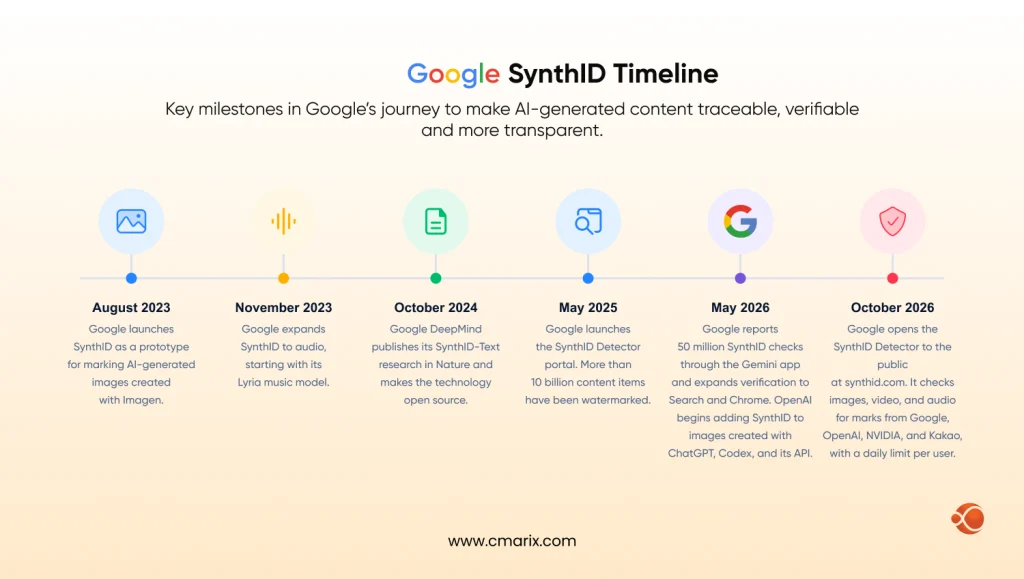
| Date | Milestone |
| October 2026 | Google opens the SynthID Detector to the public at synthid.com. It checks images, video, and audio for marks from Google, OpenAI, NVIDIA, and Kakao, with a daily limit per user. |
| May 2026 | Google reports 50 million SynthID checks through the Gemini app and expands verification to Search and Chrome. OpenAI begins adding SynthID to images created with ChatGPT, Codex, and its API. |
| May 2025 | Google launches the SynthID Detector portal. More than 10 billion content items have been watermarked. |
| October 2024 | Google DeepMind publishes its SynthID-Text research in Nature and makes the technology open source. |
| November 2023 | Google expands SynthID to audio, starting with its Lyria music model. |
| August 2023 | Google launches SynthID as a prototype for marking AI-generated images created with Imagen. |
Why Does AI Content Provenance Matter Now?
AI content is highly costly. According to the 2025 FBI Internet Crime Report, there were 22,364 instances where AI was used as technology, causing a loss of nearly $893 million. 2025 was the first time the FBI reported crimes involving AI technology separately.
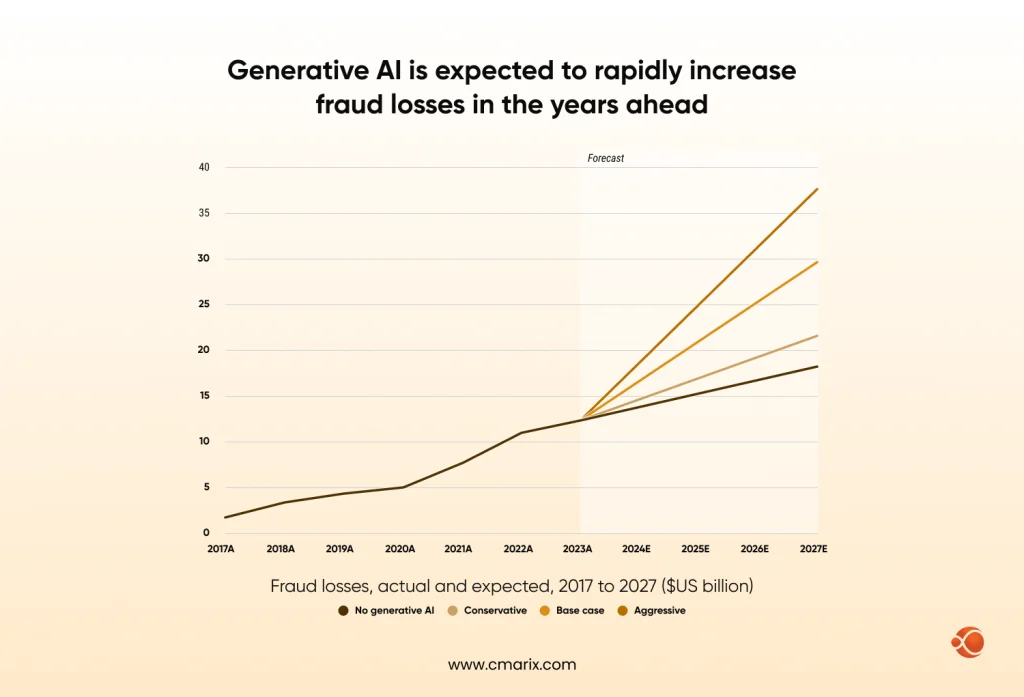
The curve points up. Deloitte projects that generative AI could push US fraud losses to $40 billion by 2027. That figure was $12.3 billion in 2023.
Deloitte’s projection implies losses more than triple in four years.
Text adds its own pressure. Google DeepMind researchers wrote in Nature that LLM output can be hard to tell apart from human writing. At scale, that changes the information ecosystem.
Regulators have noticed. Article 50 of the EU AI Act requires providers of generative AI systems to mark their output in a machine-readable format. The dates and the Code of Practice are covered later in this guide.
For business leaders, the message is simple. You can no longer rely on eyes and instinct to judge media. You need technical signals, clear policy, and trained reviewers.
A note on scope. The fraud figures above cover AI-enabled crime in general. SynthID helps only when content comes from a tool that embeds it. Criminals can use other tools, so watermarking is one layer, not a fraud fix.
How Does Google SynthID Work?
Every SynthID variant uses two parts. An embedder adds the signal while the model generates content. A detector later reads the signal from the output alone, without access to the original model.
The detector needs only the content and the right key. It never needs the original model.
| Content type | Where the signal sits | Built to survive |
| Images | Pixel data, spread across the whole image | Cropping, filters, color changes, lossy compression |
| Audio | Frequency patterns, added through a spectrogram | Added noise, MP3 compression, speed changes |
| Video | Video segments, using the image method | Frame rate changes, compression, common edits |
| Text | Word choice patterns during token sampling | Cropping, a few edits, mild paraphrasing |
How Does SynthID Watermark Images and Video?
Google’s DeepMind SynthID page says the watermark goes into the image or video segment at creation. It does not change visible quality. Google designed it to stay detectable after cropping, filters, and color changes.
Google first offered image watermarking to Vertex AI customers using Imagen. It later added SynthID to Veo for video. Google applies the image method to video segments. It designs the signal to survive changes such as frame rate shifts and lossy compression.
How Does SynthID Watermark Audio?
SynthID converts the audio wave into a spectrogram. A spectrogram maps frequencies over time. The embedder adds the watermark there and converts the result back into sound. Listeners hear normal music or speech.
Google says the audio watermark remains robust to added noise, MP3 compression, and changes in speed. A detector can also scan a track at different points. That helps flag which parts came from a model such as Lyria.
How Does SynthID Text Watermarking Work?
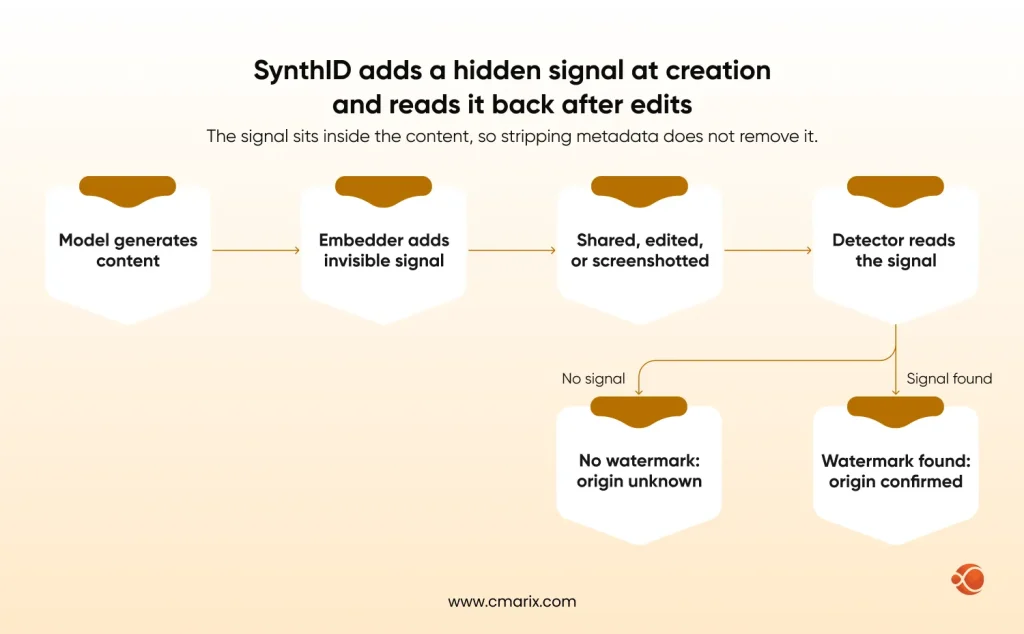
Large language models pick each word from a probability list. SynthID Text nudges those probabilities using a secret key. The nudge leaves a statistical pattern that readers cannot see but a detector can measure.
The Nature paper calls the method Tournament sampling. It changes only the sampling step, so it leaves model training untouched. Detection runs without the underlying model, which keeps checks cheap.
Google tested the approach on 20 million Gemini prompts to check that quality held up. The team found it could keep response quality while staying detectable. The researchers also say it beat comparable text watermarking methods on detection.
Google then open-sourced SynthID Text. A Hugging Face Transformers implementation lets developers add the watermark to their own models with a configuration object. No extra training is needed. Developers also get a Bayesian detector for scoring text.
What Detector Options Exist for SynthID Text?
Google’s developer documentation lets teams choose how exposed the detector is.
- Fully private: Only the model owner has access to the detector.
- Semi-private: Others check text through an API, without seeing the detector.
- Public: The detector is released for others to download and use.
That choice matters for security. A public detector helps transparency. A private one can make it harder for attackers to probe the watermark.
Where Can You Verify SynthID Today?
Google has built SynthID checks into several surfaces, and a major rival has joined in.
- SynthID Detector (synthid.com): Released for public use on 7 October 2026. Upload an image, audio file, or video, and it will tell you whether it finds a SynthID watermark. It can detect watermarks from Google and its collaborators, including OpenAI, NVIDIA, and Kakao, and will soon detect Apple’s as well. Login is required, and it allows about ten requests per person per day. No text option is available.
- Gemini app: Verification covers images, video, and audio. Google says people have used it 50 million times globally. Google is expanding the check to Search and Chrome.
- Google Search and Chrome: SynthID verification began rolling out in Search on 19 May 2026, with Chrome following. Google says its built-in checks now handle over a million requests a day.
- OpenAI: Since 19 May 2026, images from ChatGPT, Codex, and its API carry SynthID alongside C2PA Content Credentials. OpenAI also offers a verification tool for uploads.
Even so, SynthID is not a universal AI detector. A “not detected” result only means no SynthID mark was found. The content could still be AI-made by a tool that uses another watermark or none at all.
SynthID vs C2PA Content Credentials: What Is the Difference?
SynthID hides a signal inside the content. C2PA Content Credentials attach signed metadata that records how the content was made. Strong provenance uses both.
| Feature | SynthID | C2PA Content Credentials |
| Location | Inside pixels, audio, or text | Signed metadata attached to the file |
| Survives a screenshot | Usually yes | Often no, because metadata gets stripped |
| Detail provided | Limited, mostly a yes or no signal | Rich history of creation and edits |
| Main weakness | Covers only tools that embed it | Easy to remove from the file |
Google ships both. Its May 2026 announcement adds C2PA verification to Gemini, with Search and Chrome to follow. OpenAI describes the same layered idea. Watermarks give durability, and metadata gives context.
What Are the Limits of Google SynthID?
SynthID has clear limits. Google’s own documentation lists several for text. Enterprises should plan around all of them.
- Scope: It marks only content from tools that embed it. A missing watermark proves nothing about origin.
- Factual text: Watermarking works less well on factual answers. There is less room to adjust word choice without hurting accuracy.
- Rewriting and translation: Thorough rewriting or translation can sharply reduce detector confidence.
- Adversaries: SynthID Text is not designed by Google to be used alone to detect motivated adversaries.
- Truth: This technology verifies the source of images, but not their truthfulness. A watermarked image can still mislead viewers.
- Access: Detection for images, audio, and video is now public through synthid.com, but with sign-in and daily limits that Google says are meant to deter probing. Text detection is not available on the public site.
Treat SynthID as one signal in a wider review process.
How Does Google SynthID Help Enterprise AI Security?
For enterprises, SynthID works best as a triage and governance tool. As a generative AI solutions partner, CMARIX sees five practical uses.
- Impersonation checks. Security teams can test suspicious media against Google’s tools to rule Google AI output in or out.
- Fraud triage. Scams increasingly use synthetic media. When a suspicious clip may come from Google AI, a SynthID check helps your team quickly rule that source in or out. It will not flag content from other tools.
- Vendor and agency controls. Contracts could require partners to declare AI involvement and maintain provenance indicators.
- Audit trails. Team members could document whether generated content has a SynthID or C2PA mark before publication.
- Brand safety. Marketing teams can check AI imagery before it goes live and keep a record of its source.
No single check stops deepfakes. Layered controls do better.
Where Does Provenance Matter Most by Industry?
The table below shows CMARIX’s view of where provenance checks pay off first. It is analysis, not a vendor claim.
| Industry | Main risk | Where provenance helps |
| Banking and fintech | Deepfake voice and video used in fraud | Triage of suspicious customer and executive media |
| Media and publishing | Fake images and clips in news flows | Checks before publication and clear labels |
| Marketing and e-commerce | Unlabelled AI creative and brand misuse | Source records for every generated asset |
We help you build AI systems with the right security and governance.
Can Enterprises Watermark Their Own AI Models?
Yes, for text. Google open-sourced SynthID Text, and the Hugging Face release supports it for models such as Gemma. A team passes a watermarking configuration to the generation step. The model then marks its output.
Three choices matter before you start.
- Keys: The keys act as the watermarking algorithm. Treat them like any other credentials.
- Detection privacy: Decide whether to use private, semi-private, or public based on your scenario.
- Data suitability: Short or factual data contains little signal. Test on actual scenarios.
This route fits companies that run their own LLMs. It lets them mark output they ship to customers. CMARIX can help teams scope that work inside a wider generative AI integration project. Our CMARIX newsletter also covers what businesses building with AI should do now.
What Does the EU AI Act Require for Watermarking?
Article 50 requires providers of generative AI systems to ensure the machine readability of their synthetic outputs. It has applied since 2 August 2026. Under the Digital Omnibus on AI, any systems available on the market before that date must comply with marking by 2 December 2026. Obligations for watermark-detection interoperability are deferred further, to 2 February 2027.
The European Commission also published a final Code of Practice on marking and labelling AI-generated content on 10 June 2026. The Code is voluntary. It gives providers and deployers a practical route to meet Article 50. Final Commission guidelines on Article 50 followed on 20 July 2026.
The Act does not name SynthID. Providers choose their technical method, and the Code of Practice guides that choice. Google and OpenAI both pair watermarks with C2PA metadata.
Deployers have separate duties. They must clearly label deepfakes. They must also label AI-generated text published on matters of public interest, where no human review or editorial control applies.
Article 50 does not cover every AI-assisted document. It targets defined content types and defined actors. This is general information, not legal advice. Confirm your obligations with counsel.
How Can You Build an AI Provenance Strategy?
A workable plan needs six steps.
- Identify all AI technologies producing content within your organization.
- Determine which among them use SynthID, C2PA, or both.
- Include provenance verification steps within your review process.
- Label outbound AI-produced content according to your own policy and local law.
- Tag all AI-produced content in outgoing communications per your own policy and local legislation.
- Label outbound AI content according to your policy and local law.
- Set a response playbook for suspected deepfakes, including who escalates and how.
- Assign owners and review the process every quarter.
CMARIX recommends starting with the inventory. It shows where the gaps sit, and an AI governance assessment can turn those gaps into a plan. Teams building new products can also design marking in from day one through AI product development.
What Is Next for AI Watermarking?
Three clear trends can be seen. The first trend is the growing number of companies joining in. OpenAI’s May 2026 action illustrates how competitors can use a single watermark layer. Another trend is verification through everyday products: SynthID checks now sit in Gemini, Search, and Chrome, and the public detector widens access further.
Thirdly, regulations provide strict deadlines. The 2 December 2026 deadline leaves providers with only a brief window. Enterprises that map their AI flows now will adapt much faster than others.
Our team helps you integrate AI with clear controls and reliable workflows.
Why Choose CMARIX for Enterprise AI Security and Governance?
Watermarking is one layer of a trustworthy AI program. CMARIX helps enterprises build the other layers, from strategy to deployment.
- AI consulting services: Adoption roadmaps, use case validation, and an AI governance assessment before you scale.
- Generative AI integration services: Embed LLMs and multimodal AI into existing systems and APIs, with review steps built in.
- AI application development services: Custom AI applications, from strategy and proof of concept to deployment and MLOps.
CMARIX’s generative AI services also cover AI security and responsible AI. For background on transparency, read our guide to explainable AI.

Conclusion
Google’s SynthID lets enterprises effectively label AI-generated content. This technology embeds a unique signal into images, audio, video, and text. These signals resist common edits.
SynthID’s limitations are no less important. It identifies only content created with the participating tools, text cases work worst, and a watermark guarantees nothing. Robust solutions use SynthID alongside C2PA Content Credentials, strict policies, and trained reviewers.
The ticking clock of regulation makes the situation even more urgent. Under the EU AI Act, Article 50 has applied since 2 August 2026, and the deadline for marking by systems already on the market is 2 December 2026.
Start by inventorying your AI content tools, then close the gaps one layer at a time. CMARIX can help you plan that roadmap, build the supporting systems, and keep your AI trustworthy as it scales.
Frequently Asked Questions About Google SynthID
What is Google SynthID?
Google SynthID is an invisible watermarking technique developed by Google DeepMind. It embeds an invisible watermark into AI-generated audio, visual, and text at the time of creation. The detection system then detects the watermark later for authentication.
Is the SynthID watermark visible?
No. SynthID is imperceptible to people. It lives in pixel data, audio frequencies, or word-choice patterns, not in a visible logo or metadata field.
Who developed SynthID?
Google DeepMind developed SynthID. It launched in August 2023 as a prototype for Imagen images. Google later extended it to audio, video, and text.
Can SynthID detect content from any AI tool?
No. It detects only content from tools that embed it, such as Google’s models and partners’ image tools like OpenAI. A tool that never embeds SynthID leaves nothing to detect, so a “not detected” result does not prove content is human-made.
Does SynthID survive screenshots and edits?
Image watermarks are designed to resist cropping, filters, color changes, and lossy compression. Audio watermarks are designed to survive added noise, MP3 compression, and speed changes. Text is the weakest case, and thorough rewriting or translation can reduce detection accuracy.
How can I check content for SynthID?
Use the public SynthID Detector at synthid.com for images, video, and audio. Checks are also built into the Gemini app, Google Search, and Chrome. OpenAI also offers an upload tool. The public site does not check text.
Is SynthID open source?
SynthID Text is open source, and developers can use it through Hugging Face Transformers and GitHub. The image, audio, and video versions are not part of that release.
Can businesses watermark their own LLM output?
Yes. Teams that run their own models can apply SynthID Text with a watermarking configuration. They choose how exposed the detector is, from fully private to public.
Is SynthID the same as C2PA?
No. SynthID is an invisible watermark inside the content. C2PA is signed metadata attached to the file. They solve different halves of the provenance problem.
Does the EU AI Act require AI watermarking?
Article 50 requires providers of generative AI systems to mark output in a machine-readable way. It does not name SynthID, so providers can choose their method. A watermark is one option. Systems already on the market before 2 August 2026 have until 2 December 2026 under the Digital Omnibus on AI.
Does SynthID prove content is true?
No. It shows origin only. A genuine SynthID mark tells you an AI tool made the content, not whether the content is accurate.
Why does transparency matter alongside watermarking?
Watermarks show where content came from. Explainable AI shows why a system made a decision. Enterprises need both. Read this CMARIX guide on explainable AI and transparency in AI decisions, or browse the CMARIX AI Q&A hub.