


Key Takeaways
- There are 7 main types of AI agents, ranging from simple reflexive agents to multi-agent systems, and agents based on LLMs built upon them.
- The right agent type is determined by the complexity of the task, quality of data, and risk, rather than the most advanced-sounding choice.
- Each type of agent works well for different task requirements or business functions.
- Governance and security will determine the agent’s scalability.
AI agents have moved out of research papers and into support desks, codebases, and security operations. Ask ten product leaders what an AI agent is, and you will get ten answers, which is why choosing between the types of AI agents feels harder than it should.
Today, it can be a simple algorithm that turns a heater on, a planner that weighs trade-offs, or a group of LLM-based agents that pass tasks among themselves. While they share the same name, they have different designs, costs, and risk profiles. This blog describes different types of agents and their applicability in artificial intelligence.
Who This Guide Is For
- CTOs and tech leaders
- Product and operations teams
- Founders and startup teams
- Newcomers
Quick answers
- Is an AI agent the same as a chatbot? No. A chatbot responds, while an agent plans and acts toward a goal.
- Is agentic AI the same as generative AI? No. Generative AI creates content, and agentic AI uses it to pursue goals and take actions.
- What is a multi-agent system? A group of agents that coordinate on a shared task.
- Which type suits most businesses? Goal-based and LLM-based agents; utility-based agents when compromises are necessary.
- Can AI agents work without human oversight? Only for low-risk, well-tested tasks.
What Are AI Agents? Definition, Architecture, and Core Characteristics
An AI agent is a software system that senses its environment, makes informed decisions, and takes actions to reach a goal, with little step-by-step human direction. In classic AI theory, an agent in artificial intelligence is anything that senses through inputs and acts through outputs. You will also see it called an intelligent agent or an artificial intelligence agent. What has changed recently is the engine. Older agents ran on fixed rules, while many modern ones use large language models to reason, plan, and call tools.
How an AI Agent Works
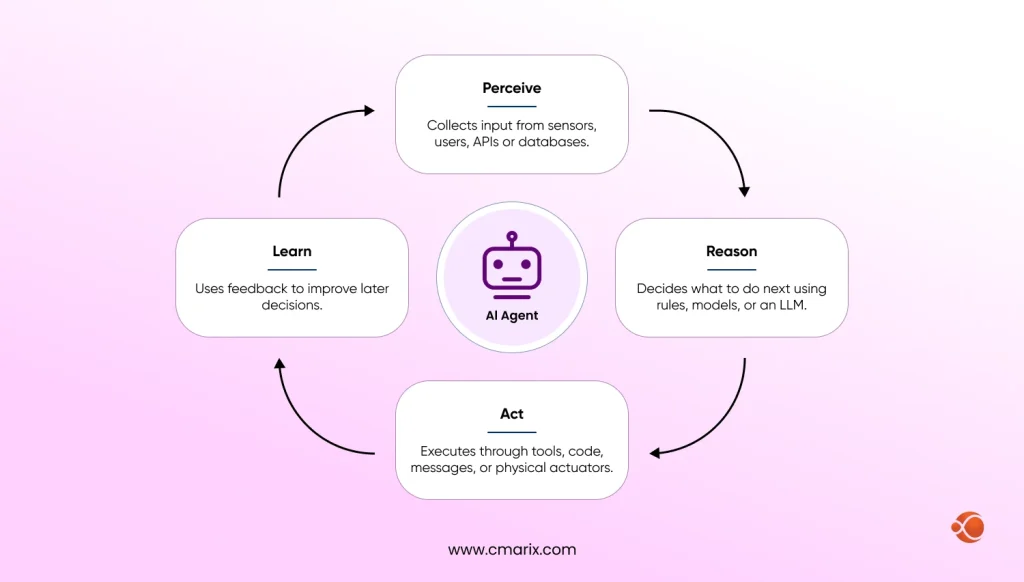
Every agent, either simple or advanced, runs some version of the same loop:
- Perceive: collects input from events, users, APIs, or databases.
- Reason: decides what to do next using rules, models, or an LLM.
- Act: executes through tools, code, messages, or physical actuators.
- Learn: uses feedback to improve later decisions, though not every agent does this.
Four Core Characteristics of an AI Agent
These are the classic traits from agent research. Each type covered below shows them to different degrees.
- Autonomy: operates without constant human control.
- Reactivity: responds to changes in its environment in a timely manner.
- Proactiveness: pursues goals instead of waiting for commands.
- Social ability: interacts with people or other agents to get work done.
AI Agent Architecture and Components
Most AI agent architectures come down to five layers.
| Component | What It Does | Example |
| Sensors or Input Layer | Receives data from the environment | Chat input, API events, camera feed |
| Memory | Stores context and past outcomes | Session history, vector store |
| Reasoning Engine | Decides the next step | Rules, planner, LLM |
| Tools and Actuators | Carries out the action | API call, code execution, robotic arm |
| Agent UI | Lets people interact with and oversee the agent | Chat window, dashboard, approval screen |
Getting these layers to work together is a design problem before it is a modeling one, which is why teams often begin with a wider plan for AI system development.
AI Agent Frameworks and Capabilities
AI agent frameworks such as CrewAI and LangGraph provide developers ready-made building blocks, so nobody has to code the loop from scratch. When you compare frameworks, look at how well they support these AI agent capabilities:
- Planning: breaking a goal into steps.
- Tool use: calling APIs, databases, and code safely.
- Memory management: keeping context across steps and sessions.
- Orchestration: coordinating several agents on one task.
- Monitoring and guardrails: logging actions, setting limits, and flagging failures.
Types of AI Agents Explained: 8 Core Types with Examples
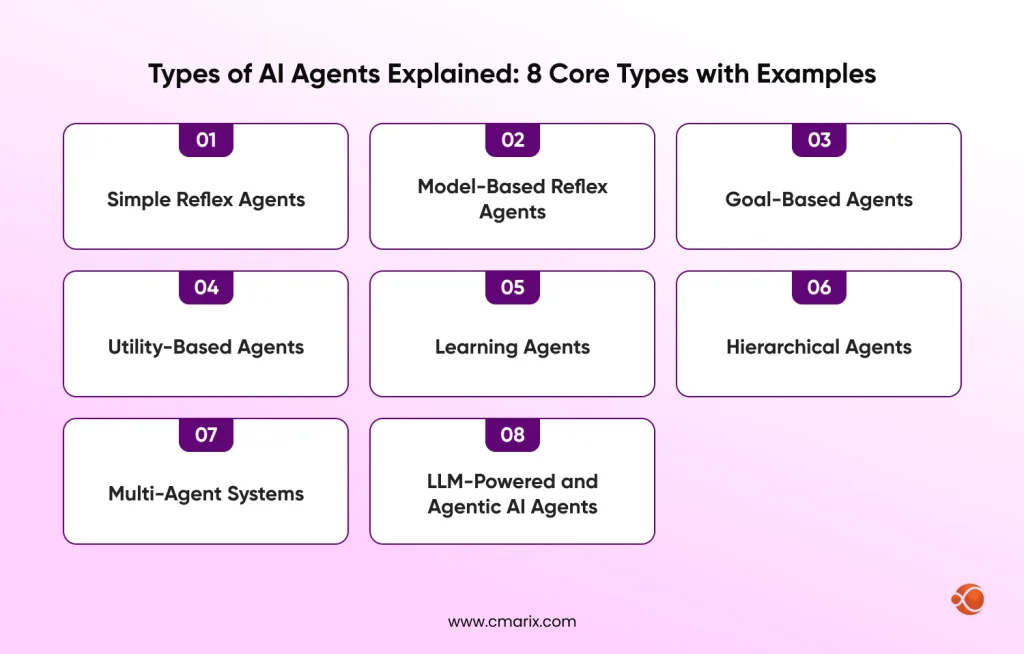
Agent categories fall into two groups. The first five categories follow the traditional classification of a book by how an agent makes decisions, and each successive category adds a feature absent in the preceding one, such as memory, planning, utility calculation, or learning. The last three categories show how agents are built and operate.
Simple Reflex Agents
A simple reflex agent maps its current input directly to action using condition-action rules. It has no predefined memory, so the same input will produce the same output; this makes the agent efficient, cheap, and easy to test.
- Example: a thermostat turning on heat if the temperature is below a certain point, or a rule that blocks a flagged sender.
- Limitation: it fails when conditions are only partly visible, because it cannot infer what it cannot see.
- Best fit: a stable environment with all information available.
Model-Based Reflex Agents
This type adds an internal model of the world, updated as new input arrives. That lets it track things it cannot see right now and estimate how its actions change the environment. Rules still drive the decision, but they run on a fuller picture than the current input alone.
- Example: A lane-assist system that keeps an eye on the vehicle once it disappears from sight, and a robotic vacuum that maintains an internal representation of its environment/state.
- Limitation: the model is not always accurate, and the agent does not think ahead while acting.
- Best fit: semi-observable environments where states are important in the short term.
Goal-Based Agents
The goal-based agent expects the action to bring it closer to its goal. The agent plans ahead multiple steps in order to reach its goal. Because the goal is explicit, you can change the target without rewriting every rule.
- Example: a navigation app that plans a route and reroutes when a road closes, or a support agent whose goal is to resolve a ticket.
- Limitation: it cannot distinguish between an optimal and a non-optimal plan as long as it achieves its goal, and may choose an inefficient path.
- Best fit: multi-step actions with an end point.
Utility-Based Agents
A utility-based AI agent picks the action with the highest utility, which encompasses how good the outcome is in terms of things like speed, cost, and risk. While a goal-based agent will stop when the goal is achieved, a utility-based agent will consider all paths that lead to the achievement of the goal and select the optimal trade-off.
- Example: a dispatch system weighing wait time, distance, and driver availability, or a trading agent balancing return against risk.
- Limitation: the utility function itself is only as good as the agent’s ability to define it, which requires significant work.
- Best fit: trade-offs between different considerations.
Learning Agents
Learning agents improve from experience instead of relying only on rules written up front. Learning agents in artificial intelligence usually have four parts: a learning element that updates behavior, a critic that scores results, a performance element that acts, and a problem generator that suggests new things to try. Teams often start from a base model and adapt it through AI Model Fine-Tuning so the agent begins closer to the target behavior.
- Example: fraud detection that is able to adapt itself to new attack strategies, or recommendation systems that become better as users click on the suggestions.
- Limitation: it requires good feedback data, and it may learn the wrong lessons from biased feedback.
- Best fit: environments where patterns change and feedback data is available.
Hierarchical Agents
Hierarchical agents divide tasks by layers. The lower levels take care of execution, whereas higher levels formulate the goal and delegate tasks. Since each level is responsible for a specific task, failure is easier to identify and isolate the extent of its influence.
- Example: in the case of the warehouse, the planning entity will assign picking activities to robots that must plan by themselves.
- Limitation: Bad initial planning influences all other levels, and delegation takes time.
- Best fit: large tasks that can be subdivided into small tasks.
Multi-Agent Systems
A multi-agent system puts various agents in a shared environment, where they cooperate or compete. In one common pattern, a lead agent assigns work to specialist workers and merges their results. In other words, peer agents negotiate directly, which suits problems with no single decision-maker.
- Example: a supply chain structure that includes different agents for inventory management, demand forecasting, and logistics that use signals.
- Limitation: coordination overhead grows with every agent added, and one agent’s error can spread to the rest.
- Best fit: complex problems that need specialized roles working together.
LLM-Powered and Agentic AI Agents
These are the types of agentic AI most teams meet first. An LLM sits at the core and does the planning, reasoning, and tool calling, often reviewing its own output before acting. In practice, they blend earlier types, combining goal-based planning with memory, tool use, and sometimes various agents in a loop. Enterprises are wiring these agents
into approvals, ticketing, and reporting, as covered in our guide to enterprise AI agents.
- Example: a process whereby the agent accesses the support ticket, reviews the order information, provides a refund up to certain limits, and sends the response back.
- Limitation: outputs are less predictable than rule-based agents, so they need guardrails, logging, and human review for high-stakes actions.
- Best fit: open-ended, language-heavy workflows.
In reality, however, these types are combined. For instance, the support platform can make use of reflex rules for routing critical tickets, LLM agents for solving routine issues, and a learning module that will help improve responses based on feedback from customers. The type selection is nothing more than deciding on the combination of decision-making rules.
Types of AI Agents at a Glance
These eight are compared together in the following table for you to see their differences at a glance.
| Type | Decision Logic | Memory | Complexity | Example | Best Use Case |
| Simple Reflex | If-then rules based on current input | None | Low | Thermostat | Stable, rule-driven tasks |
| Model-Based Reflex | Rules plus an internal world model | Short-term state | Low to medium | Robot vacuum | Partly visible environments |
| Goal-Based | Plans actions toward a goal | Task state | Medium | Route planner | Multi-step tasks with a clear end state |
| Utility-Based | Scores outcomes and selects the highest-utility option | Task state and preferences | Medium to high | Dispatch or trading agent | Decisions with trade-offs |
| Learning | Improves from feedback | Long-term experience | High | Fraud detection | Patterns that keep changing |
| Hierarchical | Higher-level agents delegate tasks to lower-level agents | Held at each level | High | Warehouse orchestration | Large, decomposable tasks |
| Multi-Agent | Agents coordinate or compete | Shared and individual | High | Supply chain agents | Complex workflows with specialized roles |
| LLM-Powered | An LLM reasons, plans, and calls tools | Context plus external memory | Medium to high | Ticket-resolution agent | Language-heavy, open-ended |
Our AI engineers map your use case to the right agent design.
AI Agent and Applications: Roles Across Business Functions
AI agents and applications now reach every major function. The agent type usually follows the risk and complexity of the task.
| Role | Agent Type Used | Example Task | Outcome |
| Customer Support | LLM-powered, goal-based | Resolve a ticket end-to-end | Faster resolution, fewer escalations |
| Sales and CRM | Goal-based, learning | Score leads and draft follow-ups | Cleaner pipeline, quicker response |
| Software Development | LLM-powered, hierarchical | Write, test, and review code | Shorter delivery cycles |
| Finance | Utility-based, learning | Flag anomalies, balance risk and return | Fewer false flags, tighter control |
| Healthcare | Model-based, learning | Handle intake and scheduling | Lower admin load |
| HR | Goal-based, LLM-powered | Screen resumes, schedule interviews | Shorter hiring cycle |
| Supply Chain | Multi-agent, utility-based | Coordinate forecasting, inventory, and routing | Fewer stock-outs and delays |
| Cybersecurity | Model-based, learning, multi-agent | Detect, triage, and contain threats | Faster response times |
Customer Support Agents
Support is where many teams start. The agent reads the ticket, pulls order and policy data, acts within set limits, and hands complex cases to a person. Designing that handoff is the hard part, and our breakdown of AI customer service agentic workflows shows how enterprises structure it.
Automated processing can be done for less risky issues like password reset or order status check. The case, along with all details, is assigned to a human representative in case of a refund above a certain limit.
Software Engineering Agents
Coding agents plan a change, write it, run tests, and open a pull request for a review. Hierarchical setups let one agent break a feature into tasks while others handle each piece. For a closer look at where this is heading in delivery teams, see AI in software engineering.
Commonly, there is a planner agent who divides the ticket into tasks, a coding agent to code them, and a review agent who verifies the tests and styles. People still approve the merge.
Cybersecurity Agents
There are too many alerts to be read by security analysts. Agents handle alert triage, correlation of signals among tools, and containment of low-risk threats. Human intervention is reserved for any threat that affects production access. Our guide on AI agents for cybersecurity covers how enterprises deploy them. A common pattern is a triage agent that enriches each alert with threat intelligence and asset data, then hands an analyst a short summary with a recommended action.
AI Agents vs Chatbots vs Generative AI
These terms get mixed up constantly, so here is the clean split.
| Term | What It Does | Acts on Its Own? | Example |
| AI Model | Predicts or generates output from input | No | LLM, image classifier |
| Chatbot | Answers within a scripted or conversational flow | No | FAQ bot |
| AI Assistant | Helps a user complete tasks on request | Limited | Voice assistant, coding copilot |
| Generative AI | Creates text, images, or code | No | Text generator |
| AI Agent | Pursues a goal, plans, uses tools, and takes action | Yes, within set limits | Ticket-resolution ag |
An AI model is one component. An agent wraps a model with memory, tools, and a decision loop, so it can plan and act instead of only answering. For a deeper look at how an AI agent vs chatbot build differs in architecture and cost, we compare the two side by side.
Agentic AI vs Generative AI: The Core Differences
Generative AI creates content in response to a prompt. Agentic AI uses that ability inside a loop to reach a goal that it plans, calls tools, checks the result, and tries again if needed. One writes the email. The other decides who to email, sends it, and follows up.
What this really means is that generative AI is a capability, while agentic AI is a behavior built around it. Most LLM-powered agents combine both.
The differences show up in four places:
- Output: generative AI returns content, while agentic AI returns a finished task.
- Autonomy: generative AI waits for each response(prompt), while agentic AI decides its own next step.
- Tools: generative AI mostly works inside the chat window, while agentic AI calls APIs, apps, and databases.
- Risk: a wrong generative answer gets read before anyone acts on it, while a wrong agent action can change a live system.
Our team designs, tests, and deploys agents that fit your stack.
How to Choose the Right Type of AI Agent for Your Business
The AI agent will depend on the task rather than the prevailing trend. While goal-based and LLM-powered agents will be the starting point for most business processes, utility-based agents must be incorporated wherever trade-offs are needed. The selection criteria include:
- Task complexity: tasks that require reflexive actions only demand reflex agents, but tasks requiring multiple stages need goal-based or LLM-powered agents.
- Data availability: learning agents need quality historical data, and reflex agents need almost none.
- Risk tolerance: risky tasks require strict restrictions, approvals, and less complicated agents.
- Integration needs: an action agent requires good APIs and proper access rights in your system.
- Budget and upkeep: more autonomy means better testing, monitoring, and maintenance.
| Scenario | Recommended Type | Why |
| Fixed rules and stable inputs, such as alert routing | Simple Reflex | Predictable and cheap to run |
| Partly visible conditions, such as inventory or monitoring | Model-Based Reflex | Tracks state it cannot directly see |
| Clear end goal across several steps, such as ticket resolution | Goal-Based or LLM-Powered | Plans actions toward the outcome |
| Competing priorities, such as pricing or risk | Utility-Based | Scores and balances trade-offs |
| Patterns that shift, such as fraud or recommendations | Learning | Adapts based on feedback |
| Large tasks with many specialties | Hierarchical or Multi-Agent | Splits and coordinates the work |
Common Mistakes When Choosing an Agent Type
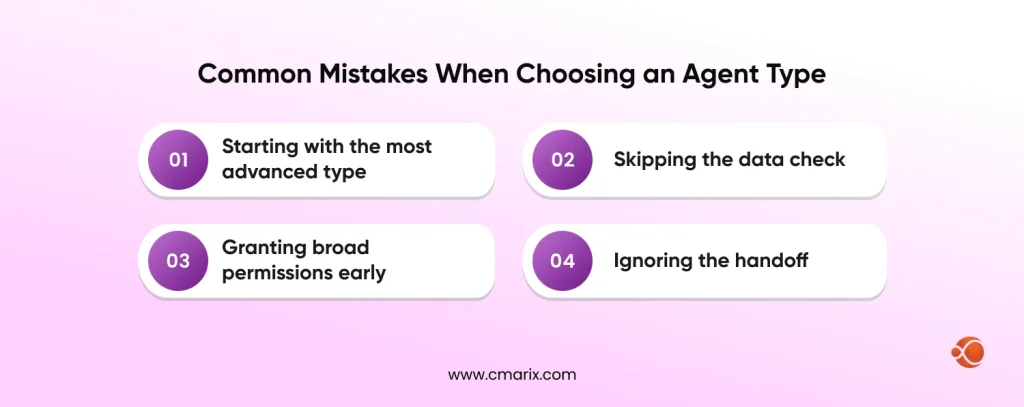
- Starting with the most advanced type: a multi-agent system for a rule-based task adds cost and failure points with no gain.
- Skipping the data check: Learning agents learn slowly when there is little historical data.
- Granting broad permissions early: start with read-only access and add write actions as the agent proves reliable.
- Ignoring the handoff: every agent needs a clear path to a person for cases it cannot handle.
Once you know the type, the next question is how it fits your application stack. Our guide to AI enterprise application development walks through that step.
Benefits and Challenges of Artificial Intelligence Agents
Key Benefits
- Round-the-clock execution: agents perform their daily routine duties without needing shifts and transfers.
- Faster cycle times: activities that used to go back and forth between departments get done within a single process.
- Consistency: the same rules and checks apply on every run.
- Scalable capacity: volume can grow without a matching rise in headcount.
Most teams first achieve this advantage from AI workflow automation tools that enable agents to interact with applications they currently work with.
Challenges and Governance
Action-oriented agents are riskier than reactive agents. Here are four challenges:
- Security and access: Since the agent with wide rights is a larger target for attacks, do not use it immediately.
- Hallucinations: An LLM-driven agent might make decisions based on hallucinations; validate the decision before acting on it.
- Integration debt: old-school systems and dirty data hinder the deployment more than the agent.
- Governance: who gets to review, approve, and audit agent decisions?
The issue then is whether AI agents can function without human supervision. Only in cases where the agent performs low-risk, fully validated actions. Any activity involving moving money, modifying access, or interacting with customers requires approval.
On February 17, 2026, NIST’s Center for AI Standards and Innovation launched the AI Agent Standards Initiative to support secure, interoperable agents. Its work runs along three pillars:
- Industry-led standards
- Open-source protocol development
- Research on agent security and identity
That is where the future of audit and identity lies for businesses.
Future of AI Agents: Trends to Watch in 2026 and Beyond
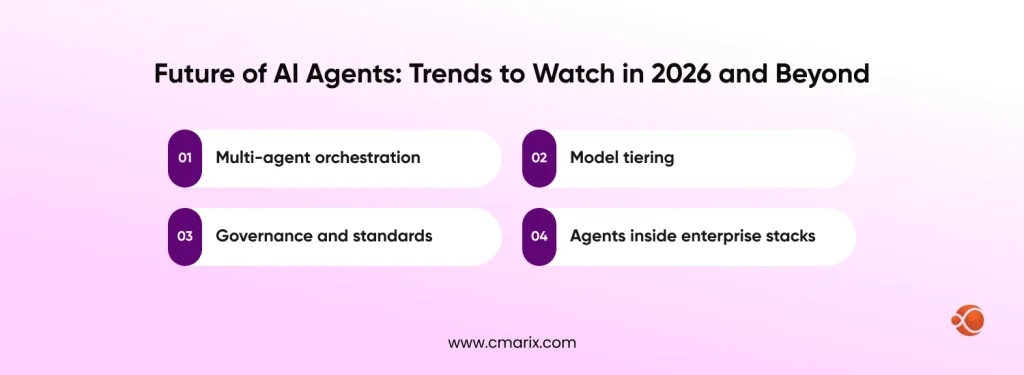
Four shifts are shaping where agents go next.
- Multi-agent orchestration: This will be done by a lead agent coordinating a group of specialized agents instead of the current system that is dependent on one agent doing all the work.
- Model tiering: GPT-6 Sol and GPT-6 Luna were released by OpenAI in September 2026 as fast and inexpensive alternatives to its GPT-6 Astra, which is the most powerful model. The cost was halved from the promotional pricing of the GPT-5.6 model, with the price reduced by 50 percent. GPT-6 Sol will cost $2 and $10 per million tokens, respectively, while Luna will cost $0.10 and $0.50, respectively. For agent modeling, this will allow simple tasks to be done using an affordable model.
- Governance and standards: identity, authorization, and auditing are on track to becoming procurement criteria, as with the example mentioned above of the NIST effort.
- Agents inside enterprise stacks: instead of standing alone, agents will sit inside CRM, ERP, and IT service tools where the work already happens.
Why Choose CMARIX as Your AI Agent Development Company
CMARIX develops AI agents for startups, enterprises, and global brands, from a single workflow agent to multi-agent systems wired into production stacks. As an AI agent development company, we begin with the business role and the risk level, then pick the simplest agent type that does the job.
Also, agents need the software around them. Our artificial intelligence app development work covers the interfaces, integrations, and controls that turn an agent from a demo into a dependable part of your product.
Conclusion
Differences in AI agents exist regarding decision-making, memorization, and coordination processes. Start by selecting the simplest AI agent that can perform the task; if it requires multi-stage activity, introduce goal-based or language model-based agents. The use of utility-based, learning, or multi-agent systems should be introduced only if the task demands their use.
FAQs About Types of AI Agents
What are the different types of AI agents?
There are eight main types: model-based reflex, simple reflex, goal-based, utility-based, learning, hierarchical, and multi-agent systems. LLM-powered agents combine various of these and are the type most businesses use today.
What are some real-world examples of AI agents?
A thermostat is a simple reflex agent, and a robot vacuum is model-based. Fraud detection is a learning agent, navigation apps are goal-based, and ticket-resolution agents are LLM-powered.
What does an AI agent do?
The AI agent senses its surroundings, thinks about what action to take, performs that action using actuators or tools, and may use feedback to improve later decisions. from the results of the action. In an enterprise, this translates to handling service tickets, responding to security incidents, scheduling jobs, or developing software on multiple systems.
What is a utility-based AI agent?
Utility-based agents select the actions that provide the greatest expected utility value for the action’s outcome based on various aspects of the outcome, including speed, cost, and risk. Goal-based agents determine whether the goal has been achieved. Utility-based agents determine how to achieve the goal.
What are the four core characteristics of an AI agent?
The four classical attributes involve reactivity, autonomy, proactiveness, and social ability. Reactivity refers to adaptation to changes, while autonomy refers to acting without external control. Proactiveness refers to goal achievement, while social ability refers to dealing with humans and other intelligent entities.
What is a learning agent in artificial intelligence?
A learning agent improves its performance from experience. It has four parts: a learning element, a critic, a performance element, and a problem generator. Fraud detection is a common example.
What is the difference between an AI model and an AI agent?
The model accepts an input and provides an output, such as a prediction or text generation. The agent is essentially a loop that uses one or more models, with memory and tools for planning and action.
What are the main capabilities of an AI agent framework?
A good framework will facilitate planning, tool use, memory management, multi-agent coordination, and monitoring. This will allow developers to develop agents without having to implement the perceive, reason, and act cycle from scratch.