


Quick Summary: AI agent development tools consist of frameworks, visual builders, and evaluation tools that take a language model and transform it into an agent capable of planning, calling tools, and executing multi-step tasks of multiple steps. In 2026, tool selection comes down to three layers: code-first frameworks (LangGraph, CrewAI, Microsoft Agent Framework, OpenAI Agents SDK, Claude Agent SDK, Google ADK, LlamaIndex), no-code/low-code builders (n8n, Dify, Microsoft Copilot Studio), and evaluation (LangSmith). Choosing the wrong layer is the most common reason pilots fail.
AI agents are shifting from demos to enterprise deployments, where they can access data, use enterprise systems, make decisions, and take multiple actions. However, developing an agent that can be deployed as part of an enterprise process is more than selecting an AI model. All the components mentioned affect its reliability.
The right tooling is dependent on the application being built. Code-based frameworks provide workflow flexibility, while low-code platforms can help teams accelerate pilot implementation. This guide compares 11 AI agent development tools, explains where each fits, and covers the key security, standards, and implementation factors enterprises should consider before choosing a platform.
Quick Answer:
- Need control over state, branching, and audit trails? LangGraph or Microsoft Agent Framework.
- Need a multi-agent prototype this week? CrewAI.
- Already committed to one model vendor? Use that vendor’s SDK: OpenAI Agents SDK, Claude Agent SDK, or Google ADK.
- Building agents over large document sets? LlamaIndex.
- Business teams building without engineers? n8n, Dify or Microsoft Copilot Studio.
- Every build, regardless of tier: add tracing and automated evals (LangSmith or an equivalent) before the pilot, not after it.
- Key numbers: 40% of firms earning more than $1 billion have scaled their AI agents, up from 27% last year (McKinsey, August 2026). The agentic AI agents market is expected to expand from $10.9 billion in 2026 to $182.9 billion by 2033 (Grand View Research). Over 40% of projects involving agentic AI could be scrapped by 2027 (Gartner).
Why the Tooling Decision Matters Now
McKinsey’s State of AI survey found that 40% of companies with revenue above $1 billion are scaling AI agents, up from 27% a year earlier.
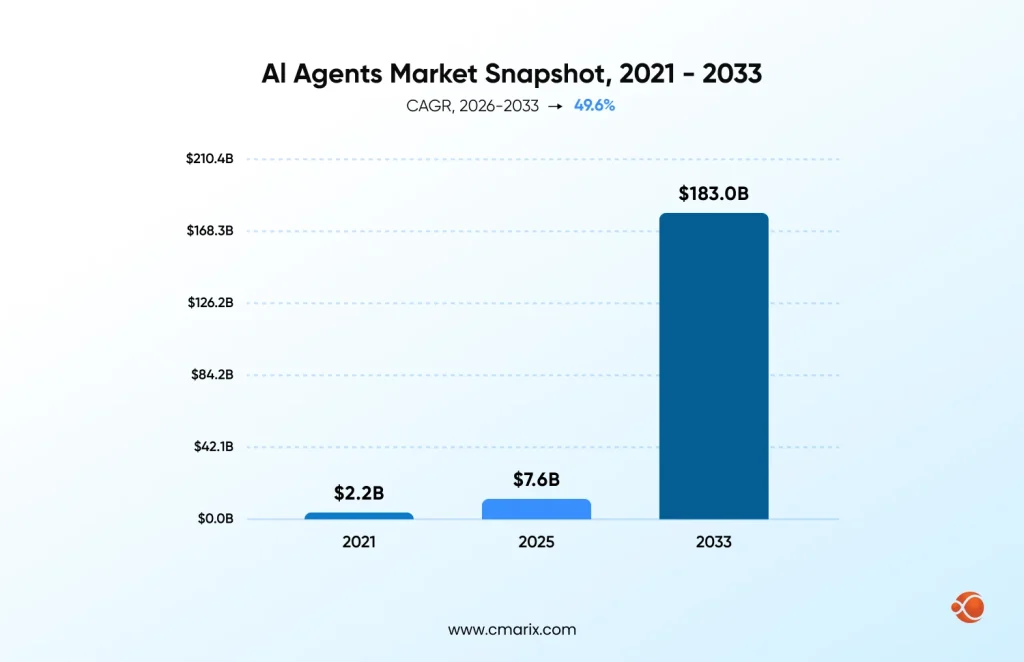
Grand View Research projects the market will reach USD 182.9 billion by 2033. Growth comes with a warning: Gartner expects more than 40% of agentic AI projects to be canceled by the end of 2027 over cost, unclear value, and weak risk controls, and says most current projects are “driven by hype and are often misapplied.” Your tool choice sets your cost curve and your security posture, so it deserves real scrutiny. For more numbers, see our AI agents statistics report.
What Are AI Agent Development Tools?
AI agent development frameworks are software frameworks that enable you to create, connect, test, and deploy AI agents. An AI agent differs from a regular chatbot because it can plan its actions and communicate with third-party applications such as CRM/ERP. For more information about how AI agents differ from chatbots, please read: AI agents vs. chatbots.
The Six Layers of an Agent Stack
| Layer | What it does | Typical tools |
| Model | Reasoning and language | OpenAI, Anthropic, Google, Meta, Mistral |
| Orchestration | Controls the loop, state and handoffs | LangGraph, CrewAI, Microsoft Agent Framework |
| Tools and protocols | Lets the agent call APIs and data | Function calling, Model Context Protocol (MCP) |
| Memory and retrieval | Holds context and grounds answers in your data | LlamaIndex, vector databases |
| Guardrails | Limits what the agent may do | Permissions, approval gates, policy checks |
| Evaluation and observability | Shows what the agent did and whether it worked | LangSmith, Langfuse, MLflow |
How to Choose an AI Agent Platform: 7 Criteria That Matter
Skip feature checklists at first. Start with these questions.
| Criterion | The question to ask |
| Control vs speed | Do you need explicit state and branching, or a working demo by Friday? |
| Model flexibility | Can you swap models without rewriting agent logic? |
| Multi-agent support | Does the tool coordinate several agents, or only one with tools? |
| Integration | Does it connect to your CRM, ERP, ticketing and cloud through MCP or standard APIs? |
| Security | Can you enforce role-based access, log every action and require human approval? |
| Observability | Can you trace each decision and replay a failure? |
| Team fit | Does your team write Python, TypeScript, .NET or no code at all? |
Cost must be on that list, but license cost never equals true value. Model operation, hosting, and the cost of keeping the agent operational always dominate. In addition to the agent builder comparisons, we provide a practical guide for choosing the best AI tools for business in 2027. You should also consider what type of AI agents you want to build and choose the tool that best fits your requirements.
11 Best AI Agent Development Tools for Enterprises
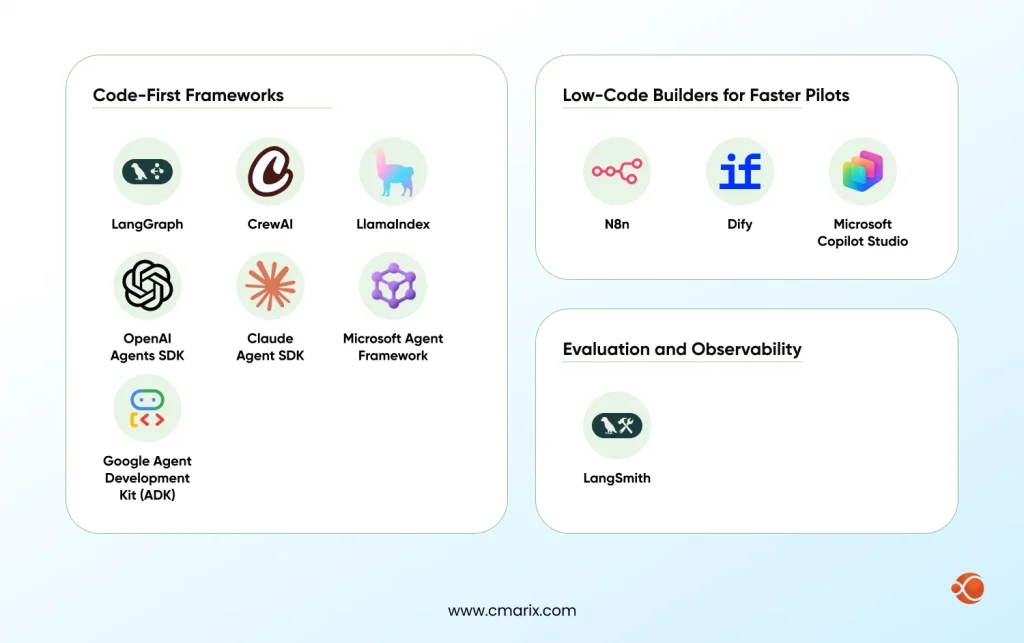
Here is the shortlist at a glance. Details follow by tier.
| Tool | Tier | Best for | Main trade-off |
| LangGraph | Code-first | Complex, stateful workflows | More upfront design |
| CrewAI | Code-first | Fast multi-agent prototypes | Less explicit control |
| Microsoft Agent Framework | Code-first | .NET and Azure enterprises | Newer ecosystem |
| OpenAI Agents SDK | Code-first | Lightweight handoff-based agents | Fewer built-in state tools |
| Claude Agent SDK | Code-first | Coding and computer-use agents | Built around Anthropic models |
| Google ADK | Code-first | Multi-language teams on Google Cloud | Pull toward Google’s stack |
| LlamaIndex | Code-first | Document-heavy knowledge agents | Not orchestration-first |
| n8n | Low-code | Agents wired into SaaS workflows | Complex logic gets messy |
| Dify | Low-code | Internal assistants and quick pilots | Less customization |
| Microsoft Copilot Studio | Low-code | Microsoft 365 organizations | Platform and licensing limits |
| LangSmith | Evaluation | Tracing, testing and monitoring | Eval design is still your job |
Versions and pricing change almost monthly in this category, so confirm both on each vendor’s site before you commit.
Tier 1: Code-First Frameworks for Custom Enterprise Agents
Pick this tier when agents touch money, regulated data, or core systems. You get the most control and the most responsibility.
1. LangGraph
In LangGraph, an agent is represented by a graph where each node represents an action, the edges represent decision-making, and the state is explicitly defined and checkpointed. This makes it easy to implement retries, branching, and human approvals.
Best for: workflows where you must explain exactly why the agent did something.
Watch out for: it demands more design work than role-based tools, and teams new to graph thinking take longer to get a first version running.
2. CrewAI
CrewAI organizes agents as a crew of specialists, each with a role, a goal, and a set of tools. Go from idea to a working multi-agent prototype faster than with most alternatives. It is model-agnostic.
Best for: research, content and analysis pipelines where several specialists hand off work along.
Watch out for: when auditors call for step-by-step controls, role-oriented abstractions may seem too abstract. Lots of people prototype this way but push their critical processes elsewhere.
3. Microsoft Agent Framework
Microsoft released Agent Framework 1.0 on April 3, 2026; it’s available for both .NET and Python, and replaces previous technologies known as Semantic Kernel and AutoGen. According to Microsoft documentation, it includes “AutoGen’s easy-to-use abstractions for agents along with Semantic Kernel’s enterprise capabilities and graph workflows.”
One real-world implication: AutoGen is currently under maintenance, which means it receives security patches but no new functionality. Plenty of “best tools” reviews from 2025 recommend it as a choice. For new installations, use its replacement.
Best for: organizations already running on Azure and .NET Core.
Watch out for: a younger ecosystem than LangChain’s, with fewer community examples.
4. OpenAI Agents SDK
A small set of primitives: agents, handoffs between agents, guardrails, sessions and built-in tracing. It is available in Python and TypeScript, and it can work with non-OpenAI models through compatible endpoints. The learning curve is short.
Best for: teams that want a minimal, official toolkit and are mostly on OpenAI models.
Watch out for: complex state management is more your problem here than in graph-based tools.
5. Claude Agent SDK
Anthropic’s SDK packages the agent loop behind Claude Code as a library for Python and TypeScript. It ships with file and shell tools, lifecycle hooks, subagents and in-process MCP servers, so it suits agents that read files, run commands and edit code.
Best for: coding agents, internal developer tooling and computer-use workflows.
Watch out for: it is built around Anthropic’s models, so a multi-vendor strategy needs a different layer.
6. Google Agent Development Kit (ADK)
ADK supports Python, TypeScript, Java and Go, which matters for enterprises with polyglot engineering teams. It handles hierarchical multi-agent designs and supports the Agent2Agent (A2A) protocol natively. Gemini is the natural model choice, though other models work.
Best for: multi-language teams on Google Cloud.
Watch out for: the framework pulls you toward Google’s infrastructure.
7. LlamaIndex
LlamaIndex started as a retrieval library and still shines there: document parsing, indexing, query engines and agent workflows built on top. If the agent’s job is answering from a large body of policies, contracts or manuals, retrieval quality decides success more than orchestration does.
Best for: knowledge, support and policy-lookup agents.
Watch out for: for multi-department workflows, pair it with an orchestration framework instead of asking it to do both jobs.
Our engineers work across LangGraph, CrewAI, AutoGen and the OpenAI Agents SDK, plus LlamaIndex for retrieval, which is why our framework choice follows the use case rather than a house preference.
Get insights about the right frameworks, models, integrations, and architecture for your AI agent projects.
Tier 2: Low-Code Builders for Faster Pilots
These visualization techniques overlay a visual canvas on the same concepts. They are just the ticket for many internal use cases, provided you know how to handle their limitations.
8. n8n
n8n is a visual workflow platform with AI agent nodes and an extensive integration library. It is self-hosted, which is great for teams with data residency regulations. It performs best where the agent just transfers data between different SaaS applications.
Best for: operations teams automating approvals, enrichment, and notifications.
Watch out for: once reasoning logic gets intricate, a canvas becomes hard to review and test. Our AI workflow automation services often start in a tool like this and move to code when the logic outgrows it.
9. Dify
Dify is an open-source drag-and-drop platform with multi-model capability and built-in retrieval pipelines. Non-technical teams and startups use it to build internal assistants.
Best for: knowledge assistants and proof-of-concept builds.
Watch out for: customization stops where the platform stops. Check export and self-hosting options before you build anything you will want to keep.
10. Microsoft Copilot Studio
Copilot Studio is a no-code builder tightly integrated with Microsoft 365. If your documents, mail and approvals already live there, an agent can reach them with little plumbing.
Best for: Microsoft 365 organizations that want business users building their own agents.
Watch out for: you work inside Microsoft’s boundaries, and licensing is tied to Microsoft subscriptions.
Tier 3: Evaluation and Observability
11. LangSmith
An agent you cannot inspect is an agent you cannot trust. LangSmith, from the LangChain team, records traces of each run, scores outputs against test sets, and monitors production behavior. Alternatives such as Langfuse, Weights & Biases, and MLflow fill the same role, and we combine several of them in our AgentOps work.
Best for: regression testing before every release.
Watch out for: the tool records and scores. Deciding what “good” means for your agent is still your work. Start with our guide to AI agent evaluation if that step feels vague.
AI Agent Tooling Standards You Should Know
Standards decide whether an agent built today still works with next year’s tools. Three efforts matter most.
| Standard | What It Does | Current Status |
| MCP | Common protocol for agents to access data and tools. | Donated to the Linux Foundation’s Agentic AI Foundation in Dec 2025. Linux Foundation announcement |
| A2A | Lets agents built with different frameworks communicate. | Supported by Google ADK and Microsoft Agent Framework. |
| NIST AI Agent Standards Initiative | Focuses on agent interoperability, security, and identity. | Launched in Feb 2026. Final guidelines were not yet available at writing. NIST announcement |
The practical advice: prefer tools that speak MCP, keep agent logic separate from vendor-specific features, and you keep your exit options.
Security and Governance: Where Agent Projects Actually Break
Software’s ability to take action changes the security threat model. Ten security risks are specific to agentic applications. The OWASP GenAI Security Project identified these in the “OWASP Top 10 for Agentic Applications,” released in December 2025. Two such risks worth committing to memory are “agent goal hijack” and “tool misuse.”
Both come down to the same solution. Reduce each agent’s privileges to the bare minimum. Then add gateways for irreversible operations and logging. A simple list of items:
- Keep tool access restricted. Don’t give an agent access to write tickets in the billing department when its job is to summarize them.
- Assume that all retrieved data may contain hostile code. Web pages and emails may do that too.
- Make the user approve certain actions. Refunds, data erasure, sending emails externally, and any regulatory processes fall into this category.
- Log every tool execution along with the identity used.
- Conduct a hostile test before release.
Dedicated platforms can help here, and we compare them in our review of AI governance tools for enterprises. Governance also shapes tool choice, since not every builder gives you per-tool permissions or audit trails.
Why Cheap or DIY Agent Builds Stall Before Production
A demo takes a weekend. A production agent takes a different kind of work. The same four problems keep coming up.
- No evaluation suite. The agent seems fine until a model update changes its behavior and nobody notices for a week.
- Tool permissions that are too broad. Fast to set up, painful to explain to a security team.
- Token costs nobody forecast. Multi-step agents call a model many times per task. This is the cost pressure behind many of the cancellations Gartner expects.
- Integrations that bend. Connecting to SAP, Salesforce,, or a legacy system with role-aware access takes more time than the agent logic itself.
None of this is a reason to avoid building. It is a reason to scope the first release small, and to bring in an AI agent development company when the project touches core systems. Teams that want to keep control can instead hire dedicated AI engineers who work inside their own process.
Build In-House, Run a Pilot, or Hire a Team?
| Route | Best when | Timeline | Cost signal |
| In-house build | You already employ agent-capable engineers | Depends on hiring | Salaries, model usage, hosting |
| Pilot with an AI partner | You need to prove value before committing | 2–6 weeks | USD 8,000–25,000 |
| Dedicated AI agent team | You are building a long-running agent program | 3–12+ months | USD 20,000–80,000+ per month |
| Outcome-based engagement | You want delivery tied to measurable results | 8–24+ weeks | USD 30,000–250,000+ |
The last three rows use our published engagement models. Your own figures will depend on integrations, data readiness, and compliance scope. For a broader view of budgets, read our guide on how much AI app development costs.
Most teams get the best results by starting with an AI proof of concept. Pick one workflow, define the success metric first, and decide the tool after you see the data.
Start with a focused proof of concept and turn a validated workflow into a production-ready AI agent.
How We Build Production AI Agents at CMARIX
At CMARIX, we are an AI software development company founded in 2009 and based in Ahmedabad, with 240+ engineers and clients in 46+ countries. We hold ISO 9001, ISO 27001, ISO/IEC 42001, and CMMI Level 3 certifications. In our AI agent practice, we have shipped 35+ agents, support 8 frameworks, work with 200+ enterprise clients, and average 9 weeks from kickoff to pilot. We offer many dedicated AI services, including custom AI agent development services.
Our delivery process is staged so that risk gets retired early:
| Phase | Timeline | Key deliverables |
| Discovery and use-case prioritization | Weeks 1–2 | Goal mapping, workflow audit, scope document |
| Tool and integration planning | Weeks 2–3 | Tool inventory, API contracts, risk matrix |
| Architecture and design | Weeks 3–5 | System diagram, orchestration plan, guardrail specification |
| Development, prompt and memory engineering | Weeks 4–6 | Prompt library, memory schema, retrieval design |
| Evaluation and safety testing | Weeks 6–8 | Test suite, KPI baselines, CI regression pipeline |
| Pilot deployment | Weeks 8–11 | Beta rollout, feedback loop, stakeholder sign-off |
| Scaling and optimization | Ongoing | Monitoring, governance documentation, improvement roadmap |
We set sample KPI targets per agent type. For knowledge and support agents, we aim for a deflection rate of at least 50% and a customer satisfaction score of at least 4.5 out of 5. For multi-agent systems, we aim for at least 40% fewer human touchpoints. These are planning targets, not guarantees, and we refine them during discovery. For multi-agent designs, our write-up on multi-agent systems across industries shows how we structure those pipelines, and our enterprise AI agents implementation framework covers the rollout side.
Our AI Agent Case Studies and Client Work
| Case Study | Industry | What It Demonstrates |
| Anyvision | Security | AI-powered security solutions |
| PrefD | Recruitment | Web platform development, third-party integrations, and iterative testing |
| EasyDays | Retail | AI-driven retail applications |
If you want agents connected to existing systems, our AI integration services, which cover CRM, ERP, and ticketing connections with permission-aware access.
Strategy First, Then Code
If you don’t know where agents fit in your leadership’s plan, our AI consulting service starts with workflow audits and a detailed roadmap. To learn more about incorporating AI into applications, read our enterprise AI app development strategy guide.
Which Industries Benefit Most From Enterprise AI Agent Platforms?
Agents pay off fastest where work is repetitive, document-heavy, and rule-bound. Examples from our delivery work:
- Healthcare: clinical documentation agents that draft notes in real time and patient-support agents for routine queries. See our healthcare software development work.
- Banking and finance: fraud detection agents that monitor transactions and route high-risk cases for review. Details are on the banking software development page.
- Logistics: route-optimization and shipment-monitoring agents. Read about logistics and transportation software.
- Insurance: claims triage and policy guidance. Explore insurance software solutions.
Gartner expects agentic AI to be in 33% of enterprise software applications by 2028, up from under 1% in 2024. Expect your vendors’ products to arrive with agents inside them before you build your own.
Final Words
No one-size-fits-all solution for developing agents exists, and any claim otherwise from someone who doesn’t understand how you function is pure conjecture. Use the right approach based on risk: a coded agent creation system for agents that will interact with your critical systems, low-code for internal testing, and the evaluation layer for all. Select tools that support MCP so you can change your strategy if needed, and get permission/consent before deployment.
FAQs About AI Agent Development Tools
What are AI agent development tools?
These refer to architectures, SDKs, visual builders, and platforms that build AI agents that make plans, utilize tools, and accomplish sequential tasks. They consist of orchestration, memory, tool integration, guardrails, and evaluation. Examples include LangGraph, CrewAI, Microsoft Agent Framework, and n8n.
What is the difference between standard AI tools and agentic AI tools?
AI tools will answer the given prompt and end there. However, agentic tools will work towards achieving an objective through several stages, call upon other systems, and remember things. This is much more serious because the agent could make mistakes that go beyond giving the wrong answer.
What are the highest-rated agentic AI coding tools available?
Rankings shift every few months, and no single list stays accurate for long. The category includes terminal agents such as Claude Code and OpenAI Codex, plus IDE-based agents. We tested nine options in our guide to the best vibe coding tools for 2026–27.
Are there free tools available for building AI agents?
Yes. LangGraph, CrewAI, the OpenAI Agents SDK, Claude Agent SDK, Google ADK, Microsoft Agent Framework, LlamaIndex, n8n (self-hosted), and Dify are available under open-source licenses. The software is free. Model API usage, hosting, and engineering time drive the costs.
What features should I look for in an AI agent platform?
Look for model flexibility, agent coordination, integration via MCP or API, role-based access control, human intervention points, and tracing and evaluation capabilities. Make sure that you can export your agent’s logic should you ever change organizations. Prioritize security over convenience when sensitive information is involved. Ensure model flexibility, agent coordination, integration via MCP or API, role-based access control, human intervention points, and tracing and evaluation capabilities. Make sure that you can export your agent’s logic should you ever change organizations. Prioritize security over convenience when sensitive information is involved.
Can I build AI agents without strong coding experience?
Yes, within limits. Dify, n8n, and Microsoft Copilot Studio let non-developers build agents visually. They work well for internal assistants and approval flows. For customer-facing agents or deep integrations with ERP and legacy systems, you will probably need engineers.
How do AI agents utilize external tools?
Through function calling and protocols such as MCP. The model decides which tool to call and with what parameters. The framework runs the call and returns the result to the model, and the loop repeats until the task is done. Each tool should have narrowly scoped permissions.
What are AI agent tooling standards?
They are shared protocols and formats that let agents, tools and frameworks work together. The main ones today are MCP for tool access, A2A for agent-to-agent communication and AGENTS.md for instructions to coding agents. NIST’s AI Agent Standards Initiative is working on security and identity standards.
What industries benefit most from enterprise AI agent platforms?
Healthcare, banking and finance, insurance, logistics, retail and telecom see early gains because their work is high-volume and rule-based. Anywhere with heavy paperwork or repetitive support queries is a good candidate. Industry-specific agents are also the fastest-growing segment, according to MarketsandMarkets.
How do an AI agent management platform and a builder tool differ?
A builder tool is where you create the agent: its logic, prompts and tool connections. A management platform governs agents after they exist: access control, monitoring, cost tracking and policy enforcement. Larger organizations usually need both. If you are weighing partners to help with either, here is how to choose the right AI agent development company.