




Key Takeaways
- The AI agent vs chatbot debate is not about which tool is “better.” It’s about matching the right technology with the right task.
- Chatbots follow scripted or rule-based logic. AI agents make autonomous decisions using LLMs, connected tools, and context memory.
- Businesses adopting agentic workflows are seeing measurable cost and speed gains, not just automation for its own sake.
- The AI Agents Market size was valued at USD 7.84 billion in 2025 and is projected to rise to USD 52.62 billion by 2030 at a CAGR of 46.3%, signaling where enterprise budgets are heading.
- Choosing between the two, or combining them, comes down to integration needs, task complexity, and how much autonomy your workflow can safely hand over.
Most businesses already have a chatbot somewhere in their stack, answering FAQs, routing support tickets, or collecting leads on a landing page. That’s worked fine for years. But the ground has shifted. Customers now expect systems that can actually resolve problems, not just point them toward an article or a human agent. That’s where the AI agent vs chatbot conversation starts to matter for real business outcomes, not just IT roadmaps.
These two concepts are frequently used interchangeably within marketing material, although they refer to different technologies, and choosing the wrong one can be very pricey when applied to certain processes. Using a chatbot in a process that requires reasoning and judgment will drive your customers crazy and kill any hope of adoption of the technology. Putting an AI agent in place of a simple flow script is just an unnecessary expense and risk without any obvious gain.
This blog walks through what each technology actually is, where the real differences show up in daily operations, and how to decide which one or which combination fits your business before you spend budget on the wrong architecture.
What Is a Chatbot? Definition and Core Functions
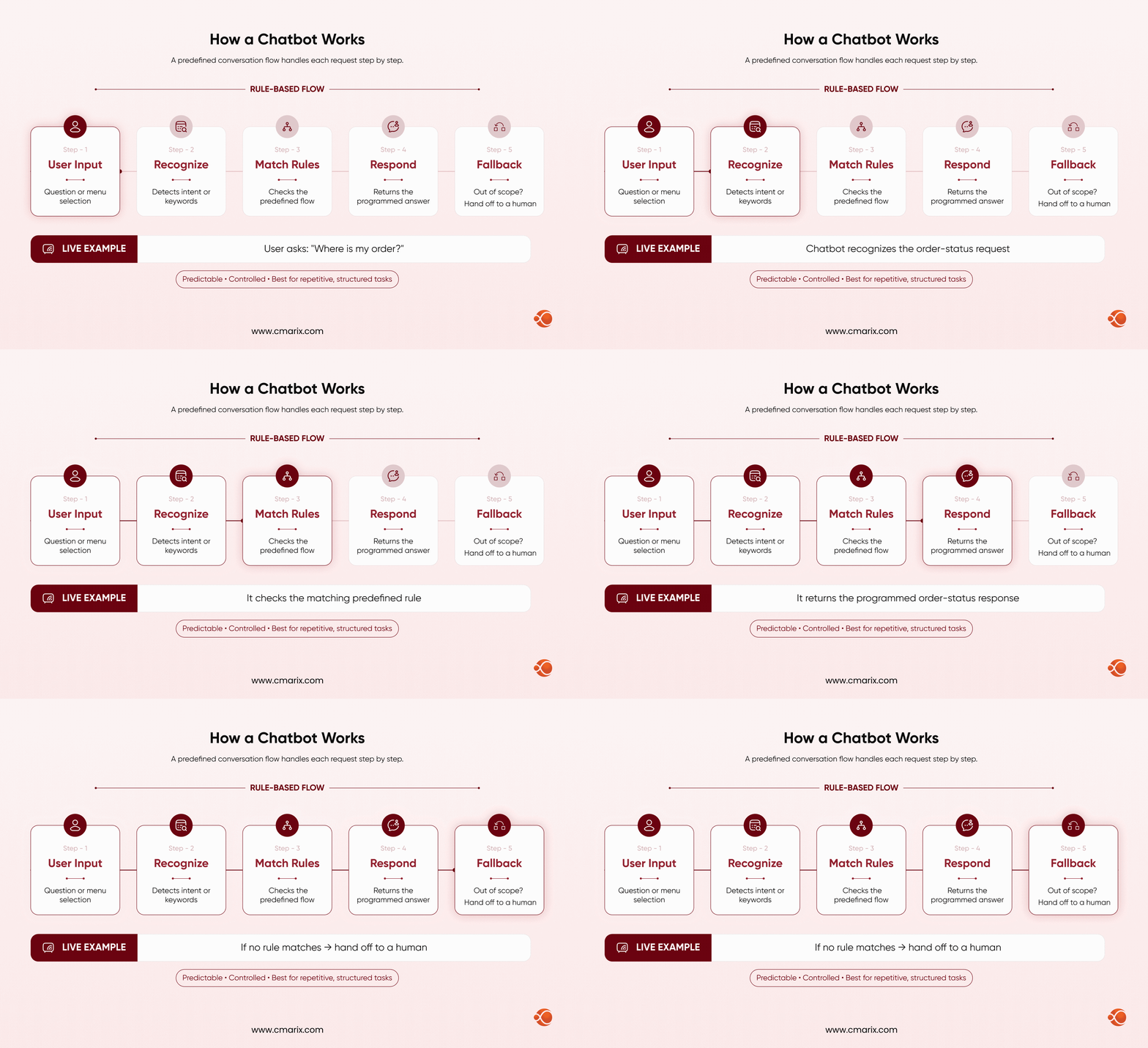
A chatbot is an interface designed to perform specific conversations. Most chatbots work based on rules: the if-then responses related to keywords or options selected by users from menus. A few advanced chatbots use Natural Language Processing(NLP) to identify phrasing differences, but the basic operation of the system remains programmed. If you ask a question out of scope of the chatbot’s programming, it will either give you a general answer or redirect the conversation to a human.
It is a strength rather than a weakness if used correctly. As all paths have been set out in advance, chatbots are predictable and controllable. An internal compliance department would be able to verify in advance everything that a chatbot will do in any situation, which is an important consideration in highly regulated environments.
Chatbots can therefore be relied upon when performing such repetitive tasks as answering order status inquiries, scheduling appointments, gathering a lead’s contact information, and guiding users through your return policy. Chatbots are easy and affordable to build and predictably perform their assigned duties; this is why many businesses have continued to use them to provide customer support. If you’re weighing whether a chatbot even makes sense for your business before going further into the comparison, this breakdown of the benefits of chatbots for your business is worth a look before you commit a budget either direction.
Talk to our team and get a clear recommendation based on your actual workflow.
What Is an AI Agent? Definition and Core Functions
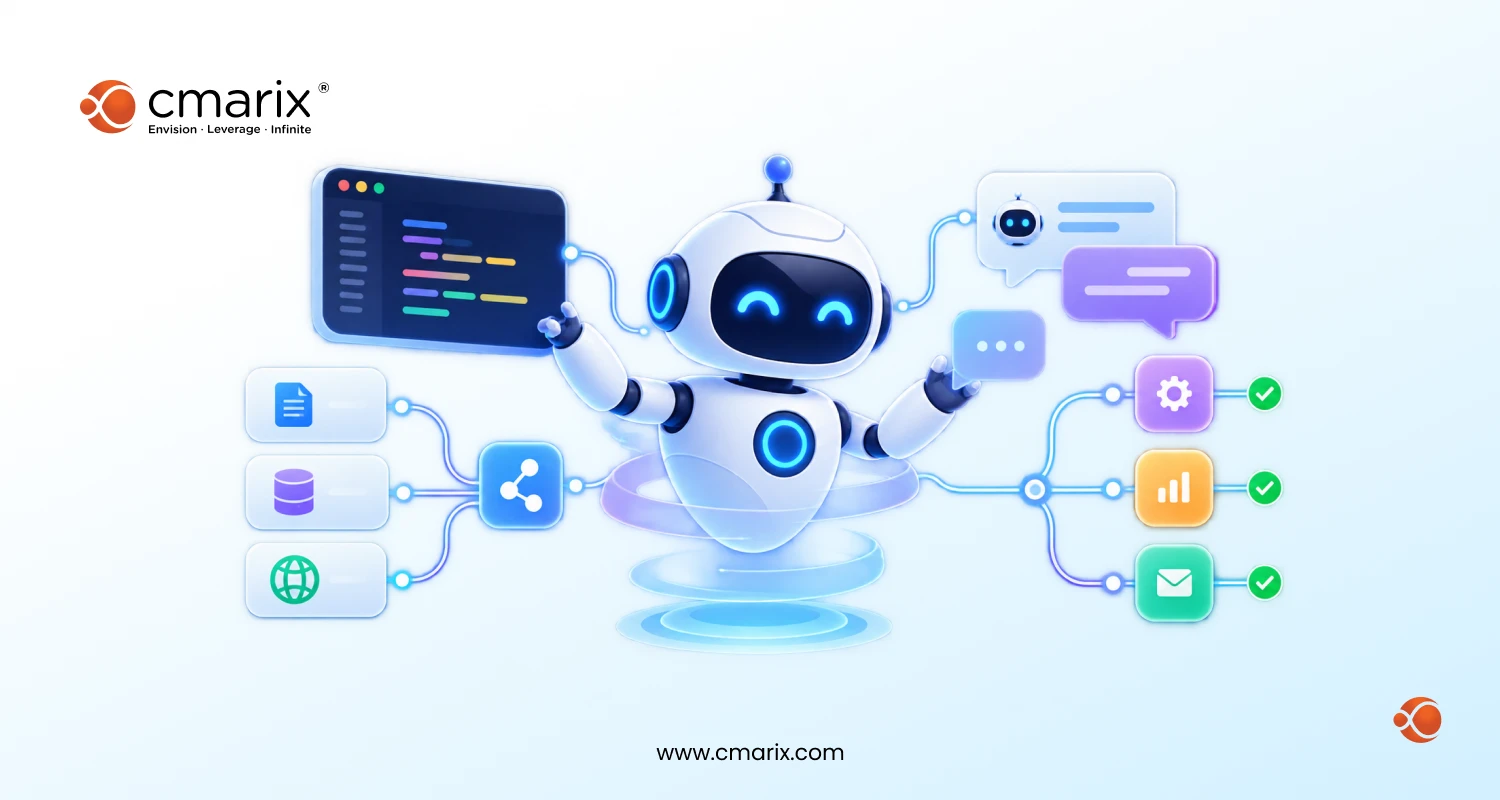
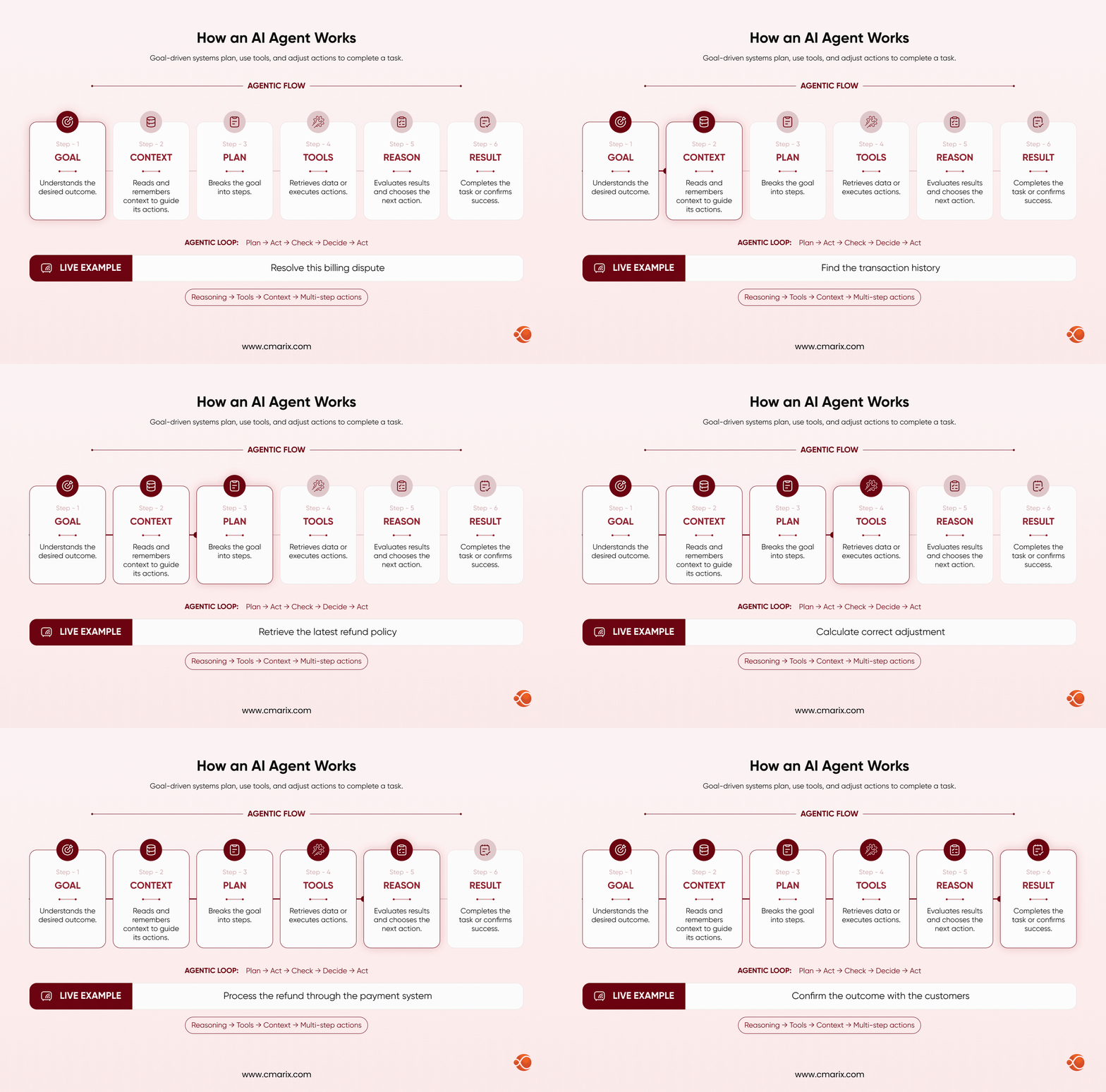
An AI agent, however, is an entirely different beast. Unlike the scripted system, it uses large language models and is built in such a way that it reasons about a particular goal, splits the task into smaller steps, and acts on it, not requiring any human approval for each step of action. This is what is meant by “agentic workflows.”
There are some technical components that make it possible. Function calling and webhooks enable the agent to execute actual tasks in other systems, such as updating a record in a CRM system or giving a refund. The Retrieval-Augmented Generation (RAG), which usually goes along with vector databases, enables the agent to use current and context-specific data rather than relying on its training only. Finally, autonomous decision-making is the component that really makes an agent different from a chatbot – the agent makes decisions about which tools to apply and in which order.
This is truly novel in the sense that an agent can maintain a goal throughout multiple interactions as well as across multiple platforms without the need for the person to remind the bot about the context of the interaction every time. If you ask it to “solve this customer’s billing dispute,” it will be able to find the transaction history, go through the refund policy, compute the adjustments, and confirm it, all as one connected process of reasoning.
This is the core of the AI Agent vs Chatbot distinction that businesses need to internalize before choosing a direction: one executes a script, the other makes judgment calls. If you want a deeper technical foundation, our piece on enterprise AI agents breaks down how larger organizations are structuring these systems.
AI Agent vs Chatbot: Key Differences Businesses Should Know
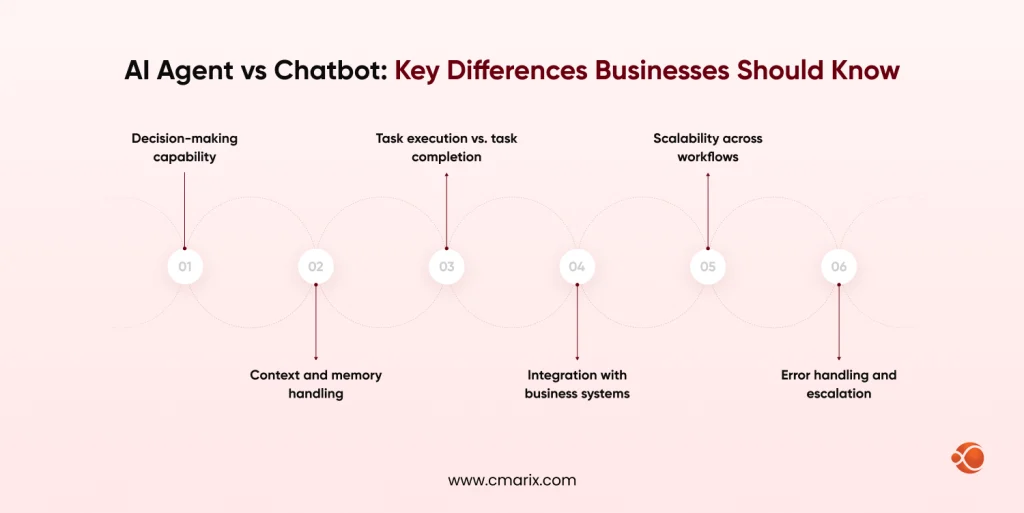
The chatbot vs conversational agent distinction isn’t just semantics. It shows up in six places that actually affect how a business operates day to day.
Decision-making capability
A chatbot selects a pre-written response based on matched intent. An agent evaluates a situation and decides on a course of action, sometimes one that wasn’t explicitly programmed in advance. This is the single biggest gap between the two, and it’s why agents can handle exceptions that would break a chatbot’s script entirely.
Context and memory handling
Chatbot agents have no memory whatsoever, meaning they forget everything after one interaction session, or just remember whatever is necessary for this particular session. The ability to remember previous conversations or other actions taken earlier is typical for agents. If a client asked for help three weeks ago, the agent will remember the situation.
Task execution vs. task completion
The task that a chatbot performs is sending a message, giving an answer, or forwarding a request. The task performed by an agent is solving the customer’s problem, completing the transaction, and confirming the results of work, usually involving several different systems.
Integration with business systems
Chatbots usually connect to one or two systems, typically a knowledge base and a ticketing tool. Agents are built to plug into CRMs, ERPs, payment systems, and internal APIs simultaneously, which is what allows them to actually finish a process end to end rather than just describe what should happen next.
Scalability across workflows
A chatbot scales well within its narrow lane but breaks down once a request falls outside its script. An agent generalizes better across variations of a task because it’s reasoning through the situation instead of matching it to a stored pattern, which means it holds up better as your product catalog, policies, or customer base grow more complex.
Error handling and escalation
A chatbot encountering an edge case will fail right away and delegate to the agent. It is often possible for the agent to try a recovery process by using different data or indicating the particular point of doubt before escalating, thus decreasing the number of cases that need to be escalated to a human. Understanding AI bot vs agent behavior at this level is what makes the next section, the actual side-by-side comparison, useful rather than abstract.
Comparison Table: AI Agent vs Chatbot at a Glance
| Factor | Chatbot | AI Agent |
| Underlying Logic | Rule-based or scripted, sometimes NLP-assisted | LLM-driven and reasoning-based |
| Decision-Making | Follows predefined paths | Makes independent decisions |
| Memory | Session-based or none | Maintains context across sessions |
| System Integration | Limited, usually 1–2 tools | Multi-system integration using APIs and webhooks |
| Handling Complex Tasks | Simple, repetitive, high-volume tasks | Complex, multi-step tasks |
| Setup Cost & Time | Lower cost and faster to launch | Higher cost and longer implementation |
| Auditability | High; every path is predefined | Lower; requires ongoing evaluation |
| Best Fit | FAQs, lead capture, basic customer support | Order resolution, workflow automation, business operations |
AI Agent vs Chatbot Use Cases by Industry
Seeing where each technology actually gets deployed makes the AI Agent vs Chatbot decision more concrete.
Customer support
A chatbot handles “where’s my order” and “how do I reset my password.” While an agent handles a customer disputing a charge, verifying policy eligibility, checking the transaction history, and issuing a resolution, all without a human touching the ticket.
Sales and lead qualification
Lead information is collected, and then the leads are assigned to a representative. The agents can qualify the leads by matching their firmographics, scheduling calls right on the calendar of the representative, and automatically following up with them if they become inactive, making lead generation into lead conversion, rather than just filling out forms.
Operations and back office
This is where AI and RPA for business processes merge with agentic AI. The agent is capable of finding discrepancies, reconciling invoice data across different systems, and correcting the problems that otherwise would have taken a person to compare spreadsheets manually.
Finance and lending
Agentic AI can be used for pulling information from the applicants and applying the information against the underwriting rules to come up with a decision. Only the borderline cases are reviewed by a human being as opposed to all applications.
Healthcare administration
Appointment booking and initial patient intake are performed by the chatbots. The agents are beginning to manage the tasks of checking for insurance eligibility and prior authorizations, which require the matching of several databases and conditional logic. In all of these cases, the same principle applies: chatbots do volume; agents do complexity.
Which One Does Your Business Actually Need? (Decision Checklist)
Before committing budget, run your use case through these questions:
- Does the task require several steps in several systems? (If yes, go for an agent. Chatbots won’t move around between your CRM, payment gateway, and inventory on their own.)
- Is the process high-volume but low-complexity? (Password reset requests, operating hours, simple FAQs – all those can be processed faster and cheaper by chatbots.)
- Is it likely that the process will require some judgment, rather than information retrieval? (Processes where you need to apply some judgment, such as deciding whether an exception for a refund exists, suggest an agent.)
- Do you already have workflow automation in place? (If so, our guide to AI workflow automation covers how agentic systems layer on top of it.)
- What does your team’s technical capacity look like? (Agents need more ongoing monitoring than chatbots. Factor that into your AI workflow automation solutions planning up front.)
Most businesses don’t end up choosing one over the other. They run chatbots for front-line, high-volume interactions and agents for the workflows behind them.
Common Mistakes to Avoid When Choosing Between AI Agents and Chatbots
| Common Mistake | Better Approach |
| One-size-fits-all thinking – Using one AI technology across the entire customer journey can overbuild some touchpoints while underserving others. | Map touchpoints individually – Evaluate each customer interaction separately and assign chatbots or AI agents based on the task, not the project. |
| Underestimating integration work – Budgeting for the AI layer but ignoring APIs, data pipelines, security reviews, and system connections. | Treat integration as a separate workstream – Scope integrations early and allocate a dedicated budget and timeline. |
| Overinvesting in a chatbot for a reasoning problem – Creating complex decision trees for tasks that require judgment. | Adopt agents when reasoning is needed – Use AI agents for workflows involving decisions, analysis, or multi-step actions. |
| Skipping evaluation before scaling – Expanding AI systems without measuring accuracy or failure scenarios. | Pilot before rollout – Define success metrics, test in controlled environments, and validate performance. See our guide on AI agent evaluation. |
| Ignoring the cost curve of scale – Assuming pilot costs will remain the same as usage grows. | Forecast usage-based costs – Model LLM, infrastructure, and API expenses before scaling. |
| Letting IT own the rollout alone – Treating AI as a technology project instead of a business initiative. | Involve business teams early – Include operational and business stakeholders from the start to define outcomes and ad |
How to Implement AI-Driven Workflows in Your Business: 5 Steps
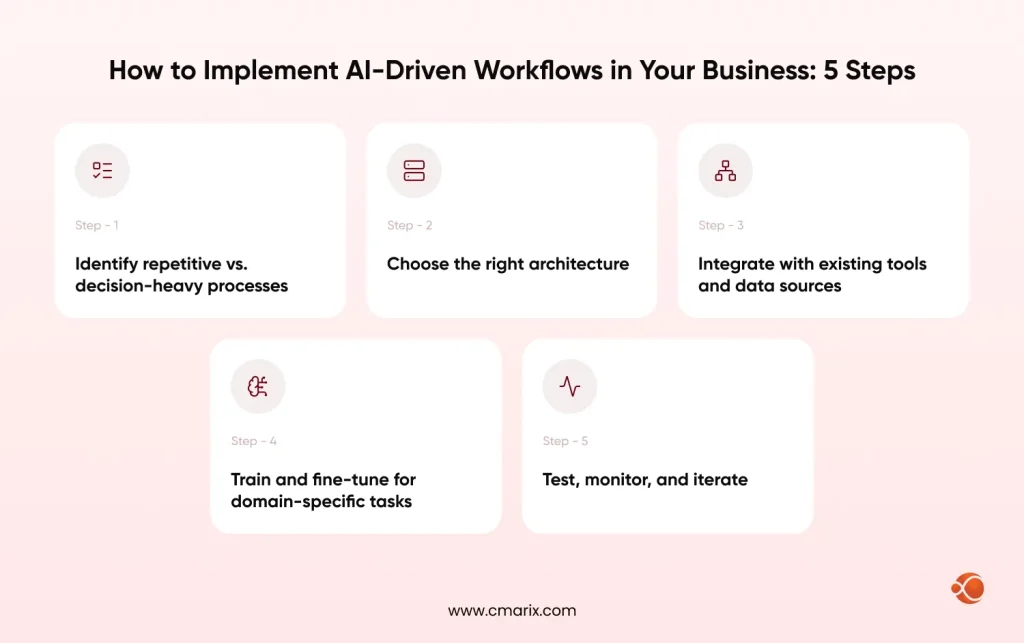
Step 1: Identify repetitive vs. decision-heavy processes
Map your current workflows and separate tasks that follow a fixed pattern from tasks that require judgment. This split determines which parts of your process need a chatbot, which need an agent, and which don’t need AI at all. Skipping this step is what leads most businesses straight into the “one-size-fits-all” mistake covered above.
Step 2: Choose the right architecture
After doing the above, determine whether the particular workflow will require either Generative or Rule-based AI logic, or perhaps a combination where the chatbot will be used for the front end, but then the agent takes over for further processing of the query. In practice, most operational systems tend to be combinations.
Step 3: Integrate with existing tools and data sources
This is where most of the engineering actually takes place. The agents require access to your CRM system, internal databases, and third-party API access where required, as well as a vector database in case the agent is supposed to use large amounts of business documents. The data quality here is just as important as the connectivity because an agent using inconsistent information is going to make inconsistent decisions regardless of how advanced the underlying model may be.
Step 4: Train and fine-tune for domain-specific tasks
An off-the-shelf LLM will not have knowledge about your refund policy, your regulatory obligations, or any other intricacies of your product catalog without training. This step is what turns your agent from a well-versed machine into something that can actually perform reliably. It typically consists of feeding your agent your documentation, solved cases in the past, and clear boundaries within which it can make decisions on its own.
Step 5: Test, monitor, and iterate
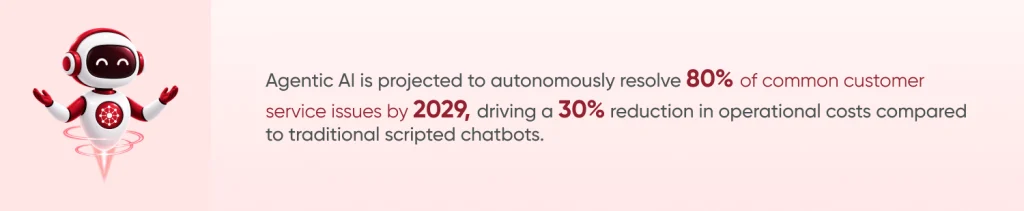
Test in a smaller space initially, measure accuracy and failure rate, then scale incrementally. Agentic AI is forecasted to be able to independently solve 80% of frequent problems faced by customers through customer service by 2029, which will lead to cost savings of 30% compared to normal scripted bots, but this can only happen if thorough testing is carried out before scaling, and not after just one deployment.
Define your minimum acceptable accuracy levels before scaling, and adjust them accordingly. If you’re weighing whether this is worth pursuing over a more conventional build, AI vs traditional software development breaks down the ROI comparison in more detail.
AI Agent vs Chatbot: Cost and ROI Considerations
Cost is usually the deciding factor once the technical picture is clear. Investment is moving in the same direction. A Zapier survey found that 84% of enterprises planned to increase their investment in AI agents in 2026, while 72% were already using or testing them. A few variables move the number more than anything else:
- Scope of integration. An agent that touches three systems costs less to build than one touching twelve. Every additional integration adds development and testing time.
- Data readiness. If your business data is scattered across disconnected tools, expect additional cost for consolidation and setting up retrieval infrastructure before the agent can perform well.
- Level of autonomy. Agents built with human-in-the-loop checkpoints at each decision are cheaper to build and safer to launch than fully autonomous systems, but they also deliver less operational cost reduction.
- Ongoing model and infrastructure costs. Unlike the fixed hosting fees associated with a chatbot, most agents will have variable LLM API costs based on usage, which must be built into the ROI equation before launch, not after.
- Maintenance and monitoring. Chatbots need occasional script updates. Agents need ongoing evaluation, since their behavior can drift as your business processes or data change.
- Change management. Rolling out an agent that removes a manual step from someone’s job requires more internal communication and process redesign than swapping in a chatbot widget. That coordination cost is real, even though it rarely shows up on a project budget line.
Correctly implemented, the return will be realized through resolution speed and decreased pressure of headcount on repetitive decisions. Companies that implement it as part of a workflow change process are likely to realize ROI sooner, largely because the cost of integration and implementation has already been factored in, unlike companies that find out during implementation.
Our team can scope your workflow and give you a realistic project estimate.
Why Choose CMARIX for AI Agent Development
CMARIX has built agentic and conversational AI systems across fintech, healthcare, and enterprise operations, which means we’ve already run into the integration problems most businesses hit for the first time mid-project. Our AI agent development company team works from the same principle covered throughout this guide: match the architecture to the task, not the other way around.
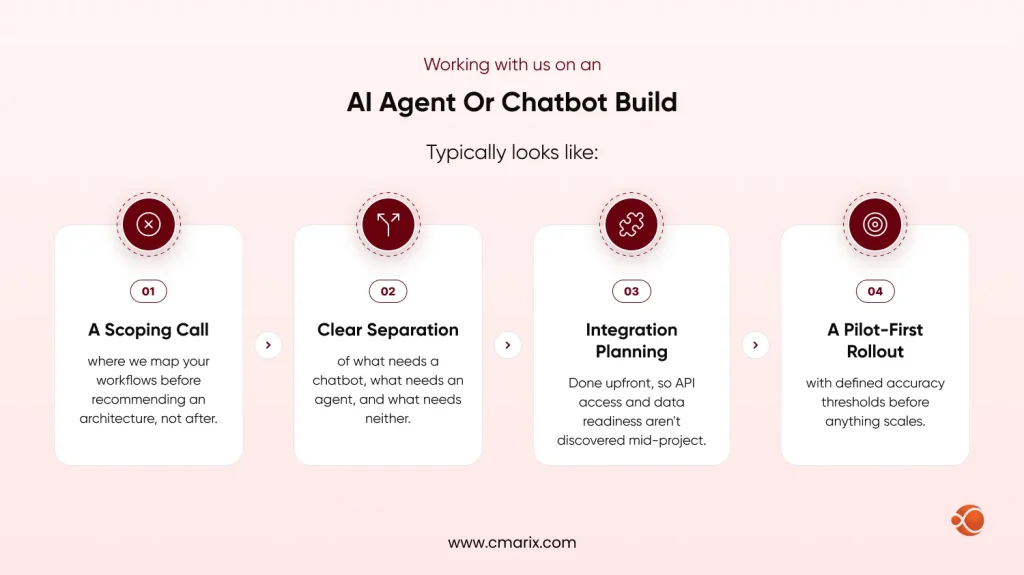
We handle the full range, from straightforward enterprise AI chatbot solutions for front-line support to full agentic systems for back-office and decision-heavy processes. If your business is somewhere between the two, unsure whether you need a chatbot, an agent, or both, that’s exactly the kind of scoping conversation we start every engagement with, backed by our broader range of AI-powered software solutions.
Conclusion
The AI Agent vs Chatbot discussion is not about who wins in the end. The question is one of self-honesty when identifying how the workflow needs work and progressing accordingly. Chatbots have an undisputed role in cases where there is a high volume of transactions and low complexity. When processes call for a capacity for reasoning, action, and memory, then agents become justified due to increased complexity and cost.
The businesses which gain the most value from the above transformation are not those which jumped on agentic AI fast but rather those which first planned their workflows well, piloted before scaling, and let procurement and business units – not only IT – define their success criteria. It is this kind of focus which enables AI-powered workflows to be more than buzz and less than reality-changing numbers.
FAQs About AI Agent vs Chatbot
What is the difference between agents and chatbots?
In a chatbot, the output is based on the pre-written logic for a particular input. The output of an AI agent relies on the use of LLMs that enable it to reason about its goal and take independent actions to achieve its goal.
What are the primary capabilities of an AI agent?
AI agents can hold context across sessions, make autonomous decisions, call functions and APIs to take real actions, and pull business-specific data through RAG and vector databases. This lets them complete multi-step tasks end to end instead of just producing a response.
What are the primary capabilities of a chatbot?
These bots can engage in structured, high-frequency dialogues via programmed or NLP-supported communication. Predictable, traceable, and rapidly deployable, these chatbots provide a reliable solution to handling FAQ requests, booking appointments, and capturing leads.
In what scenarios is an AI agent more suitable than a chatbot?
Agents are appropriate for workflows that involve judgment calls, require memory over several interactions or several systems, such as settling a dispute over bills, evaluating a loan application, and reconciling invoices from various platforms.
In what scenarios is a chatbot more suitable than an AI agent?
Chatbots would fit better in instances that are highly repetitive, such as those that require agents to respond only to routine queries, such as password recovery, order status, or store hours.
Can a chatbot evolve into an AI agent?
Not really. The rule-based structure of the chatbot does not apply to agential activity. Companies interested in taking this approach usually implement a new AI agent as an additional layer on top of the current chatbot architecture.
How do both AI agents and chatbots enhance business operations?
Combined, they span the entire gamut of customer and internal interactions: chatbots do the heavy lifting quickly up front, while agents do the intricate work needed to back them up. Done right, they save time, decrease effort, and enable humans to concentrate on cases where they really add value.
What are the main implementation risks when deploying AI workflows?
The greatest threats include underestimating integration efforts, forgoing the evaluation prior to implementation, and letting IT handle deployment without business units knowing what success looks like. In addition, cost may be difficult to predict depending on how many agents will be used because costs can grow proportionally.