




Quick Summary: Current AI trends have progressed from testing into implementation, with generative systems now being used to do multiple actions rather than help with them. By the end of this year, 40% of all enterprise software will have task-based AI agents, as compared to 5% last year. This article takes a closer look at which of today’s AI trends are worth implementing and which are just noise.
For the last two years, the AI conversation was about proving the technology worked at all. In 2026, that question has been answered. The harder one businesses are asking now is whether it’s paying off.
That shift shows up everywhere in the numbers.
| Metric | 2026 Figure |
| Organizational AI adoption | 88% of surveyed companies (2025) |
| Worldwide AI platform and model spending | $64 billion, up 63.4% from $39 billion in 2025 |
The question for companies is no longer whether to implement AI; it’s what business processes will be able to turn over control to it.
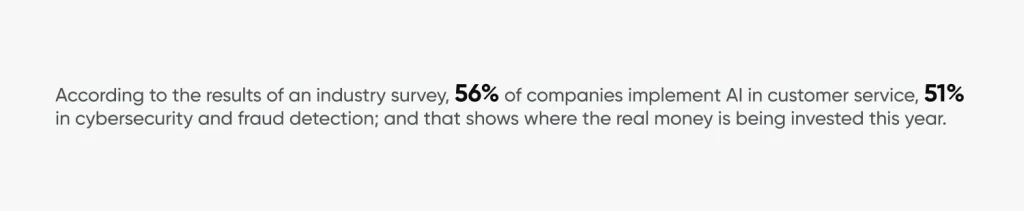
According to the results of an industry survey, 56% of companies implement AI in customer services, 51% in cybersecurity and fraud detection; and that shows where the real money is being invested this year. Not in the splashy pilots, but in the functional processes.
Here’s where the top AI trends of 2026 are heading, and what each one actually means for your business.
AI Trends in 2026: Where Business Adoption Actually Stands
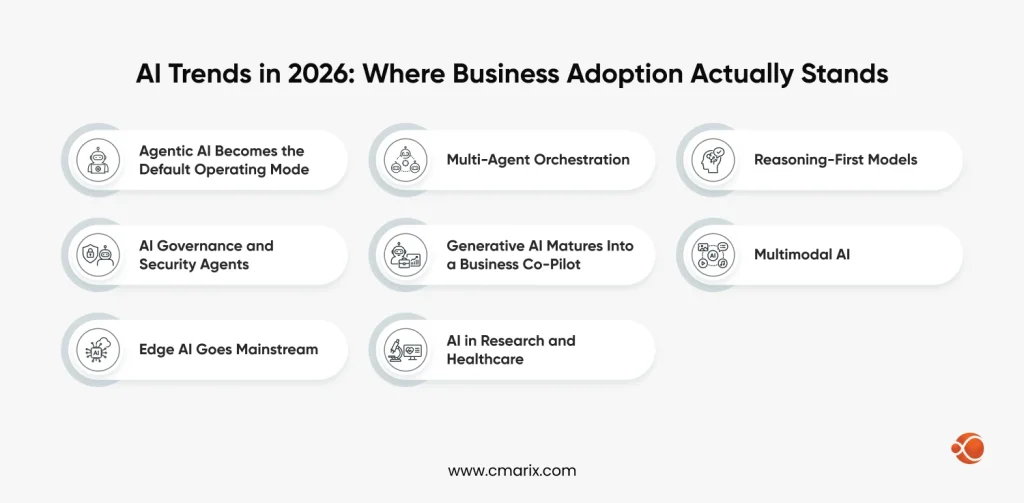
Agentic AI Becomes the Default Operating Mode
If there’s one trend defining 2026, it’s this: AI stopped waiting for instructions. Agentic AI systems interpret a goal, plan the steps to get there, and execute without needing a prompt for every action. Gartner predicts that 40% of enterprise applications will be integrated with task-specific AI agents by the end of 2026, up from less than 5% today. This represents a more than eightfold increase in just one year, making it one of the fastest adoptions in enterprise software history. In the best-case scenario estimated by Gartner, agentic AI will generate nearly 30% of enterprise application software revenues by 2035, worth over $450 billion compared to only 2% in 2025.
What changes in practice:
- Before: The AI assistant writes the answer, which then gets checked by a human who hits the send button.
- Now: The agent handles the whole support ticket process and issues the refund without any human pressing the send button.
That’s the difference between assistance and autonomy, and it’s the trend every other item on this list builds on.
We build agentic workflows that plug into your existing systems instead of replacing them.
Multi-Agent Orchestration
As soon as you have many agents working together, the next challenge arises immediately: coordination! The multi-agent orchestration layer is what controls how agents collaborate to delegate tasks, report exceptions, and follow policies, all while being able to act independently.
Imagine that this layer acts as an air traffic control system for artificial intelligence. Some agents take care of receiving information, others verify it, and yet others fulfill requests based on it. Without a layer for coordination, these agents will interfere with each other and possibly do redundant jobs. But with such a layer in place, they behave as a unified system with different components. And this is not only a technical detail but a real enterprise control plan since companies are already unable to handle this level of complexity manually.
For teams building out this kind of infrastructure, understanding the role of AI in digital transformation is a useful starting point before adding orchestration on top.
Reasoning-First Models
The biggest upgrade in AI models this year isn’t raw size. It’s how they think. Reasoning-first models break a problem into smaller steps, work through each one, and verify the result before moving forward, closer to how a person would approach a complex task than the pattern-matching of earlier generations.
It’s important directly for agentic AI because an agent capable of responding to only one trigger cannot do anything but trivial tasks. An agent that works on the basis of the reasoning approach will be able to go through several steps of the workflow, recognize errors in itself mid-process, and compensate for them. This is exactly how we can use autonomous execution in workflows that are regulated.
Businesses evaluating where to invest in this shift often start with specialized Machine Learning development, since reasoning capability is ultimately a modelling and infrastructure decision, not just a prompt engineering one.
AI Governance and Security Agents
As agents become increasingly autonomous, this question becomes all the more important – who is watching the agents? In 2026, governance ceased being an exercise in compliance and became one in procurement.
Two things are emerging side by side:
- Governance agents monitor other AI systems for policy violations, flagging when an agent steps outside its approved scope.
- Security agents detect anomalous agent behavior, the AI equivalent of an intrusion detection system, but built for autonomous software instead of human users.
Given that 51% of companies are already applying AI to cybersecurity and fraud detection, it makes sense that securing the agents themselves is now part of the same conversation. If you’re building out agent infrastructure, it’s worth reading how AI agents are reshaping enterprise defense before you scale deployment.
The organizations getting this right treat governance as an enabler, not a brake. Clear guardrails are what let a business trust an agent with a higher-stakes task in the first place.
Our engineers can audit your systems before agents start acting on their own.
Generative AI Matures Into a Business Co-Pilot
Generative AI isn’t the newest trend on this list anymore, but it’s still growing fast, and it’s still where most teams’ daily AI usage actually lives. It captured nearly half of all private AI funding in 2025, growing more than 200% year over year, and the generative AI market is projected to grow from $71.36 billion in 2025 to $890.59 billion by 2032, reflecting a long-term CAGR of 43.4%.
Among marketers specifically, generative AI use cases concentrate in a few areas:
| How Marketers Use AI | Percentage of Market |
| Basic content creation | 76% |
| Writing copy | 76% |
| Inspiring creative thinking | 71% |
| Analyzing market data | 63% |
| Generating image assets | 62% |
That’s a marketer-specific breakdown, not a picture of AI use across every function, but it’s a solid signal of where generative tools have earned daily trust.
The businesses getting the most value here aren’t treating generative AI as a novelty. They’re building it into actual workflows, from generative AI in eCommerce product descriptions to internal knowledge tools.
Multimodal AI
Most large language models started out reading text and nothing else. Multimodal AI models close that gap, working across images, text, audio, and video in a single system. That’s what allows a phone camera to identify what’s in a photo by combining metadata, visual data, and search context in one pass, the same way a person glances at a picture and immediately understands it.
For businesses, this is opening up search and content tools that feel far more natural to use, because customers no longer have to translate what they want into text-only queries. Support systems that can look at a photo of a damaged product and process a return request are a good example of where this is heading next.
Edge AI Goes Mainstream
Although cloud computing has been carrying AI loads for years now, edge AI is gaining popularity at an accelerated pace. Processing of the data at the device itself without sending it to a server first implies fewer points from which sensitive data may leak.
Self-driving cars, wearable health monitors, and smart appliances are already running on-device intelligence. As demand for real-time, secure applications keeps climbing, expect more of this shift toward the edge rather than the cloud, especially in industries where a half-second delay actually matters.
AI in Research and Healthcare
AI success stories beyond the business domain occur within clinical and research contexts. Microsoft Fabric, for example, is an AI platform that allows for consolidating heterogeneous patient data in a single database, enabling timely analysis and predictive analytics, such as identifying patients at high risk of an event.
This isn’t a small or experimental corner of the industry anymore. If you’re building or evaluating tools in this space, it’s worth reading how artificial intelligence is transforming healthcare IT systems to see where the practical wins are showing up first.
Quick Glance of AI Trends-
| Trend | What It Means for Business |
| Agentic AI | Agents execute full workflows end to end, no prompt needed for every step |
| Multi-Agent Orchestration | A coordination layer keeps multiple agents from colliding or duplicating work |
| Reasoning-First Models | Models work through steps and catch their own errors before finishing a task |
| AI Governance and Security Agents | Dedicated systems watch other AI systems for policy violations and odd behavior |
| Generative AI as Business Co-Pilot | Built into daily workflows for content, copy, and internal tools, not just chat |
| Multimodal AI | One system handles text, image, audio, and video together |
| Edge AI | Processing happens on the device, cutting latency and data exposure |
| AI in Research and Healthcare | Predictive analytics on unified patient data speeds up clinical decisions |
| AI, IoT, and Blockchain Convergence | Combined with existing infrastructure for real-time detection and verified transactions |
Where AI, IoT, and Blockchain Are Converging
The trends above don’t operate in isolation. The real value shows up when businesses combine them with the technology already running their operations.
| Technology | What AI Adds |
| IoT | Real-time pattern detection paired with longer-term predictive analysis |
| Blockchain | Transparency and trust in transactions without a middleman to verify |
| Edge Computing | Cuts the round-trip to a centralized server for autonomous vehicles, remote monitoring, and smart infrastructure |
If you’re building AI assistants for web or mobile apps that need fast, local responses, the AI-plus-edge-computing pairing is often the difference between a smooth experience and a laggy one.
For businesses running on data-heavy platforms already, understanding how data and AI are transforming businesses is a good next step before layering in any of the above.
What the Future of AI Actually Looks Like From Here
Based on where things stand right now, a few things seem clear:
- Decision-making that used to sit entirely with people will get split between human judgment and AI execution, with governance deciding where that line sits.
- Systems are going to keep getting smarter and more autonomous, not less.
- The businesses that treat 2026 as the year to build real infrastructure, not just run more pilots, are the ones who’ll be ahead when this settles into standard practice.
None of this happens by accident. If you’re figuring out where to start, how to hire AI developers in 2026 is a practical place to begin.
Why Choose CMARIX as Your AI Development Partner
CMARIX has spent years building AI systems for clients navigating exactly the shift covered in this post, from early generative AI pilots to production agentic workflows. Our team works across the full stack: model selection, integration with existing systems, and the governance layer that keeps autonomous systems accountable.
We’ve delivered AI projects across healthcare, finance, and eCommerce, helping teams move past the pilot stage into tools that actually run their operations day to day.
If you’re building, our core AI expertise includes generative AI and LLM development, AI agents, AI apps with .NET , computer vision, AI voice generators for your customer-facing tools, and enterprise AI integration.
Final Words
AI in 2026 is no longer just a future trend. It is the layer of software that companies are building today. The winners in 2023 will not be the companies that were quickest to adopt AI. They will be the companies that adopted AI but had a strategy around how to govern and orchestrate it and where human judgment still fits into the process. Do that well, and the rest of the trends below are tools you are leveraging, not technologies you are being driven by.
FAQs on AI Trends in 2026
What are the top AI trends to watch in 2026?
Multi-agent orchestration, agentic AI, and reasoning-first AI are all taking the lead in this year’s list, together with AI governance and security agents meant to control autonomous AI systems. While generative AI, multimodal AI, and edge AI are all still relevant, they are not as newsworthy as they once were.
How is generative AI evolving beyond simple chatbots?
Generative AI is moving from single chat tools into embedded workflows, powering content creation, product descriptions, and internal knowledge systems directly inside existing business software. Also, it’s paired with reasoning models, which lets it handle multi-step tasks instead of single responses.
What are the emerging trends in AI for businesses?
Other than agentic AI, enterprises are also monitoring multi-agent orchestration for managing agent fleets, AI governance as a buying factor instead of an afterthought, and edge AI to perform real-time processing of data at the device level. All these technologies are converging with blockchain and IoT.
What is the difference between traditional AI and Generative AI?
Traditional AI is usually built to classify, predict, or detect patterns in existing data, like flagging fraud or forecasting demand. Generative AI creates new content, text, images, audio, or code, based on patterns it has learned, rather than just analyzing what already exists.
How is AI impacting software development trends?
AI is now embedded in the development process itself, from code generation and testing to automated debugging and deployment checks. Reasoning-first models in particular are making AI-assisted development more reliable for multi-step engineering tasks, not just quick snippets.
What are the biggest challenges in AI adoption for 2026?
The top two concerns are governance and security, as handing over genuine autonomy to AI would mean handing over some control from the human side. Following them in importance are skills gaps, ROI calculation, and embedding AI within existing IT infrastructure.
What is Multimodal AI, and why is it a trend?
Multimodal AI processes more than one type of data- text, images, audio, and video- in a single system rather than handling each in isolation. It’s a trend because it makes search, content tools, and customer-facing systems feel far more natural to use.
How can companies prepare for the future of artificial intelligence?
Companies should create governance and data frameworks upfront before scaling implementation and not in hindsight. The organizations that are getting their clean data, AI strategy, and the proper talent pool early are always the same organizations that start to see the results from their AI projects instead of pilot projects.
Why are business leaders focusing on artificial intelligence trends?
As the chasm grows rapidly between the businesses that have mastered the use of AI and the others who are merely experimenting with it, the difference is evident in terms of speed, cost, and customer experience. Those who recognize these dynamics early are poised to make infrastructure choices rather than reacting to them.