




Quick Summary: AI healthcare startups are revolutionizing the field by turning medicine from a reactionary practice into a predictive and personalized one, backed up by data. According to research by Grand View Research, the AI in healthcare market is expected to grow from $50.7 billion in 2026 to $505.6 billion in 2033. This article covers the areas where this money and impact materialize in 2026: diagnostics, personalized medicine, predictive medicine, hospitals, funding, and regulations.
The global healthcare system is in a critical condition. The symptoms seem uncontrollable, and the chances of survival are close to zero unless companies understand, adapt to, and embrace healthcare AI solutions. With the right tools, team of developers, and clarity, AI can revolutionize medicine from a reactive solution to a personalized, proactive enabler. Such a shift marks the beginning of a new era of medical innovation, in which humans and technology will work together to improve patient outcomes and make health care better and more efficient.
Quick Highlights
- AI reduces diagnostic time and helps detect diseases earlier by leveraging medical imaging, radiology, pathology, and genomics.
- Personalized treatment plans, drug repurposing, and “digital twin” simulations are replacing one-size-fits-all medicine.
- Predictive analytics flags high-risk patients and cuts hospital readmissions before problems escalate.
- Automation of administrative processes like scheduling, billing, and claims processing yields the quickest ROI for hospitals.
- Data privacy, algorithmic bias, and legacy-system integration remain the biggest blockers to scaling any of this.
Why AI in Healthcare was a Much-Needed Addition
The global healthcare system has been running on borrowed time for a while now. Costs keep climbing, clinicians are stretched thin, and reactive care, waiting until someone is sick, then treating them, is never going to hold up against an aging population and a shrinking clinical workforce. AI healthcare startups didn’t create this problem. They’re the response to it.
What’s changed is that this response now has real market weight. Global spend on AI in healthcare is projected to grow at a 38.9% CAGR between 2026 and 2033, a trend covered in a recent World Economic Forum piece on AI transforming global health. That kind of growth rate doesn’t happen around a technology that’s still theoretical.
AI in Healthcare Market: Size and Growth in 2026
| Metric | AI Healthcare Market Size Projection |
| Market size (2025) | $36.7 billion |
| Market size (2026) | $50.7 billion |
| Projected market size (2033) | $505.6 billion |
| CAGR (2026–2033) | 38.9% |
For this reason, healthcare providers continue to invest in AI to aid clinical decision-making, automate workflows, improve care delivery, and reduce operational costs. With the growth of the AI healthcare industry, organizations that develop their AI capability early enough will be able to optimize efficiency.
How AI Healthcare Startups Are Rewriting Medical Innovation
Healthcare AI isn’t a single tool. It’s a tower of automations and algorithms stacked on top of each other, addressing four specific pain points that have been complained about in the clinical world for decades now. Companies entering this industry typically begin by hiring dedicated developers familiar with the healthcare domain.
1. AI in Diagnostics
Both radiologists and pathologists become weary. AI does not get fatigued, which is important for early detection.
AI in Medical Imaging
AI algorithms are trained on large datasets . They contain images or medical records to enable AI models to identify subtle anomalies. Whether it’s an X-ray, MRI, or even a CT scan, AI systems can be trained to produce accurate readings that a professional radiologist might miss. This is an impactful use case of AI for diagnostics. For instance, AI systems are trained to detect subtle signs of diabetic retinopathy in retinal scans.
AI in Radiology
AI-powered software can automatically flag suspicious areas in scans, helping radiologists prioritize high-priority cases and reduce diagnostic errors. The AI of one startup can read a chest X-ray for signs of early lung cancer as accurately as human specialists, but much more quickly.
AI in Pathology
AI technology is used in pathology to analyze tissue samples. Through analysis and assessment of virtual slides, AI technology can assist pathologists in identifying cancer cells, quantifying biomarker levels, and even determining tumor sensitivity to treatment.
AI in Genomics
Genetic testing in healthcare is evolving with the use of artificial intelligence, which analyzes large amounts of genetic data to determine genetic mutations and disease risk. AI can quickly scan an individual’s entire genome for patterns that contribute to rare diseases such as Alzheimer’s disease.
2. Personalized Treatment
Tailored Therapies
Healthcare AI solutions can be a blessing for cancer patients. It can analyze the patient’s tumor and recommend a specific chemotherapy or immunotherapy regimen according to its genetic profile. Such an approach can improve the project’s efficiency while reducing the risk of concerning side effects.
AI in Drug Discovery
The drug development process is long and expensive. AI is dramatically accelerating it by analyzing billions of molecular compounds and predicting their interactions. This helps identify promising drug candidates and repurpose existing drugs for new uses. This process, known as drug repurposing, can dramatically reduce the time it takes to get new treatments to patients, from years to months. You can look for a reliable medical software development company to fine-tune your drug discovery processes.
Creating “Digital Twins”
A digital twin is a groundbreaking concept that acts like a virtual model of a patient’s physiology. AI can use this model to simulate how a patient responds to different medications or surgical procedures, allowing doctors to test various treatment strategies in a safe virtual environment before using them in the real-world.
3. Predictive and Proactive Healthcare
The power of pattern recognition is what AI thrives on. Rather than responding to illness after the patient presents with symptoms, the healthcare provider may now intervene beforehand.
AI in Healthcare for Early Risk Assessment
AI healthcare solutions can analyze data from electronic health records (EHRs), patient wearables, and social determinants of health. With this data, doctors can identify individuals at high risk of developing chronic diseases such as heart disease or diabetes at a very early stage. This allows for targeted, preventative interventions, such as behavioral coaching or lifestyle change recommendations, before a patient ever becomes symptomatic.
AI for Preventing Hospital Readmissions
Hospitals are using AI to predict which patients might be at higher risk of readmission after discharge. Hospitals can flag such individuals to improve post-discharge support with additional follow-up, remote monitoring, or other ways. This has been shown to significantly reduce readmission rates and improve patient satisfaction.
AI for Forecasting Public Health Trends
The application of AI to the analysis of public health data can help predict the spread of infectious diseases within populations. This allows public health agencies to plan resource allocation and prevention strategies without room for error. The significance of AI in disease spread prediction was seen during the COVID-19 pandemic.
4. Operational Efficiency
Medical innovations often grab the news spotlight, but in reality, it’s the back offices of hospitals that see some of the quickest returns on investment for AI healthcare solutions.
Automated Admin Tasks
With sWith scheduling, billing, and AI-driven insurance claims processing mostly automated, there is no need to have someone overseeing the entire process of checking eligibility, submitting claims, or following up on denials.
Supply Chain Optimization
Predicting demand for medical supplies, avoiding stockouts, and cutting waste is a data problem more than a clinical one, and AI is well-suited to solving it.
Medical Scribing
Tools built on NLP for healthcare can listen to a doctor-patient conversation and automatically generate clinical notes, giving physicians back time they’d otherwise spend typing after hours.
5. Patient Engagement and Remote Monitoring
AI is also changing how healthcare providers stay connected with patients after they leave the hospital or clinic.
AI-Powered Remote Patient Monitoring
AI can analyze data generated by wearable and other internet-connected medical devices. This includes data on heart rate, blood oxygen levels, glucose levels, and blood pressure. It not only gathers data but also detects irregularities and signals potential risks.
AI Health Assistants
Conversational AI can be used to provide routine health information, prompt patients to take medication, help them prepare for consultations, and offer guidance on basic care. Although conversational AI cannot replace healthcare providers, it can reduce the number of repetitive questions directed to healthcare professionals.
Chronic Disease Management
For diseases like diabetes, hypertension, and heart disease, artificial intelligence can integrate patient-provided information, medical history, and behaviors to enable more personalized monitoring. This would help healthcare providers understand how a particular patient’s condition is evolving between consultations.
Top AI Healthcare Startups in the US and Middle East
| Company | Focus Area | Region | What They Do |
| Freenome | Early cancer detection | US | AI blood tests that detect cancer through biomarker analysis |
| Biofourmis | Remote patient monitoring | US | AI + wearables tracking chronic conditions and health risks in real time |
| Olive AI | Administrative automation | US | Automates billing, claims, and authorizations to cut hospital admin load |
| Vezeeta | Patient-doctor booking | Middle East | AI platform to find, compare, and book doctor appointments |
| Altibbi | Telemedicine & digital health | Middle East | AI triage for patient inquiries plus remote consultations |
| OpenEvidence | Clinical decision support | US | AI search and evidence engine physicians use at the point of care, backed by a $250M Series D in early 2026 |
These companies are a testament to how AI development solutions in the US and AI healthcare solutions in the Middle East are leading the charge in digital health, transforming the patient journey from discovery to ongoing care.
AI Healthcare Funding in 2026: Where the Money Is Going
Investor appetite remains strong, but focused. American digital health companies received an influx of $7.4 billion in capital through 244 deals in the first six months of 2026, says Rock Health, which was $1 billion more than last year’s total. 45% of it was spent on the biggest deals worth at least $100 million, despite accounting for just a small share of all deals.
What that means in practice: In other words, what it implies: AI is no longer something that investors look out for as a differentiator on its own. It is already expected from companies. Rock Health’s analysts have noted that the line separating “AI-powered” digital health companies from regular digital health firms is blurring, as almost every new product uses AI in some form.
Regulation Is Catching Up: FDA AI/ML Devices in 2026
The development of new diagnostic or clinical decision-making software now has a much clearer regulatory roadmap than it did just two years ago. The FDA had authorized 1,451 AI/ML-enabled medical devices by the end of 2025, and radiology alone accounts for roughly 76% of that list, a concentration that reflects how much easier it is to validate imaging AI than more open-ended clinical reasoning tools.
That imbalance is a signal, not just a statistic. Annual authorization volume has jumped from under two devices a year in the mid-1990s to well over 260 a year recently, so the regulatory pathway itself is no longer the bottleneck it once was for imaging-based products. Startups building outside radiology — in areas like generative clinical documentation or agentic care coordination — are still working with far less regulatory precedent, which is exactly where compliance-first engineering earns its keep.
Why Generic Software Teams Struggle With Healthcare AI
That’s the piece that most cost analyses overlook: Healthcare AI is not like any old web application with an AI layer grafted onto it. HIPAA compliance must be baked into the design from day one, not added as an afterthought when a security assessment calls for it. There are data processing challenges posed by the inconsistent and incompatible formats of EHR data. Plus, there is liability with the model predictions impacting patient care.
This is where a lot of promising healthcare AI projects stall: not on the model itself, but on the compliance and integration work around it. Teams evaluating build costs for this kind of platform often start with a telemedicine app development cost breakdown or a broader guide to building a healthcare app, since the AI layer is usually only one line item in a much larger compliance and infrastructure budget.
CMARIX has approached this from both sides: building generative AI solutions for clients who need custom clinical or administrative models, and providing expert AI consulting for teams who need a roadmap before committing engineering budget. For projects that require deep technical execution alongside strategy, skilled Python developers tend to be the backbone of the build, since most healthcare ML tooling, from data pipelines to model serving, still runs on Python.
HIPAA-ready architecture, AI models, and EHR integration for your product.
Challenges and the Future of AI in Healthcare
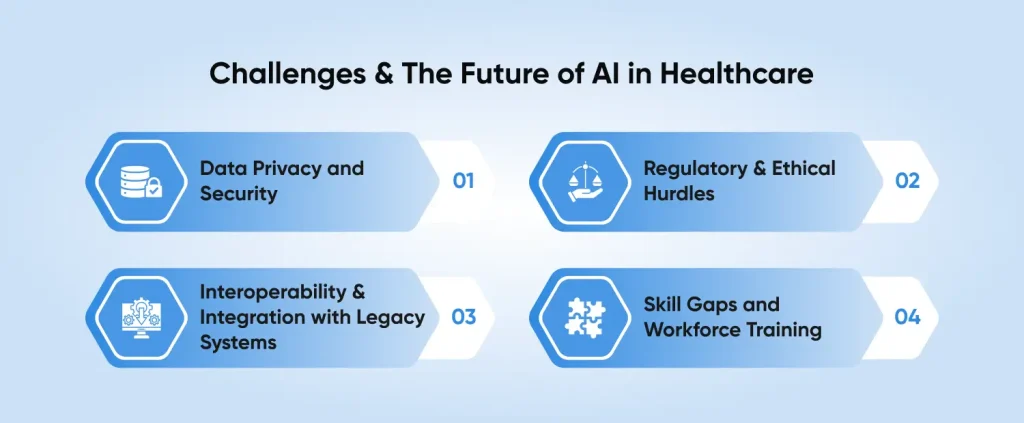
Data Privacy and Security
Protecting sensitive patient data is very important. All healthcare organizations should comply with regulations such as HIPAA in the US and GDPR in Europe. If you want to join the race in healthcare technology startups, make sure to focus on establishing security frameworks from day one.
Regulatory & Ethical Hurdles
Developing AI-powered medical devices is under close scrutiny right now. An issue that arises in this process is algorithmic bias. It emerges when the AI technology is trained on a dataset that isn’t properly sized or distributed. Always verify the training set data and the system’s accuracy.
Interoperability and Integration with Legacy Systems
The use of outdated IT solutions is quite common for many hospitals and clinics. Integrating new AI applications into such organizations is difficult due to the time required for data exchange and other processes. Different EHRs lead to variations in data formatting, hindering the creation of a proper dataset for AI.
Skill Gaps and Workforce Training
The successful implementation of AI development services requires a skilled workforce. There is a critical need for data scientists and machine learning engineers who understand healthcare, as well as for clinicians who are trained to use and trust AI-enabled patient care tools.
Looking Ahead: The Future of AI in Healthcare
The future of AI-enabled patient care promises even more profound changes.
Telemedicine AI
The integration of AI will make virtual consultations and remote patient monitoring more personalized and effective. Virtual health assistants AI can provide preliminary symptom analysis, triage patients, and answer routine questions, freeing up a doctor’s time for more complex cases.
The Rise of “Clinical AI”
As AI in medical diagnosis becomes more sophisticated, we will see its widespread use not just as a tool for radiologists but as a diagnostic assistant for primary care physicians, helping them analyze lab results and identify potential conditions more accurately.
The Promise of Explainable AI (XAI)
For doctors to trust and use AI tools, they must understand how the AI arrives at its conclusions or answers. This is a fascinating field known as Explainable AI or XAI for short. It creates transparent and interpretable AI models that will foster trust and confidence among clinicians and patients.
Bring your healthcare AI idea to life with experienced AI and healthcare software developers.
Final Words
AI-based startups within the health care sector have revolutionized the whole industry. They assist in detecting diseases at an earlier stage, in developing personalized treatment programs, in predicting the risk of diseases, and in improving the performance of hospitals.
While there are still problems to solve, like keeping patient information safe and training people to use these new tools, the positive impact is clearly worth the transition. Businesses that use AI are making healthcare smarter, more forward-looking, and easier for everyone to get. As this technology improves, proper healthcare software development services will be key to shaping the future of medicine.
FAQs on AI Healthcare Startups
How are AI healthcare startups revolutionizing medicine?
By shifting care from reactive to predictive, catching disease earlier through imaging and diagnostics, personalizing treatment to the individual, and automating the administrative load that eats into clinical time.
What are the most common use cases for AI in healthcare startups?
The use of AI in medical imaging and diagnostics, drug discovery, remote patient monitoring, risk prediction, and administrative automation, such as billing and claims processing.
What are the biggest challenges facing AI-driven medical companies today?
Privacy compliance, addressing algorithmic bias, interoperability with EHRs, and the shortage of talent with an understanding of machine learning and medicine.
How does generative AI impact the healthcare startup ecosystem?
Generative AI can enhance drug discovery through molecular simulation, automate the documentation of clinical findings by creating patient notes, and develop better patient-interface tools for triage.
What is the difference between AI and machine learning in healthcare applications?
The use of AI in health care refers to the use of intelligent machines to perform activities such as decision-making, diagnosis, and prediction. One of the examples of artificial intelligence technology used in health care is machine learning, which involves learning from health data and prediction using health data.
Which sectors of healthcare are most impacted by AI innovation?
The most AI-enabled areas of healthcare are radiology and medical imaging, administrative processes, drug discovery, and remote patient monitoring.
What are the emerging trends in AI healthcare for 2026?
Agentic AI systems that take action rather than just flag issues, wider adoption of explainable AI to build clinician trust, and deeper convergence among wearables, telemedicine, and AI-driven business process automation within hospital operations.