

Quick Summary: Agentic AI vs RPA is not an all-or-nothing comparison. RPA runs fixed, rule-based tasks fast and cheaply, while AI agents reason through goals, messy inputs, and exceptions. In this guide, we discuss the distinctions between the two technologies, when a robot needs replacement, and how to do it in seven simple steps.
Most teams that adopted RPA a few years ago know the pattern. The bots performed wonderfully well on the first day. The vendor changed the position of a button; an invoice got converted into a scanned PDF file, and then the exceptions started accumulating.
AI agents seem to be the natural solution, and often they are. However, agents have different costs, different failure modes, and need protection from things bots never needed. Stripping away all bots is the fastest way to turn an effective process into an expensive one. The real issue in the discussion between agent-based AI and RPA is which processes get an agent and which processes keep the bot.
What Is the Difference Between Agentic AI and RPA?
The quick answer is that RPA and agentic AI show up fastest when something unexpected happens. Let’s break it down.
What Is RPA?
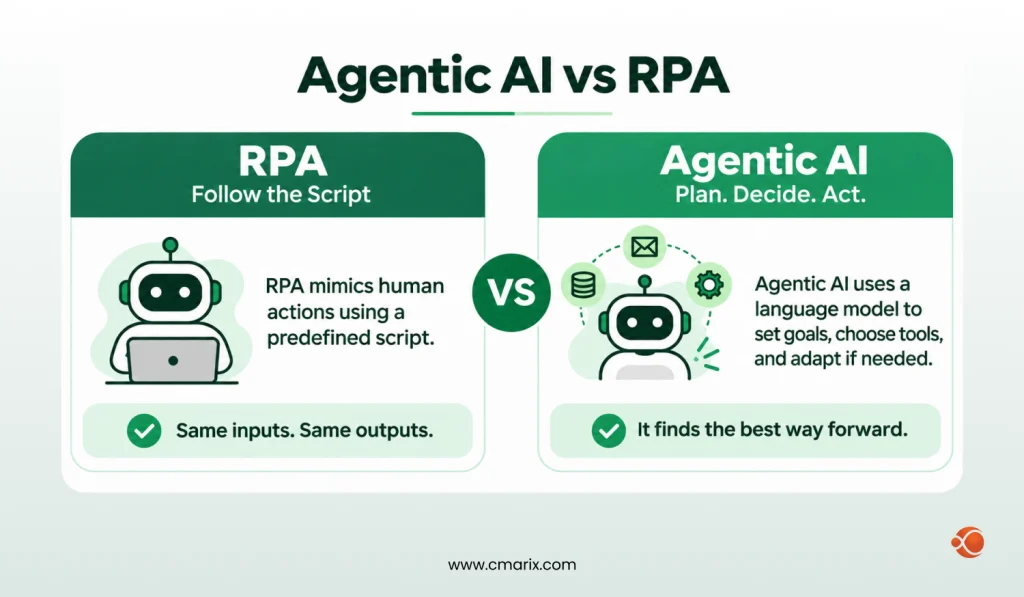
Robotic Process Automation (RPA) is an automation process whereby software mimics human actions such as logging in, clicking, copying, pasting, and moving files. The robot works according to a predefined script.
Therefore, the same inputs will generate the same outputs. This reliability is why banks, insurance companies, and shared services companies use thousands of robots for activities such as payroll processing, posting invoices, and generating reports. If you are creating a bot environment, then RPA development is a good place to start.
What Is Agentic AI?
Agentic AI is software built around a language model that gets a goal, a set of tools, and permission to decide the steps. The agent may open an email, retrieve information from the CRM, make an API call, check the policy, and ask a human if anything is wrong. If it can’t complete the task with one approach, it will try another.
| Factor | RPA | Agentic AI |
| Logic | Fixed rules and scripts | Goal-driven reasoning |
| Data | Structured and predictable | Structured and unstructured (emails, PDFs, chat) |
| Exceptions | Stops or escalates to a person | Re-plans, retries, or asks a human |
| Change Tolerance | Fails if there are changes to screen or field design | Can handle many types of changes to layout and formatting |
| Deployment | Fast with simple processes | Slower; requires tools, data access, and governance |
| Pricing | Per-bot license fee with maintenance | Usage-based pricing plus governance |
| Behavior | Same result every run | Can vary between runs |
| Best Fit | High-volume, stable steps | Variable, judgment-heavy work |
RPA vs AI vs ML vs Generative AI
These terms get mixed up constantly, so here is a quick matrix.
| Technology | What it Does | Example | Acts Toward a Goal? |
| RPA | Executes scripted steps | Posting invoices into an ERP | No |
| Machine Learning | Finds patterns and makes predictions | Flagging likely fraud | No, it predicts |
| Generative AI | Creates text, code, or images | Drafting a customer reply | No, it produces output |
| Agentic AI | Plans and acts across tools | Handling a refund request end to end | Yes, within set limits |
Generative AI vs RPA is not really a fair comparison, because a generative model writes while a bot clicks. An agent combines the model’s reasoning with tools so it can do both. If the distinction is still fuzzy, our breakdown of the difference between Generative AI and Agentic AI goes deeper.
Our automation team can audit your processes and flag the best candidates.
Can Agentic AI Replace RPA?
Partly. Almost never, all at once. Here’s why: business processes have a fixed core and a fluid edge. Robots perform well in the core; agents perform well on the edge. Using an agent for the core incurs unnecessary costs.
Market data supports a cautious view. Gartner expects over 40 percent of agentic AI projects to be canceled by the end of 2027, mostly because of rising costs, unclear business value, and weak risk controls. The same firm expects agents to make at least 15 percent of day-to-day work decisions autonomously by 2028, up from none in 2024. Both can be true at once. Agents will matter, and plenty of rushed projects will fail.
Two terms are worth separating. Intelligent process automation adds AI to RPA for jobs like document reading. But agentic process automation goes further, allowing agents to run through whole processes that include variation and judgment. What this really means for the bots you already own is covered in Scope of RPA in the Future.
What Are the Limitations of Traditional RPA?
RPA is not broken. It just hits a ceiling, and these are the first places it hits.
- Brittle UI dependence- Renaming a field or moving a button freezes a bot, leading to repetitive patches to selectors.
- Weak with unstructured data- Emails, scanned documents, and free-text notes need extra OCR or ML layers bolted on.
- No judgment- Bots follow rules. A case outside the rules lands in an exception queue for a person to fix.
- Heavy maintenance- Every process change means reconfiguring and retesting, and upkeep grows with the bot count.
- Narrow scope- Each bot handles one task. Stitching dozens into an end-to-end process takes serious orchestration.
Many teams respond by layering AI on top of what they already own, a route we cover under RPA & AI automation acceleration. Others decide a few bots have simply run their course.
When Should You Replace RPA Bots with AI Agents?
When comparing AI agents and RPA bots, the decision-making criteria are based not on the technology but on the nature of the process.
If a significant portion of a bot’s cases ends up in manual queues, if unstructured inputs come by way of email and documents, if the interfaces and formats are frequently changing, or if maintenance cost exceeds the savings – replace the bot. If, on the other hand, the sequence of actions is well-defined, data is structured, volume is high, and the auditor requires consistent results – keep the bot. And whenever an appropriate API is available, use it rather than screen scraping regardless of underlying technology.
| Process Characteristic | Better Fit | Why |
| Stable steps, structured data, high volume | RPA | Cheaper, predictable, easy to audit |
| Screens or formats change often | Agentic AI or API-based automation | Fewer breakages |
| Inputs are emails, PDFs, or free text | Agentic AI | Reads and interprets context |
| Strict rules, zero tolerance for variation | RPA | Same result every run |
| Many exceptions that need judgment | Agentic AI with human approval | Handles cases outside the rules |
| Structured core with messy edges | Hybrid | Agent triages, bot executes |
How to Replace RPA Bots with AI Agents in 7 Steps
Traditional companies will have a smooth transition, treating it as a series of small, reversible bets rather than a rebuild.
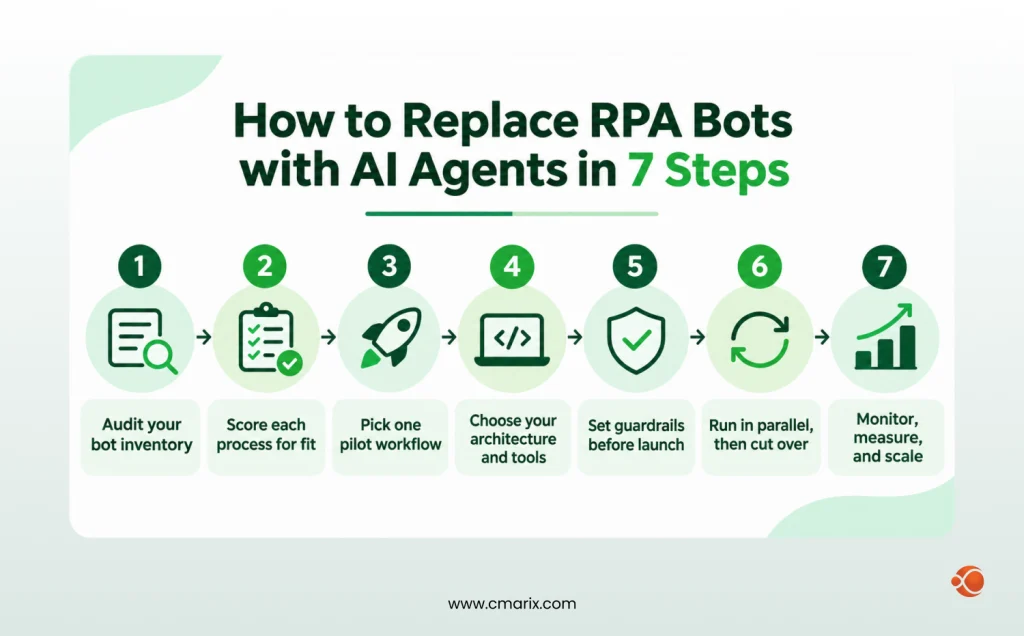
Steps 1 and 2 assess, steps 3 to 5 prove the idea on one workflow, and steps 6 and 7 cut over only once the agent matches or beats the baseline.
Step 1: Audit your bot inventory
List every bot with its owner, the systems it touches, run volume, failure rate, and hours spent on fixes. Almost all organizations realize they have bots no one uses. Start by retiring these bots because they offer cost savings with no effort.
Step 2: Score each process for fit
Rate input variability, exception rate, maintenance cost, and business risk. High variability with low risk ranks at the top of the list, while steady, high-volume processes remain with RPA.
Step 3: Pick one pilot workflow
Choosing something painful but not mission-critical, and record a baseline: handling time, error rate, and cost per case. Without a baseline, you cannot prove anything later.
Step 4: Choose your architecture and tools
Decide on the model, tool access, orchestration framework, and how the agent will call your existing bots. Wrapping a working bot as a tool the agent can trigger is often the cleanest route. The market for AI agent development tools moves quickly, so shortlist two or three and test them on your own data.
Step 5: Set guardrails before launch
Apply the least-privilege principle, set spending limits, and apply human approval for all money- or customer-information-related decisions. Document all decisions. List out things the agent is not allowed to do.
Step 6: Run in parallel, then cut over
Let the agent run in shadow mode alongside the bot and compare results on real cases. Build a test set from past exceptions and score the agent against it. Our guide to AI Agent evaluation covers the metrics worth tracking.
Step 7: Monitor, measure, and scale
Cost per task, measurement accuracy, and escalation rate. Manage prompts and policies as code, using version control and reviews. Then move to the next workflow, one at a time.
How Do RPA Bots and AI Agents Work Together?
The simplest way of understanding the relationship is brain and hand. The agent thinks and makes decisions. The bot does the task that needs to be repeated many times. This approach is called agentic RPA by vendors, and such a name can be justified only when the agent really makes decisions.
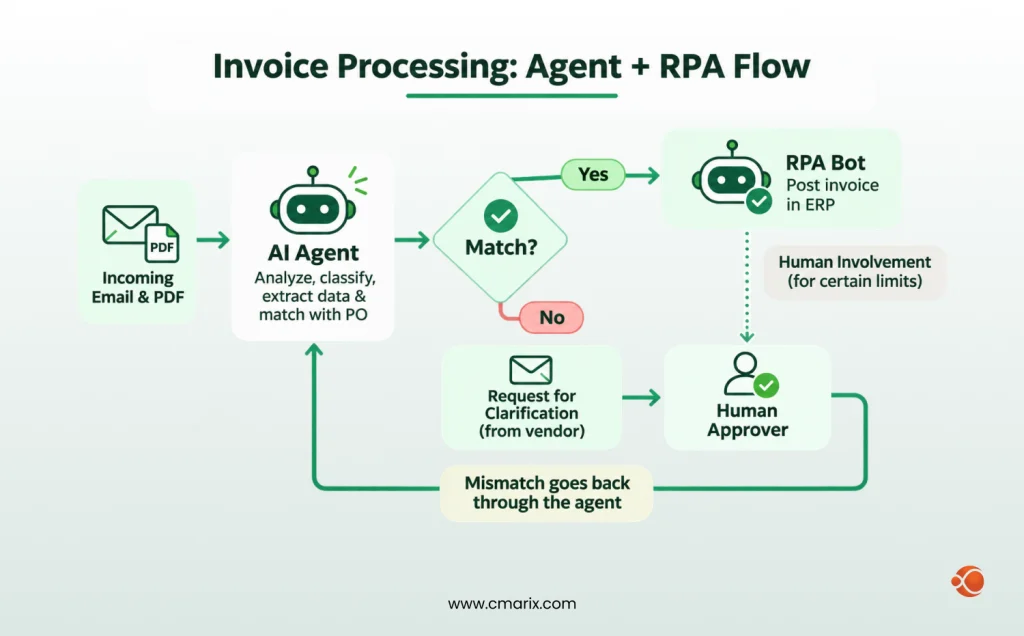
For example, consider invoice processing. The agent analyzes incoming email and the attached PDF, classifies the invoice, extracts data, and matches it with the purchase order. If there is a clear match, the invoice goes to the bot that posts it into ERP using a standard procedure. If there is a mismatch, the agent requests clarification from the vendor and forwards the matter to an approver. A human is involved above a certain limit.
Only a clean match goes straight to the bot. Any mismatch goes back through the agent to a human approver.
Different jobs call for different types of AI agents, from simple reflex agents to goal-based and multi-agent setups, so match the agent type to the task.
On multi-system integration, agents have the edge. The bot focuses on one screen at a time, but an agent can connect APIs and databases and transfer tasks across tools. If you want someone to help build the layer, Agentic AI solutions built around your existing bots are usually faster than a full rebuild.
How Much Does It Cost, and What ROI Can You Expect?
Costs vary widely by scope, vendor, region, and model choice, but use the table below as a budgeting guide, not an actual price quote.
| Cost Area | RPA | Agentic AI | What Drives It |
| Licensing or Usage | Per-bot or per-runner license | Usage-based model and token costs | Volume and model size |
| Build | Low to moderate per simple flow | Moderate to high; needs tooling and data access | Number of tools and integrations |
| Maintenance | High when interfaces change often | Lower for UI changes, greater for prompt and policy tuning | Rate of change |
| Governance | Light | Heavier: monitoring, approvals, audit logs | Risk level |
| Exceptions | Handled manually by staff | Mostly handled by the agent | Exception rate |
Gartner’s cancellation prediction proves that it is crucial not to forget that any uncertain value will inevitably lead to project failure. To keep the numbers honest, start by establishing a baseline before piloting; measure exception-handling time savings and maintenance savings, not licensing fees alone; incorporate model deployment and governance into the budget; and conduct quarterly reviews. It also helps to tie automation spend to wider business goals, which our piece on AI in digital transformation explains.
An AI MVP-based pilot is a way to test ROI for one workflow. A narrow pilot built through AI MVP development lets you prove returns on one workflow before you commit a bigger budget.
What Are the Risks of Replacing RPA with AI Agents?
- Reliability- Agents can vary between runs and occasionally get things wrong. Keep humans in the loop for important actions and test against real cases.
- Authority and access- An agent with wide-ranging permission can cause wide-ranging harm. Only allow access to what is necessary for each task.
- Auditability and compliance- Regulators want to know why a decision was made. Log inputs, reasoning steps, tool calls, and approvals.
- Agent washing and lock-in- Gartner estimates only about 130 of the thousands of vendors claiming agentic capabilities offer the real thing, and some simply relabel chatbots or RPA tools. Ask for live demos on your data and check how portable your workflows are.
Which Industries Are Moving from RPA to Agentic AI?
The answer is Finance. The accounting team has to handle invoices in multiple formats, exceptions in the reconciliation process, and extremely time-consuming month-end closing. When it comes to automation in accounting using AI versus traditional RPA tools, while bots do a good job posting transactions, agents handle reading documents, matching, and chasing exceptions, and that’s why they are becoming ubiquitous in finance departments. Teams exploring this can start with AI workflow automation services.
| Industry | Typical Bot Task | Where Agents Add Value |
| Finance | Invoice posting, reconciliations | Read multiple formats, handle discrepancies |
| Insurance | Claims data entry | Triage, documentation, fraud detection |
| Healthcare | Eligibility checks, billing | Documentation summaries, prior authorization |
| Supply Chain | Order status updates | Exception handling, supplier follow-ups |
| HR | Onboarding data entry | Screening, policy questions |
Healthcare is moving more carefully because of privacy rules, but claims, intake, and prior authorization are strong candidates. AI tools in healthcare show what is already working there.
We benchmark agent platforms against your real workflows, not demo scripts.
How to Choose and Benchmark an Agentic AI Platform?
Enterprise intelligent automation tools now range from RPA vendors adding agent features to AI-native platforms. Start with the build, buy, or partner decision.
| Option | Best For | Trade-off |
| Buy a Platform | Fast start, standard workflows | Less control, lock-in risk |
| Build In-house | Strong AI team, unique needs | Slow, hiring and upkeep |
| Partner | Mixed needs, limited bandwidth | Needs a vendor you can trust |
The steering team must conduct a bake-off using real-world examples for all selected tools, not vendor demonstrations. The metrics include correctness of the tasks performed, exception management, cost per task completed, speed, logging, security measures, integration with current bots, and hand-off to humans. Assign weights based on their significance to your organization.
It also pays to watch where the market is heading. Our roundup of Agentic AI trends shows which capabilities are maturing and which are still marketing.
Why Choose CMARIX for Agentic AI Development?
CMARIX has been building custom software since 2009 and has worked across more than 40 industries. Our team is ISO 9001:2015 and ISO 27001-certified. We don’t push you to replace everything. We start with an audit, keep the bots that earn their place, and add agents where they pay off. Pilots ship fast, guardrails go in before launch, and every agent comes with built-in logging and human approval, so your compliance team can see exactly what happened and why.
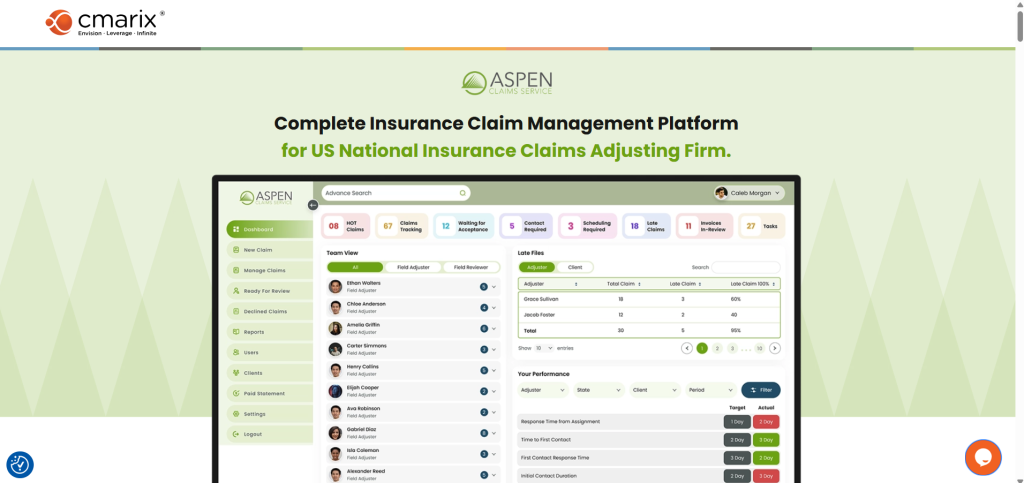
Take Aspen Claims, a web-based claims management platform we built for the US insurance market. It runs on a microservices architecture with real-time data synchronization, role-based access for admins, field adjusters, and clients, automated notifications, and integrations with claims, e-signature, and document platforms such as Symbility, XactAnalysis, CoreLogic, DocuSign, and Dropbox. Bots and agents are only as good as the systems and data underneath them, and that connected, permissioned foundation is what we bring to every automation project.
Conclusion
Agentic AI vs RPA is less a contest than a division of labor. Bots will always be the optimal choice when the task is stable and structured, and there is a lot of repetition. Agents prove necessary for unstructured input, frequent exceptions, and processes spanning multiple systems. The best solutions include both bots and agents.
Start small. Do a thorough audit of your bots, identify a single problematic workflow, establish boundaries, and test it against actual benchmarks. If the results stick, scale up. If not, then you’ve just lost a pilot project, not the entire process. Whenever you want an experienced team to help plan the move, CMARIX is ready to talk.
FAQs on Agentic AI vs RPA
What is the difference between RPA and Agentic AI?
Robotic process automation (RPA) follows fixed scripts to run repetitive tasks on structured data. Agentic AI works toward a goal, choosing steps and tools as it goes, and can handle unstructured inputs and exceptions. In short, RPA executes while agentic AI reasons.
What best distinguishes Agentic AI from traditional RPA in enterprise workflows?
The best distinction between agentic AI and traditional RPA is autonomy. A traditional bot stops when a case falls outside its rules. An agent replans, asks a human, or tries another route, making it better suited to workflows with variation, judgment, and many connected systems.
What are the biggest technical limitations of traditional RPA bots?
Traditional RPA breaks when interfaces change, struggles with unstructured data, and cannot make judgment calls. They also require ongoing maintenance, and each bot covers a narrow task, so end-to-end processes need heavy orchestration.
How do autonomous AI agents handle dynamic data changes compared to RPA?
An RPA bot depends on formats and fixed selectors, so a changed layout can stop it. The agent understands the meaning of the field/document it interacts with, allowing it to work well even when the format/layout changes. However, the agent requires monitoring due to possible misinterpretation.
How can legacy firms smoothly transition from RPA to Agentic AI systems?
Go slowly. Audit your bots, select a low-risk pilot, test the agent side by side with the current bot until it outperforms it, keep your bots around, and let your agents call on them as tools.
AI Agents vs RPA: Which architecture handles complex, multi-system integrations better?
Agents usually do better; they can call APIs, query databases, and pass work between tools, while a bot works one interface at a time. The best results often come from a hybrid approach, where the agent coordinates, and bots handle fixed, high-volume steps.
Why are finance departments switching from traditional RPA to AI for accounting automation?
Finance work involves mixed document formats, reconciliation exceptions, and tight deadlines. Agents can read invoices, reconcile discrepancies, and follow up on issues, eliminating manual exception handling. Bots are mostly retained for posting journal entries.
RPA vs AI vs ML: How do you structure a matrix for enterprise resource allocation?
Evaluate each process based on the type of data it handles, variability, risk, and data volume. Static processes with large volumes of data should be allocated to RPA; predictive analysis to ML, and tasks involving content to generative AI.
What are the key steps to ensure a profitable ROI when upgrading from RPA to Agentic AI?
Set the baseline before starting the pilot project, select processes with exceptions that cost money or require maintenance, and include model deployment and governance in the budget.
How should a technical steering committee benchmark Agentic AI software before full enterprise deployment?
Run every shortlisted tool against the same set of real past cases. Measure accuracy, exception-handling capabilities, cost per transaction, speed, auditability, and security.