

Quick summary: Token prices are still going down. However, AI invoices keep rising. This surprises most business teams because of repeated prompts, agents, and retries. LLM cost optimization techniques can reduce token costs without lowering answer quality. In this guide about LLM cost optimization, you will find nine tested tactics, a sample savings formula, and a 12-week implementation roadmap.
LLM cost optimization helps enterprises control spiraling expenses without hurting response quality, application performance, or user experience.
By choosing the right models, eliminating unnecessary token usage, caching repeated requests, and designing efficient AI workflows, businesses can make their AI operations sustainable. Gartner predicts that at least half of GenAI projects will overrun their budgets through 2028 because of poor architecture and limited operational know-how. Since inference typically accounts for at least 70% of a model’s lifetime cost, mastering cost optimization is a critical engineering priority.
LLM Cost Optimization Key Highlights
- 50% Budget Overruns: Gartner warns that at least half of GenAI initiatives will exceed their financial targets through 2028 due to poor architectural planning and operational blind spots.
- Fastest Wins: If you need to cut your bill quickly, focus on caching, smart model routing, and tight output caps. These three levers give you the fastest, most immediate drop in token spend.
- Agent Guardrails: Left to themselves, autonomous agents can get stuck in infinite loops and run up massive bills overnight. They absolutely need strict token budgets and automated backup plans (fallback trees) to keep them contained.
- Business-Centric Metrics: Don’t just watch the cost per token. Finance leaders care about cost per business outcome—like exactly how much it costs you to resolve a single customer support ticket using AI.
- Holistic Lifecycle Budgeting: Don’t just budget for the raw token bill; account for the entire lifecycle across three distinct pillars: building the solution, running the inference infrastructure, and maintaining the platform against drift.
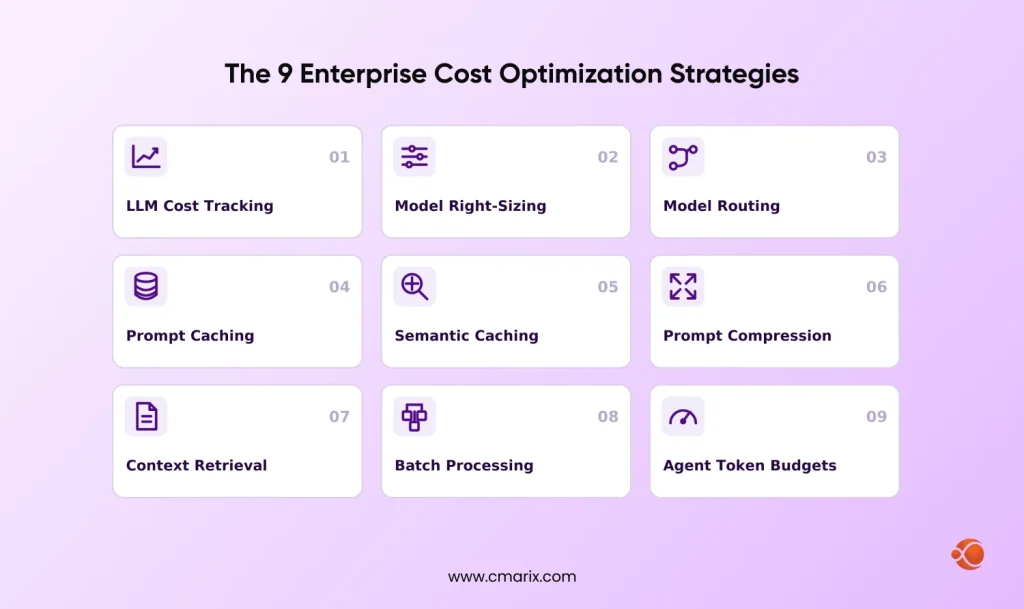
The 9 Strategies at a Glance
| # | Strategy | What it cuts | Implementation Effort |
| 1 | LLM cost tracking | Blind spots and waste | Low |
| 2 | Model right-sizing | Price per token | Low |
| 3 | Model routing | Calls to frontier models | Medium |
| 4 | Prompt caching | Repeated input cost | Low |
| 5 | Semantic caching | Duplicate model calls | Medium |
| 6 | Prompt compression and output caps | Input and output tokens | Low |
| 7 | Retrieval instead of context stuffing | Prompt size | Medium |
| 8 | Batch processing | Price on non-urgent work | Low |
| 9 | Agent token budgets and fallback trees | Runaway loops and retries | Medium |
What Is LLM Cost Optimization, and Why Is It Necessary for Enterprises?
LLM Cost Optimization is reducing the costs of running large language models. This includes token, compute, and infrastructure costs while maintaining consistent output quality. The key levers are prompts, caching, model selection, routing, and agent design.
Enterprises need it because pilots hide the real bill.Gartner expects at least 50% of GenAI projects to overrun their budgets through 2028. It blames poor architecture choices and thin operational know-how. Gartner also expects inference to make up at least 70% of a model’s lifetime cost.
Here is the paradox. Stanford HAI found that the cost of querying a GPT-3.5-level model fell from about $20 to $0.07 per million tokens. That drop took place between November 2022 and October 2024. Unit prices collapsed, yet total bills kept climbing because usage grew faster than prices fell.
The problem is exacerbated by agents. For a 10,000-token system prompt in a 50-turn interaction, the model processes 500,000 tokens before generating a single word. This is why LLM cost optimization has now become as important as security and uptime for enterprises.
Where Generative AI Infrastructure Costs Come From
Five drivers explain most overspend. Find the biggest one first.
- Tokens. Providers bill input and output separately. Output tokens usually cost several times more than input tokens.
- Model tier. Frontier models can cost many times more than small ones for the same simple task.
- Deployment mode. APIs bill by token. Self-hosting bills by GPU hours, so idle time becomes pure waste.
- Inference mode. Real-time requests cost more than batch jobs that can wait.
- The supporting stack. Vector databases, embeddings, tool APIs, and monitoring add up as traffic grows.
Sizing an AI project, not just a token bill? Get your build estimate with the Software Development Cost Calculator and see how the platform around your LLM shapes the budget.
Where Generative AI Infrastructure Costs Come From
Five drivers explain most overspend. Find the biggest one first.
- Tokens. Providers bill input and output separately. Output tokens usually cost several times more than input tokens.
- Model tier. Frontier models can cost many times more than small ones for the same simple task.
- Deployment mode. APIs bill by token. Self-hosting bills by GPU hours, so idle time becomes pure waste.
- Inference mode. Real-time requests cost more than batch jobs that can wait.
- The supporting stack. Vector databases, embeddings, tool APIs, and monitoring add up as traffic grows.
Sizing an AI project, not just a token bill? Get your build estimate with the Software Development Cost Calculator and see how the platform around your LLM shapes the budget.
Deep Dive: The 9 Enterprise Cost Optimization Strategies
Strategy 1: Set Up LLM Cost Tracking First
You cannot control what you cannot see. Tag all requests according to feature, team, model tier, and prompt version before modifying the code. Watch these five important metrics on a weekly basis:
- Tokens per request: Track input and output trends separately.
- Cost per feature: Isolate spending by customer or application feature.
- Cache hit rate: Measure how effectively your caching layers perform.
- Quality score: Evaluate outputs against a fixed test set to ensure quality doesn’t slip.
- Cost per business outcome: Measure metrics like cost per resolved support ticket to prove ROI to finance teams.
If you self-host, include GPU and memory utilization. Utilization below 50% means you’re paying for an idle machine. Cost per outcome matters most. It shows whether spending pays off.
Strategy 2: Right-Size the Model for Each Task
All teams use one model for everything. Don’t do that. Instead, go for the ladder technique. Start with the cheapest one that can do the job. Test it with labeled data from your traffic. If it fails, move to the next model.
Classification, extraction, formatting, and routing usually work well with small models. Save the frontier models for complex reasoning and important decisions. A fine-tuned small model may also outperform a bigger one in specialized tasks. The guide to fine-tuning AI models reveals when that trade-off is worth it.
Build an LLM evaluation framework before you switch anything. Without one, you cannot prove that quality held.
Strategy 3: Use Model Routing Strategies Instead of a Static Setup
Dynamic model routing stops you from paying premium frontier prices for basic user queries. Instead of sending everything to one expensive model (a static setup), you use a smart traffic controller to read the incoming request first. Simple tasks go to a cheap, lightweight model, while complex logic problems get saved for the heavyweights.
According to LMSYS RouteLLM research, smart routers can cut costs by over 85% while keeping roughly 95% of GPT-4’s quality.
Three routing patterns work in production:
- Rule-based: Route instantly using basic logic like task type, prompt length, or user subscription tier.
- Classifier-based: Use a tiny, fast model to predict a prompt’s difficulty before dispatching it.
- Cascade: Try the cheapest model first, then automatically escalate to a stronger model if confidence is low.
Watch quality as closely as cost. A weak router saves money while quietly hurting answers. Our machine learning development engineers build these classifiers and the test sets behind them.
Strategy 4: Turn On Prompt Caching for LLM Cache Optimization
Prompt caching saves money by remembering the start of a prompt so you don’t pay to process the exact same instructions over and over. It is a perfect fit for AI agents, copilots, and RAG apps, where system instructions, tool schemas, and massive reference documents rarely change from one message to the next.
For example, Anthropic charges a small premium (1.25x the base input rate according to its pricing documentation) to write to its default 5-minute cache. However, every time you read from that cache, you get a massive 90% discount (paying just 0.1x the base rate). Because the discount is so steep, reusing that cached context even once within those five minutes already pays for the initial write fee.
PwC’s research analyzed 500 agent sessions across OpenAI, Anthropic, and Google. It found that prompt caching reduced API request costs by 41%- 80% and increased time to first token by 13%- 31%. It also noted that caching dynamic tool results can increase latency.
Follow three rules:
- Put stable content first and dynamic content last.
- Keep the cached prefix identical between calls.
- Track your hit rate. A rate near 0% means your prefix keeps changing.
Strategy 5: Add Semantic Caching for Repeated Questions
Prompt caching reduces redundancy from repeated inputs. Semantic caching avoids sending the request to the model entirely. It saves past outputs as vector embeddings. If the new input has the same meaning as previous ones, then the output is retrieved from cache.
Vendors report large gains. Redis says its LangCache service can cut token usage and API bills by up to 70%. Treat that as a ceiling. Real results depend on how repetitive your traffic is. A vector database powers the similarity search.
Semantic caching works well with FAQ bots, internal knowledge workers, and helpdesks. Semantic caching does not work well when personalization is required, or answers change rapidly. Define a high similarity score. Define an expiration policy for cached answers. Do not ever serve cached answers to users with different permission levels.
Build smarter AI workflows that reduce token usage without compromising performance.
Strategy 6: Apply Prompt Compression Techniques and Output Caps
Tokens spent on filler are wasted tokens. Compress both sides of the call.
Input compression
- Combining overlapping instructions in lengthy system prompts.
- Applying structured inputs like JSON schemas, rather than prose
- Creating summaries for previously discussed messages, rather than repeating them.
- Filtering out irrelevant information from retrieved sources before using it in prompts.
Output control
- Setting a token limit for each task.
- Asking for the needed output format, such as just a JSON object.
- Avoid reasoning when the output is meant for a machine, not a human.
Research backs this up. A Google and Purdue method called CROP trains prompts to favor short reasoning. It cut output tokens by 80.6% with competitive accuracy on reasoning benchmarks. You do not need that machinery to start, because plain brevity instructions already help. Our comparison of fine-tuning versus prompt engineering shows when each approach earns its keep.
Strategy 7: Retrieve Context Instead of Stuffing It
The most usual cost driver is that of inserting whole documents within each prompt. It increases costs because it uses more of your context window. The provider charges a premium when the prompt crosses the long-context limit.
Here comes in handy the Retrieval-Augmented Generation solution. RAG retrieves only the excerpts that can answer your query. Prompts stay short, and answers stay relevant. To use it, we will need a vector database, an embedding model, and retrieval capabilities. High request volume repays that effort quickly. Read our breakdown of RAG versus fine-tuning to choose the right architecture.
Pair RAG with caching. Cache the stable instructions and keep retrieved passages at the end of the prompt.
Strategy 8: Move Non-Urgent Work to Batch
Batch APIs sacrifice performance for cost savings. Anthropic’s Message Batches API costs 50% of the standard price and delivers output within 24 hours. These requests typically complete faster. OpenAI offers an equivalent option. Anthropic’s batch and caching discounts are additive. Good batch candidates include:
- Document extraction and data enrichment
- Nightly reports and email drafts
- Bulk classification
- Evaluation runs
Notify users by email or webhook when results land. Schedule heavy jobs off-peak to smooth demand.
Strategy 9: Set Token Budgets, Guardrails, and Fallback Trees for Agents
Agents require strict budgeting. Without them, a single loop can cost a whole month’s budget in one run. The following are ways to budget tokens for agents in an affordable manner:
- Per-task token budget. Stop or escalate when a run passes its cap.
- Step and retry limits. Cap tool calls and loop depth.
- Tool result trimming. Return only the fields the agent needs.
- Memory summaries. Compress long histories instead of resending them.
- Compiled workflows. For repeatable jobs, have the model write a reusable plan once. Then run it without more model calls.
Automated fallback trees keep systems inside budget and online. A typical tree runs in this order:
- Try the primary cheap model.
- Escalate to a stronger model when confidence is low.
- Switch to a backup provider on rate limits or outages.
- Serve a cached answer when the budget runs out.
- Hand high-stakes cases to a human.
Log every branch and review how often each one fires. Our generative AI integration engineers wire these gateways into existing enterprise systems.
Should You Self-Host Open-Source Models?
Self-hosting swaps token bills for infrastructure bills. Open-source model self-hosting cost comes from GPUs, engineering time, and idle capacity. It can win at steady, high volume. It can lose badly at low or spiky volume.
| Signal | Stay on APIs | Consider self-hosting |
| Traffic | Spiky or low volume | Steady, predictable, high volume |
| Data rules | Standard compliance | Strict residency or private data |
| Team | Small platform team | In-house MLOps and GPU skills |
| Task type | Broad, changing tasks | Narrow tasks a small model handles well |
| Utilization | Cannot keep GPUs busy | Can keep GPUs busy around the clock |
See our enterprise private LLM deployment guide for cloud, on-prem, and hybrid designs. Prove the savings on an AI proof of concept before you buy hardware.
Identify AI spending gaps and build a cost-efficient LLM strategy with CMARIX.
Worked Example: What the Strategies Are Worth
These numbers are illustrative. Assume 1 million requests a month on a support assistant. Each request sends 6,000 input tokens, and 5,000 of them are stable instructions and documents. Each returns 500 output tokens. Prices are $3 per million input tokens and $15 per million output tokens.
| Stage | Change | Monthly cost | Saving vs baseline |
| Baseline | No optimization | $25,500 | 0% |
| 1 | Cache the 5,000-token stable prefix at the 10% read price | $12,000 | 53% |
| 2 | Route 70% of requests to a model priced at one fifth | $5,280 | 79% |
| 3 | Cap output from 500 to 300 tokens | $3,960 | 84% |
| 4 | Send 20% of volume through batch at half price | $3,564 | 86% |
This is the best-case scenario. It does not account for costs for writing cache entries, cache miss rates, router issues, or engineering time. Practitioners typically quote figures from 50% to 80%. Use your own numbers and do your own calculations.
When Should You Invest in an LLM Optimization Framework?
A basic API pipeline is fine for prototypes and low-volume tools. A framework pays off once spend becomes a finance topic.
| A basic API pipeline is enough when | Invest in a framework when |
| You run one feature on one model | Several features share a budget |
| Spend is small and stable | Spend grows month over month |
| Prompts are short | Prompts repeat more than 1,000 tokens |
| You have no agents | Agents loop or call tools |
| Nobody reviews AI spend | Finance asks for unit economics |
Your LLM Token Cost Optimization Blueprint for 2027
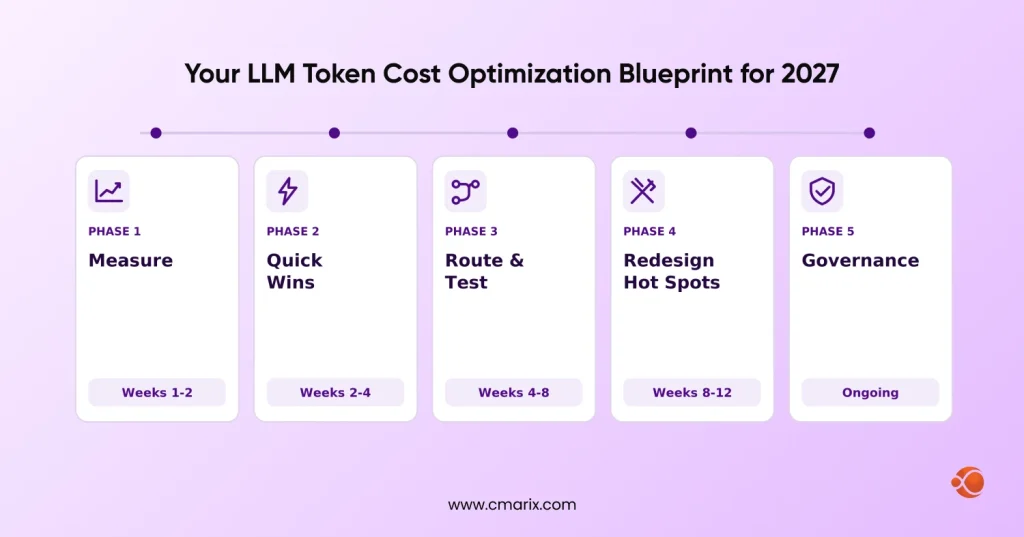
A sensible rollout follows the order of payoff. This LLM token cost optimization plan fits a 12-week window.
- Phase 1 – Measure (Weeks 1-2): Include tagging and dashboards. Establish the baseline for every feature.
- Phase 2 – Quick Wins (Weeks 2-4): Enable prompt caching, short prompts, output limitation, and asynchronous batching.
- Phase 3 – Route & Test (Weeks 4-8): Create the evaluation dataset. Implement routing and semantic caching.
- Phase 4 – Redesign Hot Spots (Weeks 8-12): Implement RAG, agent budgets, fallback tree, and compiled workflows.
- Phase 5 – Governance (Ongoing): Evaluate weekly and implement alerts. Check the model costs every quarter, as they drop constantly.
Teams that start small prove value fast. Our AI MVP development team can scope a first release with built-in cost controls.
Budget the Whole AI Project, Not Just the Token Bill
Enterprise AI framework budgeting needs three lines: build, run, and maintain. Tokens are only part of the run line. Hosting, vector storage, monitoring, evaluation, and retraining sit beside them. Our AI app development cost guide and AI product development cost breakdown cover the architecture, infrastructure, and MLOps layers. For general app budgets, see cost to develop an app.
Estimate Your Project Before You Commit Budget
Stakeholders approve budgets faster when they see numbers. Use these three CMARIX calculators to frame the conversation.
- Building a custom AI platform or integration layer? Run the Software Development Cost Calculator to price the platform around your LLM.
- Adding AI features to an iOS or Android app? Try the Mobile App Development Cost Calculator to size the build.
- Already live and worried about the run phase? Use the Software Maintenance Cost Calculator to plan monitoring, updates, and model drift work.
These tools estimate build and maintenance effort. They do not predict token spend. Pair them with the worked example above for a full picture.
Why Teams Choose CMARIX for LLM Cost Control
CMARIX is an AI software development company founded in 2009 and based in Ahmedabad, India. Its AI model fine-tuning services page reports 50+ fine-tuning solutions and 120+ successful AI deployments. As an LLM development company, CMARIX covers RAG pipelines, safety evaluation, drift detection, and self-hosted deployment.
What that means for your bill:
- Architecture design. Collaboration on routing, caching, RAG, and agent guardrails.
- Evaluation. Test sets and regression checks so savings never cost quality.
- Flexible deployment. API, private cloud, or self-hosted open-source models.
- Ongoing monitoring. Drift alerts and performance reports after launch.
Explore CMARIX generative AI solutions or its custom AI software development services to see how the pieces fit your roadmap.
Conclusion
Optimizing LLM costs doesn’t rely on a single method. It requires iteration through measuring, trimming, routing, and governance. Start by measuring, caching, and limiting outputs. Then add routing and retrieval. Apply budgeting to all agents involved.
CMARIX can help you design that loop and estimate the full project around it.
FAQs About LLM Cost Optimization
What is LLM cost optimization, and why is it necessary for enterprises?
LLM cost optimization means reducing token, compute, and infrastructure costs without affecting output quality. It is necessary for enterprises since production inference runs on each request. Gartner predicts that 50% of GenAI projects will exceed their budget allocation until 2028.
What are the primary drivers of skyrocketing generative AI infrastructure costs?
The causes include long prompts per call, agent loops, using high-end models for low-level tasks, GPU idle time, and the full stack, including vector databases. You can find more answers here.
How does prompt engineering affect your total token billing cycle?
Input and output size constraints are determined by the prompt itself. Short prompts lead to smaller input size. Limits on formatting and brevity reduce output size, which is expensive. Better prompts lead to fewer retry attempts. Always test against a fixed test set.
When should you invest in an LLM optimization framework versus a basic API pipeline?
Use a basic pipeline for smaller, stable loads. Consider a framework when costs increase every month, when you budget by feature cost, when you have looping agents, or when your finance department needs unit economics. Larger questions that exceed 1,000 tokens are also pertinent.
What are the best ways to reduce LLM API costs in production-grade applications?
First, implement LLM cost tracking, prompt caching, and output limits. Second, incorporate model routing, semantic caching, retrieval, and batch processing. Third, implement agent budgets and fallback trees. Learn more about engineering answers on AI and ML from our Q&A.
How do semantic caching tools prevent repeating identical LLM requests?
Semantic caching prevents duplicate LLM requests by checking if a similar question has already been answered. When a user submits a query, the system converts it into a vector embedding and searches a database of past interactions. If the query matches a previous entry above a set similarity threshold, the system skips the LLM entirely and returns the stored response. This saves 100% of both input and output tokens for that request.
How does dynamic LLM model routing compare to standard static setups?
A static setup sends every request to a single model, meaning you pay premium frontier prices for simple tasks like formatting text or greeting users. Dynamic routing acts as a smart traffic controller by evaluating each request before dispatching it. It automatically funnels easy tasks to cheaper, lightweight models and reserves expensive reasoning models for complex problems. Research shows this approach can cut your overall costs by 35% to 85% depending on your traffic mix.
What are the core steps of a verified LLM token cost optimization blueprint?
To reduce LLM costs efficiently, you need an organized approach. First, enable deep logging so that you understand where the money is going. Second, capture quick wins such as prompt caching, short instructions, reduced output length, and batch APIs for less critical processes. Once your quality tracking dataset is ready, apply dynamic routing and semantic caching. Finally, rearchitect your solution using RAG and agent budgets.
Which token budget strategies for autonomous AI agents maintain system performance?
You can control autonomous agents without hurting their performance by setting strict execution boundaries. Implement hard token caps per task, along with maximum limits on steps and retries, to keep agents from getting stuck in infinite loops. You should also clean up tool payloads so the agent reads only the fields it needs, and compress long conversation histories instead of re-sending entire chat logs. For highly repetitive tasks, have a flagship model write a reusable execution plan once, then let a cheaper model execute the steps.
How do engineering teams implement automated model fallback trees to stay within budget?
Engineering teams implement fallback trees within an AI gateway to keep systems online and within budget using an ordered set of rules. The system tries the primary low-cost model first, then automatically escalates to a premium model if the initial confidence score falls below your threshold. If a provider throws errors or hits rate limits, the gateway instantly reroutes traffic to a backup vendor. If a task exhausts its allocated budget entirely, the system gracefully serves a clean, pre-saved response or hands the conversation over to a human teammate.