

Quick Summary: Integrating RPA with AI and ML is revolutionizing how organizations automate complex, judgment-based processes. This guide highlights use cases, a step-by-step implementation approach, compliance, and ROI considerations for implementing intelligent automation. It also covers future trends, including hyperautomation and agentic AI, making it an invaluable resource for anyone interested in intelligent automation. It also maps the future of robotic process automation and the latest trends in the field.
Robotic Process Automation was once seen as a major achievement in automating mundane processes. Today, that achievement can feel outdated. As AI and machine learning integrate into RPA, companies can extend process automation with AI-powered decision support, prediction, and context-aware processing. Understanding the future of RPA now helps leaders plan smarter automation budgets.
McKinsey’s Global Institute, estimates that activities accounting for up to 30% of US hours worked could be automated by 2030. Generative AI accelerates that shift.
See how AI and RPA transform business operationsat enterprise scale.
At CMARIX, we’ve helped enterprises across healthcare, fintech, and manufacturing architect intelligent automation frameworks that go well beyond basic bot deployment. This comprehensive guide synthesizes everything decision-makers need to understand: from the foundational RPA + AI stack to implementation best practices, ROI metrics, compliance guardrails, and what the next generation of autonomous process intelligence will look like. Our view on the future of RPA comes from live enterprise projects, not theory.
What is intelligent Automation?
Intelligent automation combines RPA with AI, ML, and process mining. Bots execute tasks. AI interprets data and decides. Together they handle unstructured, judgment-based work.
Understanding the RPA + AI Convergence
The real issue now isn’t whether RPA and AI should be combined – it’s how soon and how thoroughly. RPA works best for structured, rule-driven processes like copying data from one system to another, creating invoices, and filling out forms. The problem is that once the process involves anything uncertain – say, interpreting unstructured data or making a decision – RPA systems reach their limits.
That is when AI takes the stage. When you add machine learning, natural language processing, and computer vision to your existing RPA platform, you turn a robotic digital employee that follows orders into a digital brain that can understand context.
What Makes RPA and AI a Perfect Match?
RPA’s execution capability is deterministic, fast, and scalable. AI provides context-specific, flexible, predictive intelligence.
The synergy works across three dimensions:
- Speed and Intelligence: RPA operates at lightning speed; AI ensures these speedy tasks account for all contexts and contingencies.
- Scale and Flexibility: The robots handle millions of processes; ML enables accurate handling of pattern shifts.
- Automation and Analytics: Every automated run also produces process data you can analyze.
- RPA and AI in business services now support finance, HR, and customer operations.
Traditional RPA: Capabilities, Benefits, and Limitations
What Traditional RPA Does Well
Traditional Robotic Process Automation excels at handling structured, rule-based processes with predictable patterns. These systems have proven their value in
- Automating Data Entry and Validation across Multiple Systems
- Invoice Processing and Accounts Payable Workflows
- Report Generation and Distribution
- Customer Onboarding Processes
- Basic Customer Service Interactions
The benefits of RPA are immediately apparent in reliability and speed for mundane activities. Companies benefit from cost savings, fewer errors, and faster processing. They can run without rest at any time and perform at the same level consistently, which humans cannot.
Where Traditional RPA Falls Short
Traditional RPA systems face various challenges when handling complex business scenarios. These challenges show why the future of robotics and automation requires AI integration:
- Unstructured Data poses a major challenge, as traditional bots struggle with emails, PDFs, images, and handwritten documents that don’t conform to predefined formats.
- Exception Handling becomes problematic when processes encounter unexpected scenarios or variations, often causing traditional RPA systems to fail or require extensive manual intervention.
- Decision-making capabilities are limited since rule-based systems cannot adapt to changing conditions or make complex decisions that require contextual understanding.
- Finally, traditional systems lack continuous learning because they don’t improve over time or learn from experience, so they require manual updates for process changes.
This is where intelligent automation solutions from providers like CMARIX bridge the gap, layering AI onto existing RPA frameworks rather than rebuilding from scratch.
How AI and ML Integration Transforms RPA Capabilities
Robotic Process Automation (RPA) excels at repetitive, deterministic tasks. However, traditional bots struggle with processes that involve unstructured data and unpredictable conditions.
When combined with ML, AI enables RPA tools to understand information, identify patterns, and make informed decisions while continuously improving processes. This convergence drives the shift toward intelligent automation, where RPA does not follow predetermined steps but adapts to changing business conditions.
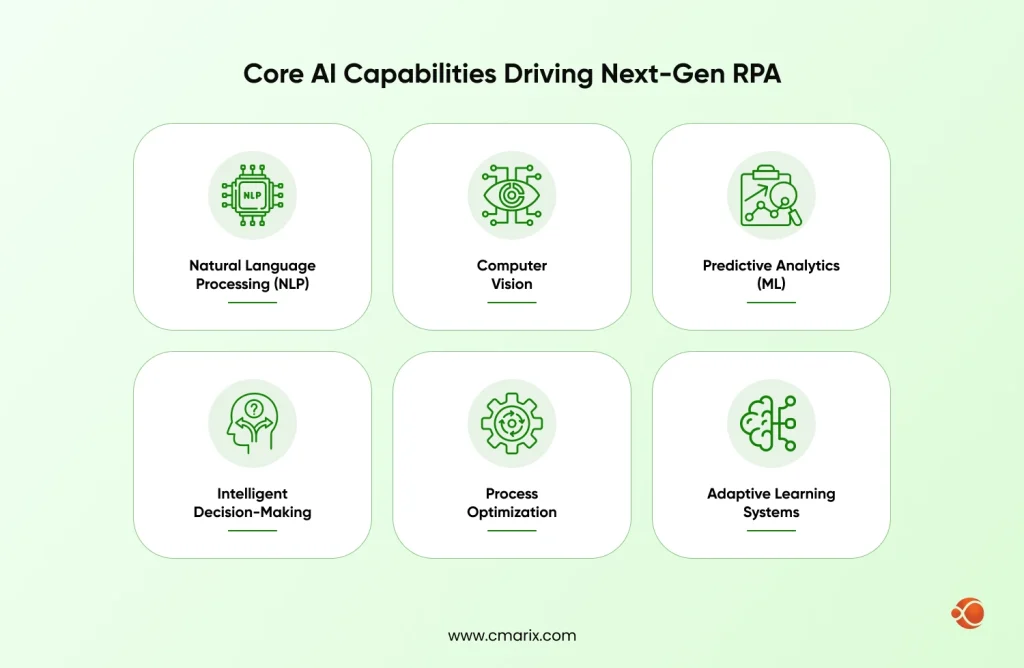
Core AI Capabilities Driving Next-Gen RPA
| AI Technology | What It Does |
| Natural Language Processing (NLP) | Understands emails, chats, documents, and other language-based data |
| Computer Vision | Interprets images, scanned documents, and visual information |
| Predictive Analytics (ML) | Forecasts outcomes, identifies risks, and detects emerging patterns |
| Intelligent Decision-Making | Uses context and business data to determine appropriate actions |
| Process Optimization | Identifies inefficiencies and continuously improves workflows |
| Adaptive Learning Systems | Learns from data, outcomes, and feedback to improve automation over time |
Together, these capabilities make it possible to use RPA in enterprise software environments where processes require continuous learning, adjustment, fine-tuning, and optimization.
Natural Language Processing: Breaking Communication Barriers
NLP enables RPA to work with human language rather than only structured fields and defined inputs. This makes automation possible for tasks such as email processing, customer interactions, document processing, and more.
Key NLP applications in RPA include:
- Email classification and routing
- Document and text analysis
- Customer sentiment analysis
- Information extraction
- Automated response generation
- Multilingual communication processing
Consider a customer service scenario in which traditional RPA could process only structured support tickets. With NLP integration through AI software development services, the same system can now process emails in multiple languages, understand customer intent, extract relevant information, route tickets to the appropriate departments, and even draft initial responses based on historical data and best practices. AI in app development makes these language features available inside custom business apps.
Computer Vision: Teaching Machines to See
Computer vision allows automation systems to understand visual data like scanned papers, photographs, forms, products, and screenshots. In tandem with RPA, computer vision allows bots to gather information and process workflows through visual data inputs.
Common applications include:
- Optical Character Recognition (OCR)
- Invoice and document processing
- Image-based quality inspection
- Signature and document verification
- Visual process monitoring
- Detection of anomalies and defects
For example, consider manufacturing. Siemens uses AI-based visual inspection to detect defects at full production speed. In a rollout with Procter & Gamble, Siemens reports scrap reductions of 10 to 20%, depending on the product.
The combination is particularly valuable when information cannot be captured reliably through conventional structured data entry.
Predictive Analytics: From Reactive to Proactive Automation
Machine learning permits RPA systems to do more than execute processes based on past events. By analyzing past and current information, predictive models can detect patterns, predict possible outcomes, and flag future issues before they become problems.
Advanced machine learning development services help improve predictive capabilities, including:
- Process bottleneck detection
- Resource planning
- Failure prediction
- Risk identification
- Demand forecasting
- Performance optimization
Financial organizations use predictive analytics in robotic process automation to forecast customer default risk, improve cash flow, and enhance the credit approval process, while accounting for current market conditions. Predictive intelligence RPA turns past process data into early warnings and better decisions.
AI model fine-tuning is crucial to keeping these predictive systems accurate and adapting to changing business conditions over time. Our AI model fine-tuning services help teams keep these models accurate as data changes.
Intelligent Decision-Making: Moving Beyond Rule-Based Automation
Classic RPA works under clear rules – if certain criteria are met, the bot executes a certain task. It is efficient when process execution can be easily predicted, but it fails when multiple criteria are involved.
AI makes context-based decision-making possible. Beyond static rules, intelligent automation can analyze information from various sources and decide what to do next.
Applications include:
- Risk-based approvals
- Intelligent case routing
- Exception handling
- Priority assignment
- Fraud detection
- Context-aware recommendations
For example, an invoice automation workflow can consider invoice value, supplier history, purchase order information, previous exceptions, and other relevant signals before deciding whether an invoice can proceed automatically or requires human review.
This does not mean removing people from the decision-making process. In high-impact scenarios, organizations can design workflows so that AI recommends an action while a human retains final approval.
The result is a more flexible automation model that combines machine speed with human judgment where it matters most.
Process Optimization: Making Automation More Efficient
Automating an inefficient process does not necessarily make the process better. AI and ML can help organizations analyze how workflows actually operate and identify opportunities for improvement.
Process optimization uses operational data to uncover bottlenecks, repetitive activities, unnecessary handoffs, and other sources of inefficiency.
AI-powered process optimization can help with:
- Bottleneck identification
- Workflow redesign
- Task prioritization
- Resource allocation
- Cycle-time reduction
- Performance monitoring
For instance, an automated approval system may be slow because some cases still require verification. Using data from past workflows, artificial intelligence can spot the traits of such delays and redesign the workflow so simple cases move quickly while complex ones are properly verified.
This creates a feedback loop in which automation is not treated as a one-time implementation but as a process that can be measured and improved continuously.
Adaptive Learning Systems: Automation That Improves Over Time
One of the biggest advantages of integrating machine learning with RPA is the ability to adapt to changing data and operating conditions.
Traditional bots generally require developers to modify rules when a process changes. Adaptive systems can learn from historical outcomes, user feedback, exceptions, and new data, reducing the need for constant manual adjustments.
Adaptive learning can support:
- Learning from process exceptions
- Feedback-driven improvements
- Changing workflow conditions
- Classification refinement
- Continuous accuracy improvements
- Model retraining and monitoring
For instance, an otherwise efficient workflow may misclassify some invoices. With more samples and user corrections to the initial categorizations, the model can be retrained and reassessed.
But adaptive automation will always require governance. It is necessary to control the models for errors, drift, unexpected behavior, and changes in business needs. Human involvement is necessary, especially when machine decisions have high-stakes consequences.
Key Technologies Shaping the Future of Intelligent Automation
Hyperautomation: The Complete Automation Ecosystem
Hyperautomation can be considered the culmination of future trends in RPA technologies, involving the combination of different elements into one comprehensive automation framework that includes:
- Process mining to discover existing processes automatically
- Task mining to identify automation opportunities through user behavior analysis
- Business process management (BPM) to manage workflows effectively
- AI/ML for adding intelligence to the framework and enabling decision-making
- Low-code/no-code platforms for rapid development and deployment
The key strength of hyperautomation is its continuous improvement capability. As processes run in the hyperautomation environment, it collects performance data and uses it to optimize them. Hyperautomation is also one of the biggest enterprise software trends today.
RPA platforms, along with low-code and no-code technologies, have become essential parts of modern automation. They help automate processes without requiring any programming skills.
| Technology | Function | Benefit |
| Process Mining | Discovers existing processes automatically | Eliminates guesswork in automation planning |
| Task Mining | Identifies automation opportunities through user behavior | Uncovers hidden inefficiencies |
| BPM | Orchestrates complex workflows | Enables end-to-end process automation |
| AI/ML | Adds intelligence and decision-making | Handles exceptions and variability |
| Low-Code/No-Code | Enables rapid automation development with minimal coding | Speeds deployment and reduces development effort |
Conversational AI Integration
Combining conversational AI and RPA enables the creation of intelligent virtual assistants that can perform complex, multistep tasks through natural language. They comprehend context, keep the conversation going, and run backend tasks while informing users about their current status and what comes next.
Lightweight AI techniques let these conversational interfaces run efficiently while delivering sophisticated interaction capabilities. Employee self-service applications include:
- Time-off requests and approvals
- Expense report processing
- HR information updates
- IT support ticket creation
The beauty of conversational AI integration is its ability to make complex automation accessible to non-technical users through natural language interfaces, a key part of the future of RPA.
Cloud-Native Architecture
The cloud-based approach to RPA delivery fundamentally changes its value proposition. While local bots have limited resources, cloud-based automation allows for:
- Elastic scalability: Deploy 500 bots during your month-end period, then scale down
- Worldwide coverage: Run the bots from regional data centers
- API-first integration: Connect to modern SaaS tools without fragile UI-based workarounds
- Continuous deployment: Push bot updates without downtime
Cloud delivery removes infrastructure limits that slow rollout.

Transforming Business Operations: Industry Use Cases
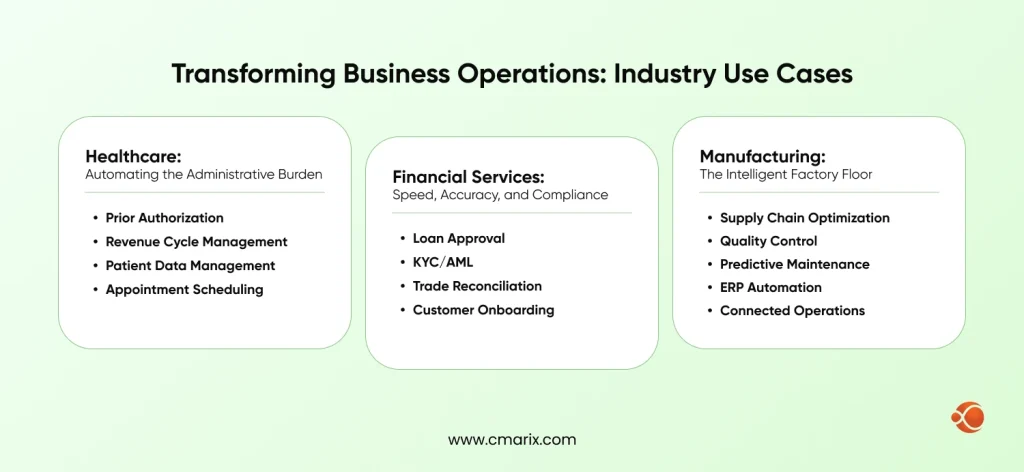
Healthcare: Automating the Administrative Burden
A Health Affairs research brief estimates wasteful administrative spending cost US healthcare $285 to $570 billion in 2019.
- Prior authorization: AI reads clinical notes; RPA submits pre-auth requests to insurers and can reduce processing time from days to minutes
- Revenue cycle management: Claims processing, denial management, and posting payments are performed by bots with the use of NLP to handle unstructured communication with payers.
- Patient data management: Automated data reconciliation between various EHR platforms, adhering to HIPAA compliance.
- Appointment scheduling: Conversational AI handles patient intake; RPA updates scheduling systems and sends reminders.
Financial Services: Speed, Accuracy, and Compliance
The dual challenge for banks and financial organizations is to increase speed in customer interactions while ensuring regulatory compliance. Here’s how AI+RPA helps achieve that:
- Loan Approval: The ML model assesses creditworthiness by analyzing unstructured data, while RPA collects, verifies, and sends the results.
- KYC/AML: The AI solution checks the client’s credentials for sanctions or suspicious activity; the RPA handles documentation and reporting processes.
- Trade Reconciliation: Automated bots reconcile millions of trades daily; exceptional cases that need human analysis are escalated to an AI-based system
- Customer onboarding: End-to-end automation reduces onboarding time from weeks to hours
Manufacturing: The Intelligent Factory Floor
Factories already use physical robots to automate production, assembly, and material handling. RPA extends this automation into the software layer, connecting factory operations with ERP systems, supply chains, finance, and reporting. When combined with AI, these technologies create a more intelligent, connected manufacturing environment:
- Supply Chain Optimization: AI predicts demand and potential supply disruptions, while RPA automates purchase orders, updates inventory records, and communicates with suppliers.
- Quality Control: Computer vision inspects products for defects at high speed and consistency, reducing reliance on manual inspection.
- Predictive Maintenance: AI analyzes sensor and equipment data to identify potential failures, while RPA automatically creates maintenance work orders and alerts the right teams.
- ERP Automation: RPA moves procurement, inventory, production, and financial data between systems, reducing manual data entry and improving operational visibility.
- Connected Operations: Physical robots automate work on the factory floor, while software bots automate the information and processes behind it. Together, they support the connected, data-driven operations envisioned by Industry 4.0.
Complex Decision-Making: Loan Approval and Customer Onboarding
Illustrative scenario: Loan Approval in Under 4 Minutes
1. Customer fills out the application (structured and unstructured docs)
2. NLP pulls out relevant info from PDFs and letters
3. ML evaluates credit score using over 200 variables
4. RPA checks bureau databases and company information
5. The decision-making process is based on rules
6. If approved, RPA creates and sends the loan agreement
7. If rejected, AI creates an individualized reason for rejection and sends it to the manual queue
8. Human underwriter reviews every rejection and borderline score.
Result: Routine approvals complete automatically. Rejections and borderline scores go to an underwriter.
Strategic Implementation: Building an RPA + AI Foundation
Building the Foundation with RPA Development Services
Successful implementation begins with intelligent process selection; not every process is a good candidate for automation. CMARIX’s RPA development services framework evaluates candidates across four dimensions:
- Volume: High-frequency processes deliver faster ROI
- Standardization: Well-defined rules enable faster bot deployment
- Stability: Processes that rarely change reduce maintenance overhead
- Strategic value: Automation of high-value processes justifies more sophisticated AI investment
| Phase | Activities & Objectives |
| Phase 1: Foundation (0–3 months) | Use of RPA technology in volume and structured business processes. Establishing governance and capturing baselines of metrics |
| Phase 2: Intelligence (3–9 months) | Incorporate ML algorithms for exception management. Implement NLP to manage document processing. Increase scope of automation |
| Phase 3: Optimization (9–18 months) | Add predictive capabilities. Incorporate conversational AI. Use process mining for continuous automation discovery |
| Phase 4: Hyperautomation (18+ months) | Evolving to an intelligent enterprise-wide automation platform. Citizen development programs. Autonomous process optimization |
This phased view gives leaders a realistic RPA adoption timeline from pilot to hyperautomation. Our RPA development services follow it and adapt each phase to client needs.
Maximizing ROI Through Strategic Planning
Organizations that treat automation as a technology effort rather than a strategy will underdeliver. Organizations earning the highest profits combine automation with:
- Executive sponsorship with a clear automation-as-a-strategic-priority mandate
- Center of Excellence (CoE) devoted to cross-disciplinary expertise
- Robust change management programs that address workforce concerns directly
- Process mining analytics fueling continuous improvement cycles

Compliance & Data Privacy in AI-Powered RPA
As automation handles more sensitive data, compliance becomes a first-class design requirement, not an afterthought. GDPR, HIPAA, and sector-specific regulations impose strict requirements on how automated systems collect, process, and store data.
Key Compliance Challenges
- Audit trails: Every automated action must be logged with sufficient detail for regulatory review
- Data minimization: AI models should be trained only on data necessary for the task, not on unnecessarily broad datasets
- Explainability: Decisions made automatically about people (credit, insurance, recruitment) should be easily explainable.
- Access controls: Bot credentials need the same privileged access management as human credentials
- Cross-border data flows: Cloud-native RPA processing data across regions must comply with data residency requirements.
Best Practice: Build automation systems using the principle of privacy by design. Run a Data Protection Impact Assessment for any process that handles personal data.
RPA Performance Metrics and ROI Framework
Operational Performance Indicators
| Metric | Target Benchmark | Definition |
| Bot Utilization Rate | > 80% | Percentage of available time bots are actively executing tasks |
| Process Cycle Time | 70–90% reduction | End-to-end time from process trigger to completion |
| Error Rate | < 0.1% | Number of exceptions relative to total transactions processed |
| First-Pass Resolution | > 95% | Transactions completed successfully without human intervention |
| Throughput | 5x–20x baseline increase | Volume processed per unit time compared to manual baseline |
Strategic Value Measurements
| Metric | Description |
| Employee Productivity Index | Hours redirected to high-value work per FTE per month |
| Customer Experience Score | NPS/CSAT improvement from faster, more accurate service delivery |
| Compliance Incident Rate | Reduction in regulatory exceptions after automation implementation |
| Innovation Velocity | Number of new automation opportunities identified per quarter via process mining |
Intelligent Automation ROI Calculation Framework
ROI (%) = (Total Benefits – Total Costs) / Total Costs x 100.
Overcoming Common Implementation Challenges
Despite the compelling ROI case, most automation programs encounter predictable obstacles. Forewarned is forearmed:
| Challenge | Root Cause | Mitigation Strategy |
| Process Variability Underestimation | Processes seem standardized but include undocumented exceptions | Use process mining and process capture before development; map all exception scenarios |
| Shadow IT and Bot Sprawl | Departments create bots without centralized governance | Establish a CoE early; enforce bot registration and standardized development frameworks |
| Change Management Resistance | Employee concerns about job displacement reduce adoption | Focus on upskilling; involve employees in automation design; communicate outcomes clearly |
| Technical Debt Accumulation | Poorly maintained bots fail as systems evolve | Include maintenance budgets in planning; implement automated bot health monitoring |
| Data Quality Issues | AI models underperform due to poor-quality training data | Establish strong data governance before AI integration; add data quality checks in intake pipelines |
Future Trends: What Comes After Hyperautomation?
Analysts expect strong growth. According to Straits Research, the market will reach USD 56.7 billion in 2034, at a CAGR of 28.3% from 2026. Latest trends in Robotic Process Automation include Agentic AI, Process Mining, and Cloud Native Bots. The future of Robotic Process Automation will combine autonomy and human supervision.
The Agentic AI + RPA Convergence
One of the major trends in the near future will be the rise of agentic AI – AI agents enabled by large language models to reason about complex goals, utilize tools, and coordinate with other systems. Agents plan steps, call tools, and adapt, while RPA bots handle the reliable execution.
Autonomous Process Intelligence
The next horizon is not automation in which processes are run, but one where processes are discovered, designed, deployed, and optimized on their own. Current AI for process mining can identify processes that can be automated by analyzing system logs. The next step will be to create agentic AI capable of automating itself.
Extended Reality (XR) Integration
AR and VR interfaces are becoming valuable assets for facilitating cooperation between humans and automated processes. Workers in manufacturing facilities who wear AR glasses communicate with automated process flows using RPA technology through gestures and voice commands.
Quantum Computing Applications
Quantum computing, though still in its infancy, will revolutionize optimization problems that currently limit intelligent automation capabilities, especially in areas such as logistics planning, financial portfolio management, and drug development. Organizations that have built a solid foundation of AI automation services now will have the upper hand when the time comes.
Why CMARIX for RPA and AI Automation?
CMARIX has more than 16 years of automation experience across sectors such as healthcare, financial services, manufacturing, retail, and more. What makes CMARIX unique is that, while most other RPA vendors focus solely on developing RPA technology, we build AI and RPA concurrently. This RPA AI approach keeps bots and models aligned as processes change
With proven delivery across 40+ industries, a transparent business-case-first approach, and full lifecycle ownership from process discovery to post-deployment optimization, CMARIX gives enterprises the technical depth and strategic clarity to build automation that actually scales. Hire RPA developers from CMARIX today to get started with your automation project.
Automate smarter with AI-powered RPA.
Conclusion: The Automation Imperative
The debate no longer hinges on whether intelligent automation should be considered an investment; it comes down to whether your organization can afford the lag in competitive ability while you delay. The convergence of RPA, AI, ML, and agent-based technologies will further shrink this window. The future of RPA will go to those who incorporate AI as a foundational part of their automation toolkit.
We see this combination as the biggest shift in enterprise software this decade. Those companies that invest in a solid automation foundation now, with the proper governance model, Center of Excellence structure, and AI strategy, will be structurally ahead of everyone else.
Whether you’re evaluating your first RPA use case or scaling toward enterprise hyperautomation, CMARIX’s RPA development services and AI integration expertise provide the end-to-end support to move from strategy to measurable outcomes.
FAQs About AI and RPA Integration
What is the future of RPA in business automation?
The future of RPA will be about intelligent automation, with bots collaborating with AI agents and machine learning algorithms. Bots handle execution, AI handles decision-making and learning, and enterprises will integrate process mining, cloud bots, and agentic AI into one platform.
How are machine learning and RPA merging?
Integration of machine learning and RPA uses a layered approach. Machine learning models read documents, calculate risks, and identify exceptions. RPA bots perform actions based on results within enterprise software. Teams retrain models as data changes.
What are the latest robotic process automation trends?
Some of the most recent trends in RPA technology are agentic AI, hyperautomation, process mining, and low-code systems. Other developments, such as cloud-native bots, conversational interfaces, and predictive analytics, are also emerging. Together, these trends are transforming automation into decision-making processes.
Is RPA dead, or is it evolving into intelligent automation?
RPA has not died. It is transforming into intelligent automation. Generative and agentic AIs require a dependable execution engine in the enterprise software suite. RPA provides that execution engine. The importance of rule-based bots is declining, while AI-powered RPA is rising.
What does the RPA market growth look like over the next decade?
Although analyst forecasts use different methodologies, they all predict strong growth. According to Straits Research, the market will be valued at USD 7.72 billion in 2026. The forecast by 2034 is USD 56.7 billion, with a 28.3% CAGR. Please treat these numbers as directional.
How does predictive intelligence RPA impact operational efficiency?
Predictive Intelligence RPA lets the bot act before a problem arises. The models predict bottlenecks, failures, or demand peaks. Once identified, the bots initiate work orders, reroute tasks, or send alerts.
What is the expected future of RPA in banking and financial services?
In applications such as lending, KYC and AML compliance, trade reconciliations, and customer onboarding, banks will combine RPA with AI. Machine learning techniques will assess risk levels, while bots will handle documentation and reporting.
What are the key stages of a robotic process automation maturity model?
The maturity model has four stages: Foundation, Intelligence, Optimization, and Hyperautomation. Foundation automates repetitive tasks under governance. Intelligence adds ML and NLP. Optimization adds prediction, conversational AI, and process mining. Hyperautomation unifies them enterprise-wide.
How is cloud computing RPA accelerating digital transformation?
Hardware limitations no longer matter with cloud-based RPA. You can scale bots up during peak times and scale back afterward. Integration happens through an API-first approach that connects to the newest SaaS software without screen-scraping technologies.
Which industries see the fastest cloud computing RPA adoption timeline?
Financial services and healthcare lead because of volume and compliance needs. A typical RPA adoption timeline runs from pilots in months to enterprise scale in 18+ months.