




Quick Summary: Blockchain development costs in 2026 vary based on project complexity, network selection, security, compliance, and integrations. Whether you’re building a simple smart contract or an enterprise blockchain platform, understanding these cost drivers helps you plan a realistic budget and avoid unexpected expenses.
Ask three vendors for a blockchain development cost estimate, and you’ll get three different numbers. That’s not a sales tactic. “Blockchain app” covers everything from a $10,000 freelance smart contract job to a $300,000 enterprise ledger. The global blockchain AI market is on track to grow from roughly $1.13 billion in 2026 to $7.53 billion by 2034. That’s a 26.76% CAGR, according to Fortune Business Insights. North America already holds over 50% of that market. Budgets follow the demand. Founders need a real number before they start calling vendors.
The State of the Blockchain Market in 2026: Market Reports
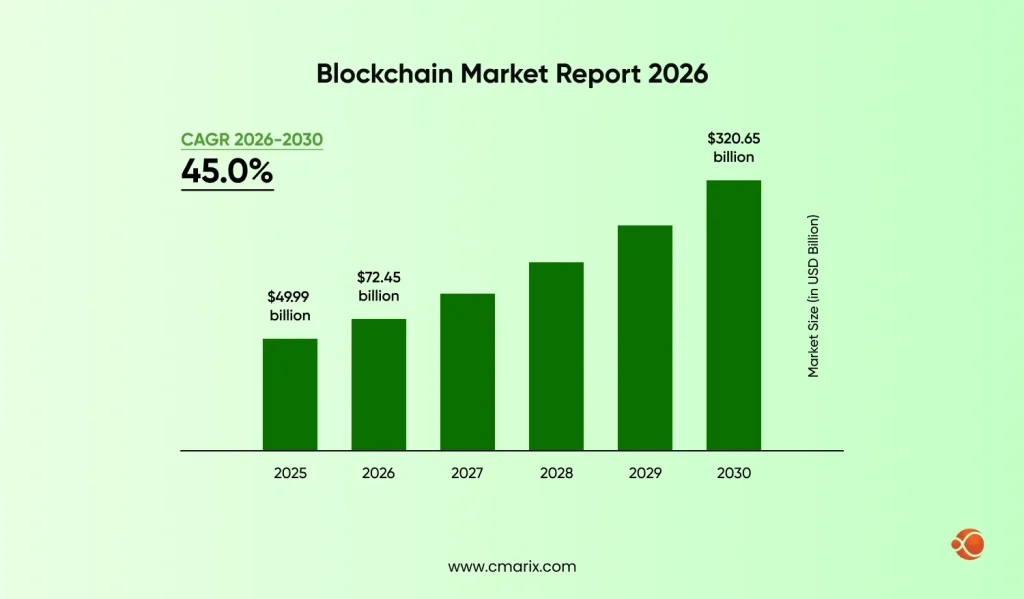
The blockchain industry has seen rapid, exponential growth in recent years. The blockchain industry is predicted to grow from $49.99 billion in 2025 to $72.45 billion in 2026 at a compound annual growth rate (CAGR) of 44.9%, reaching $320.65 billion in 2030. This growth is expected to reach $320.65 billion by 2030. This strong growth during the historical period has been driven by the rising adoption of cryptocurrencies, the implementation of early blockchain pilot initiatives, increasing demand for secure and transparent transactions, wider use of distributed ledger technology, and growing concerns about cybersecurity.
A basic token payment app sits near the bottom of that range. A DeFi lending protocol with multiple smart contracts and a security audit sits near the top. It might even spill into the next tier. Complexity, not the word “blockchain” itself, determines blockchain development costs.
Comparative Blockchain Pricing Models: Fixed-Price vs. Time & Materials
It would be useful to know what kind of pricing model a quote reflects before comparing quotes. Here are the three most popular types:
- Fixed-price model. You and the developer agree on a single number up front, regardless of hours worked. This fits small projects with clearly defined requirements.
- Time and materials. You pay for actual hours and resources used. This suits projects where the scope might shift, like an evolving DeFi protocol.
- Dedicated team model. You pay for a team working exclusively on your project over an extended period, which is common for enterprise builds.
None of them is automatically less expensive. An estimate for a poorly defined project will always be much higher due to change orders. The other approach may work well with an organized team. Find out what pricing scheme your vendor wants before you compare figures.
Key Variables Driving Blockchain Development Costs
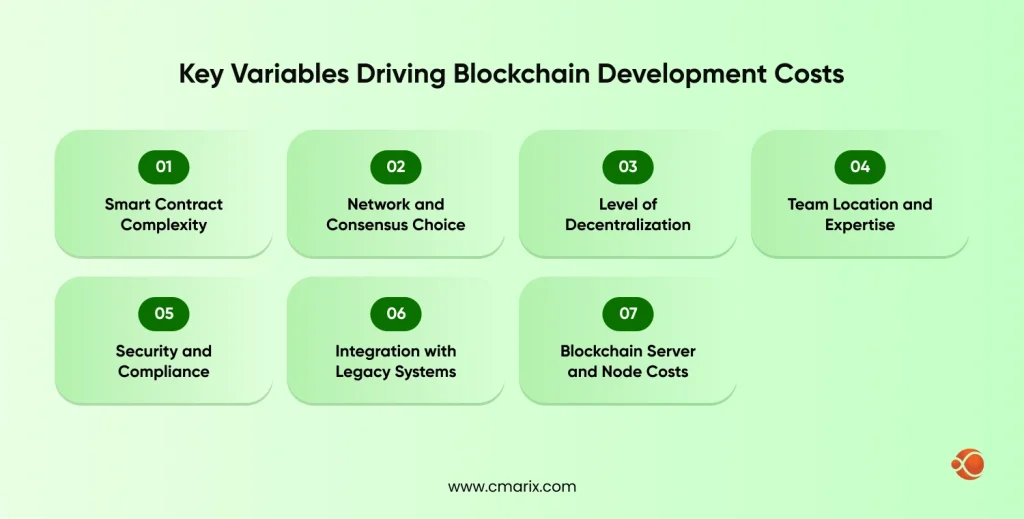
Several variables explain the gap between a $10,000 freelance quote and a $300,000 enterprise build.
Smart Contract Complexity
A simple “release funds on delivery” contract is cheap to write and test. A DeFi protocol juggling multiple token pools, liquidation logic, and price oracles needs far more testing hours, since a bug in the code can result in a direct loss of funds. This is why a DeFi app development budget typically runs higher than a standard smart contract build, even before a security audit is factored in.
Network and Consensus Choice
For public networks, such as Ethereum, there is an initial low cost of launching the project, but ongoing gas costs. In contrast, private and consortium networks, such as Hyperledger, are initially expensive because you must create your own infrastructure; however, they charge no transaction fees. It also makes a difference whether we choose Proof of Work or Proof of Stake; the former requires running energy-intensive hardware, whereas the latter doesn’t require any infrastructure spending.
Level of Decentralization
A fully decentralized system, where everything lives on-chain, costs more to build than a hybrid approach. Most businesses store large files on traditional servers and put only a cryptographic “proof” of that data on the blockchain. That hybrid model keeps both build time and cost manageable.
Team Location and Expertise
The cost to build enterprise blockchain systems climbs fastest here, since large agencies with specialized security teams and mid-size firms with 1,000+ developers price accordingly.
| Service Provider / Region | Blockchain Dev Costs |
| Freelancers | $2,000–$25,000 for a small blockchain project |
| Agencies (US, India, Philippines, Ukraine) | $25–$49 per hour |
| Agencies (Canada, Poland, Spain, Mexico) | $50–$99 per hour |
| Mid-size firms (1,000+ developers) | $40,000–$300,000 per project |
| Large agencies with specialized security teams | $400,000–$500,000+ per project |
These blockchain developer hourly rates vary widely because compliance overhead, developer supply, and cost of living differ by region, not just typical software rates.
Note: Cheaper isn’t always cheaper. While lower blockchain developer hourly rates may seem attractive, a developer who under-tests a smart contract can cost you far more in re-audits, security fixes, or even exploits down the line.
Security and Compliance
FinTech and healthcare projects need to comply with regulations for auditing, encryption, and third-party security audits before launching the system. The smart contract audit cost alone can run between $5,000 and $25,000, not mentioning sophisticated DeFi smart contracts that can cost even more.
Integration with Legacy Systems
It’s hard to find organizations that start with a blank sheet of paper. Integration with legacy CRM or ERP systems needs specific APIs and extra testing periods.
Blockchain Server and Node Costs
Running your own nodes will cost between $100 and $800 a month, based on transaction frequency. Running on the public chain requires gas fees instead of this.
Get a realistic estimate based on your project needs.
How Cost Varies by Blockchain Use Case
Different blockchain projects carry genuinely different cost structures, not just different price tags on the same build. Cryptocurrency wallets and exchanges sit at the higher end, often $125,000 to $200,000+, because of security layers, transaction signing, and real-time order matching. NFT marketplaces and DApps span a much wider range, from $35,000 for a simple utility build to $150,000 or more once multiple smart contracts and real decentralization enter the picture. DAOs and ICO platforms cost less to launch, typically $10,000 to $30,000, since governance and token logic require less infrastructure than a full transaction layer.
For a full breakdown of what drives cost within each app type, including feature sets and typical timelines, see our dedicated guide on blockchain app development cost.
Think twice before choosing blockchain? Read our breakdown on custom software development vs SaaS first. Blockchain isn’t the answer for every data problem. Knowing when a traditional build solves it faster saves you the cost entirely.
Two Kinds of Blockchain Apps
Nearly every blockchain project falls into one of two buckets, and knowing which one you’re building shapes the entire cost conversation.
- Cryptocurrency-based solutions allow users to buy, sell, and transact using digital currency. Wallets, exchanges, and ICO platforms all fall here, and they tend to carry higher security and compliance costs because real money is moving through the system.
- The non-cryptocurrency applications do not include cryptocurrency in the distributed ledger technology. Non-cryptocurrency applications include tracking devices and inventory management. The cost of the non-cryptocurrency applications may be reduced since the value element has already been incorporated into the system.
Evolution of Mobile Security with Blockchain
The evolution of mobile security with blockchain has strengthened app protection through decentralized authentication, encrypted data storage, and tamper-proof records. These features improve data integrity and user trust but also increase blockchain development costs due to added security architecture, smart contracts, and compliance requirements.
Estimated Budget Allocation: The Blockchain Project Lifecycle
It helps to see how a typical blockchain project budget splits across phases, not just the total number:
| Project Phase | Share of Total Budget |
| Initial Consultation | 5% |
| UI/UX Design | 10% |
| Development | 45% |
| Quality Assurance | 25% |
| Deployment and Maintenance | 15% |
The amount of QA at 25% is very surprising for many newcomers. During blockchain development, quality assurance is not extra work but the stage where smart contract errors and security holes are identified and fixed.
Industry-Specific Blockchain Integration Costs
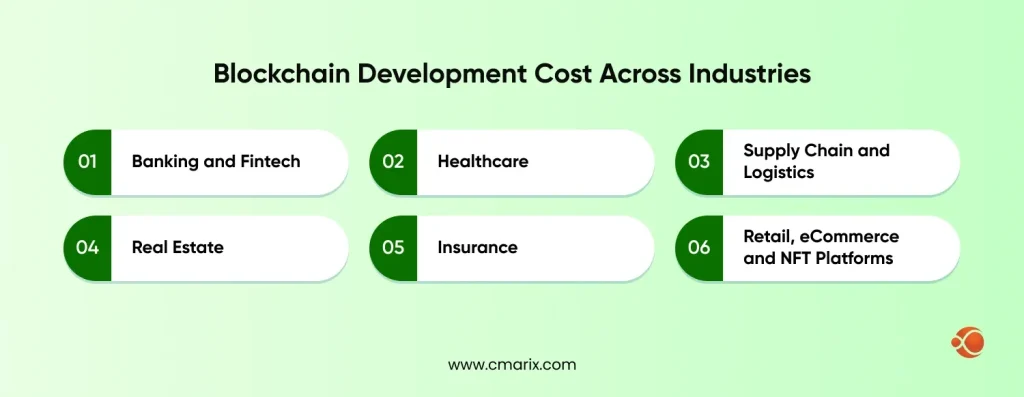
| Industry | Cost Range (USD) | Key Cost Drivers |
| Banking & Fintech | $80,000–$450,000 | • AML/KYC compliance • Smart contract security & audits • Transaction monitoring and audit trails |
| Healthcare | $70,000–$350,000 | • HIPAA compliance • Permissioned blockchain & encryption • EHR integration and access controls |
| Supply Chain & Logistics | $60,000–$280,000 | • Multi-party network complexity • Permission management • IoT and tracking integrations |
| Real Estate | $50,000–$220,000 | • Asset tokenization • Smart contract escrow • Legal and regulatory compliance |
| Insurance | $65,000–$300,000 | • Claims automation • Oracle integrations • Fraud detection and underwriting workflows |
| Retail, eCommerce & NFT | $55,000–$250,000 | • Loyalty tokenization or NFT marketplace • Wallet integration • Smart contract security audits |
Banking & Fintech
Cost Range: $80,000 – $450,000
The banking and finance tech industries bear the highest compliance costs among blockchain sectors, which is reflected in their implementation costs. Apart from the costs incurred in developing the smart contract, an additional budget will be required for anti-money laundering (AML) and know your customer (KYC) compliance, transaction monitoring, and audit trails to meet all regulatory requirements of the markets in which the platform operates.
Platforms facilitating digital asset transactions must also factor in systems that streamline reporting and transaction logging for crypto tax compliance.
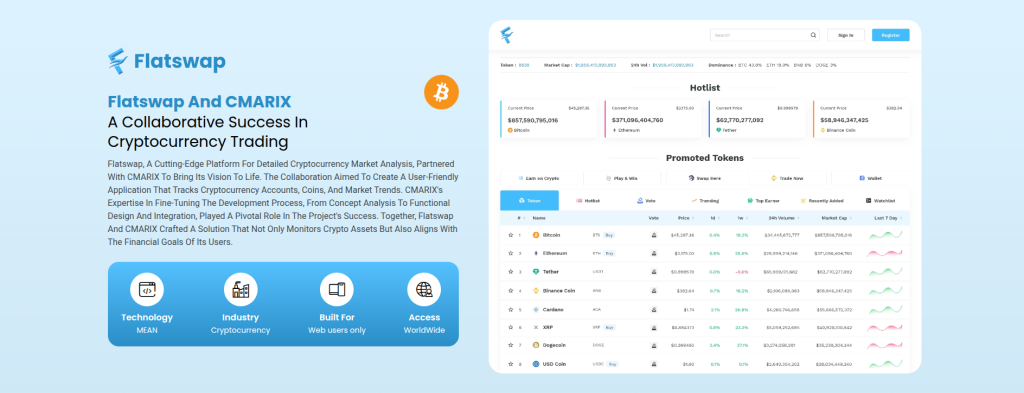
CMARIX worked on a cryptocurrency tracking platform – Flatswap, that had exactly this kind of scope. It required real-time token data, encrypted user accounts, and infrastructure capable of withstanding sudden traffic spikes. This project is a common reference point for how a mid-complexity fintech blockchain app can be structured for cost, once security and data volume requirements are factored in.
Healthcare
Cost Range: $70,000 – $350,000
For healthcare projects to be successful, HIPAA compliance is essential. This is where many budgets fail right out of the gate. Healthcare databases require secure, permissioned ledgers with ironclad security controls. These include both encryption and being able to audit down to who accessed what information and when. Clinical trial data-sharing platforms require yet another layer, including multi-party consent rules and interoperability with current electronic health record platforms.
Expect healthcare builds to run 20-30% higher than comparable non-regulated projects, due to compliance documentation and permissioned-network architecture.
Supply Chain and Logistics
Cost Range: $60,000 – $280,000
The cost of blockchain implementation in the supply chain increases in proportion to the number of parties using the blockchain system, rather than to the difficulty of the programming involved. The one company blockchain system used for traceability lies at the lowest part of the cost spectrum. The multi-party supply chain that involves different permission levels among manufacturers, distributors, and retailers, and the use of IoT sensors, lies at the highest end of the cost spectrum.
Build secure blockchain solutions tailored to your industry.
Real Estate
Cost Range: $50,000 – $220,000
The real estate blockchain development effort begins with tokenization, which includes fractional real estate ownership, smart-contract escrow, and unalterable title documentation. While the technology may not be as complex as that used in fintech or medical applications, incorporating legal requirements can increase costs beyond what the software developer’s budget reflects. The smart contracts need to reflect the applicable laws of the relevant jurisdiction, which requires legal counsel from the outset.
Insurance
Cost Range: $65,000 – $300,000
Insurance blockchain projects concentrate cost in claims automation and fraud detection logic. Parametric insurance products, policies that pay out automatically when a defined condition triggers, such as a flight delay or a weather event, need oracle integrations that pull verified real-world data onto the chain. That oracle layer is a cost center most estimates miss entirely. Underwriting platforms that connect to multiple external data sources sit at the higher end of the range.
Retail, eCommerce and NFT Platforms
Cost Range: $55,000 – $250,000
Retail blockchain spend splits into two categories: loyalty/rewards tokenization on the lower end and full NFT marketplace development on the higher end. A loyalty points system built on a permissioned chain is a relatively contained project. An NFT marketplace: minting, secondary trading, royalty enforcement, and wallet integration exposes far more smart contract surface area and requires a dedicated security audit before launch, given how frequently marketplace contracts are targeted.
These blockchain initiatives are not going solo. Companies are now integrating blockchain technology with AI for fraud detection, prediction, and compliance. It is changing the way businesses secure themselves, make decisions, and manage regulatory requirements. Read our take on how to build smarter enterprises with AI before you scope the blockchain layer. That way, the two pieces get architected together, not bolted on later.
Hidden Expenditures: Smart Contract Security Audits and Layer-2 Maintenance
There are always several consistent line items that get overlooked in the initial estimate, and these items will exceed any fixed budget.
- Layer-2 implementation. Implementing on top of the primary Ethereum blockchain quickly becomes costly for high-frequency transactions. Layer-2 implementation pricing for networks such as Polygon or Arbitrum reduces transaction fees, but it’s an added cost rather than a free upgrade.
- Ongoing maintenance. Budget 15% to 25% of your initial build cost annually for patches, upgrades, and monitoring. Blockchain apps don’t stop needing attention once they ship.
- Smart contract re-audits. Every major feature addition to a live contract usually needs another security pass. Skipping this to save money is how exploits happen.
- Third-party tooling. APIs, oracles, and off-chain services rarely appear as line items in the initial contract, but they affect the total cost of the engagement over time.
Strategies to Optimize Your Blockchain Project ROI and Development Spend
None of this means blockchain development cost has to blow past what you planned. A few practical moves keep costs in check without weakening the build.
- Start with an MVP approach. Build and validate the core blockchain functionality around a specific use case before investing in advanced features. Keeping the Web3 MVP development cost low at this stage lets you validate market demand before adding advanced features. Many successful blockchain products began this way.
- Open-source software that has been audited should be used. Software such as OpenZeppelin provides tested code for building smart contracts for multiple purposes, from token standards, access controls, and security protocols. This will save time spent on project development and reduce the risk of a failed audit.
- Be mindful of Layer-2 scalability early on. If your application demands high transaction speeds or minimal costs, use Layer-2 protocols from the start, because implementing scalability features later can require costly re-architecture.
- Prioritize smart contract optimization. Optimized smart contracts can significantly reduce gas costs. Developers who specialize in optimizing gas and contracts can help minimize operational costs.
- Utilize the Blockchain-as-a-Service solutions where feasible. Managing blockchain services through third-party cloud providers such as AWS and Azure can simplify node management, deployment, and maintenance.
- Scale incrementally depending on actual demand. Never over-engineer your platform for maximum capacity at the very start. Begin with either a small blockchain network or a permissioned blockchain network.
How to Hire Expert Blockchain Developers: Balancing Quality and Budget
Not every software developer is a blockchain developer, and the cost of hiring the wrong one shows up later, not upfront.
Start with security questions. If an individual is more concerned with audits and tests than with the features that come with them, it is likely safer to work with that developer. Platform expertise is also important to confirm. An individual with experience working on Ethereum will not know everything about Solana right away.
Ensure that they understand the business case as well as the code. A developer who knows why you choose Proof of Stake over Proof of Work, or public over private, will be able to scope the project better than someone speaking just in terms of technology.
Ready to Scope Your Blockchain Project?
Blockchain development cost isn’t a mystery once you know what’s being priced. It comes down to contract complexity, network and consensus choice, security depth, and legacy integration. A $10,000 freelance MVP and a $300,000 enterprise ledger solve very different problems. The right number depends entirely on which one you’re building.
CMARIX has built blockchain solutions across the supply chain, fintech, and NFT platforms. Our team can walk through where your project lands on this pricing map. Prefer to start with the team instead of the numbers? Take a look at how to hire expert blockchain developers, or explore our broader software development services to see how blockchain fits alongside your stack.
FAQs About Blockchain Development Cost
Which pricing model should I choose: fixed-price, time & materials, or dedicated team?
Fixed-price works best when requirements are locked in advance, like a simple payment app. Time & materials suits projects where scope may shift, such as an evolving DeFi protocol. A dedicated team model fits enterprise builds needing a team working exclusively on the project over an extended period.
Does the blockchain network I choose affect development cost?
Yes. Public networks like Ethereum have a lower upfront cost but ongoing gas fees. Private and consortium networks like Hyperledger cost more upfront since you build your own infrastructure, but they carry no transaction fees.
How much does it cost to deploy and run on the blockchain?
Ongoing node and server costs range from $100 to $800 a month. Add gas fees if you’re on a public network like Ethereum. Layer-2 solutions cut those transaction costs considerably.
What are the hidden or secondary costs to consider in blockchain?
The indirect costs that are usually overlooked when budgeting for the first time include smart contract audits, annual maintenance, Layer-2 integration, third-party tools, and re-audits after features are added.
What factors drive up the blockchain development price?
Contract complexity, network and consensus choice, level of decentralization, compliance requirements, developer expertise, team location, and legacy integration all drive up the price. For more on how businesses are adopting these tools, see our piece on the rise of cryptocurrency in business.