


At-a-glance View: Enterprises in 2026 are questioning whether endless SaaS subscriptions still make financial and strategic sense. Between rising costs, AI limitations, integration chaos, and compliance pressure, the build-vs-buy decision has become far more complex. This guide breaks down where SaaS still works, where custom software creates real advantage, and why hybrid architectures are becoming the enterprise standard.
There’s a conversation happening in boardrooms and engineering offices right now, and it goes something like this: “We’re paying $2 million a year across 40 SaaS tools, half of which our teams hardly use. Should we just build our own?”
That’s a valid question. The truth of the matter is that, while it does depend on several variables, the phrase “it depends” isn’t used here as an evasive answer that avoids making commitments. In this case, it really does depend on specific factors.
This blog is for CTOs, product leaders, and enterprise decision-makers who are past the “what is SaaS” stage and are trying to make a decision. We’ll walk through the definitions, the real cost structures, the trade-offs, and the patterns reshaping how enterprises think about software in 2026.
What Is Custom Software Development vs SaaS And Why the Distinction Matters in 2026
- Custom software development means developing software from scratch or significantly extending existing systems to fit your particular business processes, goals, and infrastructure. You own the code, the data, the architecture, and the roadmap.
- SaaS means renting access to software someone else developed, maintains, and hosts. You configure it within the boundaries the vendor allows, pay monthly or annually, and the vendor controls the update cycle.
Understanding the differences between enterprise and regular software matters here because enterprise software decisions carry a different weight. The stakes are categorically different from what a 20-person startup deals with.
How Custom Software Development and SaaS Work in Practice
When a company creates a software tailored to their needs, they have to go through the stages of defining scope, creating their own team or hiring a custom enterprise software development company, undertaking design and development processes, and then maintaining the software. The upfront cost is real. But so is the ownership.
SaaS works in a different way. You evaluate vendors, sign a contract, configure the tool, and deploy within weeks. The vendor handles infrastructure, security patches, and feature development. You trade control for speed.
What’s changed in 2026 is the middle ground. Hybrid software architecture, where enterprises use SaaS for standard operations and develop custom layers for competitive functions, is now the dominant pattern among large organizations.
Let’s map out what’s worth keeping, what’s costing you, and what should be built.
Head-to-Head: Key Differences That Actually Matter
| Dimension | Custom Software | SaaS |
| Ownership | Full — code, data, roadmap | Vendor-controlled |
| Customization | Unlimited | Within vendor limits |
| Time-to-Market | Months | Weeks |
| Security Control | You set the standards | Vendor’s shared infrastructure |
| Integration | Built to fit your stack | API-dependent, often messy |
| Scalability | Designed for your load | Vendor-managed, generalized |
| Year 1 Cost | High | Low |
| Year 5 Cost | Lower per user | Often highest due to seat scaling |
| Exit Cost | Low | High — data migration, retraining |
Ownership and Data Governance: With custom software, your data lives where you decide. With SaaS, it lives on the vendor’s infrastructure, subject to their terms, their security architecture, and their business continuity. Data sovereignty and compliance are becoming non-negotiable in regulated industries.
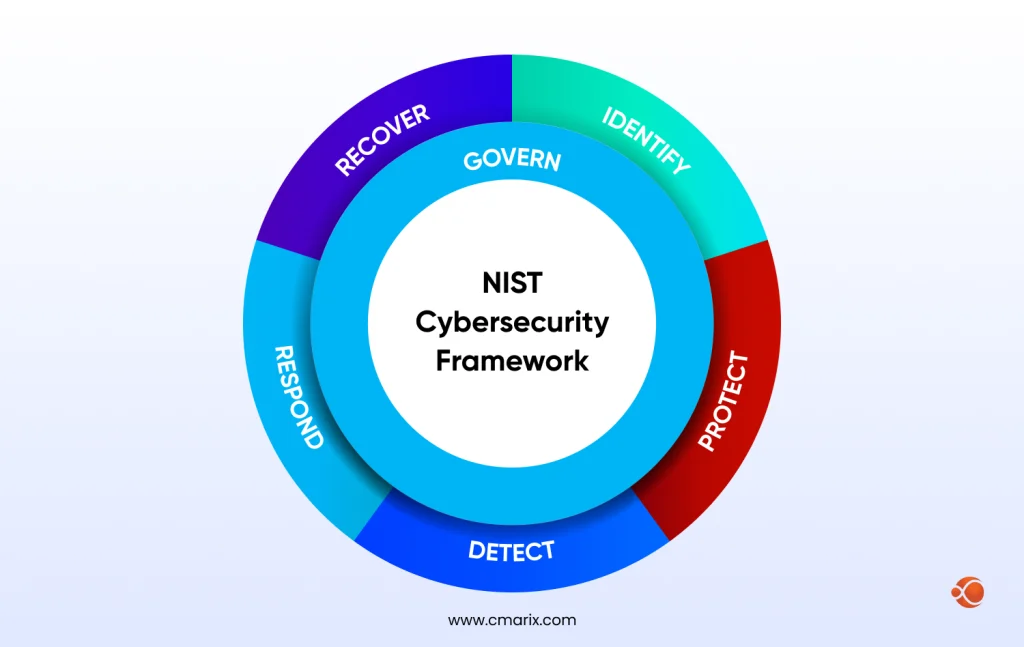
Security and Compliance: Custom platforms built to NIST’s Cybersecurity Framework (CSF 2.0) standards give enterprises full control over their security posture. SaaS vendors offer compliance certifications — SOC 2, ISO 27001 — but you’re trusting their controls, not setting your own.
Integration: Every enterprise has legacy systems. B2B SaaS integration with ERPs, CRMs, and proprietary databases requires a solid API-driven integration strategy — and SaaS vendors don’t always play nicely with each other or with older infrastructure.
Why Enterprises Are Rethinking SaaS in 2026
The SaaS model had a great run. Still it works well for the right use cases, but various forces are pushing enterprises to reconsider.
- Subscription costs and sprawl: The average large enterprise now runs 130+ SaaS applications. That’s not a tech stack, it is a liability. Redundant tools, shelfware and overlapping contracts drain budgets that could fund differentiated capability.
- Vendor lock-in: Moving off a deeply embedded SaaS platform: migrating data, retraining teams, rebuilding integrations, is expensive and disruptive. Most enterprises discover this only after they want to leave.
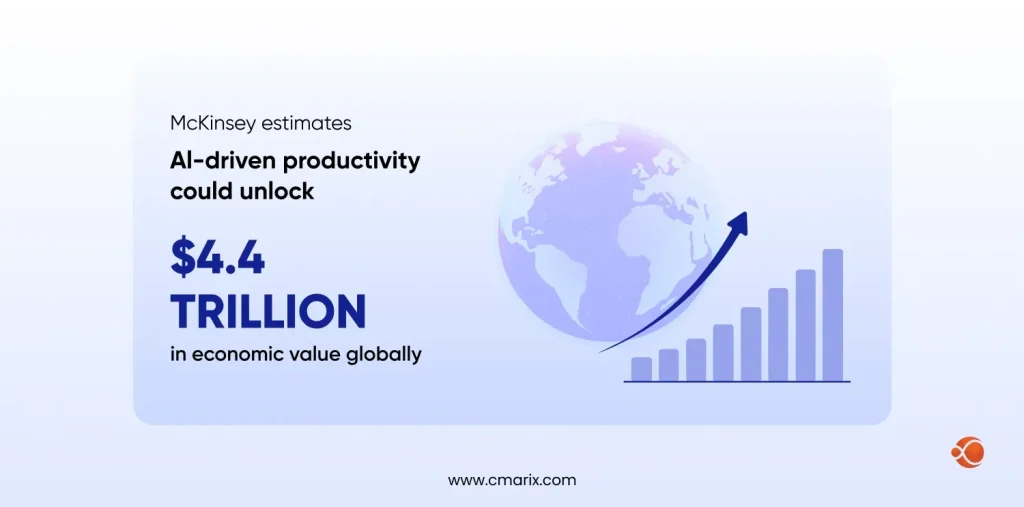
- AI integration gaps: Off-the-shelf software offers AI features, but they’re generic by design. Enterprises with proprietary data and unique processes can’t fully exploit that data inside a vendor’s sandbox. McKinsey estimates AI-driven productivity could unlock $4.4 trillion in economic value globally — enterprises that own their software and data infrastructure are better positioned to capture it.
- Regulatory pressure: HIPAA, GIDPR, DPDP Act and sector-specific regulations are tightening. Storing sensitive data in multi-tenant SaaS environments is a harder position to defend in front of regulators every year.
When SaaS Is the Right Choice for Enterprise Operations
Not everything needs to be developed. SaaS makes clear sense when the function is standard and non-differentiating, your team needs to move fast or the vendor’s feature velocity exceeds what your internal team could match.
| Use Case | Why SaaS Works Here |
| HR and Payroll | Standardized processes, compliance automation built-in |
| Basic CRM | Works until your sales process diverges significantly |
| Collaboration Tools | No competitive edge in how you run Slack or Zoom |
| Customer Support | Established platforms handle ticket routing and SLAs well |
| Expense Management | Generic process, no differentiation needed |
Worth noting: even in these categories, the calculus shifts once your business scales or your processes become genuinely complex. A custom CRM vs Salesforce comparison looks very different for a company with 500 salespeople and a non-standard sales motion than one with 20 reps following a textbook process.
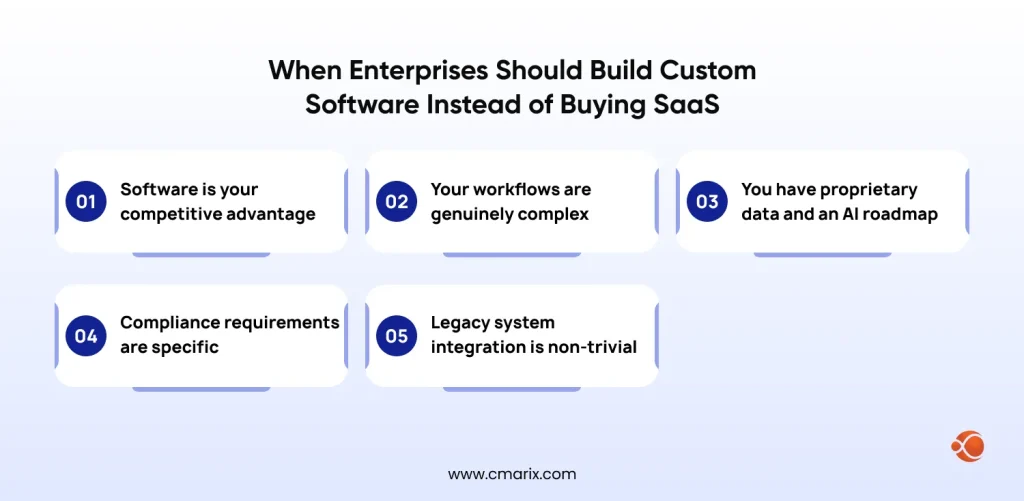
When Enterprises Should Build Custom Software Instead of Buying SaaS
This is where bespoke enterprise software solutions earn their place:
Software is your competitive advantage
If your product or customer experience runs on software, and that software looks like everyone else’s because you’re all using the same SaaS vendor, you’ve handed your differentiation to a third party. As Harvard Business Review noted in their analysis, buying software leads to competitive parity — building it creates differentiation.
Your workflows are genuinely complex
Standard SaaS handles standard processes. If your operations involve multi-party approvals, dynamic pricing engines, custom logistics routing, or regulatory reporting that doesn’t map onto a vendor’s template, you’ll spend more time trying to customize the SaaS tool than building it from scratch.
You have proprietary data and an AI roadmap
The moment your AI strategy depends on training models on your own data, you need infrastructure you control. AI-native application development built on your proprietary data gives you something competitors can’t replicate by signing the same SaaS contract.
Compliance requirements are specific
In sectors like healthcare and finance require compliance such as in audit trails, access control, and data residency capabilities that cannot be secured by shared infrastructure SaaS applications.
Legacy system integration is non-trivial
Large manufacturers, logistics companies and banks run infrastructure that’s decades old. Custom software built by experienced, dedicated full stack developers who understand enterprise architecture integrates in a better way with that landscape.
Whether you need a full custom enterprise platform or a hybrid architecture that connects your existing stack, CMARIX has delivered it before.
Custom Software vs SaaS Cost Comparison: Total Cost of Ownership Over 5 Years
| Cost Factor | SaaS | Custom Software |
| Year 1 Investment | Low | High |
| Year 3 TCO | Moderate to high | Moderate |
| Year 5 TCO | Often highest | Lower per user |
| Hidden Costs | Integration work, workarounds, price hikes | Talent, maintenance, technical debt |
| Exit Cost | High | Low — you own it |
The hidden costs are where enterprises get surprised. On the SaaS side: the cost of workarounds when the tool doesn’t fit, integration development to connect tools, and price increases once you’re locked in. On the custom side: software developers command competitive salaries and the talent market stays tight; that’s a real build hurdle.
Calculating the ROI with custom software requires looking past year one. Most enterprises doing an honest Total Cost of Ownership (TCO) model analysis find the break-even point sits between year two and year four. After that, custom typically wins on cost per user. The AI product development cost adds to the upfront investment but compounds in value over time in ways generic SaaS AI features simply don’t.
Pros and Cons of Custom Software Development vs SaaS
| Custom Software | SaaS | |
| Advantages | Full ownership and control | Fast deployment |
| Unlimited customization | Low upfront cost | |
| Proprietary AI and data capability | Vendor handles maintenance | |
| Better long-term TCO at scale | Predictable monthly costs | |
| Stronger compliance posture | Easy to trial and switch early on | |
| Disadvantages | High upfront development cost | Vendor lock-in |
| Longer time-to-market | Limited customization | |
| Requires internal technical capacity | Costs scale with users | |
| Risk of technical debt if poorly managed | Data sovereignty concerns | |
| Change management burden | AI capabilities are generic |
Industry Breakdown of Custom Software vs SaaS: Which Model Wins?
| Industry | Recommended Approach | Why |
| Healthcare | Custom or hybrid | HIPAA compliance, patient data sovereignty, complex clinical workflows |
| Fintech and Banking | Custom-first | Regulatory requirements, proprietary risk models, and real-time transaction logic |
| Retail and Ecommerce | Hybrid | SaaS for inventory and support; custom for personalization engines and customer experience |
| Manufacturing and Logistics | Custom | Legacy integration, IoT data pipelines, and unique supply chain logic |
| EdTech | Hybrid | SaaS LMS for standard delivery; custom for adaptive learning and analytics |
| Media and Entertainment | Custom or hybrid | Content delivery, recommendation algorithms, and licensing logic are differentiators |
- Healthcare organizations deal with data that simply cannot live in a generic multi-tenant environment without significant risk. Custom platforms allow them to build around their specific workflows while maintaining full HIPAA compliance.
- Fintech and Banking firms run on proprietary models — credit scoring, fraud detection, risk assessment. These are not processes you hand to a SaaS vendor. Custom software product development here isn’t a luxury; it’s a regulatory and competitive necessity.
- Retail and Ecommerce sit in an interesting territory. The back-office functions: HR, inventory and accounting are fine on SaaS. But the customer-facing experience, the recommendation engine, the personalization layer? That’s where custom web development really returns.
- Manufacturing and Logistics companies are often running ERP systems from the early 2000s alongside modern IoT infrastructure. The integration challenge alone often makes custom the more practical choice, and optimizing enterprise UX design across these environments is what determines whether teams actually use the tools built for them.
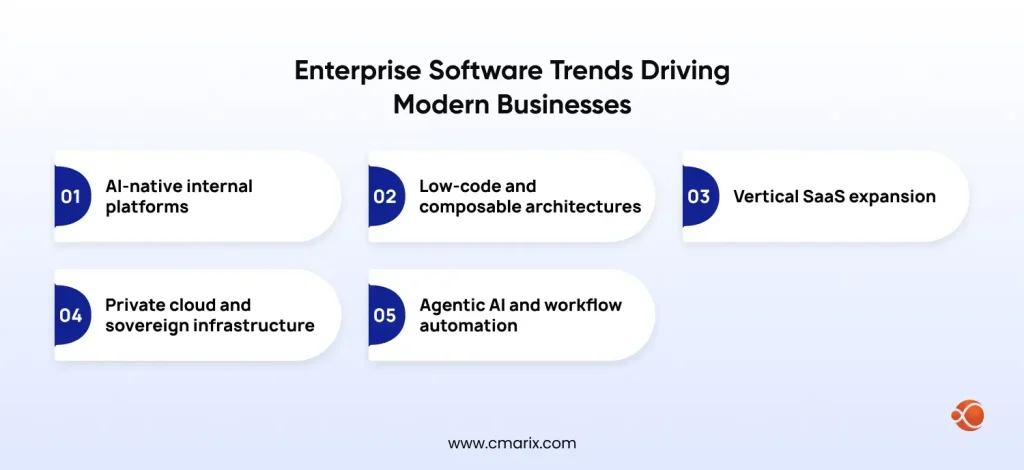
Enterprise Software Trends in 2026 That Are Reshaping the Build vs Buy Decision
AI-native internal platforms
Enterprises are moving beyond using AI as a feature inside SaaS tools toward building AI-native application development environments on their own data. The companies that own their software stack will exploit this shift far more effectively.
Low-code and composable architectures
The build vs buy decision is not anymore binary. Composable architecture lets enterprises assemble systems from modular components: some bought, built, connected through clean APIs. This is reducing the time and cost of custom development meaningfully.
Vertical SaaS expansion
Vertical SaaS, software built for specific industries rather than horizontal use cases, is growing fast. It narrows the gap between off-the-shelf software and a genuine fit. But it also increases vendor dependency within your specific industry.
Private cloud and sovereign infrastructure
More enterprises are moving workloads to private cloud environments to data residency requirements. An Azure migration done right, for example, can give enterprises the elasticity of cloud with the control of owned infrastructure.
Agentic AI and workflow automation
AI agents that execute multi-step workflows autonomously are moving from research to production. Enterprises with custom platforms can utilize specialized AI agent development services to build agentic workflows on proprietary data. Enterprises on SaaS are waiting for vendors to ship the feature.
How to Decide Between Custom Software and SaaS: A Practical Enterprise Framework
Before committing either way, answer these five questions:
- Is software a source of competitive advantage or just infrastructure? If it’s infrastructure, buy. If it drives differentiation, build.
- What does your 5-year growth look like? SaaS costs scale linearly. Custom costs don’t.
- How specific are your compliance and data requirements? The more stringent, the stronger the case for custom.
- Do you have the internal technical capacity to own what you build? A custom platform without a capable team becomes expensive technical debt.
- What’s your AI strategy? If proprietary AI capabilities matter to your business, you need infrastructure you control.
Build vs Buy vs Hybrid Checklist
| Scenario | Recommended Path |
| Standard business process, fast timeline needed | Buy (SaaS) |
| Unique workflow, high compliance requirements | Build (Custom) |
| Mix of standard ops and differentiated product | Hybrid |
| Proprietary data + AI roadmap | Build (Custom) |
| Early stage, validating product-market fit | Buy (SaaS) |
| Scale stage, cost per user is becoming painful | Evaluate custom or hybrid |
Common Mistakes That Derail Enterprise Software Decisions
- Choosing SaaS purely on upfront cost. Year one looks great. Year four looks different. Run the full TCO model before signing long-term contracts.
- Overbuilding custom too early. Some enterprises commit to full custom builds before validating that the workflow complexity actually justifies it. Prove the problem first.
- Underestimating integration complexity. Whether buying or building, connecting to existing systems is where projects consistently go over budget. Factor this in from day one.
- Ignoring change management. The best custom platform or SaaS tool fails if adoption is poor. Training, communication, and rollout strategy matter as much as the technology itself.
Why Choose CMARIX for Your Enterprise Software Decision
When the build-vs-buy decision is made, execution is everything. CMARIX has spent over a decade helping enterprises build, design, and scale custom software that actually fits, not software that requires your business to bend around it.
Be it a SaaS application developer or an end-to-end custom enterprise solution provider that knows how to build enterprise-level systems, or even a mix-and-match solution that integrates your existing architecture with custom components, we have the expertise and experience to deliver. Choose wisely. The key to making the right software choice is choosing the right partner.
Conclusion
The custom software development vs SaaS debate doesn’t have a universal answer and anyone telling you it does is probably trying to sell you something. SaaS still wins for standard, non-differentiating functions where speed and simplicity matter. Custom differentiating functions where simplicity and speed matter. Custom software wins where your data is a strategic asset, and where software is the thing that separates you from competitors using the exact same tools.
These enterprises are not picking between the two, rather being mindful of which functions should have ownership and which shouldn’t. They are innovating on areas that matter, purchasing what is pragmatic, and integrating everything together via architecture.
Where your current system setup is becoming increasingly expensive compared to the value you get out of it, or you find yourself reaching the limits of your SaaS tools. This is less about deciding to innovate, but being willing to own the innovation.
FAQs on Choosing Custom Software Development Over SaaS in 2026?
When should an enterprise build custom software instead of buying SaaS in 2026?
When software becomes an asset providing a competitive edge; when your processes are too complicated for software-as-a-service customization; when you need to train artificial intelligence using your proprietary data; when regulations require you to have infrastructure under your complete control.
How has AI affected the custom vs SaaS debate in 2026?
Yes, SaaS vendors are adding AI features, but they’re generic by design. Enterprises with proprietary data can develop AI-native capabilities on custom platforms that competitors can’t replicate by buying the same tool. AI has made the case for owning your software stack stronger for any firm with a serious data asset.
What is the “SaaS Tax” and how does it influence the decision to build?
The SaaS Tax refers to the cumulative cost of paying for capabilities you don’t fully use, paying for integration work to connect tools that don’t natively communicate, and absorbing vendor-controlled price increases year over year. As that number grows, the ROI case for building shifts.
Is custom software really more cost-effective in the long run?
For most enterprises at scale, and yes particularly beyond year three or four. The upfront development cost is real, but the per-user cost doesn’t scale the way SaaS subscriptions do, and you eliminate continuous vendor price dependency. The math depends on scale, maintenance costs and how much you’d spend customizing SaaS tools anyway.
What is a hybrid software approach and when should I use it?
A hybrid approach means using SaaS for standard, non-differentiating functions while building custom software for the processes where you need control or competitive differentiation. Most large enterprises are already doing some version of this, the goal is to do it intentionally, with a clean API-driven architecture that doesn’t create integration chaos.