

Quick Answer:
- The average app maintenance cost runs 15–25% of your original development cost annually.
- A $50,000 app typically needs $7,500–$12,500 a year in upkeep.
- Hosting and servers run $50–$5,000+ a month depending on user volume.
- The fee for developing apps on Apple’s platform is $99 annually, while Google’s platform takes a one-time $25 registration fee.
- Year one costs more than later years because of OS updates, bug discovery, and unplanned fixes.
- iOS maintenance tends to cost slightly more per release cycle; Android maintenance costs more in QA hours due to device fragmentation.
Building and launching a mobile app is a major investment, but the expenses don’t stop once it goes live. Apps need regular updates, bug fixes, security improvements, OS compatibility checks, hosting, and ongoing performance optimization to keep working reliably as users and technology evolve. This is where app maintenance costs become an important part of your long-term budget. This blog aims to explain what app maintenance involves, how much it typically costs, what factors influence the overall expense, and how businesses can manage these costs effectively over time.
Why Nobody Budgets Enough for App Maintenance
Founders plan for the build. Almost nobody plans for what comes after.
This is made very quickly apparent. Within six months of launching your application, a client contacts you confused about why the invoice for “just a few bugs” doesn’t look anything like what he was expecting. And that’s because an application isn’t something you complete; it’s something you continue to pay rent on.
Staying Live Is Active Work, Not a One-Time Task
The pressure on app owners to keep maintaining is only getting heavier. Google’s own enforcement data shows the Play Store catalog shrank from roughly 3.4 million apps to 1.8 million in about a year after the company tightened its quality and security requirements. That’s a 47% drop.
Apps that stopped getting updated, patched, or tested against new OS versions were the ones that got pulled. Staying alive isn’t passive anymore.
Compliance Adds Its Own Cost Layer
This adds yet another dimension to regulatory exposure. According to the CMS GDPR Enforcement Tracker, the total fines imposed by GDPR stand at around €6.11 billion for over 2,600 recorded cases.
Many of these fines actually came from applications that gathered user information appropriately on initial release but failed to keep up with evolving laws on how to gather, encrypt, and store information. Maintenance is not only about ensuring that the application remains functional; it is also about making sure that it is legally sound.
Get a clear estimate for support, updates, security, and performance
How Much Does It Cost to Maintain an App?
There is an industry rule of thumb that the yearly maintenance for applications takes from 15% to 25% of the development cost. Some sources cite 20% precisely. The exact amount differs because it depends on the number of users, the number of platforms, and whether the initial build was customized.
Average App Maintenance Cost by Tier
| App Tier | Typical Build Cost | Estimated Annual Maintenance | Monthly Range |
| MVP / Simple App | $15,000–$50,000 | $2,250–$12,500 | $190–$1,050 |
| Mid-Market App | $50,000–$150,000 | $7,500–$37,500 | $625–$3,125 |
| Enterprise App | $150,000–$500,000+ | $22,500–$125,000+ | $1,875–$10,400+ |
This is valid for single-platform implementations and a moderate user growth rate. If you take into account two platforms, sophisticated AI functionality, and a high growth rate of users, the cost of maintenance begins to approach the upper limit of the range, and sometimes even exceeds it.
For a fuller picture of what shapes that starting build number in the first place, our guide to the overall cost to develop an app breaks down the six variables that determine your baseline.
The Four Types of App Maintenance (And What Drives Each One)
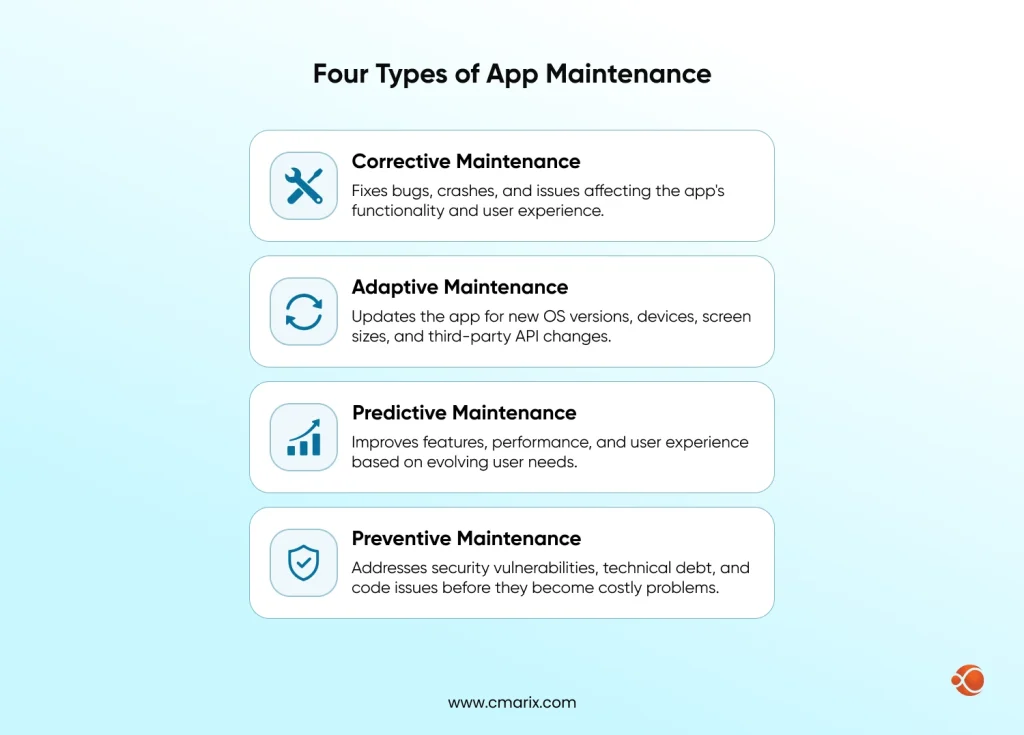
“Maintenance” gets used as a catch-all term, which is part of why budgets go wrong. It actually splits into four distinct categories, each with its own cost driver.
- Corrective maintenance: bug fixes and crash resolution, the stuff users notice immediately and complain about loudly. Usually the smallest line item if QA was solid at launch, and the largest one if it wasn’t.
- Adaptive maintenance: maintaining the application through external changes to its environment. New iOS and Android versions, new device screen dimensions, and outdated APIs from third-party services. An inevitable and continuous process, because Apple and Google release OS upgrades annually anyway.
- Perfective maintenance: improving features and performance through user experience analysis. The discretionary part of the equation, the first to go in lean times, and very often the deciding factor between the future growth and the stagnation of the app.
- Preventive Maintenance: patching security holes, reengineering the code, paying down technical debt. Invisible when done right, which is exactly why it is overlooked the most frequently, just before it ceases to be invisible.
Line-Item Breakdown: Where the Money Actually Goes
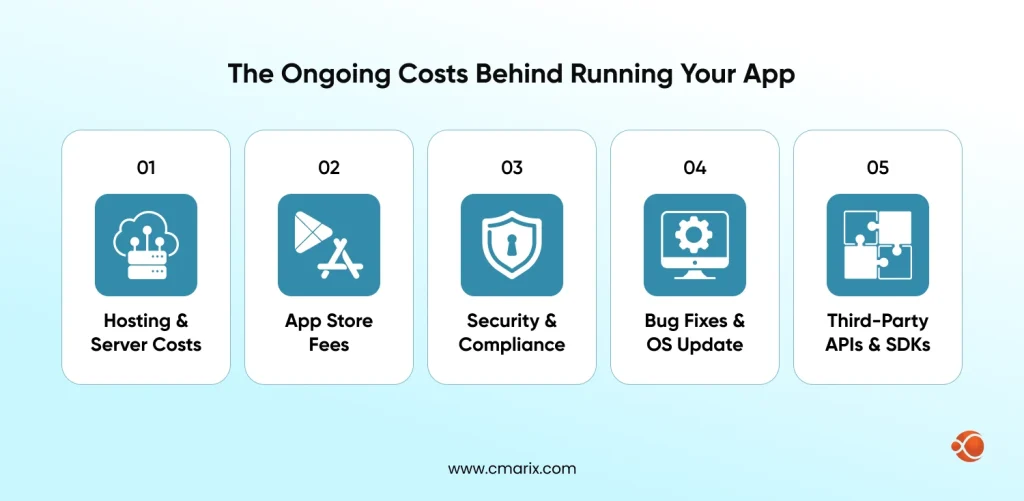
Budgeting gets easier once you stop thinking of “maintenance” as one bill and start thinking of it as five separate ones.
Hosting and Server Costs
Hosting scales with usage.
- A low-traffic app runs fine on $50–$200 a month of cloud hosting.
- A high-traffic app with real-time features, video, or large media libraries can push past $2,000–$5,000 monthly.
AWS’s own hosting best practices whitepaper makes the case for elastic, auto-scaling architecture, specifically because static server provisioning wastes money during quiet periods and buckles during traffic spikes. The wrong architecture here quietly inflates your app server cost every single month.
App Store Fees
These are the cheapest lines on the sheet:
- $99/year for Apple’s developer program
- A one-time $25 fee for Google Play
Nobody goes broke on these. They matter because missing a renewal deadline can pull your app from the store entirely.
Security and Compliance
Costs associated with security and compliance are between $5,000 and $25,000 plus yearly, determined by audits, penetration testing, and certification renewals. Fintech applications and healthcare applications are definitely at the top of that list for various reasons.
A single penetration test for a mid-sized application may take between $10,000 and $30,000, but that does not include remediation after you find the issue. Applications collecting data of European Union users have an additional overhead: the processes of consent flow, data storage, and breach notification require regular updates in compliance with new GDPR enforcement guidance.
Bug Fixes and OS-Compatibility Updates
This category usually uses the most money from the maintenance budget, around 40%-50%, since it is continuous, unforeseen in nature, and directly correlated with how much custom code the application runs.
Third-Party API and SDK Costs
These creep upward over time as usage-based pricing tiers kick in on payment gateways, mapping services, push notification platforms, and analytics tools.
In-House Team vs. Outsourced Maintenance: The Cost Difference
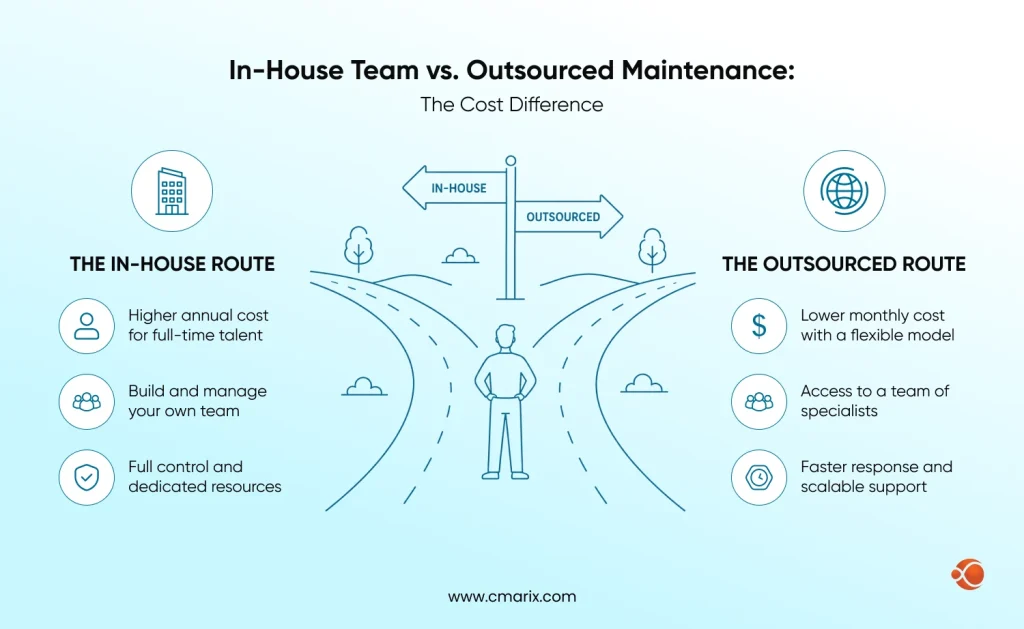
The line items above assume you’re paying for maintenance work, not who’s doing it. That second question moves the number more than most people expect.
The In-House Route
A single in-house developer capable of handling both platforms costs $70,000–$120,000 a year in North America once you add benefits and overhead, and that’s for one person, on one app, doing reactive work only. The moment you need dedicated QA, DevOps, and security review on top of that, you’re building a small internal team just to keep one app running.
The Outsourced Route
A retainer for outsourced maintenance includes only a part of a full team, including a QA Engineer, Backend Developer, and Project Manager, spending their time on maintaining your application and other applications, charging you from $1,500 to $8,000 per month based on complexity and required response time.
There is no question about the quality here if we assume that the service provider is honest. The choice is between the dedication and exclusivity of your own specialist and shared availability and a lower price.
Which One Actually Fits
- For applications requiring continuous development with high-velocity features, in-house wins.
- For applications that require consistent maintenance without having to pay the overhead of full-time salaries regardless of whether there is work in that week, outsourcing retainers take the
iOS vs. Android Maintenance Costs: How They Compare
| Factor | iOS Maintenance | Android Maintenance |
| OS update cycle | Predictable, tighter Apple review windows | More frequent, staggered across manufacturers |
| Device fragmentation | Low: limited device/screen variety | High: thousands of device/OS combinations |
| Testing effort | Lower QA hours per release | Higher QA hours per release |
| App store review | Manual review, 1–3 days, stricter rejection risk | Mostly automated, faster turnaround |
| Typical annual cost impact | Slightly higher per-release cost due to review cycles | Slightly higher overall due to QA/testing volume |
Neither platform is categorically cheaper to maintain. The cost just shows up in different places. Our dedicated breakdowns on Android app development cost and iOS app development cost go deeper into the build-side numbers that feed into these ongoing maintenance figures.
Is First-Year Maintenance More Expensive Than Later Years?
Most often, yes. The initial twelve months following the launch of an application see the highest amount of maintenance due to the discovery of bugs that the quality assurance process missed, the first wave of operating system updates, and fine-tuning performance based on real traffic rather than estimated traffic.
A reasonable planning assumption:
- Budget toward the top of your tier’s range (20–25%) for year one.
- Expect that number to settle closer to 15–18% by year two or three, assuming no major feature expansion.
Businesses that add significant new functionality, say, bolting on AI-driven personalization or a new payment flow, reset that clock and should budget accordingly. Our guide on AI app development cost covers what that kind of expansion typically adds to both the build and the ongoing upkeep.
Why Cheap Maintenance Plans Fall Apart
There’s a pattern worth naming directly: businesses that go with the lowest-bid maintenance vendor almost always end up paying more within eighteen months.
How It Usually Plays Out
The budgeting company can only address issues reactively. They will respond once the system crashes, make all repairs, and send you the bill. There is no proactive monitoring or performance profiling.
Technical debt starts accumulating silently for a year. Then one big OS update brings down half the application, and the “cost-saving” support package turns into an expensive rebuilding project.
Warning Signs to Check Before You Sign
- No mention of a security audit cadence
- No defined SLA for response time
- No proactive monitoring included
- Vague language around “as-needed” support with no baseline hours
Any one of these is a signal the vendor is pricing for reaction, not prevention.
This is how the software support and application maintenance provided by CMARIX differs from other solutions to the problem: constant monitoring, performance tuning at scheduled intervals, and quality assurance as an integral part of the retainer agreement rather than an unpleasant surprise. It will require more money at the very beginning. It will cost you much less than the emergency redevelopment resulting from reactive-only approaches.
How to Decrease the Yearly App Maintenance Cost without Sacrificing Quality
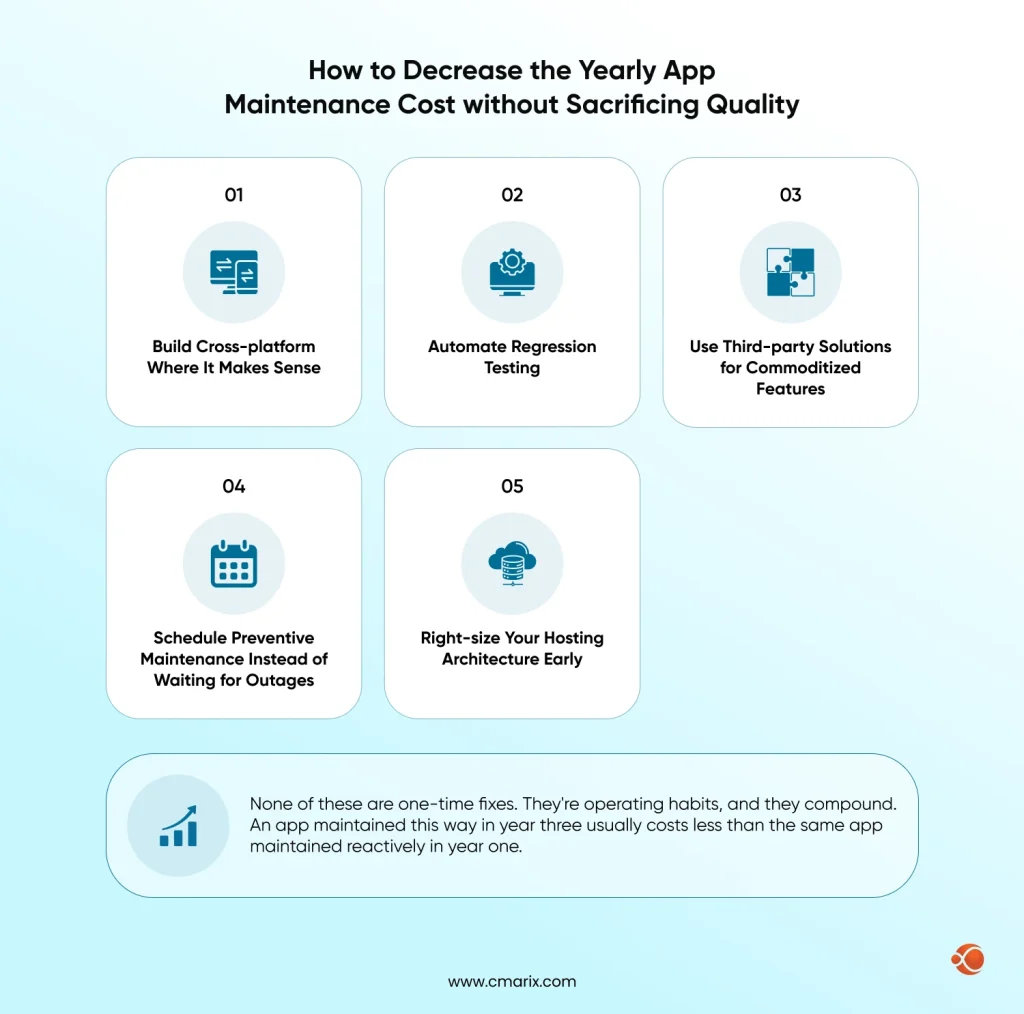
There are a few ways to decrease the cost line of app maintenance without reducing the quality:
- Build cross-platform where it makes sense. A shared codebase across iOS and Android means one bug fix, not two.
- Automate regression testing. Manual QA after each release is how the maintenance bill increases secretly. Automated software testing helps identify any issues in advance and decrease the QA line item substantially.
- Purchase third-party solutions for the commoditized features. Custom authentication or payments are rarely required for the app. Integrating them will cost less in the long run.
- Schedule preventive maintenance instead of waiting for outages. A quarterly performance and security review costs a fraction of what an unplanned outage costs in downtime and reputation.
- Right-size your hosting architecture early. Auto-scaling infrastructure avoids both the waste of over-provisioning and the emergency cost of scrambling during a traffic spike.
None of these are one-time fixes. They’re operating habits, and they compound. An app maintained this way in year three usually costs less than the same app maintained reactively in year one.

Final Words
CMARIX’s support and maintenance work spans platforms most businesses would consider unforgivingly high-stakes to get wrong.
CRUSH, a global clinical trial management platform built for Stryker, runs under an ongoing support arrangement where uptime and data integrity aren’t negotiable. A clinical trial platform going down isn’t an inconvenience; it’s a compliance incident.
That’s the same discipline CMARIX applies across end-to-end mobile app development solutions, where maintenance is scoped into the engagement from day one rather than treated as an afterthought once the app ships.
The pattern holds across industries: the businesses that treat maintenance as a planned, budgeted line item, not an emergency fund, are the ones whose apps are still running cleanly three years after launch.
FAQs on App Maintenance Cost
How much does it cost to maintain an app?
The annual cost of maintenance is planned to be 15-25% of initial development expenses. An app created for $50,000 will require $7,500-$12,500 per year for proper maintenance.
Why does mobile app maintenance cost so much after launch?
Because it is not some additional activity but a necessary one. Updates of the operating system, security and bug fixing, hosting services – all these things are recurrent and do not end when the app is released, but start.
Is first-year app maintenance more expensive than subsequent years?
Usually. Year one absorbs the bugs real users find that QA didn’t catch, plus the first round of OS compatibility updates. Costs typically ease by 15–20% in years two and three.
How much should I budget for app hosting and server costs?
Low-traffic apps run $50–$200 a month. High-traffic apps with real-time features or heavy media can run $2,000–$5,000+ monthly. Usage growth, not app complexity, is the main driver.
What happens if I stop maintaining my mobile app?
It stops working with new OS versions within a release cycle or two, becomes a security liability, and risks removal from the app stores entirely. Google alone pulled millions of outdated listings in its last enforcement wave.
How do iOS vs. Android maintenance costs compare?
Similar totals, different distribution. iOS costs more per release cycle due to Apple’s manual review process. Android costs more in QA hours due to device fragmentation. See our Android and iOS cost breakdowns for platform-specific detail.
How can I lower my annual app maintenance costs?
Automate regression testing, buy third-party integrations instead of building them, right-size hosting infrastructure, and schedule preventive maintenance instead of waiting for something to break.