


Quick Summary:
- AI has moved from a supporting tool to the core driver of digital transformation across every major industry.
- The AI in digital transformation market is valued at $560.13 billion in 2026 and is projected to reach $1.67 trillion by 2030.
- Global AI spending is set to hit $2.59 trillion in 2026, up 47% year over year.
- Agentic AI, autonomous agents that complete multi-step tasks, is moving from pilot to production across enterprise workflows.
- Healthcare, banking, retail, insurance, education, and logistics each show distinct, measurable AI use cases below.
- CMARIX helps businesses plan, build, and scale AI-driven digital transformation projects end-to-end.
The strategic integration of modern digital technologies is essential to future-proof company processes and workflows in this AI era. AI stands out as a key component of the three digital transformation pillars: people, process, and technology, either by itself or in conjunction with other technical elements. Beyond simple automation, AI-driven digital transformation revolutionizes processes, encourages creativity, and strengthens the ability to recognize patterns, trends, and solve problems across a range of industries.
Today, businesses are witnessing growth outcomes from model-based AI with the full potential of digital transformation for business.
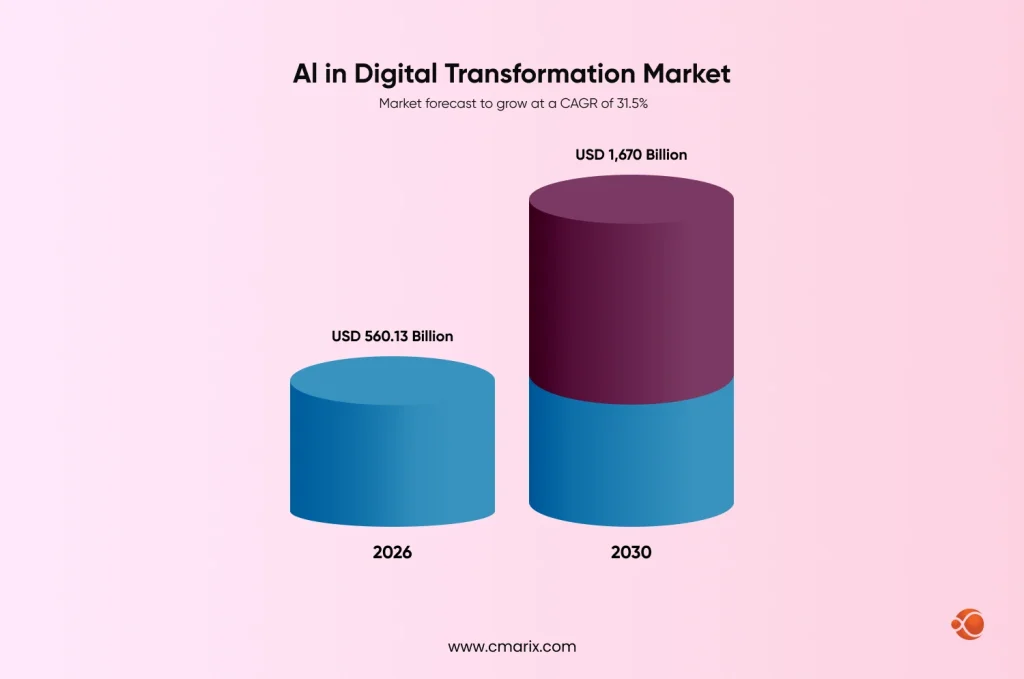
The global AI in digital transformation market is valued at $560.13 billion in 2026 and is projected to reach $1.67 trillion by 2030, growing at a 31.5% CAGR. The wider digital transformation market stands at $2.54 trillion in 2026 and is expected to reach $5.01 trillion by 2030.
Are you eager to combine your AI business ideas to maximize the benefits of AI in digital transformation? You should read this blog. We’ll talk about AI’s role in digital transformation, its main advantages, practical applications across industries, and how it works with IoT, cloud, and data analytics.
What Capabilities Power the Initiatives for AI in Digital Transformation?
Businesses may completely rethink processes, consumer experiences, and entire business models thanks to AI. Its many features support corporate digitization by enabling increased productivity and efficiency, effective risk management, and flexibility for ongoing development. Let’s explore the fundamental AI skills that power digital transformation projects.
Unlocking Data Potential
AI can automate data processing, identify patterns, and support corporate intelligence. With these capabilities, businesses can make data-driven decisions quickly and uncover hidden insights.
Computer Vision
Through the clever combination of AI and ML, computer vision allows businesses undergoing digital transformation to glean insightful business information from a variety of visual data sources, including pictures and videos. AI’s capacity to do this helps businesses achieve quality assurance more quickly and accurately.
Functionality of Generative AI Solutions
Gen AI is becoming more popular because of its advantages, including generating new types of data such as text, photos, and code, and simplifying tasks for companies in a variety of sectors. For instance, generative AI in manufacturing boosts customer assistance, expedites product creation, and promotes production and inventory control.
NLP
Through natural language processing, computers can understand and interpret human language, which underpins chatbots, analysis, and language translation. Businesses can improve customer interactions, streamline processes, and gain new insights from massive volumes of unstructured data by using data and AI for business transformation.
ML Algorithms
Because machine learning algorithms allow computers to independently analyze large volumes of data and learn from it, they are crucial for firms undergoing AI-powered digital transformation. With this capability and the right Predictive Analytics Consulting Services, businesses can improve predictive analytics, automate difficult decision-making processes, and tailor customer interactions to user preferences and behavior.
Move beyond experimentation with custom AI solutions and enterprise-ready implementation.
Use of AI in Various Industries for Digital Transformation
The extensive reach of artificial intelligence across many sectors shows its versatility and revolutionary nature. How artificial intelligence is revolutionizing digital transformation across many sectors reflects its significance in reshaping the operating environment.
Healthcare: Innovative AI Uses for Better Patient Care
The use of artificial intelligence in healthcare startups is one of the most prominent examples of innovation in the healthcare sector. It is a revolutionary technology which improves diagnoses and patient outcomes. Machine learning technologies assist in diagnosis through image analysis to identify health problems in their early stages. AI is applied in personalized medicine to tailor treatments to individual patients and thus deliver better outcomes. With predictive analytics, potential health problems can be predicted for proactive healthcare management.
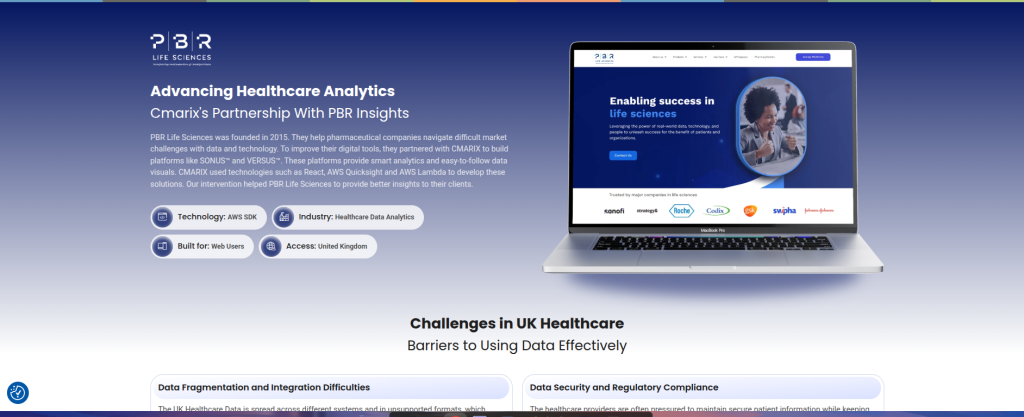
Case in point: CMARIX created PBR Insight, a healthcare analytics solution that integrates disparate patient data in the UK into visual dashboards, using machine learning to predict patient outcomes and identify at-risk communities.
FinTech: Safeguarding Exchanges and Revolutionising Services
Financial Technology (FinTech) has been on the front lines of incorporating AI into business practices, leveraging its benefits to enhance service delivery and perform safe transactions. Fraudulent transactions are prevented through real-time analysis of transactions using fraud detection algorithms. Automated trading improves investment decisions to increase gains. Automated customer service through AI ensures prompt and personalized service.
AI in Banking: Modernizing Core Financial Infrastructure
Banks have their own set of priorities that fall into the realm of FinTech; they include core account management, KYC and AML, and relationship building with customers. In modern banking, AI in banking covers almost all of the above-mentioned layers. Credit scoring models evaluate much more information than manual underwriting can; conversational AI answers account questions, and machine learning identifies unusual transactions.
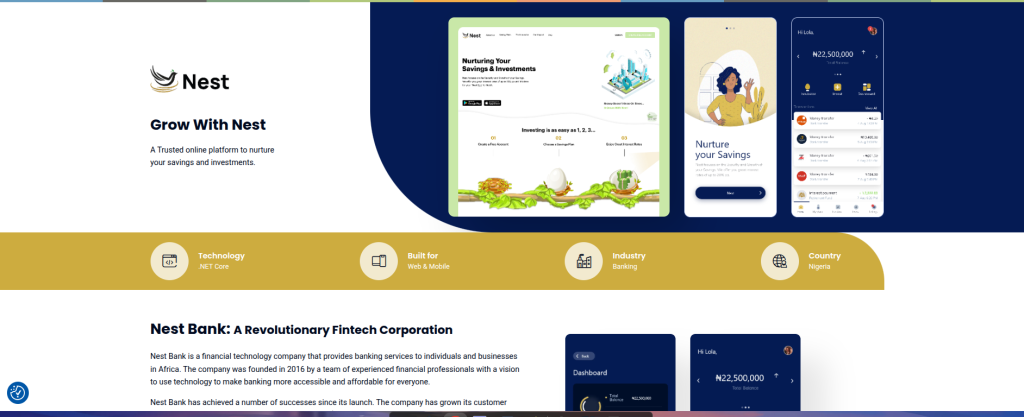
CMARIX built a similar platform for Nest Bank, a digital banking platform for savings, investments, and lending that has processed over $100 million in transactions for underserved SMEs in Africa.
Retail: Improving Operations and Customer Experiences
AI in the retail sector is making processes efficient while improving the customer experience. Machine learning-based recommendation systems make personalized recommendations, improving the customer shopping experience. Demand forecasting by AI helps optimize stock levels so there are neither overstocks nor understocks.
AI in Inventory Management: From Reactive to Predictive
Traditional inventory systems depend on historical data and manual reorder points, but the whole system falls apart whenever demand changes. The new inventory system uses AI to replace all of that with continuous forecasting, where AI calculates all the variables.
Organizations deploying AI for inventory management are expected to achieve a 10-20% reduction in inventory costs, along with a 15-30% reduction in stockouts, as stated in CMARIX’s guide on inventory management. Computer vision technology brings yet another level of inventory control through cameras that monitor shelves and warehouses.
Software Development: Boosting Coding Innovation
AI is helping to bring innovation into software development through faster development times, higher code quality, and automation of the coding process. Automated code generation reduces development time, while machine learning during app development helps detect and avoid software issues. This enables better coordination, resource management, workflow automation, and intelligent project management.
AI in Logistics and Transportation
With its ability to perform predictive maintenance to reduce downtime and expenses, as well as efficiently manage goods and routes using intelligent logistics systems, artificial intelligence has transformed the transport sector.
AI technology considers current traffic conditions, weather forecasts, and delivery schedules to allocate the best route. This helps save on fuel, speed up delivery processes, and increase fleet management efficiency.
AI in Insurance: From Paperwork to Predictive Risk
The traditional insurance model has been characterized by claims on paper, manual underwriting, and slow policy comparison. The role of artificial intelligence is to reduce the time required for the above tasks. Currently, fraud detection happens at the moment of intake as opposed to after the payment of the claim.
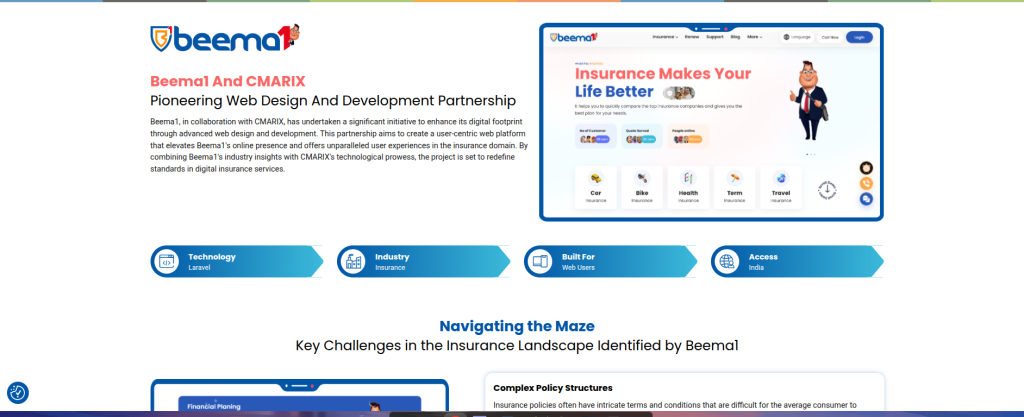
CMARIX built Beema1, a digital insurance platform, and later added automated, fraud-aware claims processing that moved the business from paper-based operations to a fully digital, real-time system.
AI in Education: Personalized Learning at Scale
Educational courses are moving away from the traditional, standard format to an adaptive one based on each individual’s learning pace. The software will be able to detect a lack of engagement and alert before the student drops out. It will also grade simple tests automatically and decide what the next lesson will be for the particular learner.
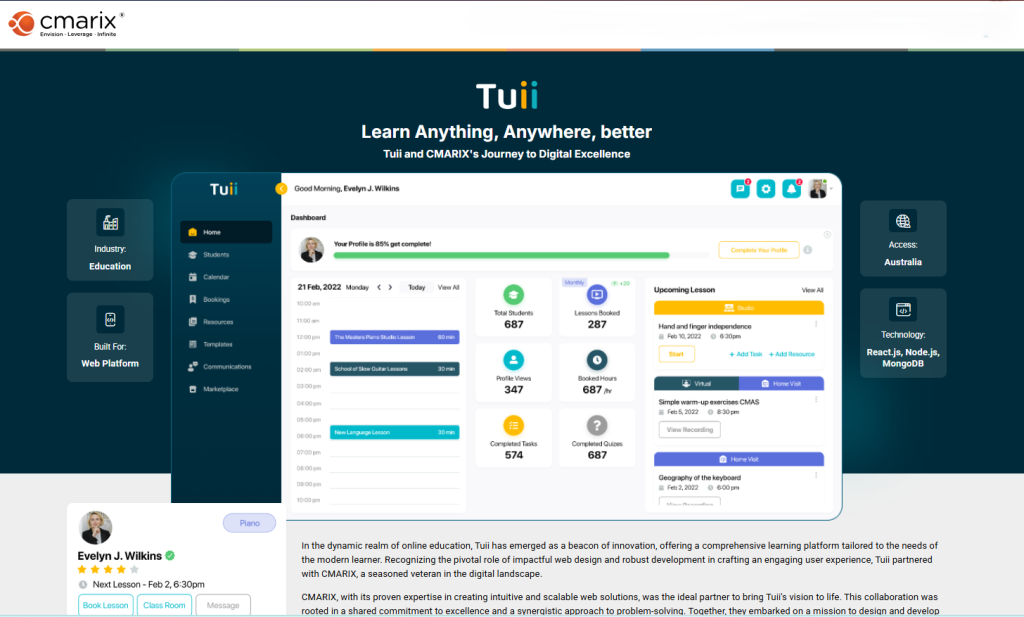
CMARIX built Tuii, an educational learning platform designed around this kind of adaptive, learner-first structure.
The Rise of Agentic AI in Digital Transformation
The 2026 digital transformation conversation has moved past chatbots and static dashboards. Agentic AI, systems that can plan, act, and complete multi-step tasks with limited human input, is now the leading trend in enterprise AI adoption.
Approximately 40% of regular enterprise work processes and commercial applications will use autonomous, task-oriented AI agents. They have already found their application in customer support triaging, procurement approval processes, incident management in the IT sphere, and supply chain exception management.
Adoption is overtaking governance. A mere 21% of businesses claim to have established governance models for AI agents. Organizations that have successfully introduced AI agents alongside robust governance, audit trails, and escalation policies suffer fewer deployment failures than those pursuing speed. Here are some important stats about Agentic AI collected by CMARIX.
Proven Strategies to Use AI to Promote Digital Transformation
Let’s examine methods for enhancing AI to make the most of its effects and yield significant advantages. It is imperative to understand that the revolutionary capacity of artificial intelligence can improve project outcomes and yield noteworthy benefits, thereby facilitating your digital transformation.
Establish Specific Goals
Defining measurable goals that support your business strategy is important for integrating AI into digital transformation. To properly manage an AI project, it is critical to have defined goals, whether the emphasis is on customer experience, income generation, or efficiency improvement.
Build Sturdy Data Foundations
Put data infrastructure focused on quality, accessibility, and security at the forefront to unleash the power of AI in digital transformation. All these elements are important for making data-driven decisions and building effective machine-learning models.
Start Small, Grow Wisely
Start by proving concepts or running pilots to validate AI solutions before scaling up within the company. An AI digital transformation strategy proves effective by validating benefits, mitigating risk, and assessing feasibility.
Modify Agile Methods
Adopt agile methodologies that will allow you to respond quickly to changes in the market and technology. Agile methodologies facilitate AI projects through adaptive planning, fast prototyping, and iterative development.
Develop Your AI Talent and Expertise
Invest in recruiting and training people with experience in generative AI, data science, and machine learning applications. Building up internal capabilities ensures that you can leverage AI sustainably.
Select Reliable Resources and Affiliates
Based on their compatibility with your technical needs, track record, and commercial goals, choose AI technology and outside partners. Partnerships and efficient tools are essential for the successful application of AI.
Ethical Implementation
Transparency, justice, and accountability are important when developing and implementing AI. To establish trust and minimize risk, one should consider various ethical problems like algorithmic transparency, data protection, and bias reduction.
Measuring ROI: What the 2026 Data Shows
Adoption and impact are distinct concepts, as shown by the 2026 statistics. Almost 90% of firms use AI in one business function on a regular basis.
However, less than 5.5% of such firms report EBIT impact of more than 5%, while 39% report any EBIT impact. Companies that are seeing the benefits of implementation combine AI adoption with governance, proper data architecture, and proven use cases.
There is the right way to approach AI implementation when all prerequisites are met. According to industry estimates, the average productivity gain through AI amounts to $7,800 per knowledge worker per annum, with an ROI of around 3.7x for AI projects. The reason for the discrepancy lies in preparation, not in the technology itself.
AI Applications in Digital Transformation
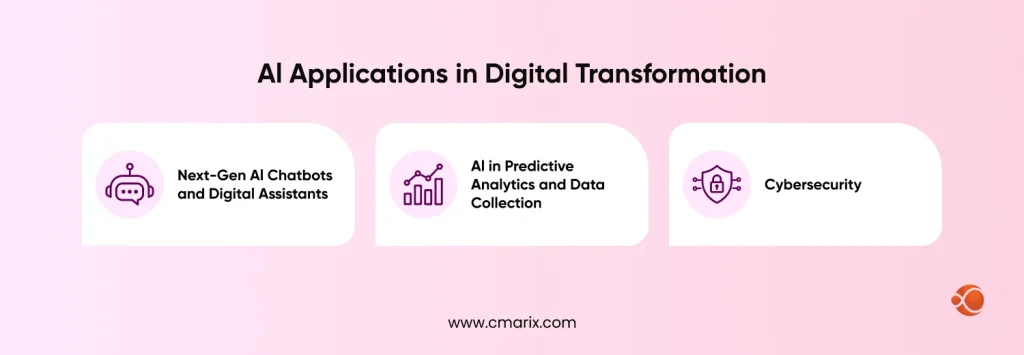
As certain businesses have already started using artificial intelligence to transform themselves digitally, other businesses are exploring the potential of this technology. In this part, we will talk about the practical applications of AI in digital transformation.
- Next-Gen AI Chatbots and Digital Assistants: Rule-based chatbots and intelligent virtual assistants are examples of AI-based customer support. Chatbots can only respond to frequently asked questions and offer users basic information and assistance.
- AI in Predictive Analytics and Data Collection: Machine learning is a tool used by artificial intelligence (AI)-driven software and solutions to assist businesses in foreseeing potential outages. Furthermore, by thoroughly analyzing datasets or historical data to yield actionable insights, sophisticated data analytics empowers companies to develop data-driven marketing and sales strategies.
- Cybersecurity: The advanced abilities of AI support cybersecurity by enabling real-time threat identification and response. Here are a couple of examples: To ensure the safe implementation of digital transformation initiatives, artificial intelligence (AI) is being used to detect suspicious bodies and facial expressions for enhanced security screening, AI-driven crime prevention, the identification of vulnerable endpoints, and monitoring the latest cybersecurity threats.
CMARIX built a similar solution for AnyVision, an AI-driven facial recognition platform used across Europe for real-time detection and crime prevention.
Monitoring Resources to Increase Productivity: Businesses may easily discover gaps, bottlenecks, and underutilization of resources with AI data analysis on resource allocation (people, materials, equipment, etc.). This results in optimized resource allocation and waste minimization. Predictive equipment maintenance also enables preemptive measures to avert expensive malfunctions and concentrate on patterns and enterprise software trends for more efficient use of resources.
You may like this: How to Integrate AI into an App?
Experience AI-Driven Digital Transformation by Partnering with CMARIX
At CMARIX, an AI software development company, we help businesses transform their digital journey through operational and strategic decisions, software product development, and digital consultancy services. We have a proven track record across almost every industry, helping clients help businesses compete in the ever-changing digital market.
We can also combine a wide range of contemporary technologies to boost productivity, efficiency, and business growth. Our innovative methodology and flexible workflows guarantee smooth project delivery, rapid upgrades, and seamless integration.
The team of professionals at CMARIX has extensive experience creating digitally enabled applications from scratch and updating legacy systems. Practice-tested proficiency in cloud computing, AI services, IoT development services, and advanced data analytics services allows us to unlock new possibilities, boost innovation, and provide insights for the future.
Beyond AnyVision and PBR Insight, our AIMO project shows the same approach in consumer tech: AI-driven body scanning and personalized coaching built to solve a real adoption problem in the wellness market.
Modernize legacy systems, deploy AI solutions, and build intelligent applications.
Final Words
AI is redefining digital transformation by enabling intelligent automation, faster decision-making, and continuous innovation across industries. Organizations that combine the right AI strategy with strong data foundations and scalable implementation are better positioned to improve efficiency, deliver superior customer experiences, and achieve long-term business growth.
FAQs on Role of AI in DIgital Transformation
What is AI-driven digital transformation?
AI-driven digital transformation is the use of AI technologies to increase efficiency, automate tasks and operations, analyze, and inform and support medical decision-making. This approach enables businesses to increase efficiency, improve the customer experience, and design innovative products.
Why is AI considered the most important part of digital transformation today?
The importance of AI in digital transformation can be explained by its ability to convert data into insights, automate processes, facilitate decision-making, and personalize the customer experience.
What is the difference between digitalization and AI-led transformation?
While digitization involves changing manual processes into digital ones, AI-driven transformation is the automation of processes with the help of artificial intelligence. The former implies implementing technology into the processes, while the latter involves making smart decisions.
How can AI accelerate the digital transformation process?
AI can expedite digital transformation through automation of routine tasks, analysis of big data, forecasting, and increased efficiency.
What are the key benefits of integrating AI into digital transformation?
Embedding AI in digital transformation ensures increased efficiency, reduced operational costs, better decision-making, improved customer experience, automated task completion, stronger security, enhanced predictive analytics, faster innovation, and sustained competitive advantage for businesses.
How do enterprises implement an AI digital transformation strategy?
Companies adopt an AI digital transformation approach by defining business goals, collecting high-quality data, identifying applications of AI, implementing pilot projects, integrating AI in existing operations, training personnel, measuring performance, and continuous improvement of AI.
Is AI part of digital transformation or a separate process?
AI is an essential part of digital transformation rather than a separate process. Digital transformation provides the overall strategy for modernization, while AI enhances it through intelligent automation, data-driven insights, predictive capabilities, and improved business decision-making.