


Quick Summary: AI in dentistry includes assessing X-rays, developing treatment plans, interacting with patients, and even robotic implant surgery. Studies have found that AI improves dentists’ ability to detect early-stage caries, although it also produces many false positives, and most data still comes from single-center trials. This blog describes the most common uses, benefits, cleared AI platforms used in US dental clinics, limitations to consider, and the future of AI in dentistry.
The dentist interpreting the bitewing X-ray scan will have a few seconds to act. A patient is in the chair, and an entire day of appointments remains. But early caries and bone loss are small and easy to miss. That is precisely what AI in dentistry was designed to help with. The program can detect what a tired eye misses, create the chart during the check-up, and inform patients about their condition between visits.
Not every tool marketed as AI in dentistry is supported by science, and some proven products may not be relevant for certain clinics. For instance, some FDA-cleared tools help interpret X-rays. Others are early pilots with limited clinical evidence. This article outlines what dental AI does right now and how to choose it wisely.
What Is AI in Dentistry?
AI in dentistry means software that learns from large sets of dental data, such as X-rays, charts, scans, and appointment records, and uses what it learns to support decisions. Machine learning (ML) in dentistry is mostly narrow AI.
A model trained on bitewing images finds cavities. A speech model turns spoken notes into a chart. A planning engine proposes tooth movements for an aligner. Each tool does one job, and the dentist stays in charge.
And it exists within an even larger stack. There are imaging systems, practice management software, billing applications, and patient messaging solutions in dental practices, and the AI integrates within the very same types of healthcare software that other parts of the healthcare system use. The market is growing fast too.
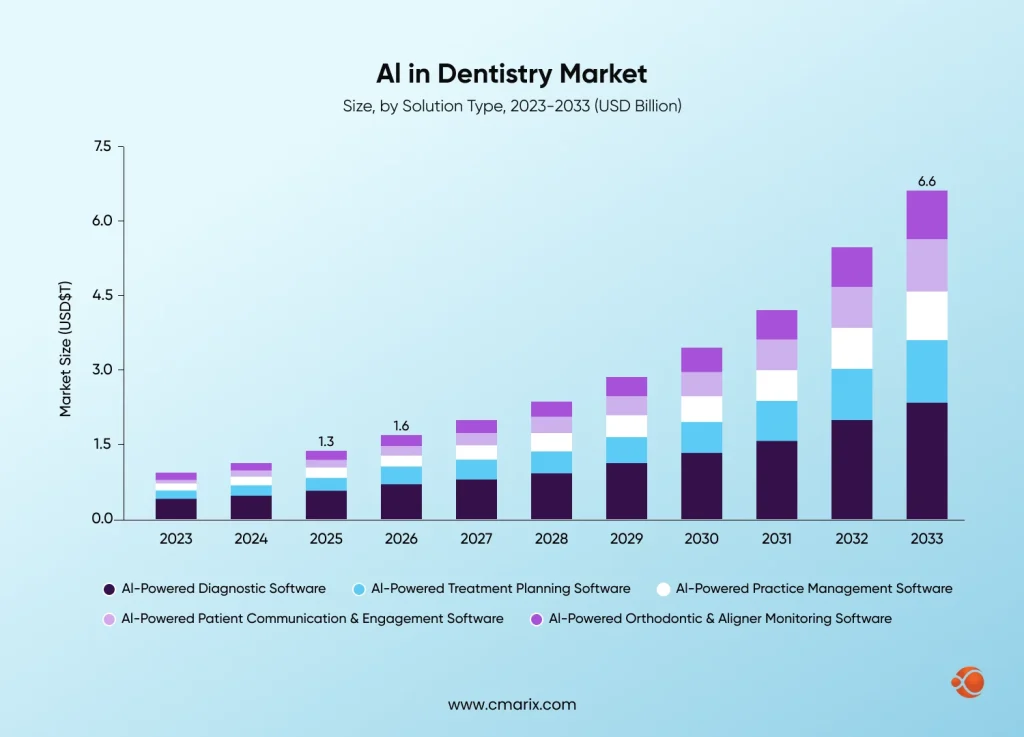
Grand View Research estimated the global value of the AI in dentistry market to be USD 1.3 billion in 2025, projecting USD 6.6 billion by 2033, which would mean a 22.7% CAGR for 2026-2033. Different analysts provide different numbers; take that into account.
Applications of Artificial Intelligence in Dentistry
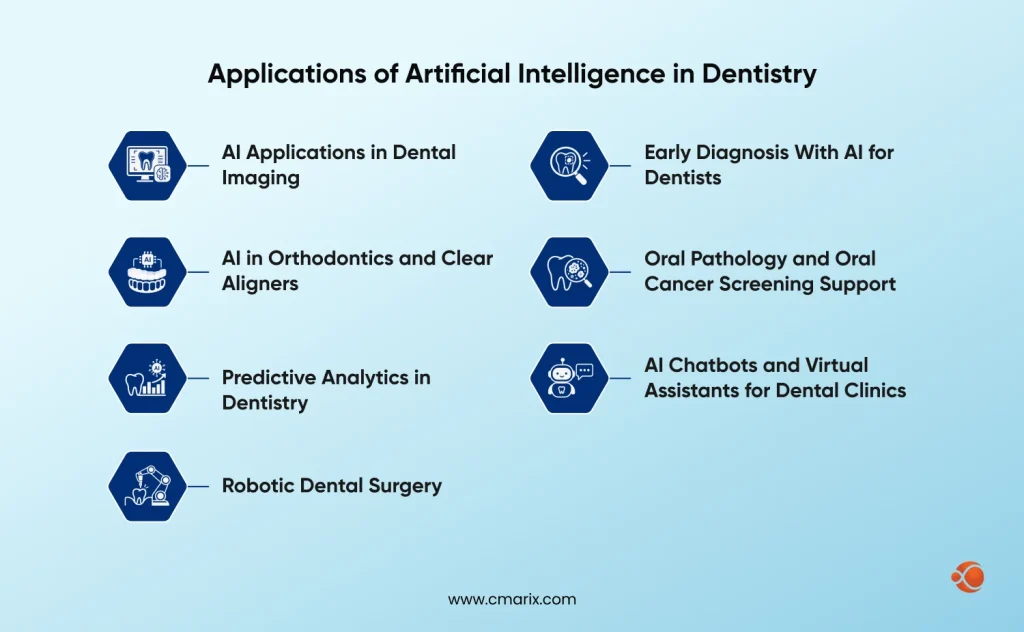
AI Applications in Dental Imaging
The area seeing the most development in dental AI is image recognition. The system analyzes the images from panoramic X-rays, bitewings, periapical X-rays, and cone-beam CT scans to detect any suspicious spots that need verification by the dentist. It can be useful for detecting cavities, bone loss, and periodontal disease.
Automated image analysis can also assist in identifying cysts, tumors, and other pathological conditions. In practice, the software typically helps with:
- Caries detection- outlining suspected decay on bitewings and periapical films
- Periodontal checks- measuring bone levels to support gum disease diagnosis
- Periapical findings- flagging possible root-end lesions and infection
- 3D review- highlighting structures and concerns on CBCT scans
Under the hood, this is computer vision in healthcare applied to dental scans. Convolutional neural networks learn to separate healthy tissue from diseased tissue by studying thousands of labeled images. It is the method behind most AI tools for dentistry that read caries and bone level. The evidence is encouraging.
A scoping review of ten peer-reviewed articles showed that AI can find more carious lesions than clinicians, with a sensitivity of 88% and specificity of 91%, especially when detecting early carious lesions. In one study included in the scoping review mentioned in the beginning, sensitivity increased to 75.8% with AI, up from 44.3%, although specificity decreased from 96.3% to 85.4%. AI in diagnostic imaging will greatly benefit dentists by helping detect diseases that might be missed with the naked eye.
Early Diagnosis With AI for Dentists
Early lesions are gentler and cheaper to treat, so catching them is where AI pays off. Software can flag suspected decay and bone loss within seconds.
Researchers are also looking at saliva. The FDI World Dental Federation notes that sensors could monitor saliva and, indirectly, oral health, but it calls this an unexplored data source in its white paper. Treat saliva-based screening as promising but early.
AI in Orthodontics and Clear Aligners
Aligner planning is currently among the busiest fields in terms of using artificial intelligence in dentistry. The computer identifies teeth on the basis of an intraoral scan, generates a plan on how they should be moved, and makes a schedule that the orthodontist can adjust. Artificial intelligence applications in dentistry can help in cephalometric analysis, which measures how the skull, jaws, and teeth relate. However, prediction accuracy remains limited. FDI claims that current prediction models are inaccurate and non-generalizable.
Oral Pathology and Oral Cancer Screening Support
Artificial Intelligence technologies are capable of analyzing images and extracting features from them. This data is used by pathologists to examine oral tissues for various oral cancers, precancerous conditions, and inflammation, aiming for more timely and reliable diagnoses. According to the American Cancer Society, there will be around 60,480 new cancers of the mouth and oropharynx and 13,150 deaths from them in the US in 2026.
Predictive Analytics in Dentistry
Predictive analytics tools in dentistry mine past cases to estimate what is likely to happen next, such as which patients may skip a recall or which lesions may progress. Some AI dental apps can estimate likely treatment responses, though accuracy varies, thus helping dentists make informed decisions. Keep expectations realistic, though.
The FDI white paper says AI risk profiling for caries, periodontitis, and tooth loss is still in its infancy, largely because training datasets are small and come from a few sources. If you want to build a model on your own clinic data, a predictive analytics consulting partner can help you judge what that data can support.
AI Chatbots and Virtual Assistants for Dental Clinics
AI chatbots use NLP (natural language processing) algorithms to respond to patients in real time. Hand anything urgent to a person, though. A chatbot should never stand in for emergency care.
As more healthcare AI startups launch products, dental clinics use chatbots for a few jobs:
- Booking, rescheduling, and canceling appointments
- Recall and hygiene reminders
- Answers to common questions about procedures, hours, and insurance
- After-hours intake, with a clear handoff to a person for anything urgent
Robotic Dental Surgery
Dental procedures are all about precision, and integrating AI in dental surgery can enhance the accuracy and precision of surgical intervention. AI-assisted robotic dental systems are no longer lab experiments. Yomi by Neocis holds FDA clearance and uses haptic guidance that constrains the drill in position, orientation, and depth, so the dentist guides the hand while the robot keeps to the plan. These systems assist the surgeon. They do not operate alone.
Quick Glance at AI Applications in Dentistry
| AI Application | Benefits |
| AI Applications in Dental Imaging | Detects periodontal diseases, bone loss, and anatomical abnormalities. |
| AI in Orthodontics and Clear Aligners | Improves orthodontic alignment and treatment predictions. |
| Early AI Diagnosis and Treatment Support | Flags oral diseases early so treatment can start sooner. |
| AI Chatbots and Virtual Assistants | Handles patient questions, bookings, and reminders. |
| AI in Oral Pathology | Improves histopathological image analysis and aids in oral cancer detection. |
| Predictive Analytics in Dental Care | Estimates risk and likely treatment response to support planning. |
| Robotic Dental Surgery | Guides implant placement with haptic robotic assistance. |
We build and integrate AI features into dental practice software.
Benefits of AI in Dentistry for Clinics and Patients
The gains are real, but they show up in specific places. These are the benefits of AI in dentistry that trials and clinics point to, with the caveats that come with each.
| Benefit | Where It Shows Up | Caveat |
| Faster, more accurate diagnosis | First-pass X-ray and CBCT reads | Needs clinician confirmation |
| Patient access and communication | Booking, reminders, after-hours answers | Urgent cases need a human |
| Time and cost savings | Charting, claims checks, routine messages | Real-world savings data is thin |
| Personalized treatment plans | One view of imaging, history, and past care | Predictive models are still limited |
| Smoother clinic workflow | Records, scheduling, billing, dental charting | Depends on system integration |
| Consistent reads | Group practices and multi-site clinics | Risk of over-detection |
| Patient education | Chairside visuals, AR and VR previews | Clear explanation still comes from the dentist |
Faster, More Accurate Diagnosis
According to the white paper of FDI, the use of AI in radiograph analysis is as accurate as manual analysis and sometimes even more accurate, with reduced assessment time and more systematic reporting. In this scenario, dental practices should use AI software as a primary screening tool. AI software detects and marks abnormalities, and the dentist confirms them. Before using the AI dental software, check that the product has FDA clearance for the claim you need.
Better Patient Access and Communication
Patients can access information related to dental procedures, hygiene tips, and dental treatment options from dental websites and apps that are integrated with Artificial Intelligence. AI-based systems and software enable patients to schedule appointments online without physically visiting. Patients also get reminders of their appointments, preventive measures, and hygiene practices with the help of AI tools.
A purpose-built AI chatbot development project can put booking, reminders, and after-hours answers on your clinic’s site and app. It is one of the most practical AI apps for the dental clinic industry because it takes repetitive calls off the front desk.
Time and Cost Savings
The return of time through claim checks, automated charting, and routine communications saves hours for the team. Also, FDI points out that artificial intelligence-based diagnostics can contribute to greater cost-effectiveness by reducing overtreatment and enabling earlier interventions, when dentists confirm every flag.. Evidence-based data on the savings is scarce; therefore, you should ask any vendor for it.
Personalized Treatment Plans
Plans work better when they reflect the whole patient, and AI in dental treatment planning is built around that idea. It can pull imaging, history, and past treatment into one view so the dentist sees risks and options together. With an advanced AI for clinicians, dentists can make informed decisions about treatment planning with the help of smart analytics tools and ensure more personalized treatment. FDI calls this direction P4 dentistry, meaning predictive, preventive, personalized, and participatory, and says it remains a promise of the future for now.
Smoother Clinic Workflow
AI can take on a lot of the admin that eats a clinic’s day. It can streamline the patient’s record, appointment scheduling, and billing tasks by automating them. Common targets include:
- Charting through voice notes
- Reminders for appointments and reminder lists
- Verification of insurance claims and billing
- Intake of forms and updating patient records
AI-powered dental charting software takes this one step further. The software listens during the examination process, converts speech into a structured chart entry, and enables the dentist to review rather than type. Connecting those steps to scheduling, billing, and follow-ups is where AI workflow automation earns its keep.
Fewer Missed Findings and More Consistent Reads
Two dentists may interpret an X-ray in two different ways, while one dentist may interpret the same image in two different ways on a busy Friday. With the model, you get the exact same interpretation of the image every time, hence making it possible for a group practice to maintain consistency across all the locations. There is a downside, however. The review also showed specificity can drop, which signals over-detection.
Better Patient Education and Treatment Acceptance
Patients believe what they see. FDI speaks about tools that mark the suspect area right on the image, which will make it easy for dentists to explain. Combine it with AR and VR presentations, dental communication, and AI-powered patient education apps, and you’ll get a tool that can turn a suggestion into something the patient understands. The follow-up is equally important. A healthcare CRM software development project can make the connection here.
Technology Integration Powering AI in Dentistry
Artificial intelligence (AI) rarely works alone. It gets stronger when paired with AR and VR, connected devices, and remote care. This is where a clinic’s tech stack starts to matter, and it ties into the bigger story of AI in digital transformation across healthcare.
Augmented and Virtual Reality
Through AR and VR, patients can benefit from interactive simulation as they get an idea of the treatment procedure and potential outcomes. FDI’s paper also points to AR and VR simulation as a way to train dental students.
Internet of Things (IoT) and Smart Dental Devices
AI plays an important role in analyzing data collected through dental devices and sensors. FDI’s examples include scoring brushing behavior from an electronic toothbrush and tracking diet through a nutrition app. AI turns that stream of data into prompts for the patient and flags for the dentist.
AI in Teledentistry
Teledentistry offers dental services via electronic communications, ranging from screening to follow-ups via videos. The use of artificial intelligence is supported in teledentistry for 3 main applications:
- Symptom checkers that help patients decide what to do next
- Asynchronous messaging with the dental team
- Remote monitoring during treatments such as orthodontic tooth movement
FDI says tools like these can extend dental services to people who have limited or no access today. If you plan to build a remote care platform, telemedicine software development covers the video, scheduling, records, and compliance work that sits around the AI.
We build AI chatbots and workflow automation for dental clinics and groups.
Real-World Dentistry Platforms for AI in the USA
These are real products with US traction. Several carry FDA clearance, which is a regulatory pathway and not the same as FDA approval, so check each product’s status with the regulator before you rely on it. Any healthcare software development services partner building in this space will do the same.
Denti.ai

Denti.ai uses AI-powered voice recognition and imaging tools to automate dental charts and radiograph analysis. It reduces the overload on dentists by performing administrative tasks like transcribing clinical notes and detecting pathological X-rays. Independent studies show a wide spread of results. In the scoping review, one in vitro study validated against histology found low sensitivity for early lesions with Denti.AI (13.7%), while a clinical bitewing study reported 69.8% sensitivity and 82% accuracy for its best setting. Test any tool on your own images before you commit.
Pearl AI
Pearl’s Second Opinion was cleared by the FDA in March 2022 as a chairside aid for detecting conditions such as decay, calculus, and root abscesses in X-rays. It provides real-time insights to dentists for making accurate diagnoses and treatment decisions. Pearl reports that study participants reading X-rays with its AI found 36% more lesions than those reading without it, and a later 3D version was cleared for CBCT scans in May 2025.
Overjet

Overjet is a combination of AI diagnosis and dental insurance automation. It analyses the X-rays to ensure accurate billing and insurance claim processing. It holds two FDA 510(k) clearances, Dental Assist for bone level measurement and Caries Assist for caries detection. The company says dentists using Caries Assist detected 32% more tooth surfaces with caries in a validation study. Because Overjet works with dental groups and insurers, it fits larger practices and payer workflows.
Yomi by Neocis

For dental implants, the Yomi robotic dental surgery system has been cleared by the FDA. The Yomi S system announced in 2025 has real-time AI-assisted guidance that illuminates nerves and other anatomical landmarks during planning and surgery.
Diagnocat

The Diagnocat technology specializes in CBCT. The report generated by its viewer consists of artificial intelligence reports, tooth charts, and 3D images. This technology had been in operation in over 50 different nations prior to receiving FDA clearance for US use in October 2025.
Align Technology (Invisalign and iTero)

Align’s iTero scanners and Invisalign software utilize machine learning for the purpose of treatment planning. ClinCheck live plan creates a doctor-ready plan in less than 15 minutes once an eligible case is uploaded, with plans being globally available in the first quarter of 2026.
Platform Comparison at a Glance
| Platform | Main Focus | Regulatory Note | Best Fit |
| Denti.ai | Voice charting and radiograph analysis | Confirm status with vendor | Clinics cutting charting time |
| Pearl | Chairside X-ray detection, 2D and 3D | FDA-cleared in 2022 (2D), later 3D | General and group practices |
| Overjet | Caries, bone levels, and claims tools | Two FDA 510(k) clearances | DSOs and payer workflows |
| Yomi by Neocis | Robotic implant guidance | FDA-cleared; Yomi S in 2025 | Implant practices |
| Diagnocat | CBCT reports and 3D views | FDA-cleared in October 2025 | Specialists using CBCT |
| Align (Invisalign, iTero) | Scanning and aligner planning | AI treatment planning, no diagnostic claims | Orthodontic and aligner work |
Before you pick any of them, ask the vendor:
- Which exact claims are FDA-cleared, and for which image types?
- What evidence is there from clinics like ours, beyond testing?
- Does it integrate with our imaging and practice management system?
- Can the dentist see where the AI identified a finding and overrule it?
Challenges of AI in Dentistry and Limits to Plan For
AI in dentistry is promising, but the honest picture includes limits. FDI’s white paper and the clinical reviews keep pointing to the same few risks.
| Challenge | What It Means | What to Do |
| Bias and narrow training data | Many models learn from small datasets from one site. FDI cites a study where 71% of US health AI applications were trained on data from just three states. | Ask how the model was trained and test it on your own patients. |
| Limited real-world validation | The scoping review revealed only a few external or multicenter studies. | Ask for validation on other image types |
| False positives and over-treatment | As the scoping review showed, higher sensitivity can come with lower specificity. | Keep the dentist as the final check on every flag. |
| Regulation and accountability | Diagnostic claims need clearance, and the clinician stays responsible. Patient data falls under HIPAA in the US and GDPR in Europe. | Match each product claim to its regulatory status. |
| Integration and cost | Tools must connect to imaging, practice management, and billing, and FDI notes interoperability is weak. | Budget for integration, training, and upkeep, not just a license. |
| Skills and complacency | FDI warns about limited digital literacy and leaning on automation too much. | Train the team to question the output. |
For custom builds, our breakdown of the cost to build a healthcare app shows how compliance and integrations move a budget.
Future of AI in Dentistry: Trends to Watch
The direction is clear even if the pace is not. Several trends are worth watching if you are building a roadmap for the next few years.
AR-Guided Robotic Surgery
Yomi S points the way with real-time navigation that highlights nerves and vital structures. Expect more guidance layers over time, including AR views of the plan, while the dentist stays in control.
Generative AI for Treatment Planning and Patient Communication
Generative models are moving into dentistry for drafting visit summaries, treatment letters, and plain-language explanations of a plan. Grand View Research now tracks generative AI as its own technology segment of the dental AI market. Teams exploring generative AI development services should keep a clinician in the loop for anything that reaches a patient.
Predictive and Preventive Care
FDI’s vision of “P4 dentistry” uses predictive models based on datasets collected from numerous practices. Techniques like federated learning, whereby the models are trained without transferring patient information, could enhance the ability to generalize.
Wearables and At-Home Monitoring
The symptom checker, intelligent brushes, and remote monitoring in orthodontic treatment are going to bring even more of healthcare into everyday life. Most of it will be done through the means of dental apps, which is why AI in app development decision-making is so important; for example, what gets processed locally or in the cloud.
Remote Screening and Teledentistry Growth
FDI envisions that there will be mobile applications that will facilitate the link between community outreach and dental clinics with the help of remote communication. The hygienists, along with other specialists, can conduct the screenings, followed by a dentist’s review.
Clearer Regulation and Wider Clinical Adoption
More products are becoming eligible for clearance, including 3D imaging devices, and the FDI has published a statement of policy regarding the use of artificial intelligence in dentistry. The white paper by the organization emphasizes the need for standardization, robust evidence, and basic knowledge of artificial intelligence among practitioners.
Why You Should Choose CMARIX for a Dental AI Platform
If you plan to build a dental AI platform, here is why teams look to CMARIX for an AI software development service.
Expert in AI and Healthcare Solutions
CMARIX has many years of experience in developing AI applications and platforms in various industries, including healthcare and dentistry. They specialize in patient management systems and AI-powered automation tools.
Focus on Compliance and Security
Dental management software deals with protected health information. CMARIX builds healthcare software with HIPAA (US) and GDPR (Europe) compliance from day one.
Successful Track Record and Global Presence
CMARIX has developed healthcare platforms for various regions, which include the development of Vezeeta, a healthcare appointment and data management system for the Middle East and North Africa.
Wrapping Up
AI in dentistry is best used as an additional pair of eyes and a speedier pair of hands for the dentist, rather than a substitute for the dentist. Wins for the technology include imaging, charting, aligner design, and patient communication. Prediction and robotics are areas of rapid growth, though they require more data and more cautious handling. When you are considering developing or procuring an application, remember three guidelines:
- Begin with one problem, not a full AI overhaul
- Ask for clinic-level evidence before you commit
- Plan for integration and compliance from day one
When you are ready to develop, it is worth the time to hire AI developers who have shipped healthcare software before.
FAQs on AI in Dentistry
What is the overall role of AI in dentistry?
AI in dentistry supports dentists with charting, image analysis, treatment planning, patient communications, and practice management. It alerts doctors to findings from X-ray and CBCT scans, drafts notes, and assists in the planning of procedures like braces and implants. The ultimate decision is left to the dentist. Today’s tools handle specific, narrow tasks.
Can artificial intelligence play a role in future root canal treatments?
Yes, mostly on the diagnosis and planning side for now. Tools such as Pearl’s Second Opinion flag periapical radiolucency on X-rays, and CBCT analysis tools help dentists read 3D scans. Guided robotics is further along in implant surgery than in endodontics, so expect AI to assist imaging and planning first, with the dentist performing the treatment.
What are the main advantages and benefits of AI in dentistry?
The main benefits of AI in dentistry are earlier detection of problems, more consistent X-ray reads, less time spent on charting and admin, clearer patient communication, and better-informed treatment plans. The evidence is strongest for imaging support. Gains in prediction and cost savings still need more real-world proof.
Will dentists be replaced by artificial intelligence in the future?
No, the tools covered in this guide assist dentists, and FDI’s white paper states that final responsibility for decisions stays with the oral healthcare provider. AI can read an image, but it cannot examine a patient, weigh their history, or build trust in the chair. The job will change more than it disappears.
How is predictive analytics dentistry used for patient emergency prediction?
True emergencies are difficult to predict. In dentistry, prediction is currently limited to the generation of risk scores, such as patients at risk of recall, lesions that will progress, and aligner cases that will require adjustments. FDI suggests that the use of AI to profile risks associated with caries, periodontal disease, and tooth loss is in its infancy.
What features should clinics look for in AI-powered dental software?
Look for FDA clearance that matches the claim being made, evidence from clinics similar to yours, and a clear view of where the AI flagged a finding so the dentist can verify it. Check that it integrates with your imaging and practice management systems and meets HIPAA requirements. The dentist should also be able to override any suggestion easily.
How can dental clinics optimize clinical workflows with an AI dental scribe?
The AI dental scribe hears what is said during the examination process, turning speech into structured chart data, which enables the dentist to review instead of typing. For instance, Denti.ai leverages voice recognition technology to automate dental charts. Start with a single provider, compare the chart data to the exam data, and link the scribe to the practice management software system.
How do major industry platforms compare, such as Pearl vs Overjet?
Both offer FDA-cleared dental imaging software. Pearl’s Second Opinion can detect multiple issues and even has a 3D alternative to be used for CBCT scans. Overjet integrates caries and bone-level detection with insurance claims, which makes it appropriate for larger numbers of patients and their insurers. Compare these imaging solutions by their FDA clearance scope, precision on your pictures, and system integration.
What are the best options for enhancing patient care with a dental AI platform?
Match the technology to the problem. Use Pearl or Overjet for X-rays and Diagnocat for CBCT. Use Denti.ai for charting. Use Align’s iTero and Invisalign for aligners and scanning, and Yomi for implants. Make sure the technology has the appropriate FDA clearance for its intended use, and pilot it in one clinic before deployment.
How can a clinic build a customized strategy using AI automation for dental practices?
Begin with the slowest repetitive processes like charting, reminders, entry, claim checking, and documentation. Analyze the flow, choose a specific use case, and quantify the time saved and mistakes identified during a certain period of time. After that, integrate tools via workflow automation and CRM to transfer data from one tool to another. If commercial products are not enough, a development partner can develop custom chatbots, automation, and predictive models.