


Quick Summary: Stock trading app development involves using the latest market data, ensuring efficient trading and portfolio management, ensuring security, and providing a good user interface. This paper addresses important issues involved in developing a stock trading application in 2026.
Just a couple of decades ago, investors used to call the stock exchange to give instructions on buying, selling, and holding stocks, or to consult about new purchases. Those times are over, thanks to web-connected stock market websites and services that enable online stock management, buying, and selling. With more advanced stock trading, customers can now use mobile apps for trading and management through modern mobile trading app development and stock trading platform solutions.
With the opening of new opportunities through stock trading apps, traders and stock market professionals are more delighted than ever. After all, stock trading apps brought the stock market right within reach on their palm-held devices. We need to understand the revolutionary impact of these apps on the stock market and investment. In addition to explaining the advantages of stock market apps, we will also explain how they work.
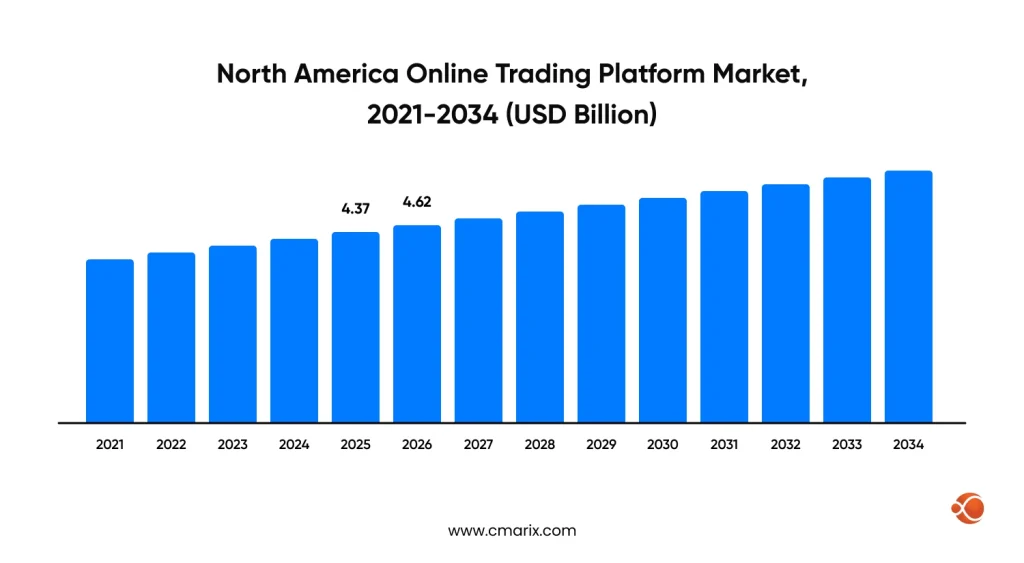
The market size for online trading platforms will reach USD 4.62 billion in North America and USD 3.52 billion in Asia-Pacific by 2026. There’s more to that story, however: worldwide capitalization of the stock market has increased 18.5% to USD 151.94 trillion, adding over USD 23 trillion to global capital markets, reports the World Federation of Exchanges.
Why Build Stock Trading Apps?
The sheer size of the user base alone proves how popular stock trading apps are. The ease these apps offer for trading stocks is enough motivation to build stock trading apps. Before you hire a mobile app developer for stock apps, it’s important to understand the advantages they offer.
Stock trading apps help busy investors and stock traders stay updated with real-time market data integration, portfolio management tools, and timely insights into portfolio performance. This encourages investors to subscribe for paid access to the app. Naturally, a stock trading app quickly gains fame and reputation and is considered invaluable by many stock traders and investors. This gives stock trading apps a huge opportunity to earn consistent revenue.
Key Features of Stock Market Apps
Though most stock trading apps offer basic features for free, leading apps like Robinhood and E-Trade also offer an array of sophisticated, advanced features for professionals and seasoned investors.
Let’s first look at the basic features of most stock trading apps on the market.
- A comprehensive, user-friendly trading dashboard to navigate across stocks and various actions like buying, selling, research, portfolio, and account management.
- Real-time stock chart streaming through real-time market data integration, along with quotes, price patterns, analysis, predictions, and strategies.
- Stock scanners to give insights about the right time to pick stocks based on an array of technical and descriptive metrics.
- Watch lists to monitor selected stocks, along with the user’s price, bid price, volume, and ongoing percentage changes.
- Latest market news and updates to support buy, sell, and long-term holding decisions, with AI-powered market analytics for deeper market insights.
- Calendars with stock market notifications with timely alerts to help users buy and sell stocks as the intended pricing threshold comes close.
Build a secure, scalable trading platform with real-time market data and smart features.
Leading Stock Trading Apps
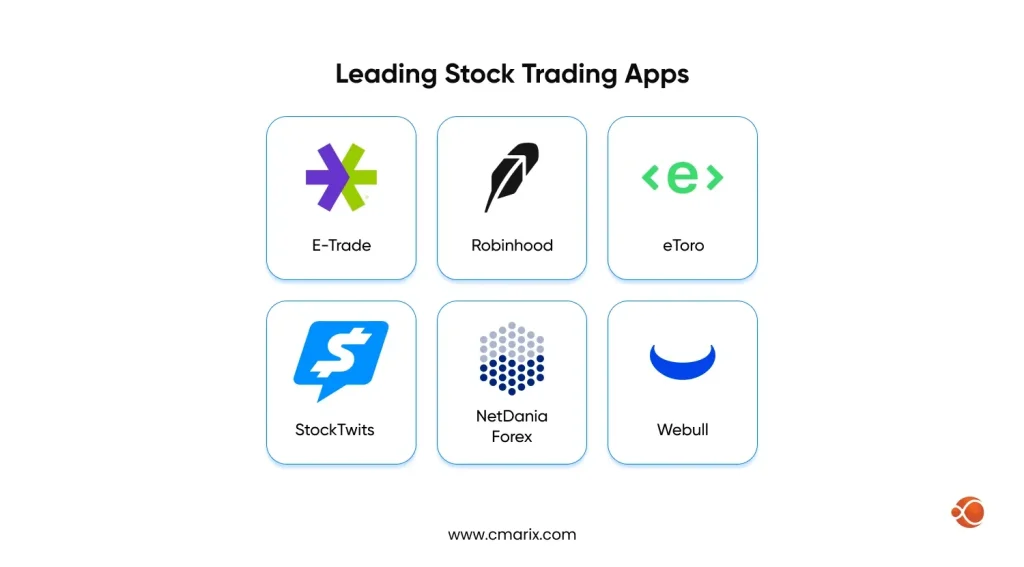
To build successful stock trading apps, it is imperative to learn from the leading ones and understand the foundations of effective Stock Trading Platform Solutions. Let’s briefly look at some successful mobile stock trading platforms.
E-Trade
This leading app, with an easy interface and an array of advanced features for tracking stock market data, executing trades, and receiving quote updates, can really help traders get the most out of mobile stock trading.
Robinhood
This free trading app even allows traders to trade stocks without paying any fees. The app earns only from the accumulated interest of its user base.
eToro
This crowdsourced trade platform, besides facilitating stock market transactions, also helps communicate with other traders and seek their advice. The app, which boasts data from millions of traders worldwide, is also a great research tool.
StockTwits
This serves as the Twitter of the stock market, sharing investors’ opinions and views on stocks and investment decisions, and informing traders about market activity and stock trends.
NetDania Forex
This mobile stock market platform allows investors to stay abreast of information on currency and commodity markets. It boasts a whole array of effective trading features, including real-time exchange rates and online charts.
Webull
Webull targets experienced traders through its charting tools, real-time stock quotes, technical analysis tools, screeners, and commission-free trades. Webull’s feature-rich interface is a useful guide for designing an online trading platform for the target audience.
How to Build A Successful Mobile Stock Trading App?
Although building stock market trading apps involves many complexities, we always advise focusing on the key success principles outlined below for mobile trading app development.
Mobile Website vs Mobile App
Though a mobile-optimized stock trading website is an option, it lacks the native accessibility and ease of anytime, anywhere access. Mobile apps are a more advanced option for mobile trading app development and support broader trading workflows. Mobile stock apps with an array of advanced native features, along with offline access to certain content and reports, are a more advanced option between the two.
Also Check: Mobile app development cost to understand the cost factors that influence a trading application project. For broader architectural planning, build a custom AI/ML-based trading platform that includes AI/ML-driven trading capabilities.
Offer A Highly Useful Trading Platform
This is where you need to learn from the leading stock market apps. Instead of unthinkingly following the features of stock apps, always incorporate features and trading mechanisms that suit typical user needs, including algorithmic trading features where required. When choosing the OS platform, always go for the one most of your target customers use.
Technology Stack
Whether you hire an iPhone app development company or the best Android app development company for your app, choosing the right technology stack matters a lot. Python is also widely used in fintech workflows, data processing, and trading logic, making it relevant to the architecture. When it comes to the appropriate technology stack for building your stock trading app, skilled developers versed in Swift, Java, Kotlin, and C# are required. For backend development, you need developers versed in server programming languages such as Ruby, PHP, Python, Java, Net, MySQL, Oracle, and SQL Server tools.
Programming in languages like HTML, CSS, and JavaScript is needed for front-end development, while Bootstrap, AngularJS, and jQuery are the necessary tools for mobile frontend development. To access the server without a page refresh, it is essential to understand AJAX.
Trading Platform Design
When designing the trading platform interface, give utmost priority to ease of access to relevant information and simple trading commands. A user-friendly trading dashboard keeps market information, orders, watchlists, and portfolio management tools easy to navigate. The UI and UX of the trading app should be considered right from the very beginning of conceptualization. In this respect, always use prototyping and similar tools. It is also important to stress usability testing for optimal outcomes.
App Security
For an app dealing with the stock market and finance, security is crucial. You need to give top priority to transaction and data security without compromising convenience and ease of use. A robust Trading Platform Architecture & Security approach also covers secure payment gateway integration, authentication, encryption, access controls, and regulatory compliance (e.g., SEBI, SEC, FINRA).
Choose the right architecture, tech stack, integrations, and security approach.
How Stock Trading Apps Make Money
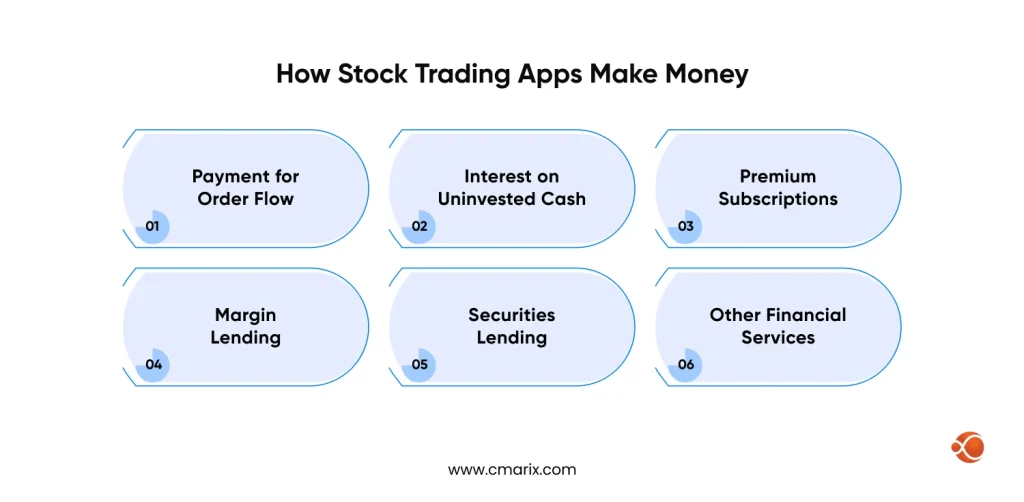
Stock trading apps are increasingly moving away from traditional per-trade commissions and using multiple revenue streams to generate income. These models are increasingly incorporated into custom trading software development for scalable stock trading platform solutions. The model often combines free trading with financial services and premium features.
Payment for Order Flow
Some commission-free online brokerage firms earn income by routing their customers’ orders to market makers, who then pay the brokerage firm for the order flow.
Interest on Uninvested Cash
If users keep money in their accounts and do not use it for investments, the website will be able to earn some interest on that money stored. Considering the size of the audience, even a small amount of interest will be a great source of income.
Premium Subscriptions
The majority of websites providing trading services also offer premium memberships with extra features such as professional charts, analysis, live data, analyst views, and portfolio management, which generate recurring income from subscription fees.
Margin Lending
In addition, apps can earn money through trading using borrowed money,, charging interest on margin accounts. This way, there will be an additional income stream and also more money for expert traders.
Securities Lending
Customers can also take securities out of their brokerage accounts for lending. Such an arrangement could potentially generate income for the customer, as well as other financial gains.
Other Financial Services
Fees can also be generated through account fees, financial product fees, interest-generating services, and alliances. The use of multiple income sources enables a stock trading application to maintain a low-cost trading environment while supporting a sustainable business model.
Why Choose CMARIX for Stock Trading App Development?
Developing a stock trading application requires an architecture that prioritizes security, accurate market data, quick transactions, and a good user interface. This includes trading platform architecture & security, real-time market data integration, and API integration for stock exchanges. CMARIX has expertise in Fintech software architecture, mobile app development, cloud computing, and secure software engineering for developing stock trading applications.
- Fintech & Mobile Expertise: Developing trading solutions such as custom algorithm trading software around portfolios, market data, trading workflows, user engagement, and algorithmic trading features.
- Real-Time Integrations: Connecting market data providers for real-time market data integration, brokerage APIs, payment gateways, authentication systems, and the best stock market API options required for API integration for stock exchanges.
- Secure Architecture: Deploying encryption, secure authentication, API security, access management, transaction tracking, auditing, and secure payment gateway integration.
- Scalable Infrastructure: Designing cloud-based backends capable of supporting concurrent users, market-data streams, growing transaction volumes, and high-frequency trading (HFT) capabilities where the use case requires them.
- End-to-End Development: Covering discovery, UI/UX, development, integrations, testing, deployment, and maintenance across custom trading software development, mobile trading app development, and forex and crypto trading app development.
- Proven Experience: 16+ years, 240+ experts, 1,600+ web apps, and 290+ mobile apps delivered across 46+ countries.
Conclusion
Finally, you need to ensure your stock trading app offers unique value in its user experience, features, or ease of use. If your app helps your users get things done without many in-app activities, you are just doing things right.
If you are looking for the best stock trading application development, like eToro or Robinhood. Talk to an Expert
FAQs on Stock Trading App Development
How much does it cost to develop a stock trading app?
On average, stock trading app development can cost $40,000 to $250,000 or more, depending on the feature set, technology stack complexity, required integrations, security, regulatory requirements, etc.
What are the essential features of a modern trading platform?
Key features of such software include user registration and KYC, live market feeds, stock search, watchlist and portfolio tracking, order placement, transaction history, pricing alerts, trading analytics, notifications, payment processing, etc.
How do I build a stock trading app from scratch?
To create such an application, you need to define the functional requirements and choose the technology stack, then design the UX, integrate market data and brokerages, create the trading functionality, and implement all security and regulatory controls.
What is the best tech stack for mobile trading application development?
The appropriate technology stack may include Flutter or React Native for mobile development, Node.js or .NET for server-side functionality, PostgreSQL and Redis for storage and caching, AWS or Azure for cloud deployment and scaling, etc.
How can AI be integrated into stock market software?
The artificial intelligence algorithms can provide the trading platform with market trend analysis, personal trading insights, sentiment analysis, anomaly detection, trading portfolio recommendations, predictions, alerts, and conversational assistants.
How do you ensure security and data privacy in a fintech app?
Securing involves encryption, multi-factor authentication, secure API design, role-based access control, tokenization, fraud detection, penetration testing, auditing, secure cloud hosting, and compliance with relevant financial data privacy regulations.
What are the regulatory requirements for launching a trading platform?
The requirements differ by country and by how the trading will be conducted, but usually include licensing, KYC/AML verification, investor protection, transaction monitoring, data security, recordkeeping, and reporting.
Can I develop a custom trading platform for both Android and iOS?
Yes. A trading platform can be developed for both Android and iOS devices, either using cross-platform development technologies such as Flutter or React Native, or by developing native applications for each platform.