

Quick Summary: Are you comparing SLM vs LLM to decide which will yield better AI ROI for your business? This guide explores the key differences between the two, the hardware needs, and why domain-specific model fine-tuning outshines general frontier models. Need assistance with implementation? Partner with a premier LLM development company like CMARIX to get cost-effective automation models today.
The enterprise artificial intelligence landscape is undergoing a paradigm shift. Companies early in their generative AI journey moved quickly to implement costly frontier models. The rationale was straightforward. More parameters equal more intelligence.
Corporate leaders face intense pressure to justify every line item in today’s tech budget. When it comes to investing in AI, you are likely standing at a challenging crossroads: do you go big with a massive frontier system, or keep things lean?
Smart tech teams know that standard, out-of-the-box AI models are often overkill. They rarely fit how your company actually works. Instead of forcing a square peg into a round hole, the best teams are turning to Lightweight AI Techniques and custom configurations. It’s all about finding that sweet spot between massive computing power and lean efficiency. When you strike that balance, you don’t just improve your data tools and customer bots; you also keep your budget completely predictable.
Smart technical teams understand that out-of-the-box LLM models are often overbuilt. They aren’t fine-tuned to fit specific corporate workflows perfectly. Instead, teams deviate toward Lightweight AI techniques and domain-specific configurations.
Balancing a massive computational scale with lean efficiency is vital. This balance refines your data analytics tools and shapes conversational automation initiatives. It also keeps operational overhead entirely predictable.
Defining the Contenders: What is an SLM vs LLM?
Before building an AI Ecosystem, teams must clearly define modern natural language processing frameworks. Understanding the difference between LLM and SLM helps you make better decisions.
What Does LLM Stand For in AI?
LLM stands for Large Language Model, the gold standard for general-purpose text AI. These massive systems use billions—sometimes even trillions—of settings called parameters to understand how we communicate. To prepare them, developers train them on massive collections of text, including everything from public books and websites to academic research papers.
This scale provides an extensive general knowledge base, allowing LLMs to handle ambiguous instructions and open-ended research. Frontier examples include ChatGPT, Claude, DeepSeek, and Gemini.
What is an SLM?
SLM stands for Small Language Model, a compact, highly optimized version of text AI. Instead of trying to hold all of human history, these systems are much smaller—typically featuring anywhere from a few million to a few billion settings called parameters. Because they are leaner, they focus on a narrow, well-defined set of tasks and do them incredibly well.
Engineers build modern SLMs using advanced model compression and knowledge distillation. Models like Gemma 2 and Microsoft Phi focus heavily on processing speed, significantly improving open-source AI inference speed.
Architectural and Deployment Differences
When you look at how these models are built, the differences in size and speed are night and day. Choosing between a small language model and an LLM completely changes the hardware you need to run it.
| Technical Feature | Small Language Model (SLM) | Large Language Model (LLM) |
| Parameter Scale | Millions to low billions (<10B parameters) | Tens of billions to trillions (>70B+ parameters) |
| Hardware Requirements | Consumer-grade GPUs, laptops, mobile, edge devices | Cloud server clusters, high-end enterprise GPU arrays |
| Latency Profile | Exceptionally low; rapid real-time token generation | Moderate to high latency; complex routing overhead |
| Primary Deployment Mode | Local on-premise, self-hosted edge environments | Public cloud APIs, highly specialized private clouds |
| Knowledge Base Depth | Moderate; highly focused on specific business domains | Extensive; spans multiple industries and subjects |
Language Model Parameter Size Comparison
Parameter scale is the absolute biggest difference between these two designs. A massive LLM ramps up its parameters to catch every tiny detail and nuance in human language.
The downside? It takes serious cloud infrastructure and a ton of memory to actually run. On the flip side, an SLM cuts out the architectural fat, focusing strictly on the tasks at hand to give you maximum performance on a much tighter budget.
Edge Computing and Local Hardware Execution
An SLM runs easily on everyday devices without needing a constant cloud connection. This means developers can build smart, compact automation directly into smartphones and laptops.
By shifting to this edge-computing design, you eliminate the need for an external network. Everything happens in real time, running seamlessly without the usual delay of sending data back and forth to a distant server.
Find the right balance between performance, scalability, and cost.
The Economics of AI: Fine-Tuning and Inference Costs
When you’re scaling a business platform, long-term survival comes down to financial sustainability. That is why tech leaders must evaluate projects through a strict AI ROI framework—one that balances everyday deployment expenses against the task accuracy you get in return.
Enterprise AI ROI = (Task Accuracy + Processing Speed) / (On-Premise Infrastructure + Carbon Footprint)
Domain-Specific Model Fine-Tuning
An SLM is significantly cheaper to fine-tune than a frontier LLM. Fine-tuning an LLM requires massive cluster configurations and long training windows. These requirements easily decimate operational budgets.
An SLM requires minimal token-processing hardware. Companies leverage AI Model Fine-Tuning services to adjust compact models. Teams use clean, proprietary corporate text on single workstations. This helps organizations build specialized models tailored to precise legal jargon at a lower cost.
According to the Google Cloud Architecture Framework, fine-tuning smaller open models like Gemma 2 delivers strong results. Enterprise teams can achieve up to a 4x improvement in cost-performance over larger models on targeted tasks.
Predicting Operational Inference Costs
Public LLM APIs are easy to start with, but their pay-per-token pricing can quickly become a financial trap. As your business grows and transaction volumes shoot up, your cloud costs can spiral out of control.
Benchmarks in the Google Vertex AI Documentation prove a crucial point. Task-specific small models fine-tuned on clean corporate data frequently match frontier LLMs. Shifting to a fine-tuned compact system stabilizes enterprise infrastructure costs. This makes on-premises AI deployment costs easier to control.
Environmental Factors and Carbon Footprint
Modern Machine Learning Governance demands accountability for hardware energy consumption. Data compiled by Stanford’s AI Index reveals shocking metrics. A frontier LLM draws roughly 0.3 to 1 Watt-hour (Wh) per query.
The infrastructure chosen for AI inference will ultimately determine the company’s long term carbon footprint. Shifting to localized, small-scale language models reduces electricity use and aligns the technology stack with sustainability goals.
Overcoming Knowledge Gaps with RAG
Critics point out LLMs’ shortcomings in internal knowledge compared with SLMs. Small models can’t provide the extra memory needed to answer historical questions.
Modern enterprises rely on custom retrieval-augmented generation RAG to fix this.
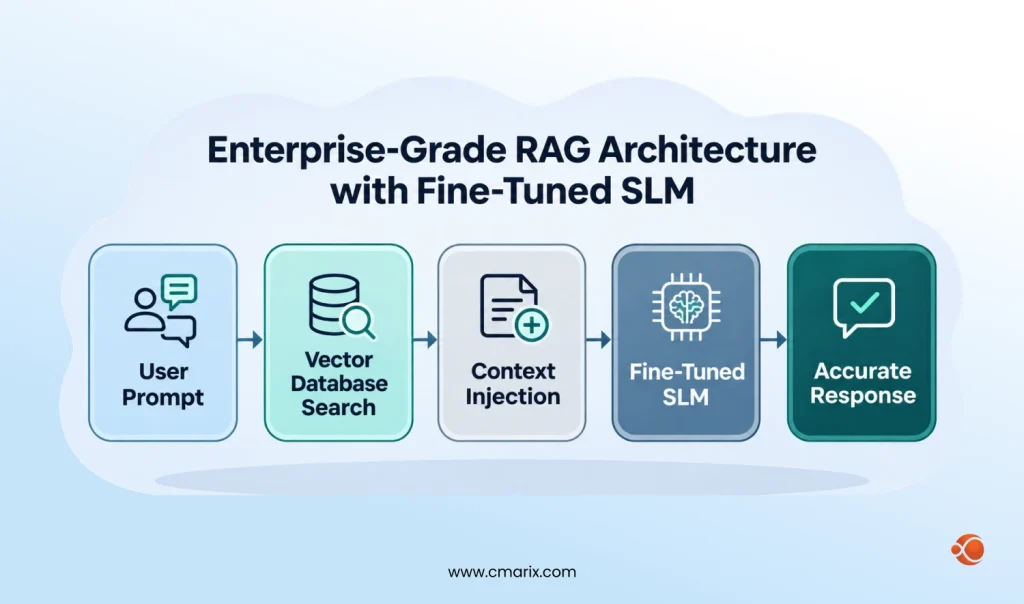
RAG architectures connect a compact model to a secure corporate vector database. The system first pulls relevant context from private company documents. It injects that text directly into the prompt window.
The SLM then uses its linguistic skills to present the answer. This delivers highly accurate answers pulled from live enterprise records.
Moving Toward Self-Hosted AI and Open-Source Models
Enterprises are rapidly migrating away from proprietary public APIs. They prefer domain-specific, open-source architectures. Three core imperatives drive this pivot:
- Data Privacy & Compliance: Regulated industries cannot risk exposing sensitive customer records. Self-hosting ensures proprietary data never leaves the corporate cloud perimeter.
- Latency Optimization: Sub-second response times are crucial for Machine Learning for Chatbots. Local edge models eliminate network hops and provide real-time token processing. Look at the key differences between Self-Hosted AI vs OpenAI APIs.
- Architectural Sovereignty: Relying on third-party APIs exposes applications to unexpected deprecations. Owning the model weights guarantees absolute control over core infrastructure.
Engineering teams should establish an objective LLM Evaluation Framework before deployment. Furthermore, maintaining compliance requires strict operational overwatch.
Industry-Specific Use Cases
To understand the SLMs vs. LLMs debate in practice, examine specific business applications.
Healthcare and Finance (SLM)
A hospital uses a localized SLM to route patient data securely. This ensures absolute data privacy. Banks use compact models like Llama 3 8B for rapid fraud detection on edge devices.
Marketing and Creative (LLM)
The digital marketing agency uses LLMs for large volumes of copywriting and brainstorming. The mammoth Foundation model applies broad general knowledge across many independent subjects.
Customer Support (SLM with RAG)
E-commerce brands deploy models like Mistral 7B connected to secure corporate databases. This intelligent, compact automation model handles thousands of customer queries daily without risky AI hallucinations.
Why Partner with CMARIX for Building Your Language Model?
Navigating the complex world of artificial intelligence requires an experienced technical partner. As a premier LLM development company, CMARIX provides the specialized engineering teams you need to fine-tune domain-specific models and deploy them securely. We make it simple for enterprises to balance fast processing speeds, strict data privacy, and predictable operational costs. Whether you’re building a custom RAG architecture or deploying efficient edge computing solutions, we deliver measurable ROI. You can trust CMARIX to design intelligent, compact automation models built specifically around your unique corporate workflows.
Final Verdict: Which Model Architecture Fits Your Goals?
The debate between SLMs and LLMs is about choosing the right tool. Select a Large Language Model (LLM) for broad creative writing capabilities. They handle complex software architecture design and multi-step logical reasoning easily. Partner with an artificial intelligence software development services provider or LLM Development Company like CMARIX. They will fine-tune and integrate an SLM for high-volume automated tasks. The SLM pathway offers unparalleled processing speed and absolute data privacy.
FAQs About SLM vs LLM
What is the main structural difference between an SLM and an LLM?
The primary difference lies in the parameter count and architecture size. LLMs use tens of billions of parameters. SLMs use millions to a few billion parameters.
What does LLM stand for in AI, and how do they compare to SLMs?
LLM stands for Large Language Model. They offer broad knowledge. SLMs are highly specialized, faster, and much more cost-effective for specific tasks.
How many parameters classify an AI model as a Small Language Model (SLM)?
Generally, AI models with under 10 billion parameters are classified as Small Language Models (SLMs).
Can you run a Small Language Model (SLM) locally on consumer hardware?
Yes. SLMs are highly optimized to run locally on laptops, smartphones, and edge devices without cloud connectivity.
Which is cheaper to fine-tune: an SLM or an LLM?
An SLM is significantly cheaper to fine-tune. It requires far less computational power, memory, and expensive hardware than an LLM.
SLM vs LLM: Which model architecture offers lower latency for edge devices?
SLMs deliver much faster response times. Because they have a much smaller footprint, they can generate tokens in real time directly on the device without sending data back and forth to the cloud.
How does Retrieval-Augmented Generation (RAG) help SLMs overcome knowledge gaps?
RAG essentially gives the SLM an open-book exam. By linking the model to your private company database, it pulls in the exact facts needed and adds them to the prompt before the model writes a response.
Why are enterprises switching from public LLM APIs to domain-specific open-source models?
It comes down to control. Companies are switching to lock down data privacy, avoid unpredictable monthly cloud bills, cut network lag, and fully own their AI setup.
How do you calculate the ROI of deploying an SLM vs an LLM?
Look at the trade-offs. Weigh the model’s accuracy and speed against internal hardware costs and the overall impact on your corporate carbon footprint.
How should enterprises benchmark inference costs before choosing an AI framework?
Run the numbers through a structured evaluation framework. Track the exact cost per query, the hardware required to run it, electricity use, and how those expenses will scale as your traffic grows.