

Quick Summary: The AI Ecosystem is the data, models, computing power, and tools that let an organization leverage AI. The Generative AI ecosystem includes those components, plus large language models, a retrieval layer, and an agent framework.
Most enterprise AI projects don’t fail because of one bad model. They fail because the pieces around the model never fit together. Data pipelines, compute, orchestration, security, and the apps people use must work as one system. That system is your AI ecosystem. SK hynix’s breakdown of the AI value chain shows how many layers sit between hardware and a business tool. At CMARIX, we map these layers for clients before we write a line of code. This guide shows how we do it. You will see what an AI ecosystem contains and how its layers connect. You will also learn how to pick models that scale.
Enterprise AI Ecosystem: At a Glance
- Key components: Data, computing power, AI models, workflows, applications, and security controls.
- Choosing AI models: Select models based on accuracy, available data, ease of understanding, computing needs, and response speed.
- Planning for growth: Build an AI system that can handle more data and users as business needs grow. The global machine learning market is projected to reach $125 billion in 2026.
- Starting with data security: Protect business data from the beginning because every AI component depends on it.
What Is an AI Ecosystem?
The AI ecosystem is simple. It covers every component a company needs to turn data into working intelligence. That includes datasets, training methods, models, compute, integration tools, and the people who run them. This glossary definition frames an AI ecosystem as a network of connected parts, not a single product.
The Core Layers of a Generative AI Ecosystem
We split every enterprise intelligence ecosystem into six layers. The table shows what each one does.
| Layer | Job | Typical components |
| Data | Collects, cleans and stores training and live data | Warehouses, lakes, labelling tools |
| Compute | Trains and serves models | GPU clusters, cloud instances, edge chips |
| Model | Learns patterns and generates output | Supervised, unsupervised, reinforcement and deep learning models, LLMs |
| Orchestration | Moves data and tasks between layers | Pipelines, workflow engines, agent frameworks |
| Application | Puts AI in front of users | Web apps, mobile apps, APIs, chat interfaces |
| Governance | Controls access, risk and compliance | Audit logs, access rules, bias checks |
Raw data processing feeds everything above it. If the data layer is messy, every model downstream inherits the mess. That is why we spend the first weeks of most AI ecosystem projects on data audits, not model selection. Some architects call this whole stack a cognitive computing architecture. The layers stay the same.
How Your AI Technology Choices Affect Costs
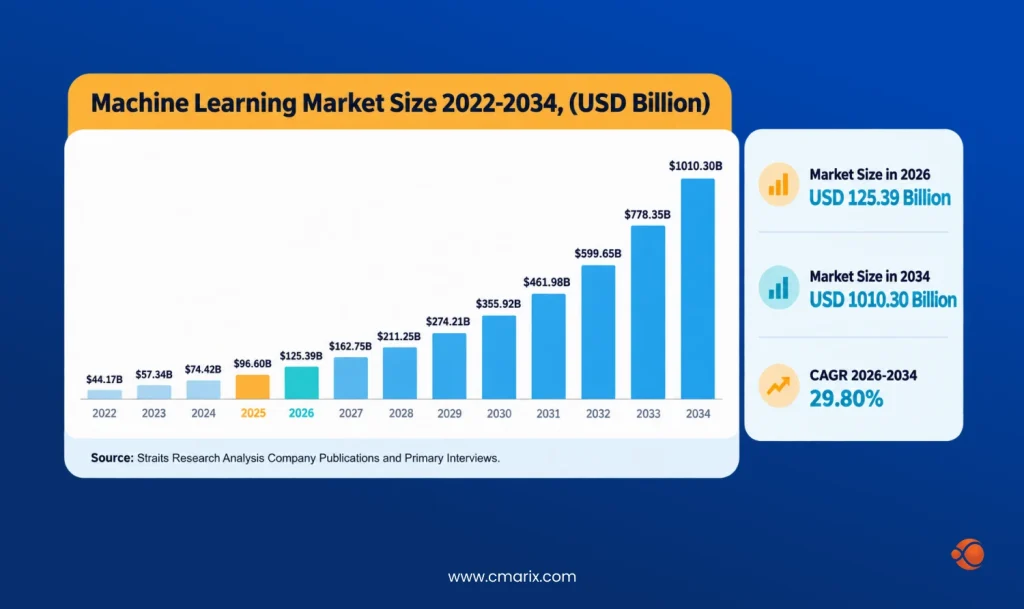
Your framework choice matters because it sets operating costs for years to come. One key study by Straits Research puts the global machine learning market at a $123.39 billion valuation in 2026, set to rise to $162.75 billion the following year.
Compute is the second biggest money pit in AI. Epoch AI actually tracks the computing power used to train major AI systems, and Our World in Data maps it out. Right now, the biggest frontier model runs are hitting a massive 10²⁶ FLOP. Training at that scale requires massive GPU clusters and highly synchronized parallelism. Realistically, most businesses will never build a model from scratch. But even for fine-tuning or inference, you still need a solid plan to secure GPU access and keep latency down.
Our guide to the role of AI in digital transformation shows how these costs map to business results.
Our AI experts can map your requirements to the right models, infrastructure, and integrations.
Four Learning Methods Behind Every AI Model
Every model in your tech stack relies on one of four main ways to learn. Picking the right one really just comes down to what data you have and what you are trying to build.
| Learning method | How it learns | Ideal use cases | Key difference |
| Supervised learning | Learns from labeled data to predict specific outcomes. | Medical diagnosis, fraud detection, voice recognition. | Needs labeled data. Best for clear predictions. |
| Unsupervised learning | Finds hidden patterns in unlabeled data. | Customer segmentation, anomaly detection, market trends. | No labels needed. Great for finding hidden structures. |
| Reinforcement learning | Learns by trial and error based on feedback from an environment. | Autonomous vehicles, robotics, chess-playing bots. | Learns from consequences. Built for dynamic tasks. |
| Deep learning | Multi-layer neural networks process complex patterns | Image recognition, speech, language processing | Handles complex data. Needs large datasets and compute |
Pro Tip: Choose supervised learning if you have labeled data and know what you want, like fraud detection. Choose unsupervised learning if labeling is too costly or doesn’t exist, like segmenting customers based on their behavior. Rely on reinforcement learning when an agent learns through actions, for example, teaching a robot how to act.

What AI Models Do Inside the Ecosystem
AI models earn their keep by taking slow, mind-numbing manual chores off your plate. They can ingest and learn from your proprietary data, the kind of inside information your competitors can’t access, and stay accurate by retraining as new data comes in. Tools like generative adversarial networks and DALL-E can spin up entirely new images and designs from a simple text prompt. Other models are great at digging through massive datasets to flag strange patterns or anomalies in real time. Ultimately, you can use them to automate entire workflows from start to finish, freeing up your team to focus strictly on the big judgment calls.
Data Orchestration and Machine Learning Infrastructure
Data orchestration frameworks are the air traffic controllers of your tech stack—they schedule, monitor, and route data across layers while enforcing access controls. A secure AI ecosystem starts here. A solid framework tracks and logs every data pivot, so if a leak happens, you can trace it back in minutes rather than chasing it for weeks.
For your machine learning infrastructure stack, you should separate training, serving, and monitoring. Training jobs are massive, unpredictable spikes. Serving needs to be steady with ultra-low latency. Monitoring catches model drift before it ruins your user experience. If your team tries to run all three on the same shared hardware, costs will skyrocket, and things will break.
Large language model integrations need the same discipline. Keep API keys, prompt logs, and output filters in the governance layer, not in app code. Our quickstart guide to building smarter enterprises with AI walks through the first build steps.
Standard Architecture vs. Enterprise Intelligence Ecosystem
Most companies start with a basic setup and quickly outgrow it. Here is exactly where the gap starts to open up:
| Focus Area | Standard architecture | Enterprise intelligence ecosystem |
| Data | Siloed per app | Shared, governed data layer |
| Models | One model per task | Model registry with versioning and reuse |
| Scaling | Manual capacity planning | Autoscaling compute with cost tracking |
| Monitoring | Uptime only | Drift, bias and output quality |
| Automation | Fixed rules | Scalable business automation platforms with agents |
| Security | Perimeter defence | Access rules per layer, full audit logs |
Conduct six tests before deploying any scalable platform: integration level, data residency, audit logs, inference cost, vendor lock-in, and support agreements. Most companies tend to replicate super.ai’s system architecture, which combines raw machine learning with human validation for unstructured data. If you have tons of documents on your desk, replicating this solution is your best bet. Build robust review pipelines so humans can handle edge cases.
Strategic Evaluation: How to Choose the Right AI Model for Your Enterprise

The model you choose will determine the performance ceiling for your entire enterprise ecosystem. For achieving long-term scalability and business ROI, architecture and engineering teams should consider the following six important considerations:
| Evaluation Factor | What to Check | Business Impact |
| Model Performance | Check precision, recall, and F1 score to see how well the model makes predictions. | Improves results and reduces errors, especially when data is uneven. |
| Data Requirements | Check how much data the model needs and whether the data is accurate and properly labeled. | Helps match the model to available data and reduces data preparation work. |
| Explainability | Check how easily people can understand why the model made a decision. | Makes reviews and audits easier, especially in finance and healthcare. |
| Model Complexity | Compare the model’s performance with the effort needed to train, run, and maintain it. | Keeps the model practical to manage over time. |
| Computing Resources | Check the hardware, memory, and computing power needed to run the model. | Helps plan infrastructure and control running costs. |
| Inference Speed | Check how quickly the model gives results, especially when fast responses are needed. | Supports applications that need quick predictions and responses. |
Our ML team helps you choose the right model for your needs.
Securing Your AI Layers
Build security into the design, not as a patch after launch. Start with data minimization. Collect only what each model needs. Add role-based access, encryption, and audit logs at every layer. For sensitive workloads, keep processing on the device. We explain this approach in our guide to secure AI development for on-device applications.
Where AI Pays Off by Industry
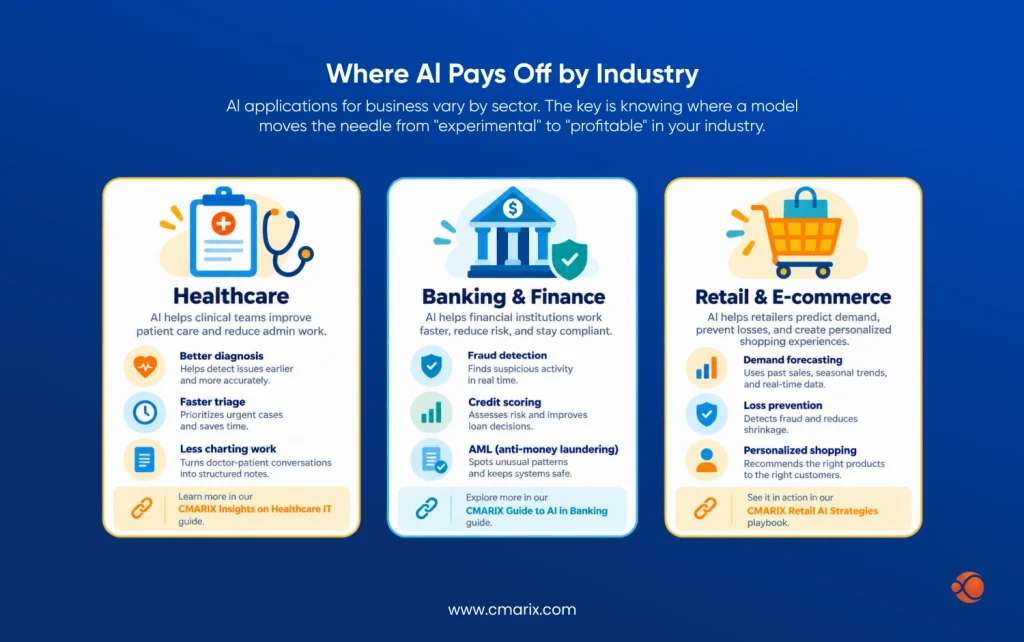
AI applications for business vary drastically by sector. The key is knowing exactly where a model moves the needle from “experimental” to “profitable” in your specific industry:
- Healthcare: Clinical teams deploy AI primarily to supercharge patient diagnosis, speed up triage, and take over dense charting duties. For example, ambient listening tools can automatically convert a routine doctor-patient visit into a structured, formatted EHR note. Early adopters are shifting away from standalone tools toward native, integrated clinical decision support systems, as CMARIX insights on Healthcare IT architecture show, linking clinical workflows directly to predictive analytics.
- Banking & Finance: Financial institutions use AI for high-velocity fraud detection, credit scoring, and anti-money laundering (AML) routines. Because explainability is a legal mandate in finance, these models must provide a clear audit trail explaining why a loan was denied or a transaction flagged. You can explore how deep risk controls and real-time transaction tracking are built into modern banking infrastructure in the CMARIX guide to AI in banking.
- Retail & E-commerce: In retail, AI helps businesses predict demand, prevent losses, and offer more personalized shopping experiences. Machine learning analyzes past sales, seasonal trends, and real-time checkout data to predict demand and keep stock levels in line with customer needs. This helps retailers reduce stockouts and manage inventory across multiple channels. To see this in practice, check out the CMARIX retail AI strategies playbook, which covers everything from handling messy, multi-channel inventories to deploying intelligent visual search.
Still unsure where to start? Our breakdown of the top AI business ideas helps you rank use cases based on market demand and execution complexity. Once you pick a winner, our step-by-step roadmap for AI in digital transformation will take your project from an initial prototype to a full production launch.
Why Build Your AI Ecosystem with CMARIX
We have delivered 230+ projects through our machine learning app development services. A team of 30+ ML engineers backs them. That experience shapes how we scope an AI ecosystem. We start with your goals, urgency, and data, then match the architecture to them.
| What you need | How we help |
| Model selection | We test supervised, unsupervised, reinforcement and deep learning options against your data |
| Ecosystem mapping | We chart your layers, gaps and integration points before build starts |
| Custom solutions | We build for your sector, from customer service automation to medical diagnosis support |
| Integration | We connect models to your existing systems and workflows |
| Ongoing support | We monitor drift, retrain models and update pipelines |
| Cost control | We size compute to the workload so budgets stay predictable |
Our LLM development services deploy fine-tuned and foundation models into web, mobile, SaaS, and enterprise apps through secure APIs.
Conclusion
An AI ecosystem works when its base is sound. That means clean data, a well-suited model, and scalable infrastructure. Every method has trade-offs. Decision trees are easy to explain, while deep networks solve harder problems. The data behind them decides the quality of both. Pair that data with the right team, and the system keeps improving as your business grows. If you want a bespoke plan, request a bespoke AI ecosystem roadmap from our AI software development team today.
FAQs About Enterprise AI Ecosystem
What is a corporate AI ecosystem and how does it function?
It’s the entire backend web of data, computing power, models, tools, and rules a business puts together to make AI work. Think of orchestration as the traffic cop routing data to your apps, while governance oversees the whole pipeline to keep you compliant and prevent rule-breaking.
What does the term “AI ecosystem” mean in enterprise tech stacks?
In your tech stack, the AI ecosystem is the engine that turns messy, stored data into real-time predictions or automated tasks. It doesn’t replace your CRM, ERP, or cloud services; it sits alongside them and hooks in via APIs to make your existing software smarter.
What are the core architectural pillars of a generative AI ecosystem?
Six main pillars hold the house up: data, compute, models, orchestration, applications, and governance. When you upgrade to a generative AI ecosystem, you are essentially stacking heavy-duty foundation models, retrieval layers like vector databases, and autonomous agent frameworks on top of that same foundation.
How do raw data processing layers connect within modern AI ecosystems?
Ingestion tools scoop up raw data, then cleaning and labeling pipelines scrub it clean, so it is ready for use. From there, a feature store or vector index feeds that prepped data into your models, while orchestration tools schedule every handoff and log the full chain of changes so nothing gets lost.
What strategies differentiate standard architectures from an advanced enterprise intelligence ecosystem?
Standard setups are clunky; they trap data in isolated silos and lock a single model to one app. An advanced enterprise intelligence ecosystem breaks those walls down by using a shared, governed data layer, managing all models in a versioned registry, and actively tracking cost spikes, model drift, and bias.
How can technical leads scale complex AI data ecosystem management processes safely?
The safest bet is to automate data lineage tracking, enforce access control for every data asset, add automated quality checks at every stage, escalate issues as you scale iteratively, and test rollback plans before launching anything new.
What operational features define a custom-orchestrated super.ai technical ecosystem infrastructure?
Key highlights include human-in-the-loop review queues and smart confidence thresholds that automatically flag and route tasks to human review as soon as the AI gets confused. You also want full audit logs that track everything and flexible connectors that easily connect to your data sources.
How do commercial data orchestration frameworks protect records against leaks?
They lock things down with end-to-end encryption at rest and in transit, enforce strict role-based access, mask sensitive fields, and log every user interaction. The system will immediately sound the alarm if a pipeline tries to touch data outside its approved sandbox.
What core procurement metrics dominate when selecting scalable business automation platforms?
Focus on integration depth, actual cost per inference, strict data residency compliance, audit-logging capabilities, vendor lock-in risk, and support terms. Always run a messy pilot using your own real-world data before signing a massive, multi-year contract.
How should a company structure its machine learning infrastructure stack for maximum efficiency?
The golden rule is to keep training, serving, and monitoring completely separate. Use elastic, on-demand GPU capacity to handle random training spikes, rely on steady, low-latency instances for day-to-day serving, set up immediate drift alerts on live models, and track your cost per prediction from day one.