

Quick Summary: AI due diligence is a structured review of an AI system’s models, data, code, security, legal standing, and delivery team before you build, buy, or back it. This guide explains an eight-step process, shows what to inspect inside an ML pipeline, and explains where AI due diligence software can speed up the work. Also, it covers investment and legal, cost drivers, red flags, and the mistakes that sink deals. Use it as a working checklist whether you are a CTO, a founder, or an investor.
Everyone is racing to ship AI features, build AI products, or fund AI companies. Boards want results this quarter. Vendors show demos or AI usage with impressive accuracy numbers. So deals close fast, and the checking happens later, if it happens at all.
AI risk doesn’t stay in one place. It hides in training data nobody had the rights to, in models that drift after launch, in open source components with wrong license, and in access controls that were never set up. A normal technical review misses most of it. To fix this, AI due diligence closes the gap, and it is what the rest of this guide is about.
AI due diligence is a review done before you build, buy, or invest, covering an AI system’s data rights, model performance, code and IP ownership, security, regulatory fit, and team. The process essentially answers three key questions: Does it work? Do we own it? And can we operate it?
What Is AI Due Diligence?
AI due diligence is the process of verifying that an AI system, product, or company is technically sound, legally clean, secure, and worth the money. It looks at the data that trained the model, how the model was built and tested, who owns the code and the IP, how the system is governed, and whether the team can keep it running once the deal is signed.
The term gets used two ways, and both matter here.
- Due diligence on AI- Reviewing an AI product, model, or technology firm before you buy, build, partner, or invest.
- AI powered due diligence- Using AI tools to review contracts, filings, and codebases faster during any deal.
Most of this guide covers the first meaning. A full section near the end covers the second.
How AI Due Diligence Differs From Traditional Software Due Diligence
Traditional reviews focus on code, infrastructure, and contracts. AI systems add two moving parts: data and models. Performance can fall without a single line of code changing, and ownership questions reach back to the datasets used for training.
| Area | Traditional software due diligence | AI due diligence |
| Core asset | Code and infrastructure | Data, models, and code together |
| Performance over time | Stable until the code changes | Can degrade as real world data shifts |
| Ownership questions | Code licenses and contracts | Training data rights, model weights, third party APIs |
| Testing | Functional and load tests | Bias, accuracy, drift, and adversarial testing |
| Regulation | GDPR, SOC 2, industry rules | All of those plus AI specific rules such as the EU AI Act |
| Explainability | Rarely required | Often required for audits and regulated use |
When You Need It
Run AI due diligence before you commit budget to an in-house build, before you sign with an AI development vendor, before you acquire an AI product or company, and before you invest in one. A good review also mirrors the way AI products actually get made, so it helps to know the AI software development process your team or vendor follows. Each stage, from data collection to deployment, is a place where something can quietly go wrong.
Why AI Due Diligence Matters in Software Projects and Deals
The risks are not theoretical. IBM’s 2025 Cost of a Data Breach Report studied 600 organizations and found that 13% had breaches involving their AI models or applications, and 97% of those lacked proper AI access controls. The same report found that heavy use of unsanctioned shadow AI added roughly $670,000 to the average breach cost. In short, AI adoption is running ahead of AI oversight.
Regulation adds pressure. Under the EU AI Act, fines reach up to 35 million euros or 7% of global annual turnover, whichever is higher, for prohibited practices, and up to 15 million euros or 3% for breaches of most other obligations, including high-risk requirements. Regulation (EU) 2026/1744, the Digital Omnibus on AI, entered into force on 27 July 2026 and moved the start date for stand-alone high-risk obligations to 2 December 2027. The penalty tiers did not change. Waiting is not a compliance plan.
This is why mature teams treat machine learning governance as part of the deal itself, not an afterthought. A review should surface six kinds of risk.
- Data risk- Training data with unclear consent, licensing, or privacy exposure.
- IP risk- Not clear ownership of code, models, or outputs, plus open source license conflicts.
- Model risk- Bias, weak accuracy outside the demo, and drift after launch.
- Security risk- Prompt injection, data leakage, model theft, and weak access control.
- Compliance risk- Gaps against the EU AI Act, GDPR, HIPAA, or sector rules.
- Cost risk- Inference and retraining bills that grow faster than revenue.
Get an independent review of your AI product before you sign anything.
How to Conduct AI Due Diligence in 8 Steps
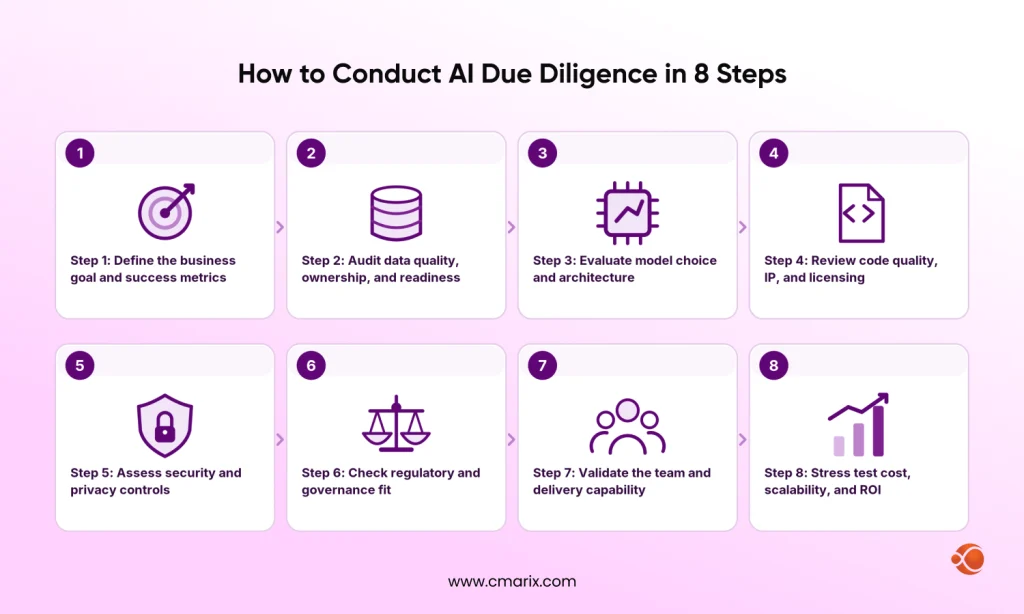
The steps below work for a buyer, a builder, or an investor. Run them in order, because each one feeds the next.
Step 1: Define the business goal and success metrics
Start off by asking yourself a question that all reviews hinge on. What is it supposed to do, and what will determine its success? Vague goals produce vague reviews. Write down the target outcome, the metric that proves it, and the number that counts as failure. Typical examples include fraud detection recall, support ticket deflection rate, and document review accuracy.
Then ask for the vendor’s or team’s own results and how they were measured. Accuracy on a clean test set means little if production data looks different. Ask what the test data was drawn from and when it was last refreshed.
- Business Objective- A sentence that states what problem the AI will solve.
- Success Metrics- Measurable objectives and a minimum requirement.
- Baseline- Current performance levels before implementing AI to ensure that the improvement is genuine and not presumed.
Step 2: Audit data quality, ownership, and readiness
Data is the most important resource, yet it is often overlooked. Identify the source of the training data and its ownership, along with the consent or license to use it. Scraped content, customer data used beyond its original purpose, and third-party datasets with restrictive terms are the usual trouble spots.
Then look at quality. Incomplete records, sloppy labels, duplicates, and skewed samples all show up later as wrong predictions.
- Provenance- Where each dataset came from and the paperwork that proves it.
- Consent and licensing- The completeness of the dataset, label accuracy, and presence of bias among users.
- Quality and labeling- Completeness, label accuracy, and bias across user groups.
- Privacy handling- How personal data is masked, stored, and deleted on request.
Step 3: Evaluate model choice and architecture
Check whether the team chose the appropriate solution. The team may choose either custom training, fine-tuning an open-source model, or using an external API. Every choice will come with its own risks: reliance on APIs leads to vendor lock-in, pricing risks, and migration of data out of the team’s environment. Custom training brings high compute costs and a need for scarce talent. A structured build vs buy AI software evaluation helps compare these paths on cost, control, and speed.
Secondly, analyze the process of serving the model, its versioning, monitoring, and rollback procedures. Request to see the model cards, experiment tracking, and training logs. Otherwise, reproducing the results becomes impossible.
Step 4: Review code quality, IP, and licensing
Consider the code from the perspective of a buyer rather than a supporter. It’s important to consider test coverage, technical debt, and dependencies. Check ownership. Intellectual property needs to be assigned for contractor agreements; for open source, on the other hand, a suitable license needs to be assigned to each of them.
Many teams now write code with assistants, so ask which tools touched the codebase, what their terms say about ownership, and whether a human reviewed the output. Our guide to AI tools for software development covers the tools your vendor may be using. A list of tools is fine. An unreviewed commit history is not.
Step 5: Assess security and privacy controls
AI systems face familiar software security threats as well as AI-specific risks, including prompt injection, training data poisoning, and attempts to extract sensitive information from models. There could be prompt injection attacks making the AI system give out data or break its own policy rules. The training dataset could be poisoned in order to skew results. Weak access control makes the AI system and dataset vulnerable to attack.
Request reports on penetration tests conducted recently, SOC 2 or ISO 27001, and any incidents in the past two years. Know the measures in place to keep secrets safe, who can access the model and whether prompts and outputs are well logged.
Step 6: Check regulatory and governance fit
Align the system with relevant regulations, most often the risk level under the EU AI Act, HIPAA, GDPR, and industry-specific regulations. The voluntary frameworks include NIST AI RMF (Risk Management Framework) and ISO/IEC 42001. Underlying governance issues include model risk ownership, change-approval processes, incident-response plans, and auditability.
Companies rarely manage this in spreadsheets for long. Dedicated enterprise AI governance tools track model inventories, approvals, and evidence in one place, and their presence is a good sign during a review.
Step 7: Validate the team and delivery capability
Even a well-performing model can lose its value without a team capable of maintaining, monitoring, and improving it after deployment. Consider the level of expertise that resides within one or two people, because key-person risk is a common concern in specialist teams. Ask for references and evidence of launches into production, not just pilots.
Get a demo of the solution on your own data. Further, understand the support terms and downtime policies in case the vendor goes out of business.
Step 8: Stress test cost, scalability, and ROI
Inference costs scale with usage, and a business case that works at demo volume can look very different at production volume. Ask for cost per 1000 requests today and at 10 times the load. Consider retraining, monitoring, cloud, and staffing, then project total cost of ownership over 3 years. For deeper insight into budget estimation, see below for details about AI product development cost.
Finish with three scenarios: best, expected, and worst case. If the deal only works in the best case, you have your answer.
Machine Learning Due Diligence: What to Inspect Inside the Pipeline
Machine learning due diligence goes one level deeper than a general AI review. It checks how the model was actually trained and whether the results hold up.
- Deep learning training pathways: Reviewers analyze the split of data into validation, training, and testing, as well as the potential leakage between them. Reviewers examine the hyperparameter tuning process, random seed management, checkpointing, and computing logs. The best way to validate the experiment is to ask the researchers to replicate one of their most impressive results from scratch.
- Third-party and open-source components: Request a software bill of materials covering libraries, frameworks, and pretrained weights. Scan licenses, pin versions, and check for known vulnerabilities. Sometimes pretrained models carry restrictions on commercial use, and it’s easy to miss them. If your team lacks in-house reviewers, a partner offering machine learning development experience can run this audit.
- Data flags in document processing systems: AI tools that read contracts, filings, and records need their own checks. Look for personal data leaking into logs, made-up citations, weak document-level permissions, missing audit trails, and any chance that one client’s files surface in another client’s results.
AI Due Diligence Checklist by Area
| Area | What to check | Red flags | Owner |
| Data | Source, consent, labeling, bias | No provenance records, scraped data with unclear rights | Data lead, legal |
| Model | Training method, test results, drift monitoring | Only Demo metrics, no version history | ML lead |
| Code and IP | Ownership, open source licenses, AI generated code | Missing IP assignments, copyleft in core code | Engineering, legal |
| Security | Access control, pen tests, prompt injection defenses | No AI access controls, no logging | Security lead |
| Compliance | Risk tier, GDPR, sector rules, audit trail | No named owner for AI risk | Compliance, legal |
| Team | Skills, key person risk, delivery record | Knowledge held by one person | CTO, HR |
| Cost | Inference cost, retraining, three-year TCO | Costs unknown at scale | Finance, CTO |
AI Due Diligence on AI Technology Firms: Investment and Legal View
Buying or backing an AI company brings its own set of problems. Due diligence on AI technology firms has to separate real technical advantage from a good demo.
- Hard to verify performance- Valuations lean on model claims that outsiders cannot easily test.
- Thin moats- Many firms build on the same underlying models, so check what the firm owns that others cannot copy, such as proprietary data or deep workflow integration.
- Provider dependence- Some AI companies rely on a single foundation model provider. Ask what happens if prices rise or terms change.
- Revenue quality- Look at customer concentration and gross margin after inference costs, not before.
Building an AI Legal Due Diligence Framework
A strong legal framework for AI due diligence follows a clear, chronological process. First, create an inventory of all your AI systems. You should map these systems against their relevant jurisdictions and risk categories. Review the licensing of your training data, IP rights assignments, open-source compliance, and contracts with the model provider. Look at liability provisions, indemnity clauses, and ongoing or threatened litigation cases.
Operational Metrics for AI Investment Due Diligence
AI investment due diligence should include numbers that a standard financial review never asks for.
- Production vs benchmark performance- The gap between lab results and live results.
- Drift and retraining cadence- How often accuracy slips and how fast the team responds.
- Inference cost per transaction- What makes up the margin economics.
- Uptime and incident count- Reliability over the past 12 months.
Using AI for Due Diligence: Software, Automation, and Compliance Tools
The term can also be used in a more pragmatic way. AI tools can process large amounts of text and code faster than any person can read, and current offerings include legal, financial, and technical due diligence services. Used appropriately, they accelerate the process. Used improperly, they bring risks.
What to Look for in AI Due Diligence Software
| Feature | Why it matters | Question to ask the vendor |
| Document ingestion and classification | Handles mixed files in a data room | Which formats and languages are supported? |
| Clause and risk extraction | Surfaces issues for human review | How is accuracy measured on legal text? |
| Source citations and audit trail | Lets reviewers verify every finding | Can each result link back to the page? |
| Access control and data residency | Protects sensitive deal material | Where is data stored and who can see it? |
| Data room and repository integrations | Cuts manual uploads | Which platforms connect out of the box? |
| Human review workflow | Keeps accountability with people | How are overrides and sign-offs recorded? |
Due Diligence Automation Tools and IP Protection
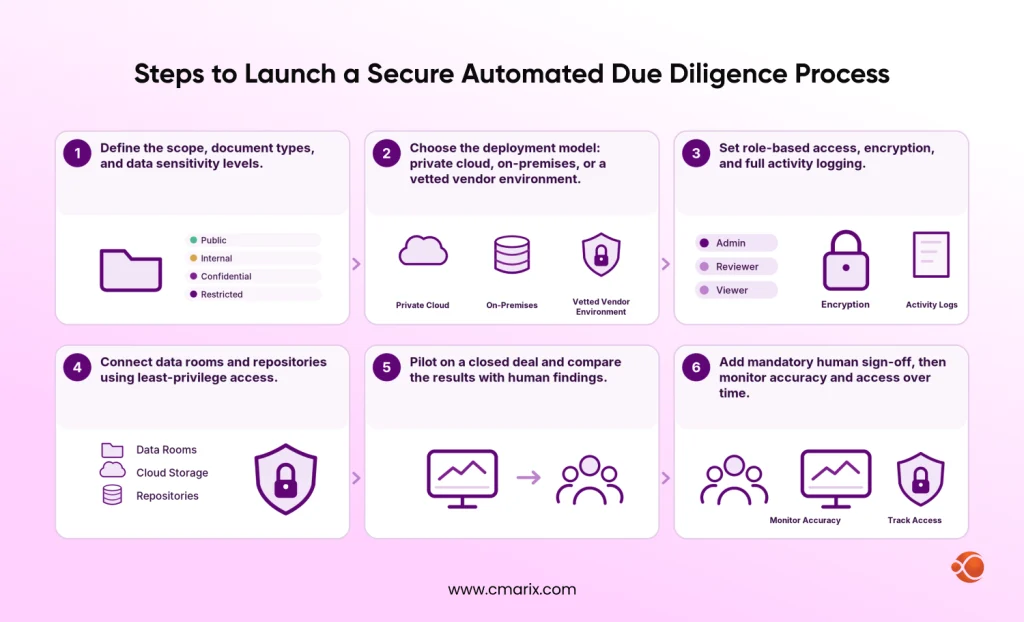
Codebase review is where proprietary IP exposure is most sensitive. The safest setups keep code inside your own environment. That means private cloud or on-premises deployment, contractual terms that bar the vendor from training on your data, and tools that analyze code locally and send out only findings, not source. Redact secrets and client names before any file leaves your network.
AI Compliance Software and Tools
AI compliance software can help you understand where each model lives, map that system to relevant rules, and identify areas of non-compliance. An ideal AI compliance solution produces audit evidence on request, so you don’t have to rebuild records the week a regulator asks. Organizations can also use AI for regulatory compliance in other ways, such as tracking policy updates and auditing documents against controls. AI for regulatory compliance tends to function better with a specific human responsible party.
AI Due Diligence by Scenario
The depth and focus change with your role in the deal.
| Scenario | Main goal | Focus areas | Typical depth |
| Building in-house | Avoid wasted budget | Data readiness, team skills, cost at scale | Light to standard |
| Hiring a vendor | Pick a partner you can trust | Delivery record, IP terms, security, references | Standard |
| Acquiring an AI product or company | Confirm value and limit liability | Data rights, IP, model performance, legal exposure | Deep |
| Investor review | Test the growth story | Moat, unit economics, revenue quality, regulation | Standard to deep |
The product context will alter the checklist as well. AI functionality embedded in a mobile product has implications for device, privacy, and app store issues, as discussed under AI in app development.
Web products will focus on API exposure, browser-side risks, and scaling with traffic, as discussed in the context of AI in web development. Organizations without an internal review process will involve a partner in AI application development and the review process to ensure decision-makers receive information on time.
How Much Does AI Due Diligence Cost, and How Long Does It Take?
Disclaimer: The numbers are indicative estimates depending on scope and do not constitute fixed quotations. Actual cost and time depend on the number of models, amount of data, regulated industry, codebase size, and how quickly the other side provides access to data.
| Review scope | Best for | Typical timeline | Indicative cost (USD) |
| Rapid review | Vendor shortlisting, early stage checks | 1 to 2 weeks | 5,000 to 15,000 |
| Standard technical and legal review | Vendor selection, mid-size deals | 3 to 6 weeks | 15,000 to 40,000 |
| Deep dive | Acquisitions, regulated industries | 6 to 10 weeks | 40,000 to 100,000+ |
Share the systems involved, the decision date, and the access you will get, and a provider can confirm the scope, timeline, and price.
Red Flags and Common Mistakes in AI Due Diligence
Some signals should slow a deal down right away.
Red flags
- The team cannot explain where the training data came from.
- Accuracy claims come from demos, not production data.
- No model versioning, monitoring, or rollback plan exists.
- Nobody owns AI governance or risk.
- The pretrained model’s license is unknown.
- The product depends on one API with no fallback.
- The seller refuses an independent test on your data.
Common mistakes
- Treating the review as a single-time event instead of a repeat check after launch.
- Coding review without considering the model’s data and behavior.
- Accepting vendor self-assessments without proof.
- Skipping a proof of concept. A short pilot on your own data, such as one delivered through AI PoC development services, tests claims before you commit the full budget.
Speak with our AI team about reviewing your next project.
Why Choose CMARIX for AI Due Diligence
A review is only as good as the people running it, and the strongest reviewers have built and shipped AI systems themselves. CMARIX operates from that position: an AI software development company that builds AI products and assesses them.
- Before you commit, our engineers can walk through all eight steps in this document regarding data readiness, model structure, code ownership, and security. Decision makers will receive concrete conclusions instead of papers.
- While you test, when a vendor claim needs proof, we can run a proof of concept on your data and compare the results with what was promised.
- After you decide, if the answer is to build, the engineers who flagged the risks can design the system around them.
Conclusion
AI due diligence helps businesses make informed decisions before investing in, acquiring, or building AI solutions. It reveals potential issues with data rights, IP ownership, model performance, security, compliance, and long-term costs before they become expensive problems.
For decision-makers, the goal is simple: verify the claims, understand the risks, and confirm the business case before committing. If gaps emerge, address them through remediation, revised deal terms, or a proof of concept. A thorough review before signing can save time, reduce financial risk, and give your AI investment a stronger foundation.
FAQs onAI Due Diligence
What is AI due diligence and why is it critical during corporate transactions?
AI due diligence is a structured review of an AI system’s data, code, models, security, legal standing, and team. In a corporate transaction, it protects the buyer or investor from paying for assets that are legally unclear, technically weak, or expensive to run. It also shapes price, deal terms, and post-deal plans.
How does machine learning due diligence evaluate deep learning training pathways?
Reviewers will review the methods of splitting the data, any test data leakage into training, and hyperparameter settings. Experiment log files, checkpoints, and computational details will be examined. Reproducibility will be assessed in that the team will be able to reproduce a core finding using the documentation.
What are the unique challenges when performing due diligence on AI technology firms?
Performance claims cannot be verified externally, and moats may be narrow because models are increasingly becoming similar. Most companies also rely on one foundation model vendor, and their data assets have questionable usage rights. The quality of revenue is a key factor because of high inference costs.
How do software engineers audit third-party open-source code components inside model pipelines?
They start with the software bill of materials, where they list all the libraries and pre-trained models that they are using. Next, automated scans are done to look for licensing issues and vulnerabilities. They also version their dependencies and review their usage.
What specific data flags should cross-functional teams inspect within AI for due diligence documents systems?
Look for personal data appearing in logs, made-up citations in outputs, and weak document-level permissions. Check that audit trails exist and that one client’s files cannot surface in another client’s results. Also, review retention and deletion rules for uploaded documents.
How can an organization establish a legally sound AI legal due diligence framework?
Create a list of all the AI tools used by the organization, correlate each with relevant legislation and risk classification, and verify training data licensing, contracts and intellectual property agreements. Analyze liabilities and possible litigation. Finally, make conclusions and propose solutions that will be reflected in the transaction structure.
What operational metrics separate a standard review from AI-powered due diligence services?
The standard review process, it depends on financial numbers and records. However, AI-driven services take into account additional metrics like performance accuracy relative to benchmarking, drift rate, retraining frequency, cost per inference and review duration, along with how frequently human experts overturn AI results.
How do corporate firms analyze codebases using due diligence automation tools without exposing proprietary IP?
They execute the tools within their own infrastructure, such as private clouds or on-premise. Contractually, they prevent vendors from training on client data, and they mask sensitive information before execution. Most tools send the result sets alone.
What core features should an investment team look for in enterprise AI due diligence software?
The focus on ingestion capabilities of documents in multiple formats, extraction of clauses and risks, along with citations that trace back to the initial page, is important. The inclusion of access control, data residency, integration with data rooms, and a human review process with sign-off is also needed.
What are the mandatory integration steps to launch a fully secure automated due diligence process pipeline?
First, define the scope of the project and the degree of confidentiality of information to be shared. Secondly, define the deployment model and access levels. Thirdly, establish a connection between data rooms and repositories with least-privilege access and then run a pilot test on a closed deal, comparing results with human due diligence.