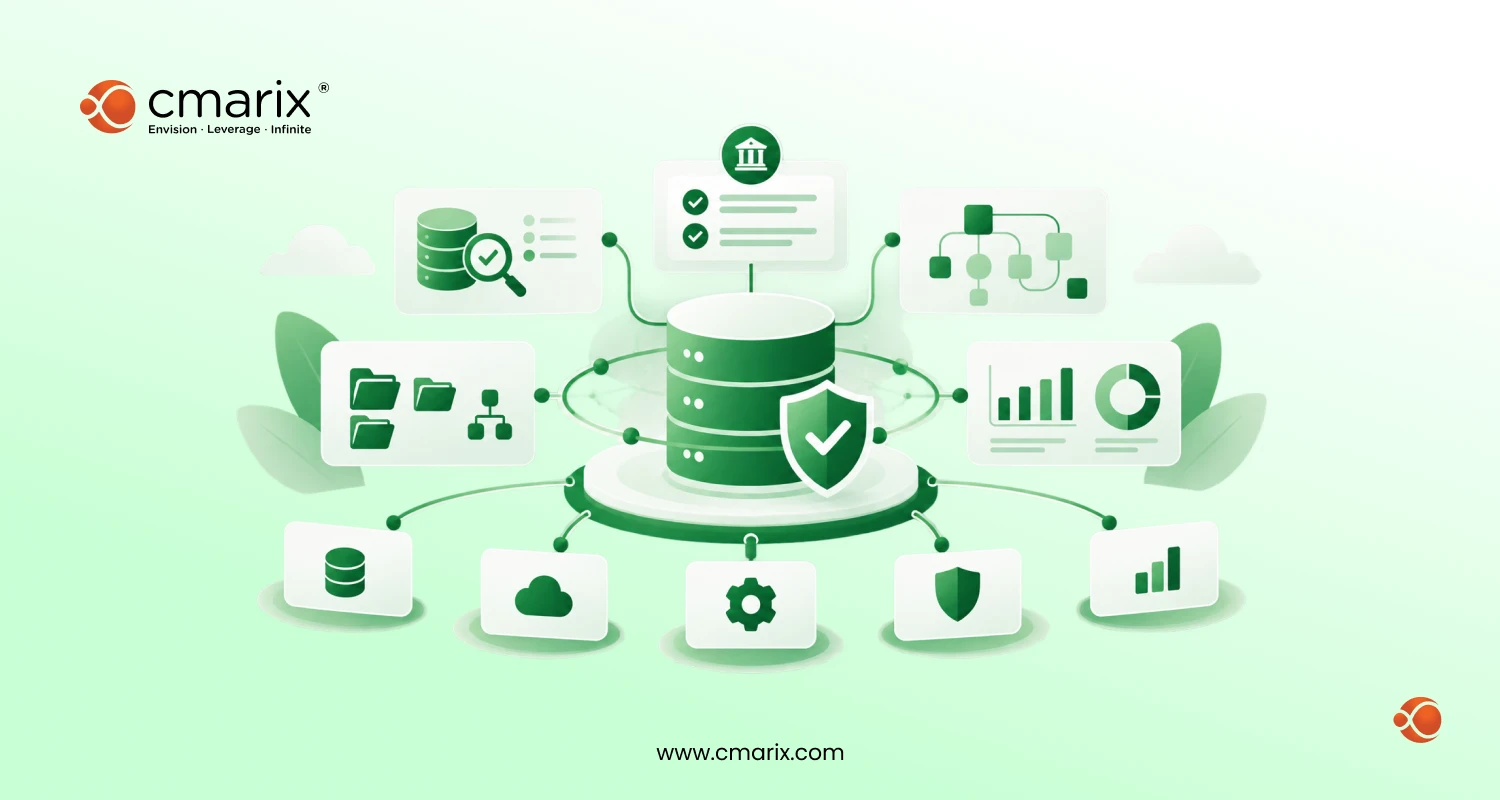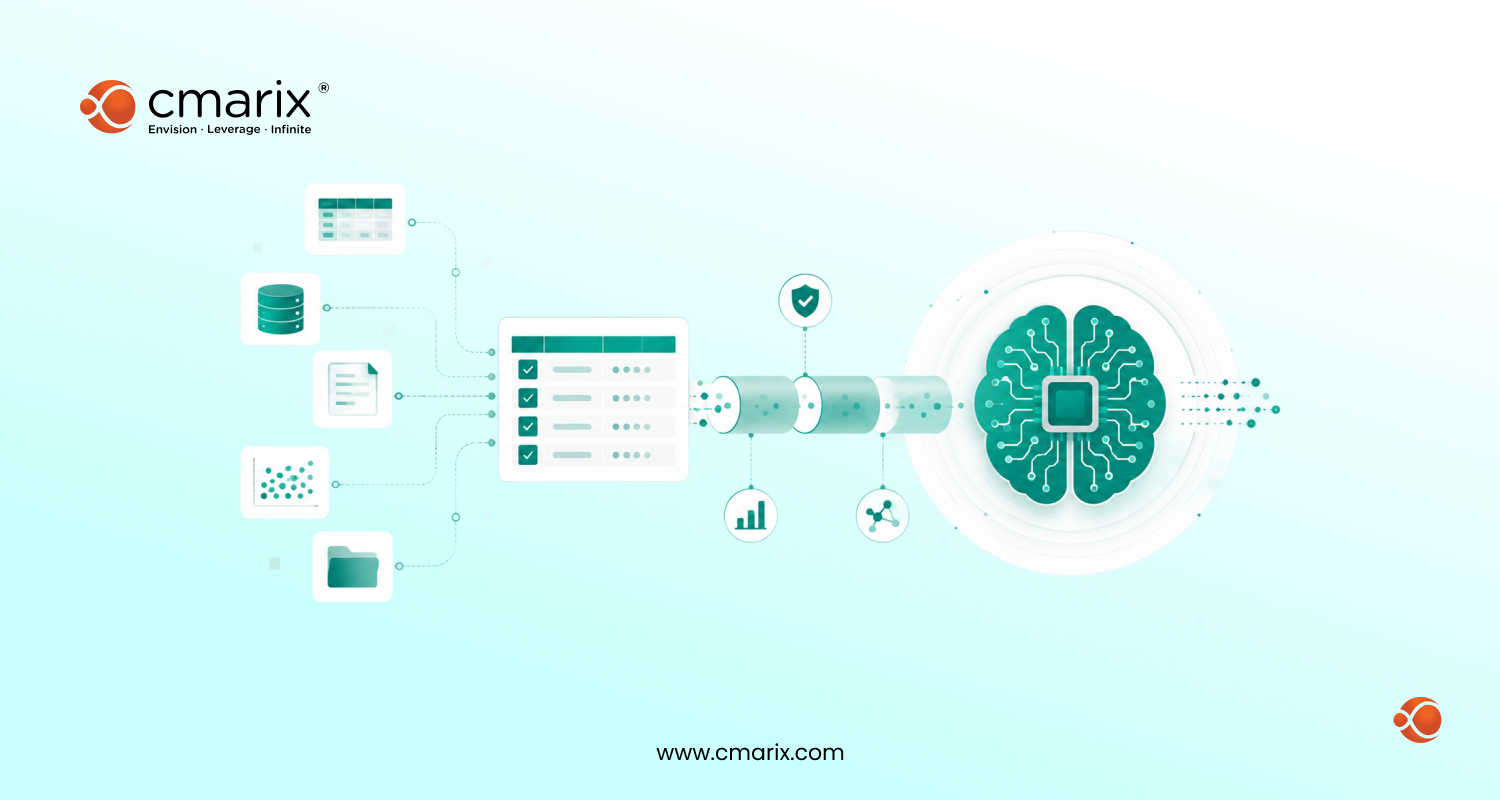





Quick Summary: Data mesh and data fabric fix the same headache: data scattered across too many systems for anyone to trust or use quickly. They go about it in opposite ways. A data fabric connects your data through a smart technology layer, while a data mesh hands data ownership to the teams who know it best. This guide explains both in plain terms, compares them side by side, and helps you pick the right fit (or a mix of the two) for 2027.
Every company has enough data to use well. Product data lives in the warehouse, sales data lives in the CRM, finance data lives in spreadsheets, and logs live in the lake no one trusts. Toss in some machine learning or AI efforts that require access to clean and connected data at any time, and the old approach of copying everything into one repository just won’t cut it.
The global data fabric market size was valued at USD 3.37 billion in 2025 and is projected to be worth reaching USD 16.46 billion by 2034, with a CAGR of 21.90% during the forecast period.
That’s where the data mesh vs data fabric debate comes in. Both solutions have many similarities, and both aim to make accessing data faster and easier, increase governance, and eliminate bottlenecks. The difference is that while one solution (Data fabric) is predominantly technological, the other (Data mesh) is primarily organizational. Getting this part wrong means wasting a year or two on implementation.
Who Should Read This Data Mesh vs Data Fabric Guide?
This guide is for CTOs, heads of data, enterprise architects, and product leaders who already know their current setup is slowing them down and now need to decide where to invest. If you want a plain answer to which approach suits your business, you’re in the right place.
What Is Data Fabric? Architecture and Core Components
A data fabric is an architecture that connects data across all your systems, whether they sit in the cloud, on-premises, or both, and provides people with one consistent way to find and use it. The data mostly stays where it is. The fabric sits on top, like a smart layer that knows what data exists, where it lives, who can touch it, and how it relates to everything else.
The term has been around for about a decade, and it picked up serious momentum as companies ended up with data spread across multiple clouds and legacy systems.
How Does a Data Fabric Work?
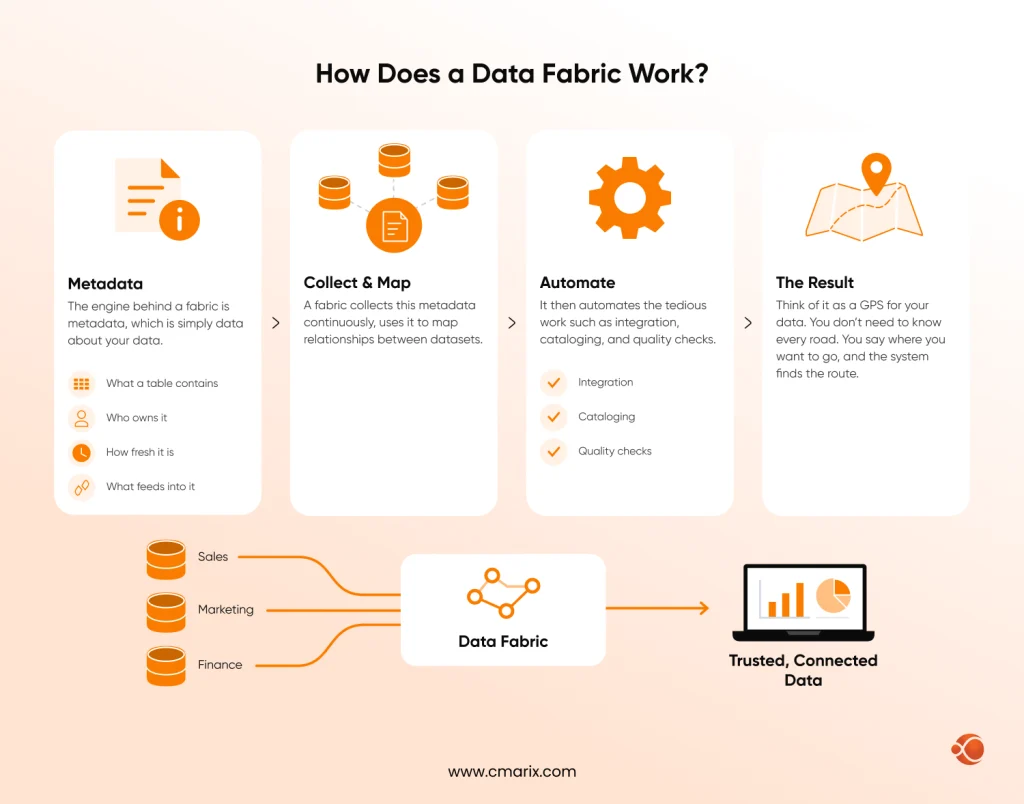
The engine behind a fabric is metadata, which is simply data about your data: what a table contains, who owns it, how fresh it is, and what feeds into it. A fabric collects this metadata continuously, uses it to map relationships between datasets, and then automates the tedious work such as integration, cataloging, and quality checks.
Think of it as a GPS for your data. You don’t need to know every road. You say where you want to go, and the system finds the route.
Core Components of a Data Fabric Architecture
- Data catalog – A searchable inventory of every dataset, with owners, definitions, and usage history.
- Active metadata layer – Metadata that updates itself in real time and triggers actions, such as flagging a broken pipeline.
- Knowledge graph – A map of how data, systems, and business concepts connect, so the fabric can recommend relevant data.
- Integration and virtualization layer – The plumbing that allows users to query data in place or move it only when needed.
- Governance and security controls – Central policies for access, privacy, and compliance applied across every source.
Best Use Cases for Data Fabric
Data fabric shines when you have a messy mix of systems and a need to unify access quickly without reorganizing your company. Banks with legacy platforms, healthcare groups juggling many sources, and enterprises midway through a cloud migration are common examples.
What Is Data Mesh? Framework, Principles, and Data Products
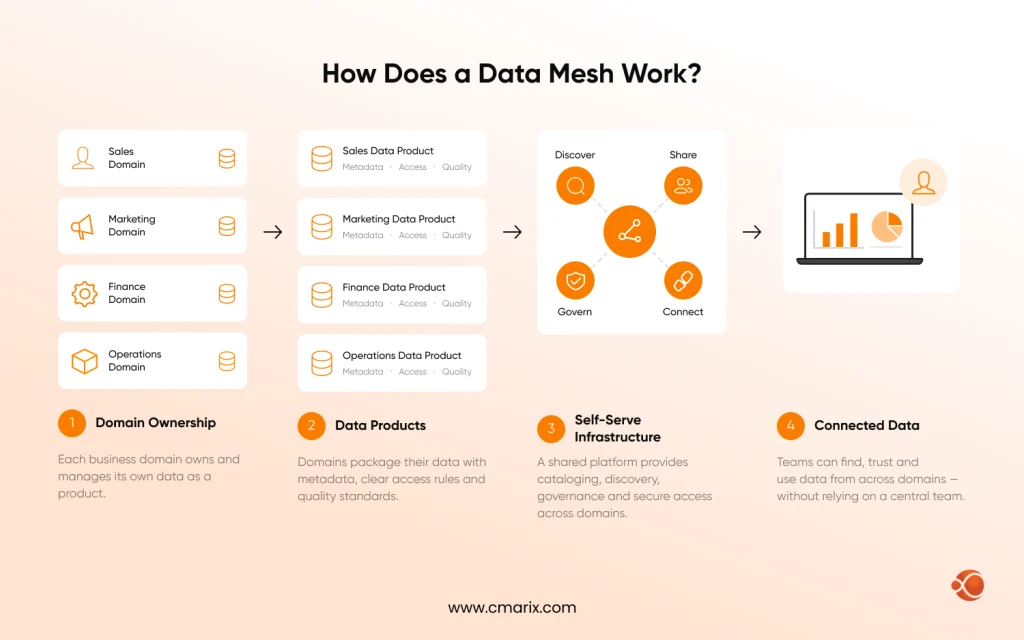
Data mesh is a way to organize people, ownership, and architecture so business teams closest to the data manage it, rather than one central data team. Zhamak Dehghani introduced the idea at ThoughtWorks in 2019, in response to central data teams becoming the bottleneck for every analytics request.
What this really means is that data mesh is less a product you buy and more an operating model you adopt. Technology supports it, but the heavy lifting is organizational.
Data Mesh Framework: The 4 Core Principles
- Domain ownership – Teams such as sales, logistics, or finance own, maintain, and answer for their own data, since they understand it best.
- Data as a product – Each dataset is treated like a product with a clear owner, documentation, quality standards, and defined users.
- Self-serve data platform – A shared platform gives every domain the tools to publish and manage data products without waiting on a central team.
- Federated governance – Global rules for security, privacy, and interoperability are set centrally, but enforced automatically inside each domain.
What Are Data Mesh Products? A Simple Example
Consider this example: There is a customer order dataset which belongs to the sales department. It has a specific owner, an easily readable description, an automatic data validation process, a way of accessing it either through an API or a SQL view, and a freshness promise as well. Other departments are able to find this dataset, trust its quality, and utilize it for their tasks without raising a request to the central team. This is a data product. Enough of these will make a mesh. For a deeper dive into how this is built technically, see our guide on Data Mesh Architecture.
Key Data Mesh Benefits
- Faster delivery – Domain teams ship data products without queuing behind a central backlog.
- Better data quality – The people who understand the data are accountable for it.
- Scales with the company – New domains plug in without redesigning a central platform.
- Clearer accountability – Every dataset has an owner, which cuts the finger-pointing when numbers look wrong.
Best Use Cases for Data Mesh
Data mesh works for big corporations where there are multiple business units, skilled engineers within each business unit, and a central data team that has now become a bottleneck. Data mesh doesn’t work well for small corporations with a limited number of data users.
Share your goals and we’ll shape a practical, phased data strategy.
Difference Between Data Mesh and Data Fabric: Side-by-Side Comparison
These two are often compared as if they were rivals, but they answer different questions. Fabric asks how we connect our data with technology. Mesh asks who should own our data and how we organize around it.
| Factor | Data Fabric | Data Mesh |
| Core idea | A connected, automated layer across all data sources | Decentralized ownership of data by business domains |
| Main focus | Technology and automation | People, process, and ownership |
| Ownership | Usually central data or IT team | Individual domain teams |
| Architecture | Centralized access layer over distributed data | Distributed data products on a shared platform |
| Governance | Centrally defined and applied through metadata | Federated: global rules, local enforcement |
| Role of metadata | The foundation of the whole design | Important, but not the driving force |
| Organizational change | Low to moderate | High |
| Best suited for | Complex hybrid and legacy environments | Large, domain-driven enterprises |
| Speed to first value | Faster, since no restructuring is needed | Slower, since culture and roles must shift |
If you remember one line, make it this one: Data fabric primarily changes how data is connected, discovered, integrated, and governed. Data mesh primarily changes how data ownership and accountability are organized.
Where Data Mesh and Data Fabric Overlap?
Despite the differences, they share goals: easier data discovery, stronger governance, less duplication, and data that is ready for analytics and AI. Both lean on good metadata, both need clear data ownership at some level, and both try to stop data from becoming a pile of disconnected silos.
Can You Combine Data Fabric and Data Mesh?
TYes. Data fabric and data mesh can work together when an organization wants domain-level data ownership without giving up centralized data discovery, governance, and access. In this model, each domain owns its data products through the data mesh, while the data fabric provides the metadata, catalog, integration, and governance capabilities that support a self-service data platform.
The mesh defines who owns the data and is responsible for it. The fabric defines how that data is connected, discovered, accessed, and governed. This combination can be useful for large organizations with distributed data ownership and complex technology environments.
Data Mesh vs Data Fabric vs Related Concepts
Data mesh and data fabric often get confused with other data terms. Here is how each one differs from a data lake, master data management and data virtualization.
Data Lake vs Data Mesh vs Data Fabric: What Each One Does
A data lake is a storage place; it’s like a big repository for raw data. Fabric and mesh are not storage. They are ways of organizing access and ownership. A mesh often keeps various lakes and warehouses, each owned by a domain, and a fabric can sit over a lake, a warehouse, and operational databases at once.
The data mesh architecture vs data lake question is really about structure: one central pool managed by one team, versus many owned data products. If your single lake has turned into a swamp, a mesh addresses the ownership problem, and a fabric addresses the findability problem.
MDM vs Data Fabric vs Data Mesh: Where Master Data Fits
Master data management (MDM) produces one version of core entities such as customers, suppliers, and products. It is more specific than either option. For the fabric architecture, master data management normally operates as one of the services in the layer. For the mesh architecture, master data normally becomes one of the data products consumed by the domains.
Data Fabric vs Data Virtualization
Data virtualization allows you to query data from many sources without moving it. It is a capability, and a useful one. A data fabric includes virtualization but adds cataloging, knowledge graphs, automation, and governance on top. Put simply, virtualization is one tool in the fabric toolbox, not the toolbox itself.
Data Mesh or Data Fabric: Which Should You Choose?
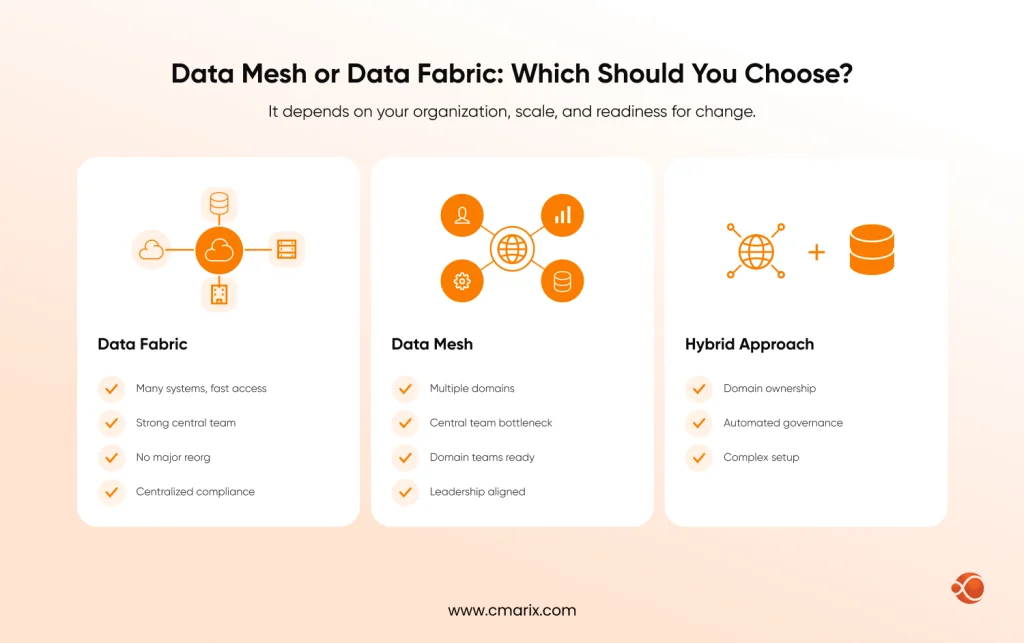
There is no one-size-fits-all answer. Your decision will depend on your organizational structure, scale, and readiness for change.
When to Choose Data Fabric
- You have many systems across cloud and on-premises, and you need unified access fast.
- Your central data team is strong, and you want to keep that model.
- You can’t afford a big reorganization right now.
- Compliance and security need consistent, centrally managed rules.
When to Choose Data Mesh
- Your company has many business domains with distinct data needs.
- A central team is the bottleneck for every request.
- Domain teams have engineers who can own data products.
- Leadership is ready to change how responsibility for data is shared.
When to Choose a Hybrid Approach
- You seek ownership of domains, but require automated governance and discovery thereof.
- You are big enough to manage your own mesh, but complicated enough to have a fabric under that.
Our architects can design a hybrid setup that fits your teams.
Data Mesh vs Data Fabric: Quick Decision Guide
| Your Situation | Better Starting Point |
| Mid-sized company, many legacy systems, strong central IT | Data fabric |
| Large enterprise, many autonomous business units | Data mesh |
| Central data team overwhelmed with requests | Data mesh |
| Strict regulatory environment, need uniform controls | Data fabric (or hybrid) |
| Low data maturity, small number of data users | Neither yet: fix the basics first |
| Large, regulated, and decentralized | Hybrid |
Data Mesh vs Data Fabric for a Customer 360 View
A Customer 360 view is a good way to feel the difference. With a data fabric, you connect the CRM, billing, support, and web analytics systems through the fabric layer, and the catalog and knowledge graph stitch the customer picture together centrally. With a data mesh, the sales, support, and marketing domains each publish a customer data product, and a team assembles the 360 view by combining them. Fabric gets you there faster with less change. Mesh gives you cleaner ownership and better scaling over time.
Data Mesh vs Data Fabric Implementation: Skills, Tools, and Cost
Team and Skill Requirements
- Data fabric- Needs strong data architects, integration engineers, and metadata specialists, usually inside a central team.
- Data mesh- Needs data engineers embedded in domains, a platform team to run the self-serve layer, and product thinking around data. This is where DataOps habits matter, and our breakdown of the Differences Between DataOps and DevOps is a useful companion read.
Data Fabric and Data Mesh Tools and Platforms
Tools change fast, so treat this as a starting point rather than a shortlist.
| Approach | Typical Tooling Categories | Examples |
| Data fabric | Integration, virtualization, active metadata, catalog | IBM Cloud Pak for Data, Informatica, Denodo, Talend |
| Data mesh | Lakehouse and warehouse platforms, query federation, streaming, catalog and governance | Databricks, Snowflake, Starburst, Confluent, Collibra, Atlan |
A note on governance: whichever route you take, you will need tooling to enforce policy. Our roundup of top enterprise data governance tools covers what to look at.
Data Mesh vs Data Fabric Cost and Effort
Cost consideration: The actual cost varies significantly depending on your data size, infrastructure, staff, and cloud vendor. Below is an illustrative first-year estimate for a medium enterprise; hence, treat it accordingly as a cost estimation range but not as a quotation.
| Factor | Data Fabric | Data Mesh |
| Approx. total cost in year one | $3.2M to $8M | $4.4M to $11M |
| Implementation services (year one) | $1.5M to $4M | $2M to $5M |
| Internal staffing (per year) | $1.2M to $2M | $1.8M to $3.5M |
| Software and tooling licenses (per year) | $500K to $2M | $600K to $2.5M |
| Reorganization and training effort | Lower | Higher |
| Time to working foundation | Shorter: about 12 to 18 months to a working foundation | Longer: about 14 to 24 months to a working foundation |
| Ongoing platform maintenance | Moderate | Moderate to high |
| Risk if rushed | Poor metadata quality | Inconsistent standards across domains |
Data Mesh Challenges and Data Fabric Pitfalls to Avoid
Data Fabric Pitfalls
- Buying the tool and skipping the groundwork- a fabric only works as well as the metadata feeding it. Messy, undocumented sources produce a messy fabric.
- Vendor lock-in- Heavy reliance on one vendor’s stack can limit flexibility later.
- Treating it as a one-time project- Fabrics need continuous tuning as sources change.
Data Mesh Challenges
- Cultural resistance- Domain teams may not want to own data, and leaders may not want to let go of control.
- Skill gaps- Not every domain has engineers who can build and maintain data products.
- Inconsistent standards- Without strong federated governance, every domain invents its own definitions and quality bar, and you rebuild the silos you were escaping.
- Platform complexity- Building a self-serve platform that domains can actually use is a serious engineering effort in itself.
Mistakes That Affect Both Approaches
- Starting with technology before defining business outcomes.
- Skipping data quality checks. Techniques like data validation in ETL pipelines should be built in early, not patched in later.
- Trying to roll out across the whole company at once instead of piloting.
- Ignoring change management and training.
How to Implement Data Mesh or Data Fabric in 5 Steps
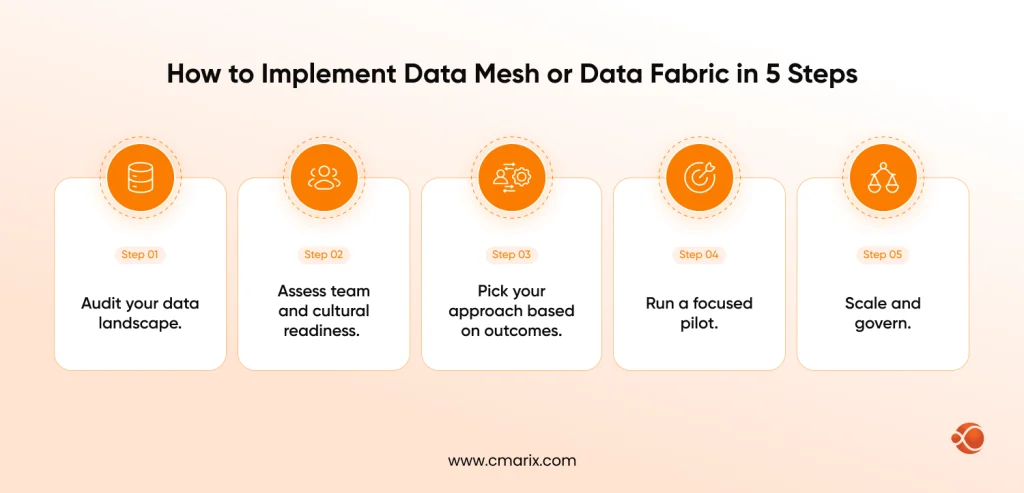
Step 1: Audit your data landscape.
Make a list of owners, sources, pain points, and cost of delay. You cannot pick the architecture if you do not know what to solve.
Step 2: Assess team and cultural readiness.
Are the domain teams ready to own the data from a skill standpoint and willing to take ownership? Is the central team strong enough to operate a fabric?
Step 3: Pick your approach based on outcomes.
To select a path based on your circumstances. Start with a business objective such as a quicker Customer 360 or AI-friendly data, not technology.
Step 4: Run a focused pilot.
Choose one use case and some key domains where you will demonstrate the value and establish the bar for quality, metadata, and governance.
Step 5: Scale and govern.
Deploy domain-by-domain or data source-by-source, automating quality assurance and policy adherence, and measuring adoption and speed of insight delivery. Teams that need more capacity can reach out to Data Engineering Consulting Services or hire data engineers.
Data Mesh vs Data Fabric in 2027: Trends Shaping Data Architecture
Three shifts are shaping how companies make this choice.
- AI readiness- Generative and agentic AI systems need trusted, well-described, easy-to-reach data. Both fabric and mesh help, because well-documented, governed data is the raw material for AI data transformation and reliable models. Weak architecture is quickly becoming the main reason AI pilots stall.
- Data products going mainstream- Even companies that never adopt a full mesh are borrowing the data product idea: clear owners, clear contracts, clear quality standards.
- Metadata becoming active- Static catalogs are giving way to metadata that triggers actions, which is the core of fabric thinking and increasingly built into mesh platforms too.
If you are building a broader data practice, our comprehensive data science guide and predictive analytics consulting services show how these architecture choices connect to analytics outcomes.
Why Choose CMARIX for Data Engineering Consulting Services?
Choosing between data mesh and data fabric is rarely purely technical, which is why working with a partner who has seen both sides helps. CMARIX have been building custom software and data solutions since 2009, with experience across 40+ industries, and we hold ISO 9001:2015 and ISO 27001 certifications.
Our team can help you assess your data landscape, design the right architecture, and build it, whether that means a fabric, a mesh, or a hybrid. From big data development services to hiring dedicated data engineers who plug straight into your team, we adapt to the way you work.
- Architecture assessment- We review your sources, teams, and goals before recommending anything.
- Pilot-first delivery- We prove value on one use case before scaling.
- Flexible engagement- Project-based, dedicated team, or consulting, depending on what you need.
Conclusion
The choice between data mesh and data fabric mainly depends on your data architecture and organizational challenges. If your challenge is tech sprawl and you want seamless access without touching your organization, a data fabric will likely be the quicker way out. If your challenge is an overloaded central team and unowned data, a data mesh solves the core issue but requires organizational change; if you are big and complex, both options can work well together.
Whatever you choose, make sure that you begin by identifying your business goal, conduct a small-scale pilot, and focus on metadata management and governance from the very start. With this strategy, your data will be ready for anything 2027 might throw at it, including artificial intelligence.
FAQs About Data Mesh vs Data Fabric
What is the fundamental difference between data mesh and data fabric?
Data fabric is an architectural framework that brings together data through systems based on automation and metadata, generally in a centralized manner. Data mesh is a framework in which each individual domain of a business is responsible for publishing its data as products. Simply put, data fabric changes tools while data mesh changes ownership.
Can an organization implement both data mesh and data fabric simultaneously?
Definitely, a lot of big companies adopt data mesh as their operating model and data fabric as a tooling layer to enable cataloging, governance, and discovery within the domains.
How do data mesh and data fabric compare to a traditional data lake or data warehouse?
Lakes and warehouses are places where data is stored. Mesh and fabric are ways of organizing access and ownership across those places. A fabric can connect several lakes and warehouses, and a mesh can have each domain run its own, so neither replaces them outright.
What role does Master Data Management (MDM) play when comparing data mesh and data fabric?
MDM produces a consistent and reliable view of entities such as customers and products. It is usually provided as a service in a layer within a data fabric. Within a data mesh architecture, master data is likely to be a shared data product.
What are the core architectural pillars of a data mesh framework?
A data mesh rests on four pillars:
Domain Ownership
Data as a Product
Self-Service Data Platform
Federated Governance
These help move accountability towards the teams that are closer to the data while maintaining standards at an enterprise level.
What are the primary technical challenges when migrating to a data mesh architecture?
The biggest challenges are developing a self-serve platform that domains can actually use, keeping standards consistent across teams, and closing skill gaps in domain teams. Managing interoperability between data products and enforcing governance automatically are also common sticking points.
What is the difference between data fabric and data virtualization?
Data virtualization allows you to query data from multiple sources without moving it. A data fabric includes virtualization but adds cataloging, active metadata, automation, knowledge graphs, and governance. Virtualization is one capability within a fabric.
How do data mesh and data fabric help in achieving a unified Customer 360 view?
A data fabric links billing, CRM, support, and analytics systems using a central layer to form the picture of the customer. In a data mesh, each domain provides its own customer data products that are later aggregated to form the 360-degree view. The data fabric implementation is typically quicker, but the data mesh scales better.
What are the key business benefits of shifting toward a data mesh paradigm?
Faster delivery of data products, improvement of data quality through ownership, and reduced dependency on a single bottleneck team are some of the advantages. Moreover, scalability is much easier since new business domains can be added.