




Quick Summary: Secure AI code generation requires more than choosing an enterprise-grade coding assistant. The developer needs to have policies for prompts, secure access to proprietary code, secure vendor arrangements, automatic SAST/SCA scans, and manual review before releasing the code. This guide describes the key security concerns in AI code development, including data leaks, code vulnerabilities, dependencies, agentic access, and intellectual property exposure. It also provides a framework for using AI coding tools without exposing proprietary code.
AI coding assistants have become an integral part of daily software development activities. They help with writing functions, creating test cases, understanding unfamiliar code, refactoring old code, and even modifying the entire repository.
That speed is valuable. It also raises an important security question: what happens to proprietary code when an AI assistant becomes part of the development workflow?
The concern goes beyond whether an AI model generates vulnerable code. Development teams also need to understand where prompts go, what context an assistant can access, how generated code enters production, and whether the output creates intellectual property or compliance concerns.
These statistics explain the importance of the issue at present. According to the 2025 Stack Overflow Developer Survey, 84% of developers use or plan to use AI technologies during the development process. However, the number of developers who distrust the accuracy of AI results is higher than those who trust it.
This creates a difficult balance. AI-assisted development is becoming mainstream, but security practices around it are still developing.
Secure AI code generation addresses that gap. It does not mean preventing developers from using AI. It means controlling what AI systems see, what they generate, and what happens before that code reaches production.
Secure AI Code Generation: What Does It Mean?
Secure AI code generation means using AI coding assistants within a development process that protects source code, credentials, intellectual property, dependencies, and application security.
The important distinction is that security does not start with the generated code. It starts before the prompt reaches the AI system.
A typical AI-assisted development workflow looks like this:
Developer → Prompt → AI Tool → Generated Code → Review → Testing → Repository → Production
Every stage creates a different security consideration.
A developer might paste an internal authentication function into an AI assistant to troubleshoot it. The generated response may be technically correct. However, the larger security issue may have occurred before the response was produced.
The proprietary authentication logic has already been integrated into an external system.
A secure approach therefore needs to answer three questions:
- What information is being sent to the AI system?
- What code is the AI system producing?
- What controls exist before that code reaches production?
These questions form the foundation of a practical AI code security strategy.
They also connect with broader AI security risks, where data exposure, access control, model behavior, and governance all contribute to the overall risk.
Why AI-Generated Code Requires a Different Security Approach
Traditional application security assumes that developers understand the code they write and that changes move through established development controls.
AI-assisted development changes that assumption.
A developer might accept a generated function without fully understanding every implementation decision. An AI agent might modify several files in a single request. A coding assistant might use repository context to generate a response. The developer could then commit those changes within minutes.
The development cycle becomes faster, but more decisions are made within it. There is also a trust problem.
The 2025 Stack Overflow Developer Survey found that many developers remain concerned about the accuracy of AI output. Developers also report frustration with AI-generated answers that appear close to correct but still require significant debugging.
That matters for security. A developer usually notices a syntax error quickly. A subtle authorization problem may remain hidden.
AI-generated code therefore introduces two separate risks. The implementation itself may contain a vulnerability, while the speed of AI-assisted development may reduce the scrutiny applied to that implementation. The solution is not to remove AI from the workflow. The solution is to introduce appropriate controls around it.
Where AI Code Generation Creates Security Exposure
AI coding assistants introduce security exposure across several parts of the software lifecycle.
Data Exposure Starts With the Prompt
Developers often think of prompts as temporary instructions. From a security perspective, however, a prompt may contain valuable company information. A single request could include proprietary business logic, database structures, authentication workflows, internal URLs, customer information, or credentials. The AI assistant may need only a small portion of that information to solve the problem. Sending an entire source file therefore creates unnecessary exposure.
It’s safer to use as little context as possible when using third-party AI services. Secrets, customer data, proprietary IDs, and business logic irrelevant to the task at hand must be stripped from the code before submission. These enterprise-grade AI privacy policies need to specify what data categories are allowed within approved tools.
Generated Code Can Introduce Traditional Vulnerabilities
AI does not eliminate established application security problems.
Generated code may still introduce:
- Input validation flaw
- Access control weakness
- SQL injection attack
- Cross-site scripting attack
- Hard-coded passwords
- Authentication weaknesses
- Unsafe deserialization attacks
- Insecure cryptography
- Vulnerable libraries
The problem becomes more serious when developers assume that AI-generated code has already been validated.
It has not. AI-generated code should therefore enter the same security testing pipeline as manually written code.
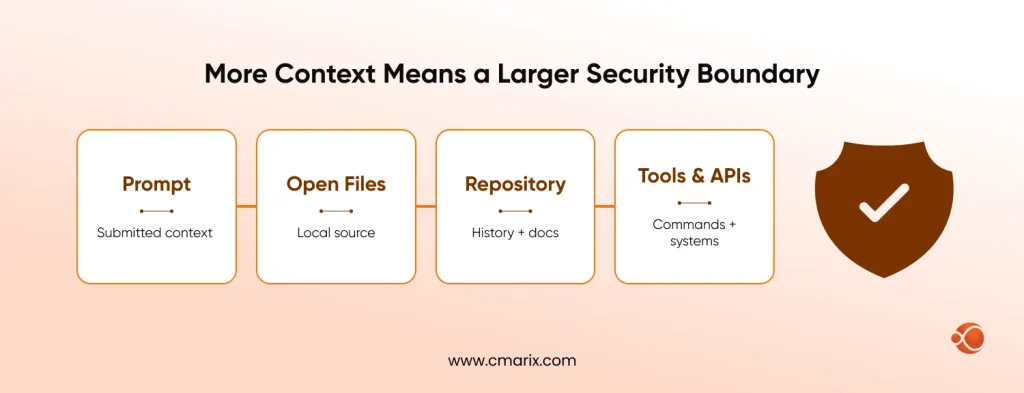
Repository Context Expands the Attack Surface
Modern coding assistants increasingly understand more than a single prompt.
Depending on the product and configuration, an assistant may access open files, repositories, documentation, commit history, terminal output, or connected development systems.
That additional context improves the quality of generated code. It also increases the amount of information that requires protection. This becomes especially important when organizations move from basic autocomplete tools to autonomous coding agents.
Talk to our experts about securing AI-assisted development workflows.
AI Coding Assistants vs. AI Coding Agents
Not every AI development tool carries the same level of risk.
A basic autocomplete assistant generally generates code using limited context. An agentic coding system may inspect a repository, modify multiple files, execute commands, run tests, and create commits.
The security boundary changes considerably.
| Tool Type | Typical Access | Security Exposure | Recommended Control |
| Code autocomplete | Current code and prompt context | Lower | Enterprise privacy controls and code review |
| Chat-based coding assistant | Submitted code and files | Medium | Prompt controls and data classification |
| IDE-integrated assistant | Project and repository context | Medium to High | Access controls and repository restrictions |
| Coding agent | Files, commands, tools and repositories | High | Least privilege and approval gates |
| CI/CD-connected agent | Build and deployment systems | Very High | Strong identity controls and human approval |
The key difference is integration surface area.
An assistant that suggests a function has limited authority. An agent that can modify repositories and deployment systems has considerably more.
Organizations adopting AI agents for cybersecurity or agentic development workflows therefore need stronger identity, access, monitoring, and approval controls. That leads to a fundamental principle of secure AI development: an AI system should receive only the access required to complete its task.
Apply Least Privilege to AI Coding Tools
The AI coding assistants must be given only the necessary permissions needed to perform their duties. The developer working on the front-end component hardly needs the AI agent to have access to production credentials. An AI agent working on unit tests will not require permission to deploy infrastructure. This happens due to the convenience of configuration.
Convenience causes unnecessary risk. A sensible access control framework involves segregation of environments based on sensitivity. The goal is not to render AI inaccessible. The goal is to avoid making the AI an unlimited identity in the organization.
| Environment | AI Access | Recommended Approach |
| Public or open-source code | Broad | Standard enterprise controls |
| Internal low-risk projects | Controlled | Approved tools and repository permissions |
| Proprietary product code | Restricted | Enterprise or self-hosted AI |
| Regulated applications | Highly restricted | Strong data controls and auditability |
| Production systems | Minimal | Human approval and tightly scoped access |
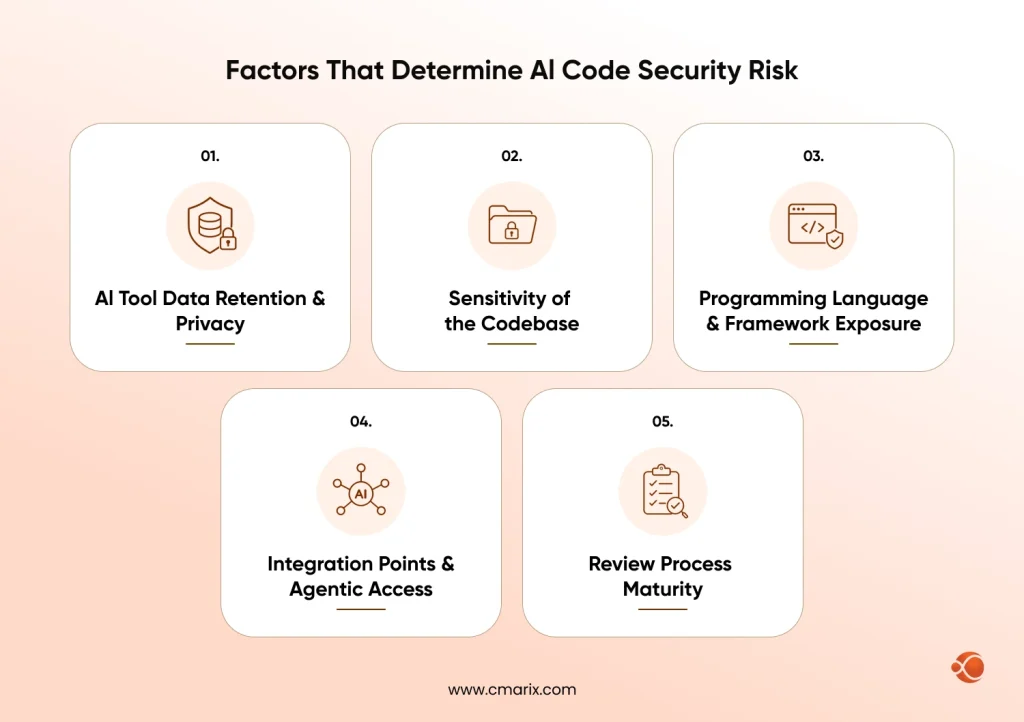
Factors That Determine AI Code Security Risk
Security exposure differs significantly between organizations.
A startup building a public website and a financial services company developing an authentication platform should not have identical AI policies.
Several factors determine the actual level of risk.
1. AI Tool Data Retention and Privacy
The first question should be simple: What happens to the code after it is submitted?
Organizations need to consider whether the provider archives prompts, retains responses, trains on customer information, and provides retention periods.
| Consideration | Why It Matters |
| Prompt retention | Sensitive code may remain in vendor systems |
| Model training | Submitted code may influence future model behavior if permitted |
| Data residency | Regulated projects may require specific locations |
| Audit logging | Security teams need visibility into usage |
| Account controls | Personal accounts may bypass enterprise policies |
| Contractual protections | Written commitments provide stronger governance |
It cannot be assumed that because two products come from the same vendor, they will have the same level of data security.
Account tier and contractual terms matter. This is also why teams evaluating ChatGPT vs alternatives should compare security controls alongside features and pricing.
2. Sensitivity of the Codebase
Not every source file requires the same level of protection. Organizations should classify code before establishing AI usage rules.
| Code Classification | Example | Recommended AI Usage |
| Public | Open-source project | Generally acceptable |
| Internal | Standard business utilities | Controlled |
| Confidential | Product-specific logic | Restricted |
| Highly Confidential | Proprietary algorithms | Self-hosted or tightly governed |
| Regulated | Sensitive application components | Strictly controlled |
Such classifications provide developers with a concrete way to determine whether the code should be used in an AI prompt. Developers generally make individual decisions when such classification does not exist.
3. Programming Language and Framework Exposure
Vulnerabilities introduced into security by AI technology do not occur evenly across all languages and frameworks in which they were generated. The research paper demonstrating this vulnerability has shown significant differences across programming languages, especially in Java. Independent security research analyzing AI-generated code across languages has shown significant differences across programming languages, especially in Java.
That finding should not be interpreted as evidence that Java itself is insecure. The more useful takeaway is that AI-generated code still requires language-specific security validation.
A generated function needs to follow the security conventions of its framework, dependencies, authentication model, and deployment environment.
| Language / Stack | Reported Exposure | Common Concern |
| Java | High in cited benchmark | Input validation and insecure defaults |
| Cross-language code | Significant | Secrets and access control |
| Python / JavaScript | Variable | Injection and dependency issues |
The programming language is therefore one risk indicator, not the complete risk assessment.
4. Integration Points and Agentic Access
Every additional AI integration creates another location where proprietary information may be accessed or transmitted.
| Integration | Potential Access | Risk |
| IDE extension | Files and project context | Medium |
| Repository integration | Source code and history | Medium to High |
| Terminal access | Local commands and files | High |
| CI/CD integration | Build and deployment systems | High |
| Cloud integrations | Infrastructure and services | Very High |
| Production access | Live systems and data | Critical |
This is where agentic development changes the security equation. A coding agent may not only read source code. It may execute commands, create files, modify configurations, and interact with APIs.
That means the permissions around the agent become just as important as the model itself.
Any AI agent linked to internal APIs should thus be tested with the same rigor used for testing other privileged integrations. The API security testing process takes on more importance where agents interface with internal or external systems.
5. Review Process Maturity
The fact that AI-generated code was created very quickly does not imply that it is subjected to a lower standard of review. On the contrary, companies should make their current development process more mature.
A practical workflow looks like this:
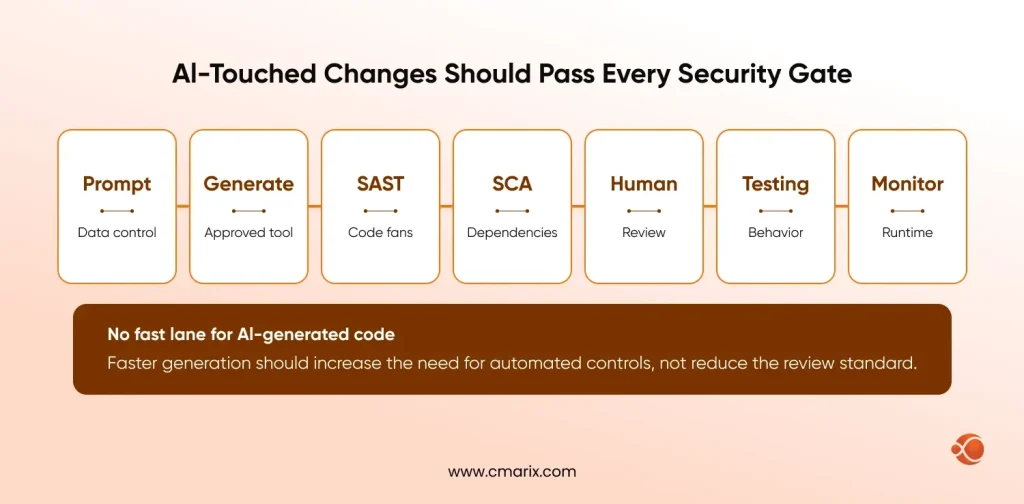
Prompt controls → Code generation → SAST → SCA → Human review → Testing → Deployment monitoring
- Each control finds a different kind of vulnerability.
- SAST finds typical code vulnerabilities.
- SCA finds vulnerable or prohibited dependencies.
- Human Review looks for architectural issues and business logic vulnerabilities.
- Testing checks functionality.
- Monitoring protects against threats after deployment.
The controls therefore complement one another rather than compete.
The Role of SAST and SCA for AI-Generated Code
- Static Application Security Testing should become a routine part of AI-assisted development. The important point is automation. If developers generate hundreds of code changes every week, security teams cannot manually inspect every line before it enters the repository. SAST provides an automated first-layer analysis.
- Software Composition Analysis addresses another common problem. AI assistants may suggest packages that seem very handy but could lead to dependency vulnerabilities or incompatibility.
A secure pipeline should therefore check AI-written code for:
- Vulnerabilities
- Dependency threats
- Secrets
- Injection attacks
- Authentication weaknesses
- Licensing issues
- Misconfigurations
- Code anomalies
The scan results should feed directly into the normal pull request workflow.
AI-generated code should never receive a faster path into production simply because it was generated faster.
Human-in-the-Loop Review for AI-Generated Code
Automation finds patterns; humans find context. This becomes important for review of AI-written software code. An analysis tool might detect potentially dangerous SQL construction. It may not be able to determine why a specific authorization represents a business risk.
A qualified reviewer can assess whether the implementation adheres to the application’s intended security model. The reviewer should therefore examine more than syntax.
The review should consider whether:
- Authorization is done on the proper boundary.
- Sensitive data is exposed.
- Error messages provide internal details.
- Dependencies are appropriate.
- Security assumptions match the application’s architecture.
- Business rules remain intact.
- The generated implementation follows established coding standards.
Human review does not, by default, slow AI development.
When security checks and review rules are integrated into the pull request process, they become part of the existing workflow.
Prompt Engineering for Secure Coding
Secure AI code generation also begins with better prompts. A secure prompt provides enough technical context to solve the problem without exposing unnecessary proprietary information.
Instead of submitting the entire internal authentication module, the developer can document the required behavior in pseudocode and in the sanitized interface.
The goal is to preserve the technical problem while removing sensitive implementation details.
A secure coding prompt should:
- Define the programming language used.
- Describe the desired behavior.
- Specify any security requirements.
- Not include irrelevant customer information.
- Avoid unnecessary customer information.
- Remove proprietary identifiers where possible.
- Ask the model to identify potential security weaknesses.
The final step is particularly useful.
Asking an AI assistant to identify weaknesses in its proposed implementation adds an additional layer of review. It does not replace SAST, SCA, or human review. It improves the quality of the first-pass output.
Enterprise AI Privacy Policies Need More Than a No-Training Clause
A no-training commitment is important, but it is not a complete AI privacy strategy.
Organizations also need clear internal rules.
An enterprise AI policy should define which tools developers may use, what information they may submit, which repositories AI systems may access, and what happens when a developer violates the policy.
| Policy Area | What the Policy Should Define |
| Approved tools | Which AI assistants developers may use |
| Data classification | Which information may enter each tool |
| Account ownership | Whether personal accounts are prohibited |
| Retention | How long prompts and outputs remain available |
| Access | Which repositories AI tools may access |
| Review | Which AI-generated changes require additional approval |
| Monitoring | How AI-assisted development is logged |
| Incident response | What happens after accidental disclosure |
This also addresses the problem of shadow AI. Developers may install an AI extension because it solves a problem quickly. Security teams may have no visibility into that extension. The organization then has an unmanaged AI endpoint inside its development environment. An approved-tool policy closes that gap.
Intellectual Property and Trade Secret Protection for AI Code
Security is only one aspect of protecting proprietary code.
Intellectual property introduces another layer of risk.
AI-generated code can raise questions around ownership, provenance, licensing, and similarity to existing code.
This becomes especially important when software contains commercially valuable algorithms or proprietary workflows.
Organizations should maintain visibility into:
- The AI tools used by developers
- Which repositories have used AI in their development
- The changes that have been made using AI
- The security controls used
- The dependencies which have been added via AI recommendations
- The vendor terms of the AI tool
Software composition and license scanning should remain part of the workflow.
According to studies conducted by Snyk, StackHawk, Kiuwan, and others, there is an emphasis on security testing, controlled AI implementation, and code review from the AI. The approach to take is simple: treat the AI-generated code as an external contribution until its safety is determined.
Custom Development vs. SaaS for Sensitive AI Workloads
The deployment model becomes important when proprietary code is highly sensitive.
SaaS AI assistants provide speed and convenience. They also introduce an external service into the development workflow.
Self-hosted AI provides greater control over data movement. It also introduces requirements for infrastructure, security, model management, and maintenance.
Neither model is automatically secure.
The right choice depends on the workload.
| Requirement | SaaS AI | Self-Hosted AI |
| Fast deployment | Strong | Moderate |
| Infrastructure control | Limited | Strong |
| Data control | Vendor dependent | Stronger |
| Operational overhead | Lower | Higher |
| Custom security controls | Moderate | High |
| Sensitive workloads | Requires strict vendor controls | Often better suited |
However, a comprehensive analysis comparing custom software development vs with SaaS must also consider security and governance, as well as cost and development speed. In fact, in many instances, a balanced approach would be needed, in which low-risk development is done through SaaS solutions.
Industry-Specific AI Code Security Requirements
The consequences of a vulnerability change significantly between industries.
A marketing website and a banking application should not operate under the same AI development policy.
| Industry | Typical Exposure | Additional Requirement |
| Financial services | High | Strong audit trails and access controls |
| Healthcare | High | Sensitive-data restrictions and vendor review |
| SaaS | Medium | SAST, SCA and IP controls |
| E-commerce | Medium | API and payment security testing |
| Internal applications | Low to Medium | Approved-tool policy |
| Public projects | Lower | Standard secure development controls |
Security requirements for applications that involve health data are stringent. Security requirements for financial applications are strict and involve authentication, authorization, transactions, and auditing. It is therefore necessary that the AI policy be integrated into the current security and compliance initiatives.
How to Build a Secure AI Code Generation Workflow
A strong AI development program does not depend on one security tool. It establishes controls at every important stage.
Step 1: Classify Code Before Using AI
Developers need to have guidelines on how much information they can provide. There should be no limitations on open source code. But there should be very strict regulations for trade secrets. This decision must be made before the prompt is given to the model.
Step 2: Approve Specific AI Tools
Security professionals need a list of approved AI tools that include documented guidelines around the following areas:
Data retention, training uses, access permissions, integration capabilities, auditing features, and user management.Making AI tool choices into a governance issue rather than an individual developer choice.
Step 3: Restrict AI Permissions
AI agents should receive only the permissions required for their task. This is crucial for controlling AI operations and the access we provide it.
- Repository access should be restricted.
- Production credentials need to be kept safe and seperate.
- Deployment permissions must have explicit approval.
Step 4: Scan Every AI-Touched Change
AI-generated code should automatically be entered into SAST and SCA pipelines. Secret scanning should run alongside them. The objective is simple: AI-generated code should never bypass existing security gates.
Step 5: Require Human Review
A competent engineer must review changes to the security-sensitive AI’s business logic, access control, architecture, dependencies, and data management.
Step 6: Track AI-Assisted Changes
Organizations must retain sufficient provenance to track AI-made contributions to the codebase. It is not necessary to track all developer interactions, but sufficient visibility into the process is needed to know how changes are made and reviewed.
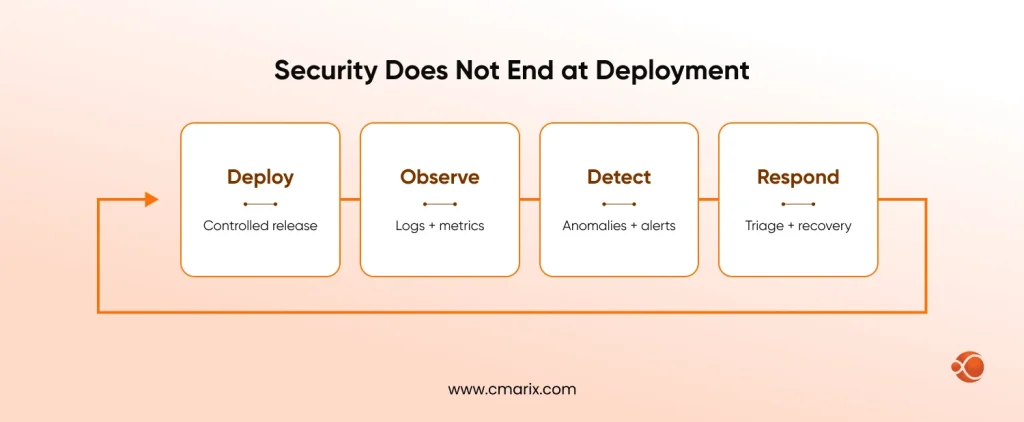
Step 7: Monitor After Deployment
Security measures have to continue to function even after their implementation. Monitoring, logging, anomaly detection, and incident management are extremely important, as security problems may arise even during the production phase of the application.
Build AI workflows with stronger security, access controls, and governance.
Building the Right Team for Secure AI Development
Secure AI code generation requires cooperation between development, security, DevOps, and QA teams.
No single role owns the entire process.
| Role | Primary Responsibility |
| Engineering Lead | Defines acceptable AI development practices |
| AppSec Engineer | Owns security testing and vulnerability triage |
| DevSecOps Engineer | Integrates SAST, SCA and secret scanning |
| Developer | Uses approved tools and follows data policies |
| Security Reviewer | Reviews high-risk AI-generated changes |
| QA Engineer | Tests functionality and security scenarios |
| Compliance Team | Reviews regulatory and contractual requirements |
This structure creates accountability without unnecessarily complicating AI adoption. Developers know what they are allowed to do. Security teams know what they need to monitor. Leadership gains visibility into the overall risk.
Common Mistakes That Weaken AI Code Security
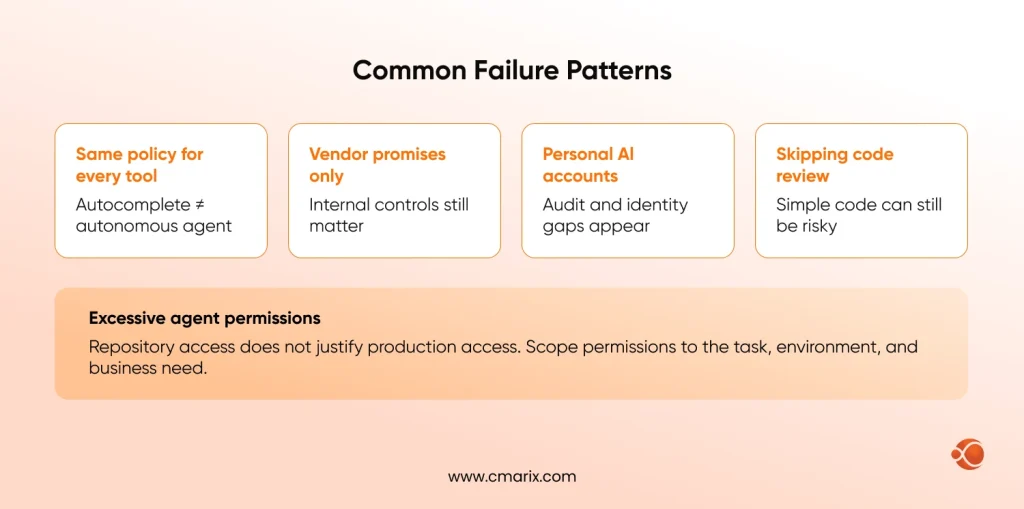
Treating Every AI Tool as Equivalent
A chat assistant, IDE autocomplete system, and autonomous coding tool have distinct access paradigms. Treating them with the same policy would be superfluous.
Relying Only on Vendor Promises
Vendor privacy commitments matter.
They should still be supported by internal controls around data classification, permissions, and developer behavior.
Allowing Personal AI Accounts
Personal accounts may bypass enterprise retention, audit, identity, and access controls.
Development environments should use managed accounts wherever possible.
Skipping Review Because the Code Looks Simple
Simple code can still introduce serious security weaknesses. Authentication, authorization, validation, and data access require careful review regardless of who generated the implementation.
Giving AI Agents Excessive Permissions
An agent does not need production access simply because it needs repository access. Permissions should remain specific to the task.
How to Reduce AI Code Security Risk Without Slowing Development
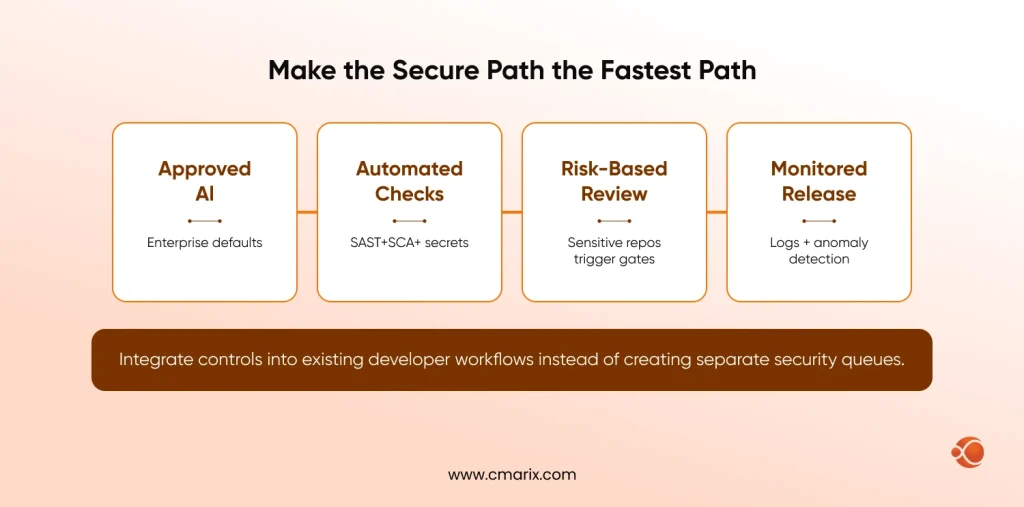
Security controls tend to fail when developers view them as impediments. Instead, the optimal strategy is to ensure that the secure way is the easiest way. Scanning and SCA checks should be integrated into the current CI/CD pipeline. AI tools that are allowed for use should come with an out-of-the-box enterprise configuration. Templates for safe prompts should be provided to developers. Permissions on the repository should adhere to typical identity controls. Review rules should be triggered automatically based on sensitive repositories.
Organizations already investing in AI in digital transformation should treat secure AI development as part of that broader transformation.
AI adoption without governance creates technical debt. AI adoption with governance creates a repeatable development capability.
Why Choose CMARIX for Secure AI Development?
Secure AI code generation requires more than selecting a coding assistant. It requires development architecture, security controls, testing practices, and engineering expertise working together throughout the software lifecycle. CMARIX builds AI-enabled software with security and quality controls integrated into the development process. Organizations requiring additional engineering capacity can hire dedicated developers for AI-assisted product development and ongoing engineering work.
For Python-heavy AI systems, teams can work with top Python developers across backend development, AI integrations, APIs, and data-driven applications.
Quality assurance remains equally important. Organizations can also bring in end-to-end quality assurance testers to validate functionality, integrations, security scenarios, and AI-generated changes before production release.
The objective is not simply to generate more code. It is to generate code faster while maintaining engineering quality, security, and control over proprietary information.

Final Thoughts
AI coding assistants have become an integral part of the software development process. The issue that now arises is not whether the development team should use them. The issue is rather how to use them while ensuring confidentiality of the proprietary code and maintaining the security of the application. Herein lies a need for a secure AI development methodology that begins with data classification.
The most successful companies don’t consider AI-generated code to be trusted code. They see it as untrusted input that must be validated. This approach enables organizations to enjoy the advantages of AI while maintaining control over their code, intellectual property, apps, and development environment. Security of AI code generation is not about creating boundaries for developers. It is about implementing appropriate guardrails that will allow developers to leverage AI without compromising on security.
FAQs on Secure AI Code Generation
Are AI coding tools allowed to train on my proprietary code?
It depends on the tool’s terms, privacy settings, and deployment model. Teams should verify that code and prompts are excluded from model training before use.
What data should I strictly avoid sending to AI assistants?
Credentials, API keys, customer data, sensitive company information, proprietary algorithms or code, and regulated data are off-limits for AI assistants. Any sensitive code or documents should be analyzed exclusively using authorized, controlled AI tools.
What are the best technical safeguards to prevent accidental data leaks?
Access control, data loss prevention (DLP), a private AI environment, secret scanning, and prompt/code filtering will ensure there is no accidental exposure of any data. Logging and continuous monitoring also play their role here.
Do I legally own the software generated by AI?
The ownership of software produced by AI depends on applicable laws, contract terms, and the AI tool’s terms of service. AI-generated content can pose copyright/licensing issues that need to be investigated in advance.
Can AI tools accidentally introduce restricted open-source code into my project?
Absolutely. The AI-generated code may resemble restricted code under an open-source license. Software Composition Analysis, code scanning, and license checks should be part of your development process.
How can my team safely validate AI-generated code before deployment?
Run AI-generated code through SAST, dependency and license scanning, automated tests, and human code review. Security testing and post-deployment monitoring should follow before and after production release.