




Quick Summary: AI cost savings is now becoming a realistic method for companies to save money on operations. This guide explains how AI reduces costs by automating workflows, enabling predictive maintenance, optimizing cloud costs, automating customer support services, and improving supply chain management. Additionally, it discusses how to calculate AI cost savings, how to avoid implementing costs that are hard to recognize, and an actionable plan for cost savings.
More than 90% of executives believe that artificial intelligence will be critical in reducing costs for their business in the next 18 months. This is not mere marketing talk. Rather, it is an observation made by finance and operations experts on the balance sheets of their organizations. Cost reduction due to AI is no longer something that is going to happen in the future but is currently being experienced by businesses.
This guide breaks down exactly how AI reduces costs across real business functions. It is backed by data, case studies, and a practical starting plan you can use this quarter.
Whether you run a small operations team, a mid-size company, or a large global enterprise, the same underlying question applies. Where is your budget being wasted on work that AI could handle faster, cheaper, and more accurately?
Why AI Cost Savings Matter Right Now
Financial pressure is not likely to go away anytime soon. Any finance executive worth their salt is facing increasing pressure to make ends meet with fewer resources. Any technology executive is faced with the task of proving ROI before getting new technologies. This is precisely why AI savings at the board level have become crucial.
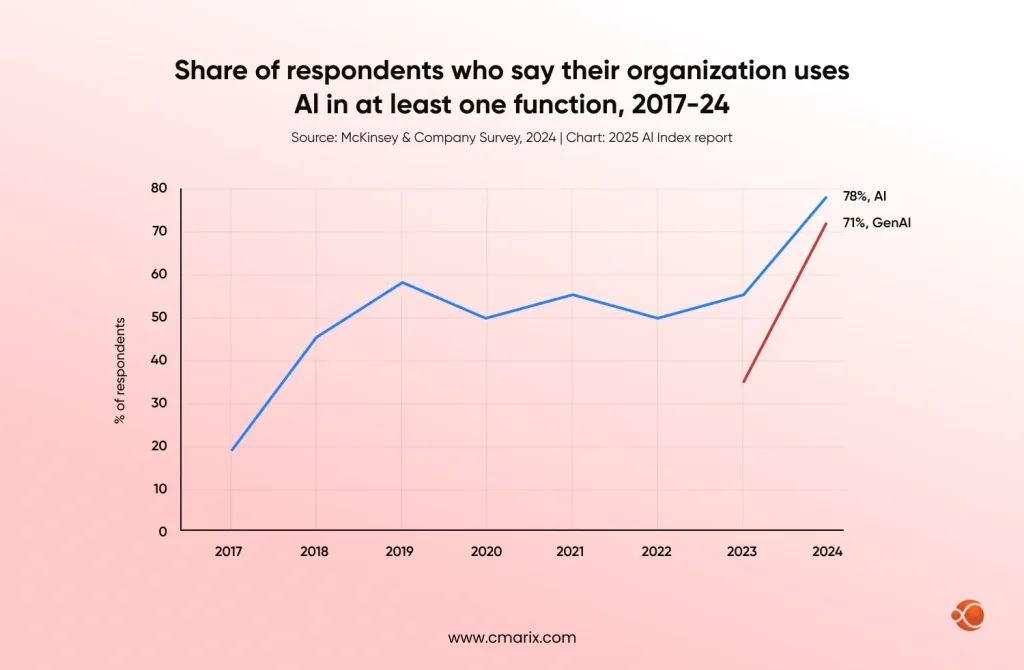
Evidence supports the change. The Stanford AI Index Report 2025 states that about half of firms adopting AI for their service operations have reported reductions in expenses. The same applies to supply chain management and software development. As far as revenue is concerned, the report indicates that 71% of firms using AI for marketing and sales had increases in their revenue. This was followed by 63% and 57% in supply chain management and service operations.
This is not a series of isolated successes. On the contrary, these constitute a trend. Artificial intelligence technology is no longer experimental. Cloud computing software has become much more affordable and accessible than it was two years ago.
The Real Cost of Doing Nothing
But there is also a downside to doing nothing. Competitors using AI technology for workflow automation, cloud expense optimization, and machine breakdown prediction have an inherent cost advantage. Businesses that depend solely on manual work are at a disadvantage. The more time passes, the bigger this gap gets. Any business that saves 10% of its operational costs today can use this margin for growth tomorrow.
At CMARIX, we see this pattern repeat across nearly every industry we work with. Companies do not adopt AI because it is trendy. They adopt it because smarter enterprises with AI consistently outperform slower-moving competitors on cost, speed, and customer experience.
How Does AI Actually Reduce Costs?
So how does AI reduce costs in practice? The short answer is that AI removes manual, repetitive, and error-prone work that quietly drains company budgets. It replaces guesswork with prediction. It replaces slow, sequential processes with automated ones that run continuously.
Three forces drive most AI-driven cost optimization results.
First, automation eliminates repetitive jobs done by people. No one is required anymore to constantly monitor data input, keep schedules, handle invoicing, and answer customer inquiries that can be answered automatically.
Second, prediction can help avoid costly errors. Instead of facing problems such as defective machinery or unhappy customers, artificial intelligence helps organizations detect potential problems.
Third, optimization finds waste that humans typically miss. Cloud infrastructure, staffing schedules, and inventory levels are full of small inefficiencies that add up fast. AI is very good at spotting them at scale.
When companies look at artificial intelligence business models, they usually begin with something simple like automating one process at a time. This is because it’s likely to deliver the best outcomes. This way, they can track savings along the way.
Key Areas Where AI Delivers Cost Savings
AI cost savings are not uniformly spread out throughout the enterprise. Some areas show quick results within days, while others might take months to yield value due to the buildup of data. This is where you will find the most benefit, at least based on our experience.
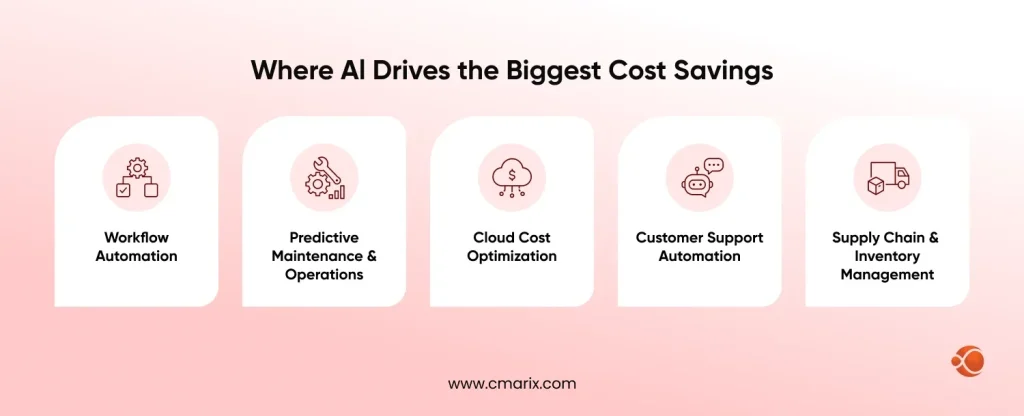
Workflow Automation
Manual processes are costly since they involve people’s time in activities that do not need actual decision-making. AI workflow automation handles data entry, approval, scheduling, and reporting without continuous monitoring. It leaves people with activities that actually need their attention.
AI orchestration for modern AI workflows is required by modern platforms to establish Modern AI Workflows. The difference is that there is only one process for automating different tools. There is no need to have five tools and perform all handoffs manually. This approach decreases errors, saves time, and eliminates extra work.
Modern platforms also rely on AI orchestration for modern AI workflows to connect multiple tools into a single automated pipeline. Instead of five separate systems each requiring manual handoffs, one orchestrated workflow moves data automatically from step to step. This reduces errors, shortens turnaround time, and cuts the administrative overhead that usually comes with cross-department processes.
Predictive Maintenance and Operations
Unexpected equipment breakdowns are one of the most expensive issues in manufacturing, logistics, and facility management. Predictive maintenance uses data collected by sensors and machine learning to alert about possible issues before they become problems.
According to McKinsey & Company, predictive maintenance can reduce maintenance costs by 10% to 40%. It can also cut unplanned downtime by up to 50%. Separate industry research shows predictive strategies lowering expenses by roughly 30% to 40% compared to purely reactive maintenance models. For manufacturers running equipment around the clock, this use case often pays for the entire AI investment in year one. See how one manufacturer cut costs with our predictive maintenance case study.
Cloud Cost Optimization
Cloud spend has become one of the quickest-rising costs in every tech budget. AI-powered cloud cost optimization tools constantly analyze usage and right-size cloud resources. In addition, they turn off idle infrastructure that would otherwise be billed for service 24/7.
Instead of relying on a quarterly manual audit, businesses get real-time visibility into exactly where money is being wasted. That visibility alone routinely uncovers 15% to 30% in avoidable cloud spend. The savings compound every month once the system is running.
Customer Support Automation
AI-powered chatbots and virtual assistants currently solve many customer queries on their own, without involving any humans. This reduces costs related to staffing support staff. Moreover, response times remain faster than even the fastest human-only support teams can provide.
Specifically, retailers and fintech firms have embraced AI-driven fintech cost efficiency strategies. This is because they employ automation not only to reduce costs but also to improve customer satisfaction. The benefits in question go beyond reducing manpower. Faster response times mean lower churn rates and cost savings, with the added benefit of higher revenue.
Supply Chain and Inventory Management
Cash gets tied up by overstocking, and revenue opportunities get lost due to stockouts. This is where AI is particularly well suited to address both issues simultaneously. Through machine learning algorithms, forecasts can be made far more accurately than any spreadsheet or gut feel ever could.
Software and Product Development Costs
AI cost savings can also be seen in development processes. AI-based code writing, testing, and quality assurance save developers time on routine tasks. As a result, the timeline gets shorter, but not the number of people working on the project.
AI product development costs and AI app development costs should be understood from the very beginning to help companies prepare accordingly and avoid budget overspending in later stages. When teams prepare to develop AI-assisted software from the start, there are fewer issues down the road.
How to Measure AI Cost Savings Accurately
Many businesses struggle to prove AI cost savings even when the technology is working well. That is usually a measurement problem rather than a technology problem. Without a clear baseline, it is impossible to know how much money AI is actually saving.
Begin by determining what your cost baseline is right now, before implementing an AI tool. This will be the actual hours, number of people, or dollars currently used to perform your process. The cost baseline is the standard by which all future comparisons will be made.
Then separate one-off implementation costs from savings associated with operations. A project can be costly at the end of month one but yield significant returns on AI cost savings by month six. This is after accounting for the initial implementation cost.
Finally, review results on a fixed cadence, such as quarterly, rather than waiting for an annual report. AI models improve with more data over time. Early results often understate the long-term AI cost savings a business will eventually see.

Real-World Proof That AI Cost Savings Work
Numbers are important, but the evidence behind them is even more crucial. A hospital in the La Crosse, Wisconsin, region introduced an evidence-based decision-making system aimed at detecting patients at risk of being readmitted to the hospital. Research published regarding this project revealed that readmission levels fell significantly within six months after the launch.
This isn’t even close to being the only piece of evidence. Predictive maintenance in manufacturing can result in double-digit savings in maintenance costs within just the first year of use. AI demand forecasts in retail allow retailers to save on excess inventory while protecting their bottom line during peak times. This is precisely how our healthcare cost reduction case studies using AI work across all industries.
This is not the only example. Companies that use predictive maintenance claim to save more than ten percent on maintenance costs in their first year. Companies that use AI for demand prediction cut down unnecessary inventory without impacting sales.
The Hidden Costs of AI to Watch
AI cost savings are real, but they are not automatic. Poorly scoped AI projects can quietly become expensive without anyone noticing until the invoice arrives.
Be alert to four typical cost pitfalls. Inadequate data quality standards usually mean costly rework during implementation. The proliferation of tools within each department results in double licensing costs and integration problems. Model maintenance may not be considered at all in the initial budget. Underestimated integration with existing systems is a major reason most AI projects go over budget. A fifth pitfall that merits consideration is vendor lock-in. Changing vendors later will usually be significantly more expensive than expected initially.
Recent industry research found that many companies recorded cost savings of less than 10% from their AI initiatives. This often happened because these hidden costs were never planned for from day one. The businesses that avoid these traps budget for AI cost optimization from the start. They do not bolt AI onto broken processes and hope for the best.
How to Start Implementing AI for Cost Savings
No radical changes throughout the whole business organization are required to get started. Initial efforts should be limited to deliver quick results and prove their value so you can make further investments in the project.
- Audit your workflows to identify the most repetitive, laborious, and costly processes.
- Select a process to apply an AI solution to, where you know the cost of baseline operations – support ticketing, invoicing, scheduling, etc.
- Run an AI pilot on that single process for at least 90 days.
- Expand gradually into AI operational efficiency gains across adjacent departments once the pilot proves out.
- Reassesses spend regularly, rather than treating AI cost optimization as a one-time project with a fixed end date.
This sequence keeps risk low while building internal confidence in the technology across your organization. It also gives finance teams a real number to point to before approving the next phase of investment. Most businesses find that a successful first pilot makes every subsequent AI cost savings conversation easier to fund.
Why Partner with CMARIX for AI Cost Savings
Every business’s path to AI cost savings looks different. Getting the approach right on the first attempt matters more than moving fast. That is exactly where CMARIX comes in.
Our team provides custom AI software development services built around your actual cost bottlenecks, not generic templates. We start with an audit of where your budget is actually going before recommending a single tool. For businesses that need strategic direction first, our AI consulting services map out where AI will save the most money. We also define the right order of implementation. Where a broader AI-native product fits better, our generative AI solutions help teams launch faster without inflating the budget.
CMARIX has helped businesses across healthcare, retail, and fintech turn AI investment into measurable, trackable savings. If reducing costs is the goal, we can help you get there. We help you avoid the guesswork, scope creep, and hidden costs described above.
The Bottom Line on AI Cost Savings
AI cost reductions have moved out of the realm of speculation and into the real world in terms of their impact on operations, logistics, software development, and customer service across most industries. The companies that are witnessing the greatest success in implementing AI do so with a mindset of using it as a cost-saving tool.
Are you looking to convert your AI investments into proven cost savings? Then CMARIX is the right choice for you. We provide a solution that matches your company’s requirements and budgets, ensuring that the companies that implement it now become the benchmark to follow in the coming year.
Frequently Asked Questions About AI Cost Savings
How much can a typical business expect to save using AI?
Most businesses save between 5% and 20% on operational costs within the first year of AI adoption. Savings grow substantially in functions like service operations, supply chain, and software engineering. AI cost reduction benefits tend to compound over time.
Will AI completely replace human workers to save money?
Absolutely not; AI is meant to assist humans in their work rather than replace them. In most instances, the costs saved by using AI involve automating repetitive tasks, thus allowing employees to engage in more productive work.
What are the hidden costs of AI I should watch out for?
The highest hidden costs come from poor data quality, tool sprawl, and unplanned integration work with legacy systems. Planning for these costs upfront protects your AI cost savings over the long term.
How can I identify where to start implementing AI for cost savings?
I have to review processes for redundant, bulk work with a quantifiable cost basis. The support ticket handling, invoice processing, and scheduling are among the most obvious places to begin.
How does AI prevent supply chain and inventory waste?
AI provides more precise forecasting, leading to lower overstocking and product shortages. It helps save on carrying costs while avoiding sales losses.
Does AI minimize costly human errors?
Absolutely. AI greatly decreases the probability of manual errors in areas such as finance, logistics, and operations, which means far fewer expensive corrections and complications further down the road.