




Quick Summary: Planning your AI investment? Want to know how much does it cost to develop an AI app? This guide breaks down every factor behind AI app development cost in 2026, from team structure and architecture decisions to hidden expenses and ROI timelines, so enterprise leaders can budget with confidence and build without costly surprises.
Companies now see AI applications as key drivers to improve user experience, streamline processes, and get ahead of competitors. Nevertheless, getting an accurate estimate of the AI app development cost is still among the hardest tasks in this field.
According to the Stanford University AI Index Report, AI implementation at the enterprise level has more than doubled in the last three years. Moreover, the Gartner 2026 AI Technology Trends study states that by 2026, over 80% of enterprises will implement agentic AI workflows, completely changing their cost structures.
Here comes another statistic that should be considered equally important: according to other surveys and enterprise AI studies, 11% of AI projects can reach full-scale production, while 70-80% fail to move from the pilot phase to the deployment stage. This problem cannot be regarded as a technological problem. In fact, it lies in poor planning and inadequate cost strategies.
In contrast to legacy application development, AI applications also have extra layers of expenses in the form of data pipeline processing, machine learning models, dedicated software engineers, and the burgeoning expense of agentic workflow orchestration.
The AI app development cost range typically spans $30,000 USD for basic implementations to $500,000+ USD for enterprise-level platforms. This guide breaks down every variable, including the critical 2026 architectural decisions around RAG vs. fine-tuning and edge vs. cloud, so your team can plan your AI Budget 2026-2027 with confidence. CMARIX has delivered AI solutions across 40+ industries, and this guide reflects what we have learned from real projects.
The Rise of the AI Market: Why Now?
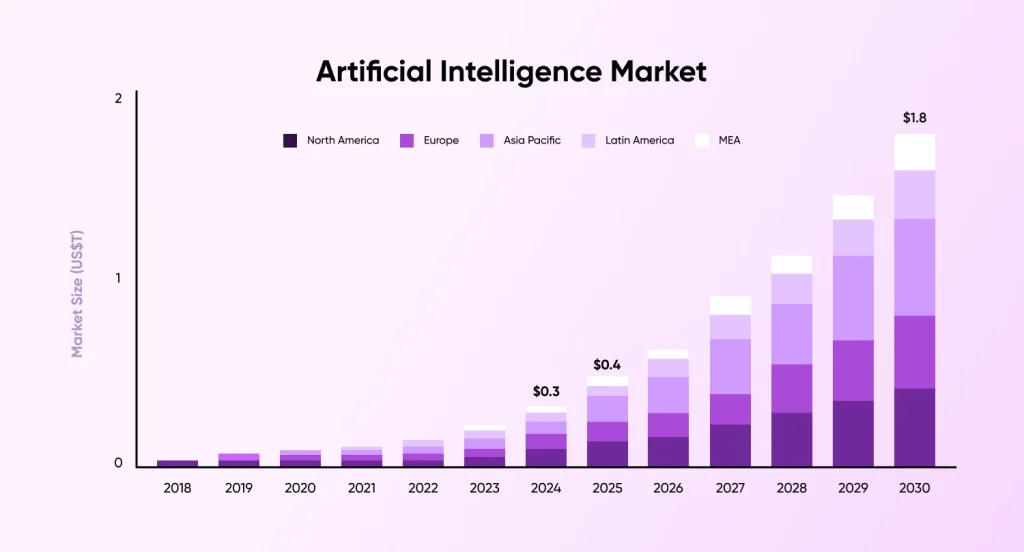
As reported by the McKinsey Global Institute State of AI 2025, the global AI market is projected to grow to USD 1.8 trillion by 2030. The primary growth drivers are:
- Increased accessibility to historical datasets is accelerating the pace of AI innovation.
- Affordability of cloud-based data storage enables large-scale data usage across sectors
- Improvements in deep learning, transformer architectures, and artificial neural networks
- Next-generation computing architectures supporting faster deployment, including Edge AI chips
- Rapid maturation of agentic AI workflows enabling autonomous, multi-step task execution
Costs do matter and make an actual difference. Today, there is more demand than supply for AI specialists, and salaries for senior ML engineers range from $130 to $200 per hour in the US market. In addition, regulatory compliance entails increased expenditures of 10%-20% of total project costs in case of the EU AI Act and new US regulations. McKinsey reports that efficiency improves by 20%-30% at AI-powered companies.
Projects that skip formal cost analysis are 2.3× more likely to experience significant budget overruns, making rigorous cost planning a competitive necessity rather than a formality.
Why AI Projects Fail: The 70–80% Problem
Before diving into cost frameworks, it is worth understanding where AI budgets go wrong. Gartner’s analysis of enterprise AI adoption consistently shows that most AI failures are not technical. They stem from three root causes:
- Unclear business objectives: Poor requirements definition adds 30–50% to the total project cost.
- Underestimated data readiness costs: Insufficient data preparation is the single largest hidden expense in AI projects.
- Misaligned architecture decisions: Choosing the wrong approach. For example, fine-tuning when RAG suffices wastes $50,000–$200,000 in avoidable spend.
Understanding AI development cost means understanding these failure modes first and building a structured cost plan that addresses them proactively.
Validate requirements, data readiness, and architecture before investing in development.
How to Conduct AI App Development Cost Analysis
AI development cost analysis is a systematic process to determine the budget needed for your specific project. It accounts for current market rates for AI developers, infrastructure costs, data requirements, and model complexity.
Step 1: Understanding Your AI Requirements
Identify the scope of functionality, required features, required data types, and integration challenges. The more clearly defined you can make this scope, the better the cost model that you create will be. Consider the following questions: What problem does this solve? What functionalities does this require? What data sources are available?
A prior question enterprises must answer: Should you build vs buy AI software?
| Criteria | Build Custom | Buy / License |
| Unique competitive advantage | Justified | Wasteful |
| Standard business function | Overkill | Recommended |
| Proprietary data integration | Necessary | Limited |
| Fast time-to-market needed | Slower (6–18 months) | Faster (weeks) |
| Long-term cost | Lower after 3 years | Ongoing licensing fees |
| Vendor lock-in risk | None | High |
| Customization depth | Unlimited | Constrained |
Rule of thumb: if your AI feature is a competitive differentiator, build it. If it is a table-stakes business function, a SaaS solution may be a better fit.
CMARIX specializes in custom builds for enterprises where differentiation matters. We also help clients audit existing AI tool investments through our product auditing service to identify over-investment in tools that can be better replaced by custom logic.
Step 2: Segment the Project into Phases
Segmenting your work into stages in the AI development lifecycle will help you ascertain costs and ensure proper time management. Here is a tabulated form of the market charges for 2026:
| Phase | Key Activities | Timeline | Cost (USD) |
| Discovery & Planning | Requirements, feasibility, tech selection, architecture | 2–4 weeks | $8,000 – $25,000 |
| Design Phase | UI/UX, AI interaction design, wireframes, prototypes | 3–6 weeks | $15,000 – $40,000 |
| AI Model Development | Data prep, model training, algorithm dev, optimization | 6–16 weeks | $40,000 – $150,000 |
| App Development | Frontend, backend, API, AI model integration | 8–20 weeks | $50,000 – $200,000 |
| Testing & Validation | AI, performance, security, and user acceptance testing | 3–8 weeks | $15,000 – $60,000 |
| Deployment & Launch | Cloud deploy, server config, production setup, go-live | 1–3 weeks | $5,000 – $20,000 |
| Maintenance & Updates | Model retraining, monitoring, bug fixes, feature updates | Ongoing | $15,000 – $80,000/yr |
Step 3: Evaluate Your AI Developer Hiring Requirements
The fundamental use cases of AI might be handled by just one or two engineers; however, more complex scenarios will require an entire team of experts in AI engineering, machine learning, and data science. Minimum hourly rates in 2026:
| Role | Key Responsibilities | US Rate (USD/hr) | India Rate (USD/hr) |
| AI Developer | Build & integrate AI models, implement algorithms, optimize workflows | $100 – $200 | $30 – $70 |
| ML Engineer | Design & train ML models, select algorithms, ensure pipeline scalability | $130 – $200 | $35 – $80 |
| Data Scientist | Analyze datasets, build predictive models, refine training data | $120 – $180 | $30 – $75 |
| Data Engineer | Design pipelines, clean/process raw data, maintain ETL workflows | $110 – $160 | $28 – $65 |
| DevOps Engineer | Deploy & monitor AI systems, manage CI/CD and cloud infrastructure | $100 – $150 | $25 – $60 |
| UI/UX Designer | Design AI interfaces, improve human-AI interaction patterns | $80 – $130 | $20 – $50 |
Hiring independent contractors is not only costly but also disorganized. An AI development team offers an organized team of machine learning engineers, data scientists, back-end developers, and DevOps engineers at cost-effective package rates 40% to 60% below the U.S. market rate.
Step 4: Choose the Right AI Technology Stack
Selecting the appropriate set of technologies based on your problem will determine your costs and results. Below is a well-structured list of the principal AI technology stacks to consider in 2026 for project success.
- Machine Learning (Structured Data & Predictions): Machine learning development services are best for customer segmentation, fraud detection, sales forecasting, and recommendation engines. Key tools: Scikit-learn, XGBoost, LightGBM, H2O.ai, Google Cloud AutoML.
- Deep Learning (Unstructured Data) is best for image recognition, audio processing, video analysis, and complex NLP. Key tools: TensorFlow, PyTorch, Keras, JAX, DeepSpeed.
- Natural Language Processing: The transformer revolution of combining computer vision and AI (BERT, GPT-4, Claude) has made it possible to build sophisticated language applications without training from scratch. Key tools: Hugging Face Transformers, spaCy, NLTK, OpenAI API, AllenNLP.
- Computer Vision: Ideal use cases include retail analytics, medical imaging, self-driving cars, and quality control applications. Relevant frameworks: OpenCV, YOLO, Detectron2, MediaPipe, MMDetection.
- Generative AI is among the most disruptive types of technologies in 2026. Best for content generation, code generation, image creation, and automation in design. Major technologies: OpenAI (GPT-4, DALL-E), Midjourney, Claude, Runway ML, Stable Diffusion, and Jasper.
- RAG vs. Fine-Tuning (2026 Priority Decision): In any NLP or generative AI application, this is now the most important decision to make; see the relevant section below. Making the wrong decision will cost $50,000-$200,000 in unnecessary spending.
- Agentic AI Workflows (2026 Priority): Agentic architectures, such as AutoGen, CrewAI, and LangGraph, allow for task sequences to be completed autonomously with little human interaction required. The costs associated with agentic architectures include a 30-60% increase in overhead over normal development times due to coordination, error recovery, and testing.
- Edge AI (2026 Priority): Utilizing AI inference at the edge (either on-device or on-premises) lowers latency and minimizes data transfer expenses, but necessitates specific optimizations through TensorRT, OpenVINO, and ONNX Runtime. This is primarily useful in manufacturing, healthcare, and autonomous applications. Refer to the “Edge AI vs Cloud AI” comparison section below.
- Reinforcement Learning should be used for dynamic decisions and robotics process automation. Tools: OpenAI Gym, Stable Baselines3, RLlib, DeepMind Acme. Use with care, since many reinforcement learning applications are implemented incorrectly. Contact an AI expert first.
Step 5: AI App Infrastructure and Data Planning
Plan the technical backbone of your AI project by estimating all infrastructure-related costs, including:
- Cloud computing platform services: AWS, Azure, GCP
- GPU/TPU instance services for training machine learning models
- Data storage, bandwidth, and pipeline services
- Third-party AI API usage (OpenAI, Hugging Face, etc.)
- Edge inference hardware, if applicable
- Long-term monitoring, scaling, and compliance services
Cloud hosting monthly costs at scale (2026):
| Traffic Level | Monthly Cost (USD) |
| Basic AI app (low traffic) | $500 – $2,000 |
| Mid-tier (10K–100K users) | $2,000 – $10,000 |
| Enterprise (100K+ users, real-time) | $10,000 – $50,000 |
Token costs for LLM-based features:
| Model | Cost per 1K Tokens |
| GPT-4 class | ~$0.01 – $0.03 |
| Anthropic Claude API | ~$0.008 – $0.024 |
| Open-source self-hosted (LLaMA, Mistral) | Near zero (compute cost only) |
Step 6: Comprehensive Cost Estimation
Build a full cost profile covering developer rates, infrastructure, software licensing, design, QA, DevOps, project management, and model retraining sprints.
Remember to factor in a buffer of 10-20%. This is the least followed tip in AI project budgeting.
Benefits of AI App Development Cost Analysis
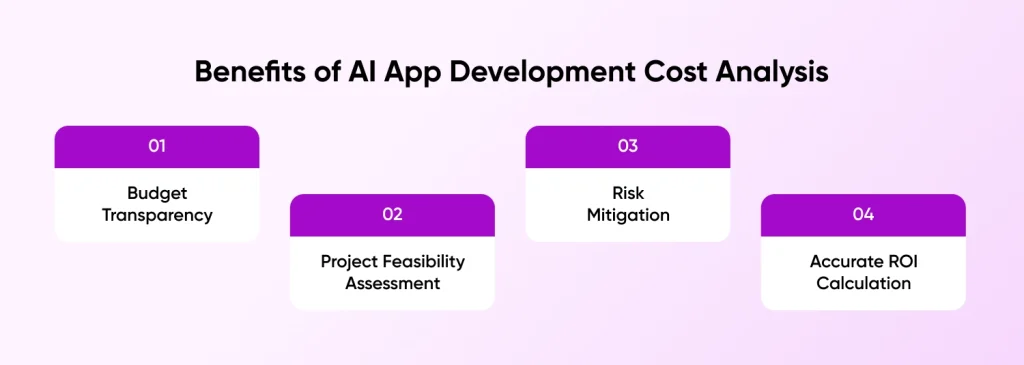
- Budget Transparency: A detailed cost model shows exactly where your AI development funds are going, helping you stay on track and avoid surprise expenses at every stage.
- Project Feasibility Assessment: It will help you find out whether your project can be completed within budget limitations and is expected to generate sufficient ROI.
- Risk Mitigation: Identifying potential budget overruns early, particularly around model training costs and data pipeline complexity, allows teams to plan mitigation strategies proactively.
- Accurate ROI Calculation: Knowing how much the project is expected to cost will allow you to calculate its expected ROI and overall ROI reliably.
AI App Development Cost Comparison: Enterprise RAG vs. Fine-Tuning
This is now the most important architectural decision in AI software development cost planning. Understanding the comparison between RAG and Fine-Tuning can save your business $100,000 or more.
What Is RAG Architecture?
Enterprise RAG architecture connects a large language model to your private knowledge base at query time. The model retrieves relevant documents dynamically. It does not need retraining when your data changes.
RAG Cost Breakdown (2026 estimates):
| Component | Estimated Cost (USD) |
| Vector database setup (Pinecone, Weaviate) | $5,000 – $20,000 |
| Document ingestion pipeline | $10,000 – $35,000 |
| API integration (OpenAI, Anthropic, etc.) | $8,000 – $25,000 |
| Ongoing inference cost (per 1M tokens) | $10 – $60 |
| Total RAG build | $25,000 – $80,000 |
What Is Fine-Tuning?
Retraining fine-tunes the base model using your proprietary data. It internalizes domain-specific knowledge. It makes inference faster but costly to update.
Fine-Tuning Cost Breakdown (2026 estimates):
| Component | Estimated Cost (USD) |
| Data curation and labeling | $20,000 – $80,000 |
| GPU compute (A100/H100 cluster time) | $15,000 – $100,000 |
| Model validation and safety testing | $10,000 – $40,000 |
| Retraining cadence (quarterly) | $15,000 – $60,000/cycle |
| Total fine-tuning build | $60,000 – $280,000+ |
The Decision Framework
Choose RAG when:
- There are frequent updates in your knowledge base (policies, products, documents, etc.)
- Source document citations are necessary for audit purposes
- You operate in the healthcare, legal, or finance domain.
- Budget is the main concern, and speed to market is essential.
Choose fine-tuning when:
- Your task requires deep stylistic consistency (e.g., brand voice generation at scale)
- Latency must be minimized for high-volume real-time inference.
- Your training data is proprietary and cannot be sent to third-party APIs
In most enterprise cases, RAG delivers 70–80% of fine-tuning’s capability at 30% of the cost. Start with RAG. Scale to fine-tuning only when specific performance thresholds require it.
Get a technical assessment based on your data, compliance requirements, and AI objectives.
Edge Computing vs. Cloud AI: The Cost of Where You Process
This decision now carries major financial weight. The right answer between Edge computing and cloud computing depends on your data sensitivity, latency needs, and volume.
Comparison: Edge vs. Cloud for AI Apps (2026)
| Factor | Edge Computing | Cloud AI (AWS/GCP/Azure) |
| Upfront hardware cost | $15,000 – $100,000+ (NVIDIA Jetson, custom HW) | $0 – $5,000 (infrastructure setup only) |
| Inference cost at scale | Near zero (local processing) | $0.01 – $0.10 per request (API-based) |
| Latency | 5–20ms (on-device) | 80–400ms (network dependent) |
| Data privacy | Full control, no data leaves device | Depends on vendor contract and region |
| Model update cycle | Complex OTA deployment | Instant, centrally managed |
| Best for | Manufacturing, medical devices, IoT, autonomous systems | SaaS apps, chatbots, recommendation engines |
| Maintenance cost | $10,000 – $50,000/year (hardware + firmware) | Included in compute fees |
| Compliance | Easier for HIPAA, GDPR (data stays local) | Requires contractual data processing agreements |
The Hybrid Approach
In advanced enterprise applications of AI, a hybrid approach is adopted. In this case, simple models are used in edge computing, while complex models are used in the cloud. The CMARIX’s guide to choosing between edge computing and cloud computing architecture helps to understand how to create an AI app.
Major Factors Influencing Cost of Building Custom AI Apps in 2026
1. AI Application Type and Complexity
The biggest determining factor that drives up costs is the kind of AI application that one intends to build. Chatbots that use pre-trained natural language processing models do not need a lot of customization. Autonomous AI applications, on the other hand, need much more.
| AI App Type | Cost Range (USD) | Key Complexity Factors |
| Simple Chatbot | $15,000 – $50,000 | Pre-trained models, basic NLP |
| Recommendation Engine | $25,000 – $80,000 | User behavior analysis, collaborative filtering |
| Image Recognition App | $40,000 – $120,000 | Computer vision, model training |
| Voice Assistant | $60,000 – $150,000 | Speech processing, context understanding |
| Predictive Analytics Platform | $80,000 – $200,000 | Statistical modeling, data pipeline integration |
| Computer Vision System | $100,000 – $300,000 | Deep learning, real-time processing |
| Autonomous / Agentic AI System | $200,000 – $500,000+ | Multi-modal AI, agentic workflow orchestration |
| Enterprise AI Platform | $300,000 – $1,000,000+ | Scalable architecture, Edge AI, enterprise integration |
2. Geographic Location of AI Development Team
Geographical Location continues to be one of the cost elements that carries weight. The world’s geography, when it comes to the availability of AI talent, leads to disparities in rates, even though the divide continues to shrink as remote work becomes the norm.
| Region | Annual Cost (USD) | Hourly Rate | Key Considerations |
| North America | $120,000 – $200,000 | $80 – $200/hr | Premium talent, timezone alignment |
| Western Europe | $80,000 – $150,000 | $60 – $150/hr | Strong technical skills, GDPR expertise |
| Eastern Europe | $40,000 – $80,000 | $30 – $80/hr | Excellent technical education, cost-effective |
| India & South Asia | $25,000 – $60,000 | $20 – $60/hr | Large talent pool, English proficiency |
| Latin America | $35,000 – $70,000 | $25 – $70/hr | Timezone compatibility with US |
3. AI Model Training Cost and Complexity
The way you choose to develop a model can greatly affect your budget. If you want to integrate pre-trained models, that can save time, but there is little room for customization. If you opt to build everything from scratch, you will get full control, but you will also pay the most.
| Approach | Cost Range | Description |
| Pre-trained Model Integration | $5,000 – $25,000 | Leveraging GPT, BERT, or CV APIs with minor customization |
| Custom Model Fine-tuning | $20,000 – $80,000 | Adapting pre-trained models with domain-specific data |
| Built-from-Scratch Models | $50,000 – $200,000+ | Full custom algorithm design, training infrastructure, and testing |
| Large Language Models (LLMs) | $100,000 – $500,000+ | Enterprise-scale models requiring massive compute and specialized talent |
4. AI App Development Timeline and Urgency
The project’s timeline has a considerable effect on its expenses as a result of resource distribution and priority handling. Premium prices will have to be offered to ensure the availability of staff.
| Timeline Scenario | Cost Impact |
| Standard Timeline | Baseline cost with optimal resource allocation |
| Accelerated Development | 25–40% cost increase due to additional resources and coordination overhead |
| Rush Projects | 50–100% premium for immediate talent acquisition and parallel workstreams |
| Extended Timeline | Higher total costs due to prolonged resource commitment and scope expansion |
Cost Breakdown by Project Scale
| Scale | Cost Range (USD) | Team Size | Timeline | Complexity |
| Small Scale | $15,000 – $50,000 | 1–2 developers | 2–4 months | Basic API integration |
| Medium Scale | $50,000 – $200,000 | 3–5 specialists | 4–8 months | Custom model development |
| Large Scale | $200,000 – $500,000+ | 5–10+ members | 8–18 months | Enterprise-grade solution |
- Small-Scale AI Projects ($15,000 – $50,000): Such projects are perfect for startups trying out AI implementation in their products or organizations experimenting with using AI to solve a particular problem. Small-scale AI projects usually utilize already built AI APIs without much custom modeling. The typical examples of such projects are simple chatbots, recommendation engines, and image recognition using available APIs.
- Medium-Scale AI Projects ($50,000 – $200,000): Medium-scale projects usually include custom modeling tailored to the client’s business needs and thus require higher levels of developer expertise. Typical examples of medium-scale projects include advanced NLU-based chatbots, recommendation engines with user behavior analysis capabilities, and Computer vision development projects.
- Large-Scale AI Projects ($200,000 – $500,000+): Large-scale AI solutions use multiple modalities and have high infrastructure requirements. Large-scale projects usually have several agentic flows as well as edge AI modules.
API-Based Generative AI Solutions
Almost all business operations will start by implementing API solutions as they require low startup costs. Generative AI integration in your app comes with some cost considerations apart from typical ML models.
However, on-demand pricing may prove to be very costly on a large scale. Some of the pricing considerations that you should consider include:
Generative AI feature-specific cost impacts:
| Feature Type | Basic Integration | Advanced Build |
| Text generation (LLM) | $15,000 – $40,000 (API + prompt engineering) | $40,000 – $120,000 (RAG system) |
| Image/video generation | $10,000 – $30,000 (Stable Diffusion API) | $40,000 – $120,000 (custom fine-tuning) |
| Code generation | $20,000 – $60,000 (basic) | $80,000 – $250,000 (enterprise, custom training) |
| Multimodal AI (text + image + audio) | — | $80,000 – $300,000+ |
For high-volume applications processing millions of queries monthly, self-hosting open-source models such as LLaMA 3, Mistral, or Phi-3 can save $50,000–$200,000/year in API token costs.
Hidden Costs to Consider When Budgeting for AI
1. Data Acquisition and Processing
Poor-quality data is the most common reason AI projects fail or require expensive restarts. Plan for data-related costs early:
- Data acquisition from licensed external sources: $10,000 – $100,000
- Data cleaning, labeling, and structuring: $15,000 – $60,000
- Scalable, compliant data storage: $1,000 – $10,000/month
- Data pipeline engineering for enterprise integrations: $15,000 – $50,000
- Ongoing data governance: $8,000 – $30,000/year
2. Technology and Computing Requirements
AI demands significant compute, particularly during model training and high-concurrency inference:
- GPU/TPU instances: $2,000 – $15,000/month
- Cloud hosting: $1,500 – $8,000/month
- Data transfer and API calls: $500 – $3,000/month
3. Privacy, Security, and Compliance
If your AI app handles sensitive data, regulatory compliance is non-negotiable:
- GDPR/HIPAA compliance engineering: $20,000 – $80,000
- Security tooling and access controls: $15,000 – $50,000
- Third-party audits and certifications: $10,000 – $30,000
4. Model Explainability (XAI)
Enterprise procurement teams and regulators increasingly demand that AI decisions be explainable. Adding XAI layers costs $10,000 – $40,000 in development time.
5. Prompt Engineering and System Tuning
For LLM-based apps, optimizing prompts and system instructions is ongoing work. Budget 10–15% of the initial build cost annually for this maintenance.
6. Model Drift Monitoring
AI models degrade as real-world data shifts. Monitoring systems and retraining pipelines cost $10,000 – $40,000 to implement and $5,000 – $20,000/year to maintain.
7. Ongoing Maintenance and Model Upkeep
AI systems require continuous monitoring, retraining as data distributions shift, and regular updates. This is especially true for LLMs and agentic systems:
- Model retraining cycles: $5,000 – $25,000 per cycle
- Performance monitoring: $3,000 – $15,000/month
- Technical support: $8,000 – $40,000/year
8. Team Training and Change Management
Your development team built it. Your business teams need to use it effectively. Training programs for AI tools cost $5,000 – $30,000 per deployment.
Together, these hidden costs often add 30–50% to the quoted build cost. They are the most commonly missed line items in initial vendor quotes.

AI ROI Framework: When Does AI App Investment Pay Off?
According to McKinsey’s State of AI report, organizations with mature AI capabilities report 20–30% efficiency improvements in core operations. The ROI timeline varies by application type.
| AI App Type | Avg. Build Cost | Annual Savings / Revenue Gain | Typical Payback Period |
| Customer service automation | $40,000 – $120,000 | $80,000 – $300,000 | 6–18 months |
| Predictive maintenance | $80,000 – $250,000 | $200,000 – $1M+ | 12–24 months |
| Sales / demand forecasting | $60,000 – $180,000 | $100,000 – $500,000 | 8–20 months |
| Healthcare diagnostic AI | $150,000 – $500,000 | $300,000 – $2M+ | 18–36 months |
| Document processing (NLP) | $50,000 – $150,000 | $100,000 – $600,000 | 6–15 months |
How to calculate ROI on an AI investment: ROI of an AI investment calculation: Begin with a defined problem and a metric against which to measure it. Work out the cost of your problem today – labor required, error rates, churn, lost sales. Estimate the improved future state with conservative projections (15-25%). Annualized cost savings divided by the total cost of the solution (development and ongoing maintenance). A payback period of less than two years is often considered good ROI for enterprise-level AI investments. You can find out more about this in our CMARIX AI ROI Framework guide.
The ROI case for AI is strong when the build is scoped correctly. The failure cases are almost always projects that started without a validated problem statement and cost plan.
How to Reduce AI Development Cost Without Sacrificing Quality
1. Start with an AI POC
Validate your AI premise before committing fully. An AI proof of concept that is targeted will take 3-6 weeks to develop and cost $8,000–$25,000.
2. Choose RAG Over Fine-Tuning Initially
As covered above, RAG provides 70–80% of fine-tuning’s accuracy at 30% of the cost. Shift to fine-tuning only when specific performance thresholds require it.
3. Use Open-Source Models Where Possible
LLaMA 3, Mistral, and Phi-3 are production-grade open-source models. Self-hosting them eliminates ongoing API token costs. For high-volume apps, this can save $50,000 – $200,000/year.
4. Hire a Dedicated AI Team
By engaging a dedicated AI team consisting of a machine learning engineer, data scientist, backend engineer, and DevOps engineer, it can be done offshoring at a lower cost between 40% and 60% as opposed to a US-based team, while maintaining high quality using efficient project management.
5. Architect for Incremental Scaling
Architect for a modular design. Begin with one AI-based capability and then add more capabilities when the need arises through validated user acceptance.
6. Add a Contingency Buffer
It is imperative that you always include a contingency buffer in the range of 10-20%. This is the single most forgotten aspect when it comes to AI project budgeting.
Why Hire AI Developers from CMARIX?
Our team has a strong blend of technical skill sets in areas such as PyTorch, TensorFlow, LangChain, and state-of-the-art agentic AI development, coupled with practical experience implementing solutions in the healthcare, financial services, e-commerce, and manufacturing sectors.
- Full-service delivery: from architecture design to model training, deployment, and optimization
- Industry-specific services designed to meet compliance, scalability, and security requirements
- Scalable approach: hire individual AI engineers or a whole team based on your needs
- Proven track record of successful delivery of projects for multiple global clients
For context, here is how provider types compare on typical project cost:
| Provider Type | Typical Project Cost | Notes |
| Big 4 Consulting (Deloitte, Accenture) | $500,000 – $5M+ | Strategy-heavy, high overhead |
| US Boutique AI Firms | $150,000 – $800,000 | Specialized but expensive |
| Offshore Development Partner (Tier 1) | $50,000 – $300,000 | Cost-efficient, quality varies |
| CMARIX (India-based, US-managed) | $40,000 – $350,000 | ISO-certified, 40+ industries, dedicated teams |
Contact our senior engineers for a free AI development cost estimation.
Final Words
When it comes to AI app development in 2026, there are no more “ifs”. There are only questions about how prepared you are going into the process. The cost of implementing AI ranges from $15,000 for an API-based app to over $1,000,000 for an enterprise-level platform. However, all these prices vary based on one important principle.
Every dollar of variance traces back to an early decision: how clearly you defined the problem, how honestly you assessed your data readiness, whether you chose RAG or fine-tuning, edge or cloud, build or buy.
But it was not because of the size of the budget that some of these organizations saw the best ROIs on their AI investments; it was simply because they treated cost management as an integral part of their strategy, rather than a mere formality. Let’s begin our journey with this AI cost estimation guide and validate our assumptions through discovery and incremental growth.
FAQs on AI App Development Cost
How much does AI app development cost in 2026?
AI app development costs range from $15,000 for basic API-based applications to $1,000,000 for enterprise-level apps. However, the average cost range is $50,000-$200,000. This depends on a number of factors, such as the complexity of the application itself, the amount of data necessary, infrastructure needs, RAG versus fine-tuning choices, and ongoing maintenance responsibilities.
What factors most influence AI app development costs?
Five main drivers include the kind of model that an organization needs to implement (RAG, fine-tuning or completely custom), quality and quantity of available data, integration needs for existing infrastructure, compliance needs (in healthcare, financial and legal environments), and geography and experience level of the team.
What are the hidden costs most enterprises miss?
Four common hidden expenses include data cleansing and labeling ($10,000-$80,000, depending on the amount); drift detection and model re-training pipelines; compliance and audits; and training of users. Overall, these may contribute an extra 30-50% cost to the build expenses.
Can I reduce AI app development costs without compromising quality?
Yes, you should. Employ pre-trained models and RAG architectures if possible; begin your AI proof-of-concept with an $8,000 – $25,000 budget; leverage open-source platforms such as PyTorch and TensorFlow; and hire an offshore team that has successfully delivered on similar projects. With offshore resources, you’ll see 40%-60% reduction in blended team cost compared to a pure US team.
What are the maintenance costs after launching an AI app?
They will amount to 15-25% annually of the building expenses. An AI application that costs $100,000 will demand from $15,000 to $25,000 per year for maintenance operations such as monitoring, training, scaling, and protection. RAG solutions involve relatively lower maintenance costs since knowledge base updates don’t entail training.
What is agentic AI, and does it cost more to build?
Agentic AI refers to a system that can execute tasks independently involving multiple steps by combining various tools and sub-agents. Indeed, agentic AI solutions incur greater costs since additional orchestration mechanisms and testing increase development time by 30-60% as compared to other integration strategies.
What is Edge AI, and when should I consider it?
This approach involves performing machine learning computations directly in hardware or on-device, which reduces latency and expenses for inference services. Edge AI applies mainly to manufacturing processes, healthcare, autonomous solutions, where real-time inference is required. The downside of using Edge AI includes higher device expenses ($15,000-$100,000+), but near-zero inference expenses.
How do I integrate AI into an existing business application?
First off, pinpoint a problem that AI can fix such as automation, enhancing customer services, or creating predictive analyses. Find suitable training datasets, use proper AI frameworks, and conduct a test on a small scale first before deploying on a larger scale. The discovery phase will cost anywhere between $8,000 to $25,000 but is worth avoiding common pitfalls.
How much does AI cost to run on an ongoing basis?
Ongoing AI operational cost breaks into three components: compute/inference (cloud API or self-hosted GPU) at $500 – $50,000/month depending on traffic volume; data pipeline and storage at $200 – $5,000/month; and monitoring, retraining, and engineering support at $5,000 – $20,000/month. Open-source models self-hosted on your infrastructure eliminate API token costs, but require a higher upfront infrastructure investment.