

Quick Summary: Website development cost in 2026 varies between $2,000 for a small brochure website for a business and above $150,000 for a custom web portal, and the major portion of that difference depends on the intricacy of design, work done at the back end, and integration. This guide breaks the market into three pricing tiers, walks through a seven-step way to calculate your own budget, and shows the math behind each number so nothing here is a guess.
Most companies begin pricing a website the wrong way. They ask vendors, “How much does a website cost?” as if there’s only one number to get started, then get disappointed when three different providers come back with different quotes for what feels like the same request.
The truth is that website development cost isn’t really one question; it’s five or six smaller ones stacked together: what kind of site, how much backend logic, how much custom design, which features, and who’s building it. A five-page marketing site and a client portal with role-based logins are both “websites,” but they don’t belong anywhere near the same budget conversation.
What Is Website Development Cost?
Website development cost is the total you pay to design, build, and launch a functioning website, including everything from UI/UX design and frontend and backend development to CMS setup, third-party integrations, and initial testing. It does not automatically include continuous hosting, domain renewal, or website maintenance and support, which are recurring costs layered on top of the one-time build.
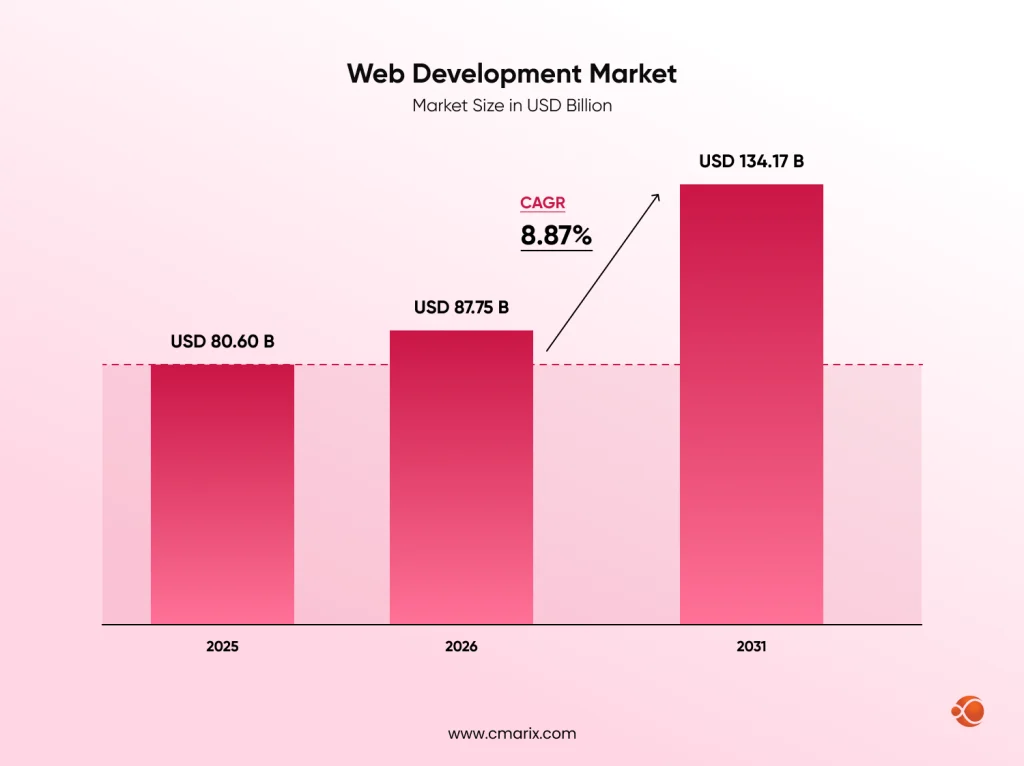
According to Mordor Intelligence, the web development services market was valued at $80.6 billion in 2025 and is projected to grow to $87.75 billion in 2026, reaching $134.17 billion by 2031 at a compound annual growth rate of 8.87%. That growth is being driven largely by businesses that used to treat a website as a one-time expense and now treat it as a platform that needs ongoing investment, which is part of why budgets vary so widely depending on what “done” actually means for a given project.
Website Development Cost by Tier
Before getting into how the number is calculated, here’s where most projects land. Every dollar figure later in this guide maps back to one of these three tiers.
| Tier | What It Covers | Build Cost | Annual Maintenance |
| Starter / Small Business | A 5- to 10-page brochure site, template-based or lightly customized design, standard CMS setup | $2,000 – $9,000 | ~$1,200 |
| Mid-Market / Custom CMS | Custom corporate website design, a CMS-driven build, moderate integrations like booking, CRM, or payment gateways | $9,000 – $30,000 | $3,000 – $6,000 |
| Enterprise / Web Portal | A custom web application or web portal, complex integrations, multi-role dashboards, financial or regulatory compliance needs | $30,000 – $150,000+ | $10,000+ |
That puts the full website development pricing range at $2,000 to $150,000 or more. Most small and mid-sized businesses land between $9,000 and $30,000 once they move past a basic brochure site and need a real CMS behind the scenes.
How to Calculate Your Website Development Cost in 7 Steps
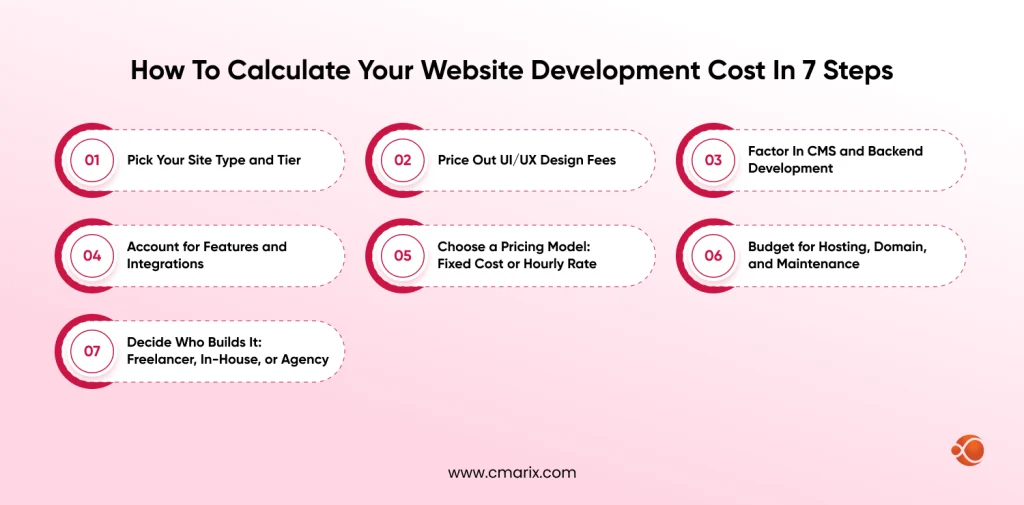
Step 1: Pick Site Type and Tier
Start with what you are making, because that one choice will determine the top and bottom line of all that follows:
- Brochure or marketing site – a few pages designed to sell you, usually Starter.
- Corporate or CMS-driven site – a larger site with a blog, resource library, or team-managed content, usually Mid-Market.
- Custom web application or web portal – login-gated dashboards, client accounts, or workflow tools, usually Enterprise. If you’re weighing WordPress against a custom build, our guide on the cost to develop a WordPress website breaks down where CMS pricing tends to land compared to fully custom development.
- eCommerce store – Product catalog, online checkout process, and payment processing for an eCommerce store, which can range from Starter to Enterprise based on catalog size and platform. If Magento is on your shortlist, it’s worth reading through current Magento pricing before committing, since licensing and extension costs shift the math more than most people expect.
Step 2: Price Out UI/UX Design Fees
Design is usually the first line item people underestimate. A template with light customization might run $500 to $2,000. Fully custom UI/UX, including wireframes, user flows, and a design system your dev team can build from, typically runs $3,000 to $15,000 depending on how many unique page templates you need. Scalability and feature requirements you know are coming later, like a future member portal, are worth designing around now even if you’re not building them yet, since retrofitting navigation and layout later usually costs more than planning for it upfront.
Step 3: Factor In CMS and Backend Development
This is where frontend development costs begin to differ from backend development costs. Frontend development – which refers to the part that users navigate through and click on – is typically just a fraction of the total cost once backend functionality comes into play. It is only when there is full-stack development that includes database development, admin panel development, user authentication, or even API integration that a project can be considered to be an enterprise project. CMS development costs, on the other hand, depend on whether you customize an existing system such as WordPress or build your own CMS, while web portal development costs scale the fastest.
Our team can scope the backend requirements on a quick call, no pressure either way.
Step 4: Account for Features and Integrations
Add up every feature you actually need, not every feature that sounds nice to have:
- E-commerce functionality – product pages, cart, checkout, and payment gateway integration, which alone can add $2,000 to $10,000+ depending on catalog complexity.
- Membership or client portals – gated content and login systems, generally adding $1,000 to $5,000 to a Mid-Market build.
- CRM or booking integrations – connecting your site to sales or scheduling tools, usually a few hundred to a couple thousand dollars per integration depending on how custom the connection needs to be.
- Compliance requirements – accessibility standards, data privacy rules, or financial regulatory compliance for anything handling payments or sensitive data, which tends to push a project into Enterprise territory regardless of how simple the frontend looks.
Step 5: Choose a Pricing Model: Fixed Cost or Hourly Rate
How you pay determines budget predictability. There are two pricing models: fixed cost and hourly rate. Each suits certain cases: fixed pricing works when the project scope won’t change, and the client wants budget predictability, which suits most Starter and Mid-Market projects. Hourly or Time and Materials can be used when the project scope will change during the work process, which often happens in Enterprise projects when new requirements emerge as real users test the portal.
Here’s how the math checks out at the Starter tier: an offshore developer working with a blended rate of about $30 per hour and putting in about 300 hours to build a brochure site gets $9,000, which is exactly the maximum budget of the Starter level. A Mid-Market corporate site with a blended rate of $35 per hour and 600 hours of development time totals $21,000.
Step 6: Budget for Hosting, Domain, and Maintenance
Domain and hosting prices are low but accumulate together. Domain registration costs $10 to $20 annually. Shared hosting costs $8 to $15 per month, while dedicated or VPS hosting for a website used by many people and classified as Mid-Market or Enterprise costs much more. To this cost, you should add website maintenance, which includes fixing all vulnerabilities, making backups, and dealing with any kind of bugs, and you will get the price for annual website maintenance from the table above – about $1,200 for the Starter website, up to $10,000 for the Enterprise website.
Step 7: Decide Who Builds It: Freelancer, In-House, or Agency
Who does the work shapes both the cost to hire a software developer and how the total budget breaks down:
- Freelance – generally the cheapest option, ideal for a well-scoped Starter project where you don’t need a full team. Our breakdown of the cost to hire a software developer covers how rates shift by region, since offshore freelance rates and U.S.-based freelance rates can differ by 3x or more for the same skill level.
- In-house – makes sense if you’re building and iterating on a site continuously, but carries salary, benefits, and management overhead that rarely makes sense for a single project.
- Agency – typically the highest cost per hour, but includes project management, QA, and a coordinated team, which matters most on Mid-Market and Enterprise builds where a discovery phase and multiple specialists are involved rather than a single generalist developer.

Quick Website Development Step-wise Cost Estimation
Here’s every component from the steps above in one place, so you can total up your own project without flipping back and forth.
| Cost Component | Typical Range |
| UI/UX design (template) | $500 – $2,000 |
| UI/UX design (fully custom) | $3,000 – $15,000 |
| E-commerce functionality | $2,000 – $10,000+ |
| Membership or client portal | $1,000 – $5,000 |
| CRM or booking integration | A few hundred – $2,000 per integration |
| Domain registration | $10 – $20 / year |
| Shared hosting | $8 – $15 / month |
| Maintenance, Starter tier | ~$1,200 / year |
| Maintenance, Mid-Market tier | $3,000 – $6,000 / year |
| Maintenance, Enterprise tier | $10,000+ / year |
What’s Changing Website Development Pricing in 2026
AI is compressing design time, not backend time
AI tools are starting to speed up the design and frontend portion of a build. That’s nudging Starter and Mid-Market budgets down slightly. Backend and integration work hasn’t seen the same shift, since that’s still hands-on engineering. Our guide to AI in web development covers where AI is actually saving build time today, from accessibility audits to code generation, and where it’s still mostly hype.
Vertical-specific builds cost more than they look
When a website needs to do more than serve pages, the pricing model changes drastically, and the industry plays a big role in that. For example, in education, the eLearning development costs run higher than a standard corporate site, even at a similar page count. Progress tracking, course players, and LMS architecture all add backend complexity that a plain brochure site never touches.
Get a tailored breakdown before you commit to a build.
Why Choose CMARIX for Website Development
Selecting the right partner can be as important as choosing the right price tier. CMARIX operates across all three tiers, from Started marketing websites to custom enterprise websites, and scopes projects either to a flat cost or an hourly rate, depending on how rigid your requirements are.
All the processes involved, from the development of the front-end and back-end of websites to the construction of CMS and web portal websites, and even the maintenance and support of your website, are managed within the same organization, thereby saving you from having to coordinate among various partners such as designers, developers, and hosting services separately. If you’re unsure whether to choose WordPress or a custom website, or whether to work with freelance developers or an agency, a quick project scoping discussion can help.
FAQs on Website Development Cost
How much does it cost to build a website?
Website development cost in 2026 ranges from $2,000 for a Starter brochure site to $150,000 or more for a custom Enterprise web portal. Most small and mid-sized businesses land between $9,000 and $30,000 once a custom CMS and a handful of integrations are involved.
What is the average cost of web development services?
There isn’t one average that applies across every project, since a five-page site and a client portal aren’t priced the same way. Within three pricing tiers, most small and mid-sized business builds fall between $9,000 and $30,000, the Mid-Market range.
How do you calculate website development cost?
Add up design fees, frontend and backend development, features and integrations, your chosen pricing model, and ongoing hosting and maintenance. The seven-step breakdown above walks through each of these in order, and every example number is checked against the $2,000 to $150,000+ tier table so nothing here is a random figure.
What factors influence website development pricing?
The biggest factors are site type and tier, design complexity, backend and CMS requirements, the number and complexity of integrations, your pricing model, and who builds it. Compliance needs, like financial regulatory compliance for anything handling payments, can push a project into a higher tier regardless of how simple the frontend looks.
How much does custom website development cost?
Custom website development costs typically start where the Mid-Market tier begins, around $9,000, and can exceed $150,000 for a fully custom Enterprise web application. The more custom logic and unique features involved, the further a project moves from Starter pricing.
What does a CMS website cost?
CMS development cost depends on whether you’re configuring an existing platform or building a custom content management system. A standard CMS-driven corporate site falls in the Mid-Market tier, $9,000 to $30,000, while a lightweight CMS setup on a template can stay in the Starter range.
How much does it cost to develop a web portal?
Web portal development costs fall in the Enterprise tier, usually $30,000 to $150,000 or more, because portals require custom user roles, permissions, and data models rather than off-the-shelf CMS features.
Does website development cost include hosting and domain?
No. Hosting and domains are monthly fees that don’t contribute to the build cost because they are recurring. Domains cost between $10 and $20 annually, while hosting costs about $8 to $15 per month, depending on the plan you choose.
How much should I budget for website maintenance?
Maintaining a Starter site will cost about $1,200 per year; a Mid-market site will cost between $3,000 and $6,000; and an Enterprise portal that requires security monitoring and maintenance will cost $10,000 or more. These costs cover website maintenance and support, not construction.
How much does a B2B website cost to develop?
A B2B website usually falls in the Mid-Market to Enterprise range, $9,000 to $150,000+, depending on whether it needs a client portal, CRM integration, or quote and proposal tools on top of standard marketing pages.