





Quick Summary: A cash advance application is all about trust, and trust starts with the way that you handle the financial data of your customers. The following article will show you step-by-step how you can create your very own private LLM for credit scoring. This will help answer the questions of “why,” “how,” and “at what cost.”
The effectiveness of cash advance applications is contingent upon their capability to underwrite accurately and quickly. Be too restrictive, and people will simply take their business elsewhere. But be too lenient and defaults will eat into your profits. Traditional scoring algorithms do not have the ability to deal with both challenges simultaneously, which is why there are a lot of lending apps that are looking at using an LLM for credit scoring that understands a bank statement.
Pressure is being applied from both sides. Consumers want a response within seconds rather than days, and any friction in the approval process drives them toward the app that approves quickest. On the other hand, consumers who lack a credit file or whose credit history is thin- the exact people a cash advance product is designed for- don’t score well on bureau data. A rules engine built around FICO (Fair Isaac Corporation) bands will simply decline these consumers outright or approve them blind.
Many of the LLM providers’ terms of use for their API mean that your users’ transaction records with their bank, income information, and spending patterns are going outside of your network to a third-party service. While this will be acceptable for most consumer applications, it won’t be for a lending app that processes consumers’ sensitive financial information according to GLBA, state lending regulations, and growing fair-lending requirements. Only a privately hosted LLM, which you install, manage, and control on an end-to-end basis, becomes an increasingly viable option for regulated lenders. This blog post is a road map on how to build such a model.
What Is a Private LLM for Credit Scoring?
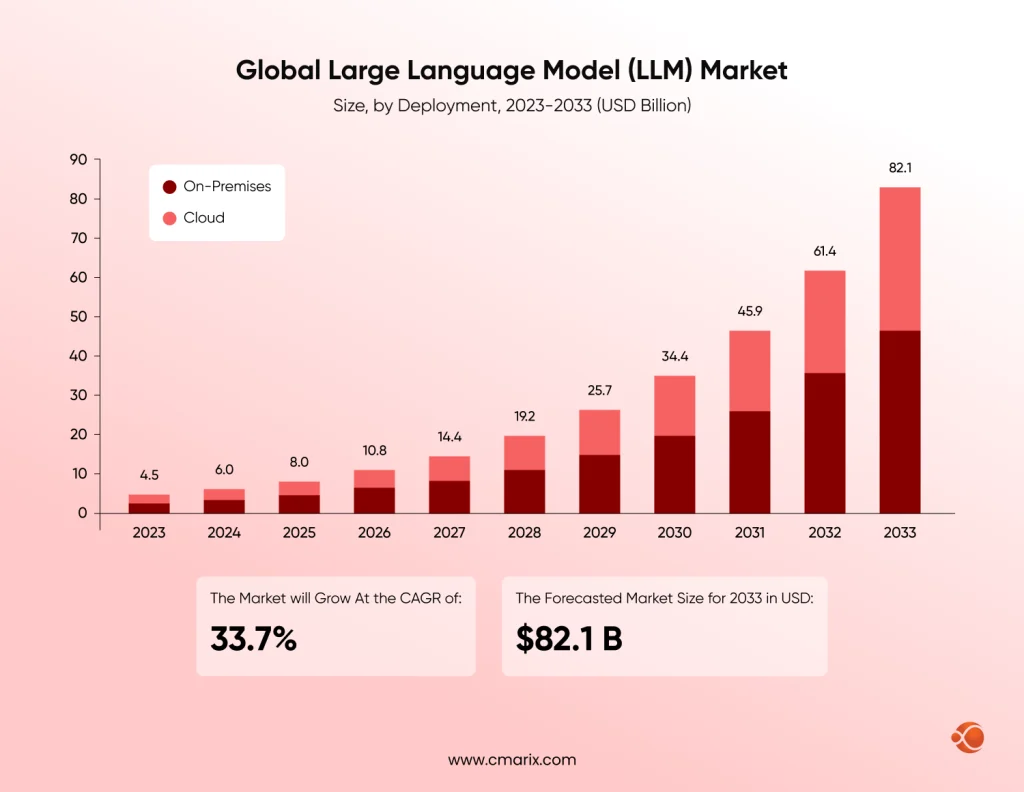
A private LLM for credit scoring is a language model that runs entirely inside infrastructure you control, whether that’s your own servers or a locked-down cloud environment (VPC), and is used to analyze bank statements, income patterns, and spending behavior to make or support underwriting decisions. The global large language model (LLM) Market size is expected to be around USD 82.1 billion by 2033, up from USD 4.5 billion in 2023, growing at a CAGR of 33.7% during the forecast period from 2024 to 2033.
The difference from calling GPT-4 or Claude through a public API isn’t the intelligence of the model. It’s custody. With a private deployment, applicant data never leaves your environment, the model’s outputs are fully auditable, and you decide exactly how long data is retained and who can access it. That custody is what makes the model usable for a regulated lending decision in the first place. It’s also worth understanding how this fits alongside LLM vs NLP approaches to credit modelling, since not every text or data-processing problem in underwriting needs a full generative model.
Choosing the Best Approach for Private LLM Credit Scoring System Development
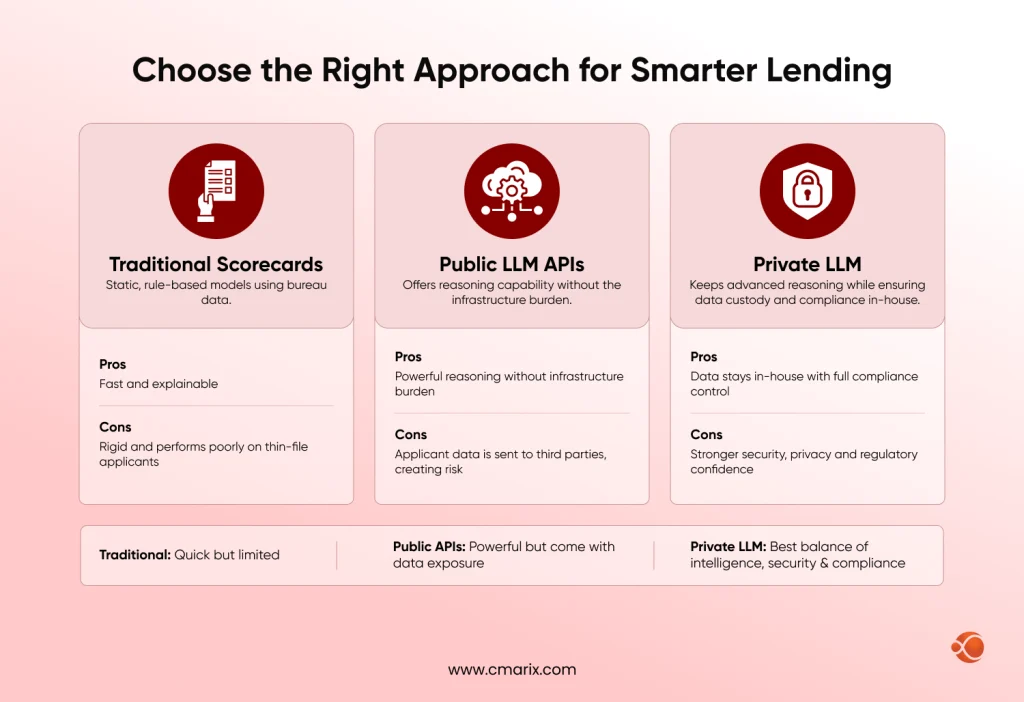
It also helps to place it against the two things it’s replacing or augmenting:
- Traditional scorecards rely on static, rule-based logic and bureau data. Fast and explainable, but rigid, and they perform poorly on thin-file applicants.
- Public LLM APIs offer the reasoning capability without the infrastructure burden, but every call sends applicant data to a third party, creating the exposure covered next.
- A private LLM keeps the reasoning capability of a modern language model while keeping data custody and compliance ownership entirely in-house, functioning as the engine behind a fully Automated Underwriting System (AUS) rather than a bolt-on chatbot.
Nothing here requires training a model from scratch. Almost every private LLM deployment for credit scoring starts from an open-weight base model fine-tuned on your own historical underwriting data, which is a far smaller project than it sounds, and it fits within the broader shift toward artificial intelligence in digital transformation across financial services.
Why Cash Advance Apps Need Private LLMs, Not Public APIs
Three problems push lenders away from public LLM APIs specifically:
Data sovereignty
Bank statement data, payroll data, and spending history are about as sensitive as consumer financial data gets. Sending that data to a third-party API, even one with a solid privacy policy, means you no longer fully control where it goes, how long it’s retained, or who can subpoena it from that provider instead of from you. If that provider changes its terms of service, gets acquired, or suffers a breach, your applicants’ financial histories are exposed in ways you can’t fully explain to a regulator or to the applicants themselves.
Regulatory exposure
The GLBA and state-level lending rules were not built for LLM API, but regulators are becoming more and more interested in knowing how the AI decision is made and what the source of data is. Having the system installed privately allows answering these questions much more accurately than saying, “the third-party model provider is working on it.” Plus, you won’t be tied up by their roadmaps and costs.
Cost at scale
Per-token API pricing looks fine in a pilot and turns into an unpredictable, scaling line item once you’re running thousands of underwriting decisions a day. A private model has a fixed infrastructure cost that doesn’t move with volume the same way, which makes budgeting and unit economics far more predictable as the app grows.
It is not to suggest that using a public API does not serve any purpose. In many cases, this might be the best option for use when creating a proof of concept or an internal tool that will never need to touch the applicant’s PII. This will not suffice, however, when implementing a production underwriting system that needs to process real applicant data, and it is best if developers come to understand this early on.
Build vs Buy vs Partner: Choosing Your Development Path
Before any architecture decisions, you have to decide who builds a private LLM for credit scoring:
- Build in-house – Full control and IP ownership, but you need ML engineers, MLOps infrastructure, and compliance expertise on staff, which is a heavy lift for most cash advance startups and even mid-size lenders. Timelines tend to run long because the team is usually learning fintech compliance requirements while building, and hiring for this specific combination of skills, ML engineering plus lending compliance, is slow even for well-funded teams.
- Buy an off-the-shelf risk engine – Fast to integrate, but you’re limited to the vendor’s model architecture and data sources, and you inherit whatever compliance gaps or blind spots their product has. Harder to differentiate on underwriting accuracy, since competitors can buy the same engine, and you’re often locked into the vendor’s pricing model as volume grows.
- Partner with a development team that’s done this before – You get the speed of buying with the customization of building. A partner with prior lending-domain experience already understands the compliance surface instead of discovering it mid-project, which is usually what gets a compliant, differentiated product to market fastest, without the multi-year hiring runway that building fully in-house requires.
Domain experience matters more here than general AI experience. A team that’s shipped chatbots or content tools can absolutely write the code for a credit-scoring model, but they haven’t necessarily internalized why adverse action reasoning has to be specific, or why a model that’s 2 percent more accurate isn’t worth it if it can’t explain itself to a state regulator. This is the same reasoning that applies more broadly when a lender decides how to make a fintech app in the first place, and the same trade-offs are worth reading up on in our breakdown of Build vs Buy AI Software.
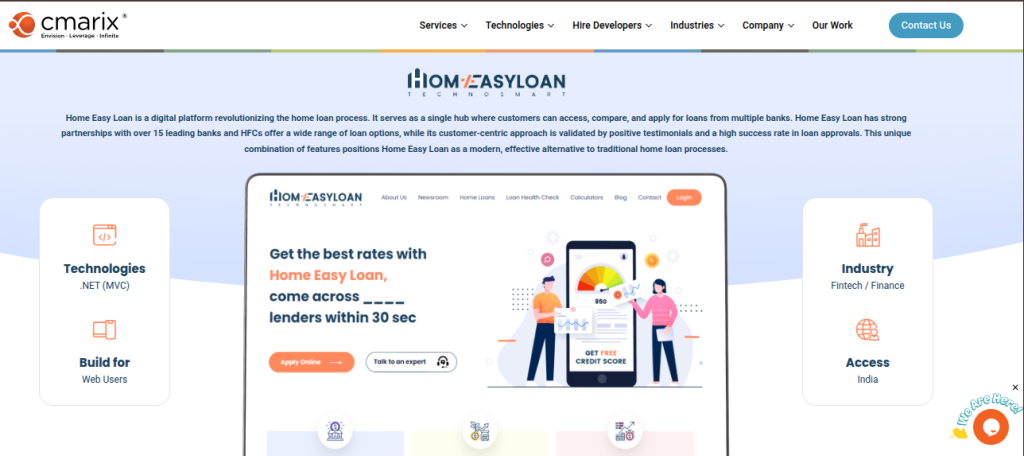
CMARIX built the Home Easy Loan Aggregator platform, which involved exactly this kind of eligibility logic and lending-specific data handling, and that background carries directly into how a credit-scoring LLM gets architected, backed by our broader custom FinTech software development practice.
How to Build a Private LLM for Credit Scoring in 8 Steps
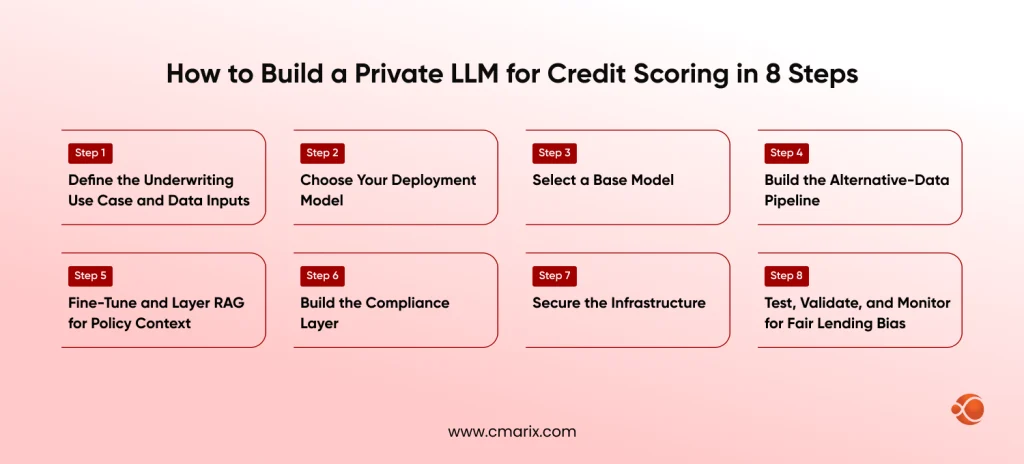
Step 1: Define the Underwriting Use Case and Data Inputs
Before the model even touches the data, understand explicitly what the LLM is making a decision on and which data is allowed to be considered. For cash advance underwriting, it usually involves banking activity, balance trends, payrolls, and current debts. Determine beforehand whether the model is the ultimate decision-maker or it just scores the risk, leaving decision-making to another party.
This will also give you your minimum data needs line. Gather only that data which you are sure is required to make your decision, since every additional piece of data adds another piece of work on the protection and explanation fronts.
Step 2: Choose Your Deployment Model
Three different options are available to choose from, including being completely on-premises, the use of a private VPC through an AWS- or Azure-like service, or having both – sensitive processing being on-premises while other applications running in the cloud.
Most cash advance apps land on a private VPC, since it delivers the isolation of on-premises AI deployment without the capital cost of owning hardware.
- Fully on-premise – Maximum control, highest upfront cost, best for lenders already running other regulated workloads on owned hardware.
- Private VPC – The default choice for most builds. Isolated network and dedicated computer, with no data traversing a shared multi-tenant environment.
- Hybrid – Sensitive scoring logic stays on-prem while lower-risk workloads, like the app backend, run in standard cloud infrastructure.
Step 3: Select a Base Model
There is no need to employ a frontier model here. An open-weight small language model such as Mistral, LLaMA, or Qwen with parameters of 7B to 70B can operate well under controlled infrastructure and is definitely up to the task of recognizing and reasoning necessary for credit scoring. The choice of the model must be based on inference cost, fine-tuning capabilities, and maintenance.
A smaller, well fine-tuned model that runs cheaply will usually outperform a larger general-purpose model that hasn’t seen your specific underwriting patterns. Bigger isn’t automatically better, and it’s rarely where the budget should go. This is where solid LLM Fine-Tuning practice matters more than raw model size.
Step 4: Build the Alternative-Data Pipeline
And that is how the accuracy of underwriting comes about. Access bank information through an aggregator, and develop features based on income stability, cash flow volatility, number of overdrafts, and types of expenditure. This kind of alternative data analysis is the LLM’s real job here: extracting signals a seasoned underwriter would notice, but a static credit score misses.
Common signals worth engineering into the pipeline:
- Predictable income – The trend of deposit receipts within a period of 60-90 days.
- Cash flow volatility – The extent to which account balances vary from one paycheck to another, indicating users who have a thin cushion even with predictable income.
- Overdraft activity – An early warning signal for repayment risk that a scorecard cannot reveal.
- Discretionary spending behavior – Whether discretionary spending is reduced during periods of low income, a sign of financial discipline traditional scores don’t capture.
Step 5: Fine-Tune and Layer RAG for Policy Context
Train the base model using historic underwriting decisions and results so that it adjusts itself according to your risk profile rather than an average one. Use retrieval-augmented generation (RAG) as a separate layer above the base model, which will use your up-to-date lending policy and state-specific interest rate cap without incorporating it into model parameters.
This translates to having two components working hand-in-hand: the fine-tuned model evaluates the application, while the RAG uses your lending policy and regulation as they currently exist when you are making the decision. Should you update your lending policy, just change the document and you’ll have it reflected right away without any training phase. After deployment, test your model not by accuracy alone but via a full-fledged LLM evaluation framework, as this is a credit model.
Step 6: Build the Compliance Layer
Every automated credit decision requires an audit trail that describes what input data was used, what output came from the model, and why. This is not an optional component but a layer without which the model won’t be compliant and usable legally. The component for generating reasons for adverse actions should be included in the pipeline directly, allowing declined applicants to receive an exact reason for denial. This is also the point when
Explainable Artificial Intelligence (XAI) turns from a desirable feature into a mandatory one because the compliance officer must be able to track the decision to its driving factors.
- Decision logging – Every input, output, and model version used, retained as long as regulation requires.
- Adverse action generation – Automated, specific reason codes tied to the actual signals behind a decline.
- Explainability tooling – A way for a compliance officer, not just an engineer, to trace why the model made a given call.
Step 7: Secure the Infrastructure
Encrypt data at rest and in transit, enforce strict role-based access controls on who can query the model or view outputs, and log every access. Treat the model endpoint itself as a sensitive asset, not just the underlying database, since prompt-level access can leak as much as a database breach can.
For a lending institution dealing with thousands of applicants’ bank information, that could make all the difference between having a problem that can be contained and having one that could bring down the entire business. This is also the right time to conduct a security evaluation using a framework such as SOC 2, the very kind of activity our DevOps consulting services group is able to perform for infrastructure construction projects.
Step 8: Test, Validate, and Monitor for Fair Lending Bias
Test the model using historic data divided into protected class proxies (geographic regions, age groups as legally allowed) in order to look for disparate impacts prior to deployment. This is not something you do once. Set up continuous monitoring as drifts in the models may start to exhibit bias a few months down the line from a seemingly clean launch.
Establish a recurring cadence of disparate impact testing, with a documented investigation process whenever the gap in approval rates between groups crosses a defined threshold.
Compliance Checklist for AI-Driven Credit Decisions
Getting financial data compliance right is what separates a model you can defend to a regulator from one that’s a liability waiting to surface:
| Compliance Requirement | Checklist |
| ECOA & Regulation B | ☐ Generate clear, specific adverse action notices for rejected applicants instead of generic rejection messages. |
| FCRA | ☐ Provide applicants with access to the data influencing decisions and a process to dispute or correct inaccurate information. |
| CFPB Guidance | ☐ Ensure AI-driven decisions include explainable, regulator-ready reasons for approvals or denials—avoid relying on model complexity as an explanation. |
| State Lending Laws | ☐ Apply state-specific rate caps, licensing, and disclosure requirements through a policy or RAG layer that stays updated by jurisdiction. |
| Ongoing Bias Monitoring | ☐ Conduct and document regular disparate impact testing throughout the model lifecycle, not just before deployment. |
Our team can walk through your specific regulatory exposure.
Common Mistakes When Building AI-Powered Credit Scoring Systems
A few patterns show up repeatedly in private LLM underwriting projects that run into trouble:
- Treating compliance as a post-launch add-on – Retrofitting adverse action reasoning and audit logging after launch costs far more than building it in from the start.
- Over-indexing on model size – A larger model that’s harder to audit and more expensive to run rarely beats a smaller, well-fine-tuned one for this use case.
- Skipping bias testing until launch is imminent – Issues found late are far harder to fix than ones caught during fine-tuning, when training data can still be adjusted.
- Underestimating the data pipeline effort – Teams often budget generously for the model and lightly for bank-data integration, when it’s usually the reverse that reflects reality.
Cost to Build a Private LLM for Credit Scoring
| Component | MVP Scope (Approx. Cost) | Enterprise Scale (Approx. Cost) |
| Base model licensing/hosting | Open-weight model, single VPC instance — $15K to $35K | Multi-region deployment with redundancy — $60K to $150K |
| Data pipeline (bank aggregation, feature engineering) | Single aggregator integration — $25K to $60K | Multiple aggregators with custom feature store — $100K to $200K |
| Fine-tuning and RAG layer | Initial fine-tune on limited historical data — $40K to $90K | Continuous retraining pipeline — $150K to $300K |
| Compliance and audit infrastructure | Basic audit logging and adverse action templates — $20K to $50K | Full audit trail with automated bias monitoring dashboards — $100K to $250K |
| Security and infrastructure | Standard VPC security configuration — $15K to $35K | SOC 2/ISO-aligned infrastructure with dedicated security review — $50K to $120K |
| Total Estimated Build Cost | ~$120K to $270K | ~$450K to $900K+ |
| Estimated Timeline | 4 to 6 months | 8 to 14 months |
These are directional ranges pulled from current fintech LLM development benchmarks, not a quote. Compliance-heavy builds typically run 20 to 40 percent above a comparable non-regulated AI project, and that’s usually the line item early estimates miss. Exact figures depend heavily on data volume, the number of states you’re licensed in, and how much compliance tooling already exists versus needing to be built from scratch. Talk to a development partner with lending experience before locking a budget.
How to Choose the Right Development Partner for a Private LLM for Credit Scoring
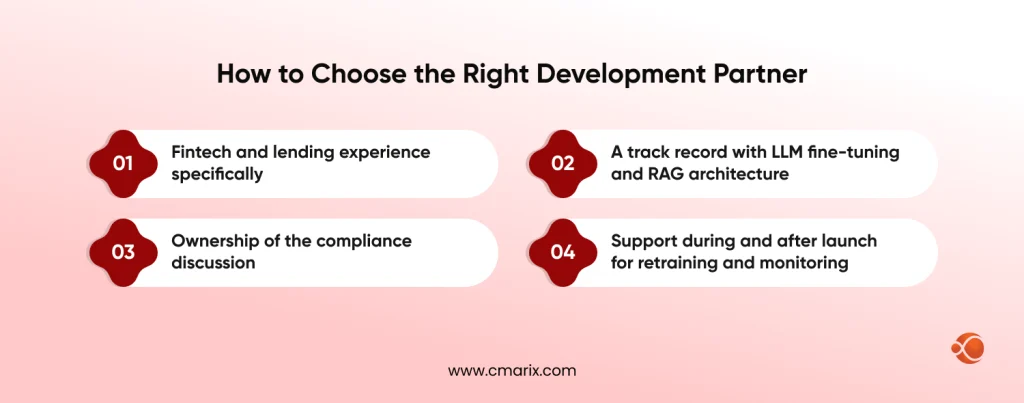
Not every AI development shop can build a private LLM. Look for:
- Fintech and lending experience specifically – The compliance surface is too particular to learn on your dime, and a team that learns ECOA and FCRA during the project will reflect that in the schedule and the architecture. If you’re building something adjacent, like a competitor to an established player, our breakdown of cash advance apps like MoneyLion is a useful reference point for the feature and compliance surface involved.
- A track record with LLM fine-tuning and RAG architecture – not just API integration work. Wiring a chatbot to an existing API is a different skill set from fine-tuning a model on proprietary underwriting data and building a policy-aware retrieval layer around it.
- Ownership of the compliance discussion – It’s a warning sign when your partner doesn’t mention ECOA or FCRA in the scoping call, since this almost always indicates that they see compliance as an issue you’ll solve after delivery.
- Support during and after launch for retraining and monitoring – if the credit model isn’t being refreshed, it will soon be biased or flawed. Find out what the retraining cycle and monitoring dashboard look like after launch.
Why CMARIX Is the Right Partner for Private LLM Development in FinTech
CMARIX has 17 years of experience developing software for finance-related projects, including banking, lending, and trading systems; hence, our expertise in AI/ML is based on our deep knowledge of what regulated financial decisions should look like rather than abstract AI best practices. The banking software development services provided by CMARIX include the full technological stack that a project like this requires – from model fine-tuning to RAG infrastructure to data pipeline engineering.
It is this pairing of in-depth fintech domain knowledge with hands-on LLM engineering that distinguishes a well-performing demo from one that can withstand regulatory scrutiny. Partnering with an expert LLM development Company ensures that an important aspect of any credit scoring project’s success lies in choices made even before any model code is written:e the choice of data, audit trail organization, and system design, where compliance and accuracy grow hand-in-hand rather than at cross-purposes.
Turn your lending data into a secure, explainable AI solution built for compliance.
Conclusion
Commercially available LLM APIs may help a business bring an AI-based credit score to market quickly, but these APIs lack the rigidity necessary for an underwriting decision to be made correctly. Only a custom-built LLM for credit scoring, designed with the proper data pipeline, fine-tuning, and compliance layers from the very beginning, can make AI-driven underwriting more than just a proof of concept (PoC).
Developing such an LLM is technically challenging enough, but what often proves to be even more difficult is working on the accompanying compliance effort: bias detection, adverse action reasons and management, audit capabilities, and so on. It is at this point that the value of the right development partner becomes apparent, and those who opt for a different approach often find themselves in a tough situation down the road. When deciding between building, buying, or partnering, begin with assessing the compliance requirements and only then move to the technical architecture.
FAQs About Private LLMs for Credit Scoring
Why do cash advance apps need a private LLM instead of a public API?
The use of a public API leads to your bank details being sent to a third party for each and every application, creating a risk of data sovereignty and GLBA compliance issues. On the other hand, the use of a private LLM leads to data being kept within your own infrastructure, provides audit capabilities, and prevents any unpredictability associated with paying per token on an external API.
What types of “alternative data” can a private LLM analyze?
Apart from the data obtained by the traditional bureau, the LLM can analyze the history of transactions made at banks, payroll deposits, cash flows, the number of times an account was overdrawn, and categories of spending. It is through such alternative data analysis that the model is able to evaluate thin-file applicants.
How does the model prevent the AI from making biased or discriminatory decisions?
Bias avoidance is not an individual characteristic but a series of actions that involve evaluating the model using the historical data separated by protected class proxies prior to its deployment and performing disparate impact testing on a regular basis after its deployment. If the approval rate difference between two classes exceeds a certain threshold, the investigation is triggered.
How do you meet the “explainability” requirements of credit regulators?
Explainable AI (XAI) is embedded within the compliance layer and is not an add-on. Each decision produces a unique adverse action code related to the true signals used for the decision, as well as an entire audit trail for the compliance officer to examine without having to understand the model code.
What are the core technology components of this architecture?
The elements that make up the private LLM for credit scoring are five: an open-weight base model, a fine-tune pipeline based on your underwriting experience, a RAG component with policies and regulations, an alternative data pipeline sourcing bank aggregators, and the compliance and audit layer with detailed logs and adverse action reasons.
Will a private LLM be fast enough for instant cash advance approvals?
Yes. A well-designed private setup will give an answer in a few seconds, not minutes, when using a sufficiently sized open-weighted LLM deployed on purpose-built infrastructure. The latency is more dependent on how the data pipelines and RAG retrieval is designed rather than the use of an LLM itself.