


Quick Overview:
- MVP development cost: Most MVPs cost between $15,000 and $150,000+, depending on overall project complexity and features.
- Timeline: Most MVPs take around 6–24 weeks to design, develop, test, and launch.
- Simple MVPs: Basic MVPs can start at around $15,000 with a limited feature set.
- Complex MVPs: AI, fintech, and healthtech MVPs can cost $150,000–$250,000+ due to advanced requirements.
- Development region: Average development rates range from $20–$70/hour in India all the way to $120–$250/hour in the US and Canada.
- Compliance: Requirements like HIPAA, GDPR, and SOC 2 can increase costs by 20–40%.
- Hidden costs: It is advisable to set aside 10–15% of your budget for hosting, APIs, maintenance, and ongoing support.
- No-code tools: No-code platforms show upfront cost reduction but are likely to create scalability limitations later.
- Best way to save: Reduce unnecessary features while maintaining development and product quality.
- Main goal: Build only what you need to validate your idea with real users.
How much should you actually budget to turn your startup idea into a working product without overspending before you know it will work?
MVP development costs often range from $15,000 to $150,000, with compliance-heavy or AI-enabled products. Enterprise-grade IT projects often run 45% over budget on average, as per McKinsey and Oxford research, which shows why there is a need to invest in a proper MVP development project before committing to a full build.
The total amount will depend on several factors, including the number of features, your target platform, the tech stack you use for the project, the makeup of your development team, and industry standards. For example, a basic MVP with one primary feature will not go far above the bottom end of the estimated range, while more complex apps may require a much bigger budget.
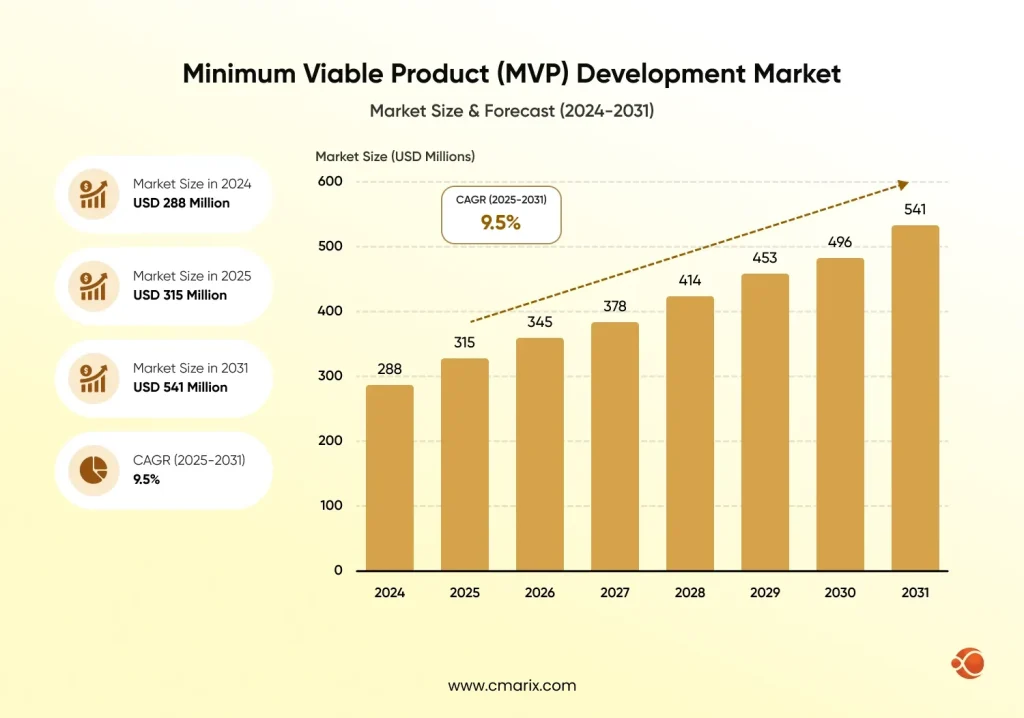
This is why the overall MVP development market value reached USD 315 million in 2025, and is expected to reach USD 541 million by 2031, showcasing a CAGR of 9.5% during the forecast period.
This guide breaks the number down by phase, platform, industry, region, and team, so you can build a realistic budget instead of guessing.
Quick Answer: App MVP Cost by Complexity
| Tier | Typical Features | Estimated Cost (USD) | Timeline |
| Simple MVP | Landing page, one core feature, basic auth | $15,000-$35,000 | 6-10 weeks |
| Standard MVP | Multi-role app, payments, integrations | $35,000-$80,000 | 10-16 weeks |
| Complex MVP | AI features, compliance, multiple platforms | $80,000-$150,000+ | 16-24 weeks |
What Is an MVP and Why Cost Planning Matters
A minimum viable product, or MVP, is the smallest working version of a product that still solves a real customer problem. The concept, as described on Wikipedia, centers on building just enough functionality to test an idea in the market. A study published through the AIS Electronic Library frames this the same way: an MVP collects the maximum validated learning about customers with the least possible development effort.
It is important to plan your costs properly since a responsible and effective MVP project is supposed to be a controlled experiment, not a shortcut. Each dollar spent on the MVP project should signal whether the product is worthy of further investment. Founders who are new to outsourcing should also read CMARIX’s startup software development guide before selecting a build partner.
The MVP Development Process, Step by Step
Every solid MVP goes through five steps, no matter who develops it.
- Discovery and Validation: problem recognition and setting the criteria for success.
- Scoping and prioritization: finding out what is needed and what is not in developing an MVP.
- Design: wireframes and user flow basics that are not complicated to the extent where they impede validation.
- Development and QA: building your product, with code reviews being an inherent part of the process.
- Launch and learn: shipping to a small group of early users and measuring activation, retention, and feedback.
The most costly mistake that entrepreneurs can make is skipping the discovery phase. An hour spent figuring out what needs to be scoped will save many times that amount of time during development of the wrong solution.
MVP Development Cost by Phase
Total MVP development cost breaks into three phases: pre-development, development, and post-launch.
| Phase | What It Covers | Typical Cost (USD) |
| Pre-development | Discovery, market validation, wireframes, UI/UX design | $2,500-$20,000 |
| Development | Frontend, backend, database, integrations, QA/testing | $10,000-$100,000+ |
| Post-launch | Deployment, app store fees, initial marketing, first-month support | $1,500-$15,000 |
Founders frequently budget only for development and forget the other two phases exist, which is a common source of mid-project sticker shock.
Get a clear estimate based on your features and scope.
MVP Development Cost by Product Type and Industry
Industry adds its own multiplier on top of raw feature complexity, mostly because of compliance and integration depth.
| Product Type | Cost Range (USD) | Typical Timeline |
| Simple SaaS | $15,000-$40,000 | 6-8 weeks |
| Mobile app (cross-platform) | $25,000-$60,000 | 8-12 weeks |
| Marketplace (two-sided) | $30,000-$80,000 | 10-14 weeks |
| Fintech MVP (PCI-DSS) | $50,000-$150,000+ | 12-18 weeks |
| Healthtech MVP (HIPAA) | $60,000-$250,000+ | 14-22 weeks |
| AI/ML product | $40,000-$100,000+ | 12-20 weeks |
HIPAA compliance alone typically adds a meaningful five-figure sum in infrastructure and documentation work before a single user-facing feature ships, which is why healthtech and fintech MVPs consistently sit at the top of the range.
Cost to Build MVP Project: Regional Rate Comparison
Where your development team sits changes the total far more than most founders expect.
| Region | Hourly Rate (USD) | Trade-offs |
| US / Canada | $120-$250 | Same time zone, highest cost |
| Western Europe | $100-$180 | Strong talent, moderate overlap |
| Eastern Europe | $50-$100 | Strong engineering culture, reasonable overlap |
| India | $20-$70 | Large talent pool, wide quality range, partner choice matters most here |
| Latin America | $40-$80 | US-friendly time zones, growing tech scene |
CMARIX’s very own cost of developing an app calculator, based on over 250 delivered mobile apps, is quite similar – moving from the US to an Indian development company saves the company 40-70% in total cost of development, but only when the partner company follows the delivery discipline.
MVP Development Cost Breakdown As Per Team Composition
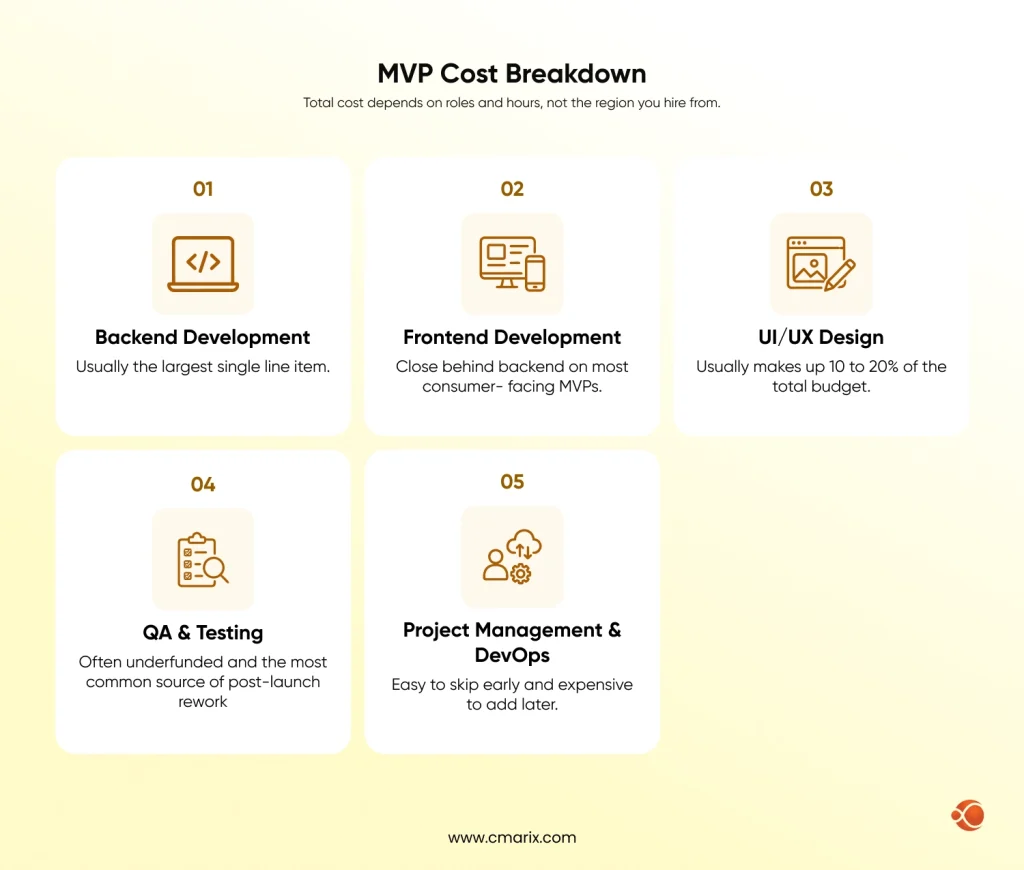
Whichever region you hire from, the total cost comes down to roles and hours.
- Backend development, usually the largest single line item
- Frontend development, close behind backend on most consumer-facing MVPs
- User interface/user experience design, which usually makes up 10 to 20% of the total budget
- QA and testing, often underfunded and the most common source of post-launch rework
- Project management and DevOps, easy to skip early and expensive to add later
What Factors Increase MVP Development Cost the Most?
- Number of features and their complexity, particularly in real-time or AI-enabled ones
- Platform selection, because building natively for mobile is more expensive than a single build for the web
- Third-party integrations, including payment gateways and CRMs
- Compliance requirements such as HIPAA, GDPR, or SOC 2, which add scoping, audit, and documentation work
- Design depth, since MVP design cost for UI/UX can run 10 to 20 percent of the total budget
- Team model and location, from in-house hires to an offshore dedicated team
Get the right scope, timeline, and budget before you start.
Tech Stack Choices That Change the Number
Cross-platform frameworks close much of the native-versus-cross-platform cost gap. FlutterFlow for MVP development lets teams ship a single codebase across iOS, Android, and web, one of the more reliable ways to cut MVP development cost without sacrificing a native feel.
In the back end, MVP development using Node.js is still a preferred option due to its non-blocking nature, which allows for fast iterations and predictable hosting costs as usage increases.
For teams weighing all three approaches at once, CMARIX’s breakdown of hybrid MVP app development is a useful next read.
Low-Code and No-Code: Is It the Cheaper Path to an MVP?
Is low-code or no-code cheaper for MVPs?
Usually, yes, for early-stage validation.
Gartner has forecast that a large majority of new enterprise applications will use low-code or no-code technology, up sharply from a small share just a few years earlier.
No-code MVP cost can run as low as a few hundred dollars a month in tooling, though most founders eventually outgrow these platforms once they need custom logic or true scalability.
How much does AI-assisted MVP development reduce costs?
When teams use AI coding assistants for tasks such as writing boilerplate code, testing, and documentation, a significant decrease in developer hours is common, although the savings vary depending on how good the team is at code reviews and the complexity of their products. When the AI-generated code is unverified, it often fails silently, not loudly.
MVP vs. POC vs. Prototype: Which Costs Less?
These three phases are often confused by founders, which results in wasted money. Proof of concept just confirms the technical possibility of the project. A prototype confirms user experience through a non-working but clickable design.
MVP is the only one out of these three phases that real users can interact with and pay for. You will find information on how to distinguish these phases from each other in the CMARIX guide. It will help you to avoid a typical mistake in budget planning – spending on MVP development could be spent on a $3,000-$8,000 prototype.
Hidden and Recurring Costs Founders Oversee
- Hosting and infrastructure, which scale with usage rather than with your original budget
- Third-party API and service fees, usually charged per use rather than as a flat rate.
- App store fees, both one-time developer accounts and ongoing revenue share
- Post-launch maintenance, commonly 15 to 25 percent of the initial build cost annually
- Security and compliance upkeep, which is ongoing rather than a one-time cost for regulated products
A realistic MVP budget sets aside 10 to 15 percent specifically for the unglamorous costs that show up after launch, not just the build itself.
How to Reduce MVP Development Cost Efficiently
- Don’t narrow scope at the expense of quality. Fewer features mean lower costs more quickly than lowering engineering costs.
- Build validation into your process with a landing page, waitlist, or clickable prototype before building anything.
- Leverage cross-platform development frameworks where appropriate to reduce MVP development costs from developing twice.
- Break the product roadmap into phases to allow MVP testing of the riskiest assumption first.
- Pick milestone billing over hourly billing to avoid scope expansion.
Common Mistakes That Inflate MVP Development Cost
CB Insights has found that a lack of market need is the single most common reason startups fail, ahead of running out of cash or having the wrong team. That single data point explains most MVP cost overruns.
- Focusing on creating something the investor wants rather than the user needs
- Altering scope during a sprint without adjusting the budget and schedule
- Not doing a discovery stage and going straight into development
- Selecting a development partner based on cost and paying twice for technical debt.
- Not taking into account the actual cost of developing an app with maintenance and hosting costs
How Founders Offset MVP Development Cost
Bootstrapped entrepreneurs in India and elsewhere can minimize the real dollar amount spent on their MVP by leveraging lean engineering along with incubation help at an early stage. An example of an incubator that provides non-dilutive grants and credits to partner services, including cloud hosting credits, for startups in the idea-MVP phase is NSRCEL from IIM Bangalore. Combining this kind of incubator with a scope-fixed MVP project can help lower a startup founder’s out-of-pocket expense before raising money.
Real MVP Examples and What They Reveal About Budgeting
Some of the most recognizable products in tech started as strikingly simple MVPs. CMARIX’s own roundup of successful MVP examples walks through how Uber, Airbnb, Dropbox, Spotify, and Instagram each validated demand before scaling.
Not only Dropbox, which launched its product in the form of a demo video, but also Airbnb, which began as a listing platform for just one design conference, used its money to prove demand, not to make unnecessary features work.
How Long Does It Take to Build an MVP in 2026?
Most MVPs take between 6 and 24 weeks, depending on complexity.
| Complexity | Timeline | Typical Examples |
| Simple | 6-10 weeks | Landing page and waitlist, single-purpose tool |
| Standard | 10-16 weeks | SaaS with integrations, marketplace with two user types |
| Complex | 16-24 weeks | AI/ML product, compliance-heavy fintech or healthtech |
Rushing this timeline is one of the fastest ways to inflate MVP development cost through rework.
DevOps and Infrastructure: A Hidden Cost Driver
Infrastructural choices made during the MVP creation process influence the future cost in a hidden way. Implementing Azure DevOps pipelines early provides automated testing and deployment from the first days, saving many hours of manual QA work that would accumulate over time. It is a modest investment to prevent a cost spike for application development.
How to Choose an MVP Development Partner
The partner you choose shapes your budget as much as your feature list does. A few questions separate strong partners from expensive mistakes.
- Do they lead with discovery, or do they quote a price after one call?
- Is code review a standard part of their process, including for AI-assisted work?
- Can they show experience in your specific industry, especially if it is regulated?
- Is MVP development pricing transparent about what triggers a change order versus what is included?
- Do you own the code and repositories outright from day one?
For founders hiring their own team instead of a full-service partner, CMARIX’s guide on what to check before you hire full-stack developers and its comparison of hiring a dedicated development team versus an offshore development team are both useful starting points.
Why Founders Choose CMARIX for MVP Development
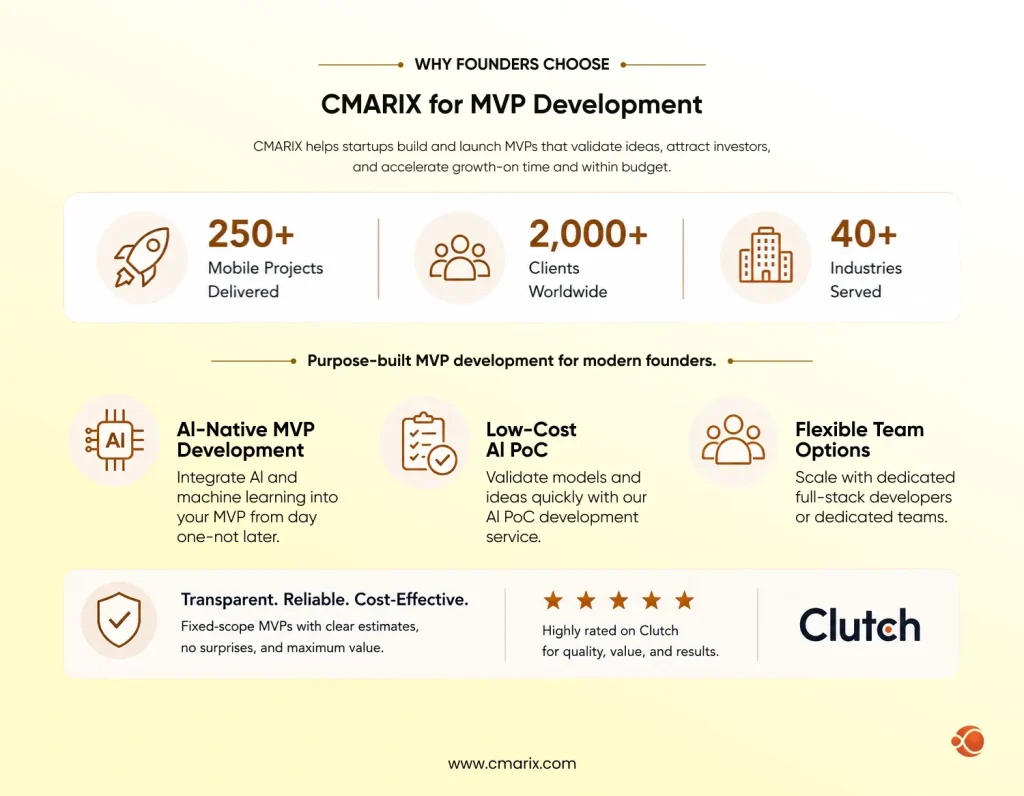
CMARIX has executed 250+ mobile projects for over 2,000 clients spread across 40+ industries, ranging from startups to Fortune 500 corporations. Client project investment, as verified by independent reviews on Clutch, ranges from $3,000 to over $200,000. Cost-effectiveness is one of the common strengths mentioned in these reviews. The team estimates the scope of every Minimum Viable Product (MVP) development project in terms of a fixed core functionality set.
For teams that need AI-native features, CMARIX’s AI MVP development solutions bring machine learning capability into the MVP stage itself, rather than bolting it on later at a higher cost, and its AI PoC development service is a lower-cost first step when even the underlying model choice still needs validating. For founders who want direct control over their build, CMARIX also connects startups with dedicated full-stack developers and broader dedicated development teams who can plug directly into an existing product roadmap.
Methodology note: The range of costs mentioned in the guide is taken from industry sources for MVPs and mobile application development costs, along with the delivery data of CMARIX from over 250 mobile applications. However, the actual cost for any particular MVP will depend on its specific details and can be obtained only through a quote.
FAQs About AI MVP Development Costs
How much does it cost to build an MVP in 2026?
The average price of an MVP is between $15,000 and $150,000, depending on whether it is a simple MVP with one feature or a very complicated one with AI. Developing an MVP in fintech and healthtech, together with compliance, starts at $250,000.
What is the cheapest way to develop an MVP?
Creating the front-end using no-code platforms while using Node.js in the back-end, along with a good MVP vs. POC vs. prototype scoping choice, often results in a minimum real-life price.
What factors increase MVP development costs the most?
Feature complexity, native multi-platform builds, heavy third-party integrations, and regulated-industry compliance are the biggest levers. See the full factors that increase MVP cost above.
Is low-code or no-code cheaper for MVPs?
Yes, for early validation. See the full breakdown of low-code and no-code MVP costs above.
How long does it take to build an MVP?
Most MVPs take 6 to 24 weeks from discovery through launch. See the full MVP timeline by complexity above.
Does a no-code MVP cost less than a custom-built one?
Yes, at first sight, but not forever since the costs for a no-code MVP increase significantly with the implementation of custom logic or scaling. This is when most founders go for a hybrid or custom-built MVP.
Is it cheaper to build a web MVP or a mobile MVP?
No, usually not, since web MVPs are easier to build as there’s no need for an app store review cycle or native SDK usage.
Budgeting an MVP correctly is less about finding the cheapest developer and more about spending only on what proves the idea. Talk to CMARIX’s MVP development team to get a scoped MVP cost estimate before writing a single line of code.