


Quick Summary: PropTech software development turns manual, paper-heavy real estate operations into connected digital platforms. This guide covers what PropTech software development actually involves, what it costs to build, which features matter most, and how CMARIX approaches real estate software projects in 2026-27.
Real estate companies are adopting PropTech software development to modernize their property management, leasing, sales, investment, and client experience solutions. From real estate CRM and property management software to MLS/IDX solutions, real estate marketplaces, mobile applications, AI-based property valuation tools, smart building technologies, and automated tenant solutions, technology is transforming how properties are marketed, managed, bought, sold, and maintained. As AI, IoT, automation, and property data connectivity become more feasible, real estate businesses are increasingly moving beyond simple listing portals to full-fledged real estate software platforms.
This guide outlines key aspects of PropTech software development, including the most important features and technologies, the cost and time required, and the factors businesses should consider when selecting a real estate software development company in 2026-27.
In this blog, we cover:
- What is PropTech software development, and how does it work?
- How big is the PropTech market in 2026, and what is driving its growth?
- Why are real estate businesses investing in custom software development?
- Which features should a modern PropTech platform include?
- What types of PropTech and real estate software can businesses build?
- How can AI, IoT, automation, and smart building technology improve real estate operations?
- What are the latest PropTech trends shaping real estate software in 2026-27?
- How much does it cost to build PropTech software?
- How long does it take to develop a real estate app or PropTech platform?
- Which technology stack is best for PropTech software development?
- Which APIs and third-party integrations are commonly used in real estate software?
- How can businesses keep PropTech platforms secure and compliant?
- Should you build custom real estate software or use an off-the-shelf solution?
- What should you look for when choosing a PropTech software development company?
- Why choose CMARIX for real estate and PropTech software development?
What Is PropTech Software Development?
PropTech software development is the process of designing and building digital platforms that automate real estate operations such as listings, leasing, tenant communication, and investment analysis. Proptech is short for property technology, the broader use of technology in real estate to replace spreadsheets, paper contracts, and manual coordination between agents, landlords, tenants, and investors.
Whether it is a property management platform, a real estate CRM, or a listing engine like Zillow, proptech software moves real estate transactions online and makes property data usable in real time. It is not one product. It is a category of software that spans residential, commercial, and industrial real estate.
How Big Is the PropTech Market in 2026?
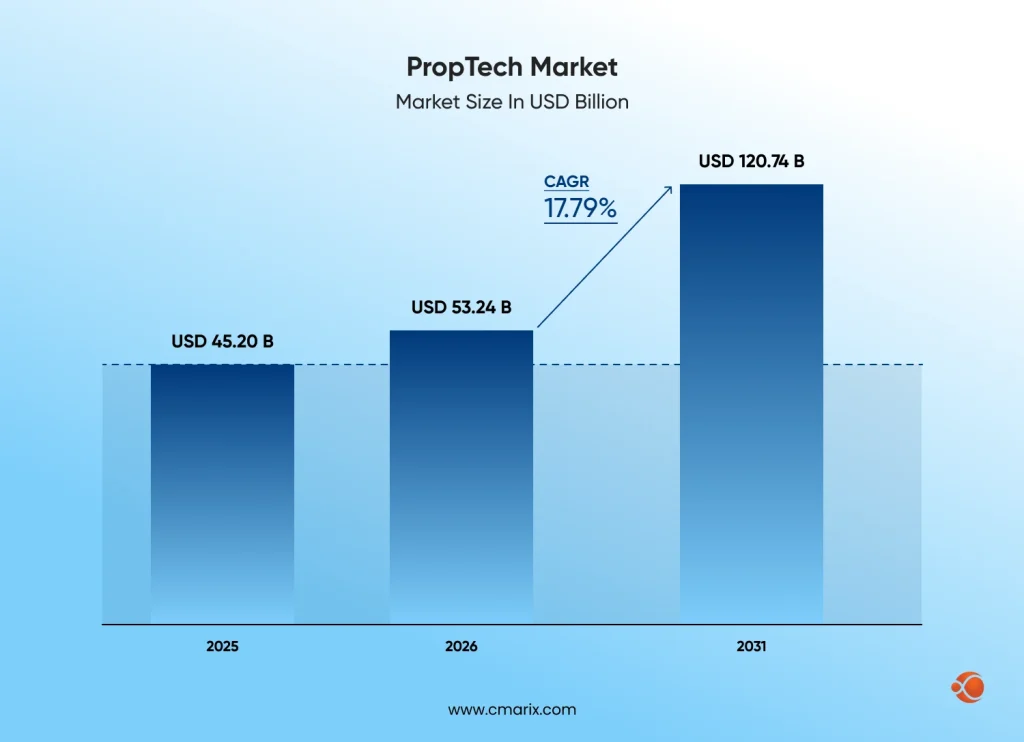
PropTech investment isn’t a guess or a trend piece. The global PropTech market is valued at USD 53.24 billion in 2026, up from USD 45.20 billion in 2025. It is projected to reach USD 120.74 billion by 2031, growing at a CAGR of 17.79%, according to Mordor Intelligence. Cloud-based deployment already accounts for more than three-quarters of that market, which is one reason most new proptech platforms are built cloud-first rather than on-premises.
Adoption on the ground confirms that expenditure. According to JLL’s 2025 Global Real Estate Technology Survey , which polled more than 1,500 senior real estate decision-makers, 88% of investors, owners, and landlords have begun piloting AI, and 92% of corporate real estate occupiers are also doing the same.
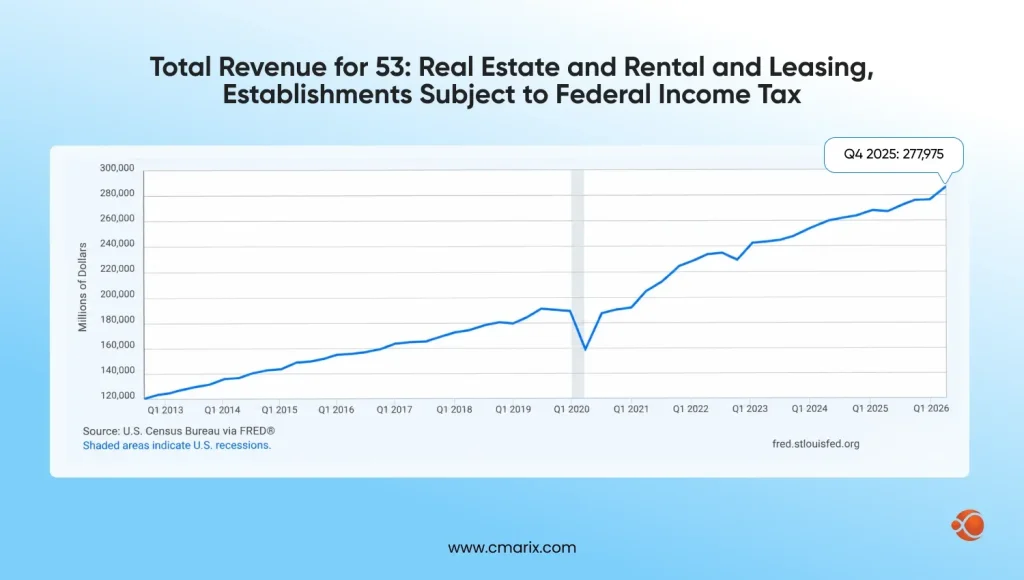
In the United States, the real estate, rental, and leasing industry recorded revenues exceeding $277 billion per quarter by the end of 2025, based on data from the Census Bureau and the Federal Reserve Bank of St. Louis.
Why Real Estate Businesses Are Investing in PropTech Software Development
Three forces are pushing real estate companies toward custom software instead of spreadsheets and generic tools.
- Legacy systems create data silos. Property managers often juggle separate tools for leasing, accounting, and maintenance requests. None of them talk to each other, which slows decisions and creates errors.
- Buyers and tenants expect a self-serve experience. They want to filter listings, book a viewing, and sign a lease without calling anyone, the same way they shop online.
- Smart building and IoT adoption is accelerating. Connected sensors for energy, security, and maintenance depend on software that can collect and act on that data, which is why IoT-enabled real estate platforms have moved from a nice-to-have to a standard request. Some firms are also exploring blockchain and Web3 technology in real estate, using smart contracts and tokenization to make transactions and land records more transparent.
Create a scalable platform for smarter real estate operations.
What Are The Core PropTech Software Features
Most proptech platforms, regardless of niche, share a common feature backbone:
- Property listings that can be searched and filtered online
- Digital lease agreements with electronic signatures
- Portals for tenants and owners to communicate and access documents
- Online rent payment systems
- Maintenance requests management
- Portfolio analytics
- Integration with other systems such as CRM, MLS, and accounting systems
- Access controls and auditing for regulatory compliance
Skipping any one of these usually shows up later as a support burden, not a cost saving.
Types of PropTech Software Solutions
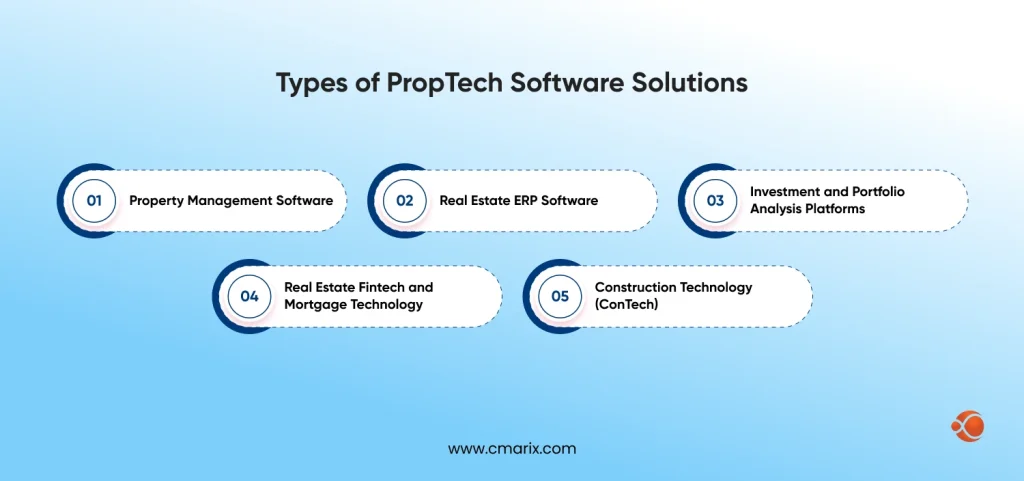
Real estate software development company teams typically build across a handful of recurring solution types.
Property Management Software
Consolidates leasing, rent collection, maintenance, and vendor management into one solution instead of five separate ones.
Real Estate CRM Software
Manages leads, follows up on them, and gives agents a holistic view of a buyer’s or tenant’s path from first contact to closing.
MLS and Listing Platforms
Gathers property information from various sources onto a single searchable interface. Teams looking to build a real estate site like Zillow often start here, integrating listing information, mapping, and lead generation into a single marketplace.
Real Estate ERP Software
Combines finance, inventory, human resources, and transaction management into one system for major developers and real estate firms. Our guide on ERP software development provides detailed information about the build process and technology stack.
Investment and Portfolio Analysis Platforms
Provides investors with tools to analyze the market, forecast ROI, and assess risk through the property portfolio.
Real Estate Fintech and Mortgage Technology
Manages digital lending, escrow, rent payments, and investments such as fractional ownership platforms. This is where the proptech and fintech meet directly.
Construction Technology (ConTech)
Covers project management, Building Information Modeling (BIM), and on-site progress tracking for developers and general contractors building the properties that other proptech tools later manage.
Benefits of PropTech Software Development
Beyond replacing spreadsheets, a working PropTech platform changes how a real estate business operates day-to-day.
- Real-time decision-making. Leasing, sales, and maintenance data live in one dashboard, so owners and asset managers see portfolio performance as it happens instead of waiting for a monthly report.
- Operational efficiency. Automated rent invoicing, payment tracking, and maintenance scheduling cut the manual work that used to eat up a property manager’s week.
- A stronger tenant and buyer experience. Self-service portals, instant updates, and mobile-first communication replace phone tag and email chains.
- Better-informed investment decisions. AI-assisted analytics surface pricing trends and ROI signals that would take a human analyst days to compile manually.
- Sustainability and smart resource use. Connected HVAC, lighting, and energy systems cut waste and support ESG reporting requirements that are becoming standard for institutional portfolios.
Challenges of Building PropTech Software
None of this comes without friction. The real risks in a PropTech build tend to show up in five places.
- High upfront cost for enterprise builds. A full enterprise platform with AI and IoT integrations can run past $150,000, which is why most teams start with a scoped MVP instead of the full vision.
- Legacy system integration. Many real estate firms still run on decade-old property management software. Migrating that data cleanly, without losing lease history or payment records, is usually the hardest part of the project, not the new features.
- Resistance of employees to change. Employees used to working with paper or comfortable with a particular software may resist a new system, despite its time-saving benefits. Implementing new technology step by step with proper training usually works better than a sudden transition.
- Skills gaps among property management personnel. The use of a comprehensive dashboard becomes meaningless without having an understanding of its data, which means vendor training and documentation become equally important to the actual application itself.
- Data security and compliance exposure. Real estate platforms hold financial records, identity documents, and payment data, which makes them a meaningful breach target. See the security section below for how CMARIX approaches this.
Innovative PropTech App Ideas Worth Building in 2026-27
Beyond the core categories, a few app ideas are seeing real demand this year:
- AI-driven home valuation applications that estimate the price of the house within seconds based on sales history
- Virtual and augmented reality tour apps that let buyers walk through a listing remotely
- Predictive maintenance apps for landlords, powered by machine learning models that flag issues before tenants report them
- Smart lease management apps with automated rent escalation and renewal reminders
- Hyperlocal neighborhood insight apps that combine crime, school, and amenity data into one score
For a longer list with feature breakdowns, our post on innovative real estate app ideas covers seven concepts in more depth.
Real Estate APIs That Power Modern PropTech Platforms
Few proptech platforms are built from scratch. They rely heavily on third-party APIs to provide data that would have taken years to collect. We have put together an analysis of some of the best real estate APIs, including services such as Zillow, Realtor, and RETS.
Behind every one of these integrations sits standard web API architecture. If your team is new to this layer, our web API development guide walks through REST, SOAP, and partner API patterns, along with security practices for handling sensitive property and financial data.
What Industry Leaders Are Saying About PropTech in 2026
The shift toward practical, working AI rather than pilot projects is a theme echoing across the industry. Prasan Kale, co-founder and CEO of CRE AI workflow platform Outcome, told Commercial Observer that the commercial real estate industry is done experimenting. He said 2026 will be the year of AI that works today, not pilots that take months to deploy.
That view lines up with how established real estate bodies are framing the shift. Speaking on a housing technology panel at SXSW, John Jones, senior vice president of government relations at Nareit, said it is not PropTech or human interaction; it is PropTech and human interaction, pointing to AI and digital platforms becoming core to how real estate is operated and scaled, not a replacement for people.
PropTech App Development Cost and Timeline
Cost depends heavily on scope, so treat these as planning ranges rather than a quote:
| Platform Type | Scope | Estimated Cost | Estimated Timeline |
| Focused MVP | Listings, search, basic CRM | $15,000 to $50,000 | 8 to 12 weeks |
| Mid-complexity Platform | Property management or CRM with integrations | $50,000 to $150,000 | 4 to 7 months |
| Enterprise-grade Platform | Multi-role, AI, IoT, ERP-level integrations | $150,000 to $400,000+ | 8 to 12+ months |
MLS and IDX data access can add several weeks to any timeline, since broker approval alone typically takes 2 to 4 months in the U.S. Factor that in early, not after design is finished.
Build connected solutions for property, leasing, and tenant management.
Recommended Tech Stack for PropTech Software Development
A dependable, current proptech stack usually looks like this:
- Frontend: React, Angular, or Vue.js for web; React Native or Flutter for mobile
- Backend: Node.js, Python (Django or FastAPI), or .NET Core
- Database: PostgreSQL or MySQL for transactional data, MongoDB for flexible listing data
- Cloud: AWS, Azure, or Google Cloud, with containerized deployment via Docker and Kubernetes
- AI/ML: TensorFlow or PyTorch for valuation and recommendation models
- Optional: blockchain frameworks for tokenized property transactions
The right combination depends on your data volume, integration list, and whether you need real-time features like chat or live availability updates.
Keeping PropTech Software Secure and Compliant
Because the software handles sensitive information such as finances, identity details, and transaction data, you can’t ignore security. PropTech needs data encryption in transit and at rest, role-based access controls, a secure API gateway, and pen tests, whether you rely on the market or not.
How to Choose the Right PropTech Software Development Company
A few questions separate a reliable partner from a risky one:
- Have they shipped real estate software before, or is this their first attempt at the domain?
- Do they recommend starting with an MVP to validate the idea before a full build?
- Do they follow best practices for profitable proptech app development?
- Can they show software product development work that scaled past a first version?
- Do they employ skilled web developers who understand both frontend UX and backend data architecture?
- Will you own the source code and infrastructure outright after delivery?
A vendor that cannot answer these clearly is a bigger risk than a slightly higher hourly rate.
Why Choose CMARIX for PropTech Software Development
CMARIX has been building software since 2009 and has delivered more than 2,000 projects across 46+ countries, backed by a 240+ person engineering team. Our real estate software development company practice covers property management, real estate CRM, MLS platforms, and real estate ERP builds, and CMARIX has built and integrated ERP systems for manufacturing, finance, and real estate clients for over 16 years.
CMARIX holds a 4.7/5 rating on Clutch and a 5/5 rating on GoodFirms and TopDevelopers, ratings built on delivery track record rather than marketing spend. If you are scoping a proptech build, whether it is a lean MVP or a multi-module ERP platform, that is the kind of delivery history worth checking before signing a contract with anyone.

Final Words
PropTech software development is no longer optional for real estate businesses competing for buyer and tenant attention. The market data, the AI adoption numbers, and the quotes from industry leaders in this guide all point in the same direction: real estate companies that invest in the right software now will out-execute the ones still running on spreadsheets in 2027. Have more questions about how a build like this would work for your business? Browse our Q&A hub or check our FAQs page, or get in touch with CMARIX to scope your project.
Frequently Asked Questions
What is PropTech software development?
PropTech software development is the process of building digital platforms and applications, from property management software development to real estate CRMs, that automate real estate operations and replace manual, paper-based processes.
How much does PropTech development cost?
The price usually ranges from $15,000 to $150,000, and can reach $400,000 for more complex applications that incorporate artificial intelligence and Internet of Things technologies.
How long does it take to build a PropTech app?
A narrow MVP takes about 8 to 12 weeks. A mid-complexity platform takes 4 to 7 months. An enterprise-grade system with multiple integrations can take 8 to 12 months or longer.
What are the key features of PropTech software?
Key features include centrally maintained listings, e-leasing and electronic signature capabilities, tenant and owner portals, online payment capabilities, maintenance management, reporting, and integrations with CRM, MLS, and accounting systems.
What tech stack is best for PropTech?
Most teams use React, Angular, or Vue for the frontend, Node.js, Python, or .NET Core for the backend, and PostgreSQL or MongoDB for the database, hosted on AWS, Azure, or Google Cloud.
How do you ensure PropTech data security?
Through encryption in transit and at rest, role-based access control, secure API gateways, regular penetration testing, and compliance with regulations like GDPR and CCPA.
Can PropTech integrate with existing CRM systems?
Yes. Most PropTech platforms connect to existing CRM, MLS, and accounting systems through REST APIs, which is why we plan the API architecture early in the build.
What are the latest trends in PropTech?
AI-driven valuation and predictive maintenance, IoT-enabled smart buildings, blockchain-based property tokenization, and embedded fintech for rent and mortgage payments.