

Quick Summary: EHR integration connects your software to electronic health records so patient data moves where care happens, with no retyping. This guide covers the main approaches (FHIR, HL7 v2, and middleware), best practices, a step-by-step process, and a full cost breakdown. In 2027, most projects cost between $10,000 and $250,000+, depending on how many EHRs and interfaces you connect. Maintenance then adds $3,000 to $15,000 per interface every year.
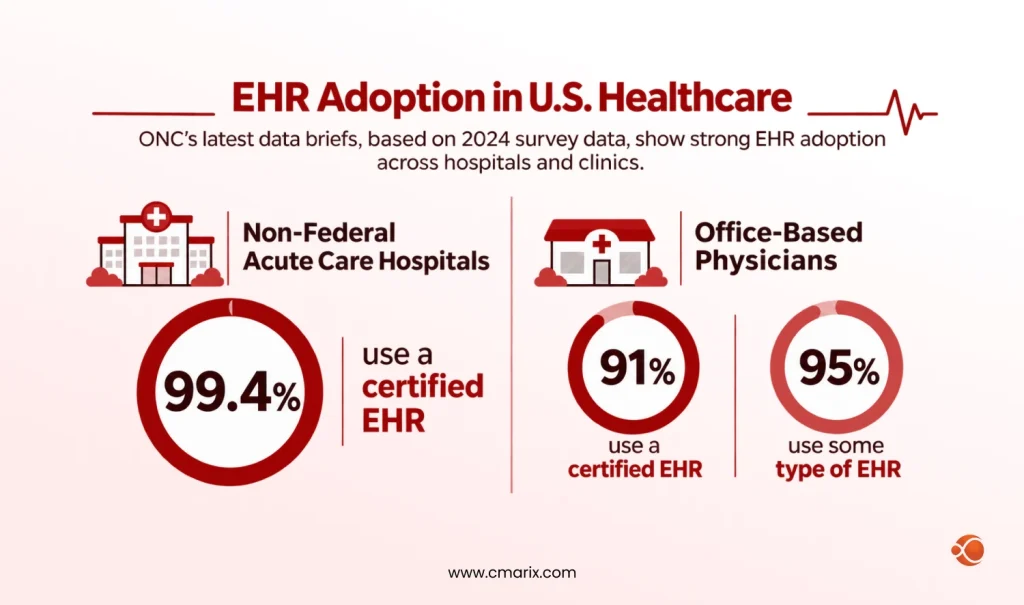
Almost every hospital and most clinics in the US now run on an electronic health record. ONC’s latest data briefs, published in June 2026 and based on 2024 survey data, show that 99.4% of non-federal acute care hospitals use a certified EHR. On the clinic side, 91% of office-based physicians use a certified EHR, and 95% use some type of EHR. If you build healthcare software, whether that is a telehealth platform, a patient portal, a billing tool, or an AI scribe, your product has to work with that record. That is where EHR integration comes in.
Integrating an EHR system is supposed to be one process, yet it turns out to be many small processes. Epic and athenahealth don’t integrate the same way. HL7 v2 interface messages vary from hospital to hospital. Compliance makes things even more complicated. Two software providers may quote the same project but make it tens of thousands of dollars apart. This blog post reveals what it takes to integrate an EHR system in 2027.
Quick EHR Integration Cost Highlights:
- Basic EHR integration (one read-only FHIR connection or one one-way HL7 interface) costs $10,000 to $40,000.
- Mid-Market EHR integration (a two-way connection with one major EHR, or a small set of interfaces) costs $40,000 to $100,000.
- Enterprise EHR integration (several EHRs, a middleware hub, 10+ interfaces) costs $100,000 to $250,000+.
- Maintenance runs $3,000 to $15,000 per interface per year.
- Developer rates range from $20 to $180 per hour depending on region.
Note: These are approximate estimates based on published market ranges. Your final number depends on scope, EHR vendor, interface count, and compliance needs.
What Is EHR Integration and How Does It Work?
EHR integration is the process of connecting an electronic health record system with other software so data flows between them automatically. A lab system pushes results into the chart. A telehealth app pulls the medication list from the patient before a video consult. A billing software gets encounter information without any duplicate entry.
You will also hear the terms EMR integration and EMR system integration. An EMR usually lives inside one practice, while an EHR is built to share records across organizations. The technical work is close to identical, so this guide uses EHR integration for both. If you are moving records from one system to another instead of connecting them live, that is closer to migration, and our post on EHR data integration covers it.
Common things teams connect to an EHR include:
- Telehealth platforms: Pull schedules and patient history before a visit, then write the visit note back.
- Patient portals and apps: Show records, lab results, and prescriptions to patients.
- Revenue cycle and billing tools: Receive encounters and charges without manual entry.
- Labs, imaging and pharmacy systems: Send orders and receive results.
- Analytics and AI tools: Read clinical data for reporting, risk scoring, and documentation.
Why EHR Integration Matters for Healthcare Software in 2027
The business case is simple. When systems do not talk to each other, staff retype data, errors occur, and clinicians lose time they should spend with patients. Good EHR integration cuts that waste, speeds up billing, and gives care teams one reliable view of the patient.
The rules are pushing in the same direction. The Cures Act and information blocking regulations expect providers to share data through standard APIs. TEFCA (Trusted Exchange Framework and Common Agreement) is building a national exchange network. CMS also requires many payers to have patient access, provider access, and prior authorization APIs live by January 2027, so the demand for working EHR integrations is only going up. Telehealth EHR integration is a good example. A remote visit is far more useful when the clinician can see the full chart on screen, and far less useful when they cannot.
It also fits a bigger shift. Interoperability sits near the top of most healthcare technology trend lists, and vendors that cannot connect to the EHR are quietly losing deals to those that can.
EHR Integration Approaches: FHIR, HL7 v2 and Middleware
Most modern EHR integration work starts with the HL7 FHIR specification. Data pipeline engineers design solutions that map clinical processes to structured JSON/XML schemas called resources. The resources include entities such as Patient, Observation, and MedicationRequest. External applications log in using SMART on FHIR, which uses OAuth 2.0 to ensure access only to relevant data.
Though legacy interfaces still matter. HL7 v2 sends pipe-delimited messages over a persistent connection and remains the workhorse for admissions, orders, and results. The RESTful EHR interface based on FHIR is more friendly for learning, testing, and scaling. HL7 v2 should be considered a more secure choice when the hospital application predates FHIR or only has an interface for orders and charges.
| Approach | Best For | Build Speed | Flexibility | Relative Cost |
| FHIR R4 API with SMART on FHIR | New apps, patient data access, modern EHRs | Fast | High | Low to Medium |
| HL7 v2 interface | Orders, results, admissions, older systems | Medium | Low | Medium to High |
| C-CDA documents | Summary of care exchange | Medium | Low | Medium |
| Vendor specific API | EHRs with limited FHIR support | Medium | Medium | Medium |
| Middleware or integration engine | Many EHRs, many interfaces | Slower to start | High | Higher upfront, lower over time |
| Direct database access | Rare cases with vendor permission | Fast | Low | Low upfront, high risk |
If you plan to connect to more than two or three systems, a middleware layer such as an integration engine or a unified API service usually pays for itself. It translates once and reuses the work, instead of rebuilding a custom interface for every new customer.
Our healthcare engineers will review your stack and recommend a plan.
EHR System Integration: Epic, Oracle Health, athenahealth and More
No two EHRs are integrated in the same way. Some publish open FHIR APIs you can test in a sandbox within days. Others require an approval process, a marketplace review, or a per-interface license on the hospital side. Knowing what you are walking into saves weeks.
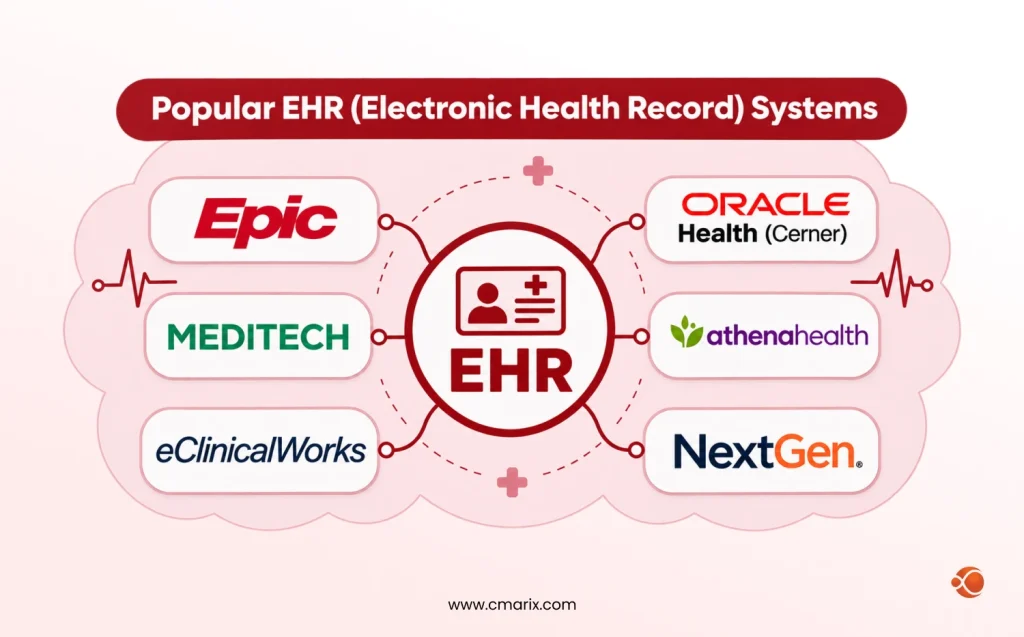
Healthcare software is a wide field, and the types of medical software you build decide which EHRs you will need to support first. A clinic scheduling app and a hospital analytics platform rarely start with the same vendor.
| EHR | Common Integration Routes | What to Watch For | Typical Tier |
| Epic | FHIR R4, SMART apps, HL7 v2, bulk data | Marketplace review, per-interface licensing at the health system | Basic to Mid-Market ($10,000 to $80,000) |
| Oracle Health (Cerner) | FHIR R4, vendor APIs, HL7 v2 | Site-by-site configuration differences | Mid-Market |
| MEDITECH | FHIR APIs, HL7 v2 | Older installs often need HL7 v2 | Mid-Market |
| athenahealth | Marketplace APIs, FHIR | Partner program requirements | Basic to Mid-Market ($10,000 to $80,000) |
| eClinicalWorks | FHIR APIs, partner program | Variation between practice setups | Basic to Mid-Market |
| NextGen | FHIR APIs, HL7 v2 interface engine | Interface testing with each customer | Mid-Market |
EHR Integration Best Practices for Secure, Scalable Systems
These EHR integration best practices come from the problems that most often sink projects. None of them are exotic. They just get skipped as a deadline approaches.
- Go FHIR first: Use FHIR wherever the EHR supports the resources you need, and fall back to HL7 v2 only for what FHIR cannot do. This is the core of a sound EHR integration strategy.
- Map workflows before writing code: Work with clinicians and front desk staff. A straightforward data field on paper can translate into three distinct behaviors in the real world.
- Use an integration engine when scale is coming: Tools like Mirth Connect or a commercial engine keep transformations in one place. Teams already working in the Microsoft ecosystem can also build EMR software using Microsoft Dynamics 365 and connect it to other systems through standard APIs.
- Build HIPAA compliance from day one: Encrypt data in transit and at rest, use role-based access, keep audit logs, and follow HIPAA Security Rule guidance from the start, not as a final pass.
- Test with realistic data: Sandbox data is clean. Real patient data is not. Test duplicate patients, missing fields, and odd characters before go-live.
- Plan for patient matching: Wrong matches are the most dangerous failure in any integration. Define your matching policy at the outset.
- Monitor everything after launch: Note every message, alert when failures occur, and measure the time taken for each transaction.
- Expect change: EHR vendors update APIs on their own schedule. Version your interfaces so an upgrade does not break production.
How to Do EHR Integration: A Step-by-Step Process
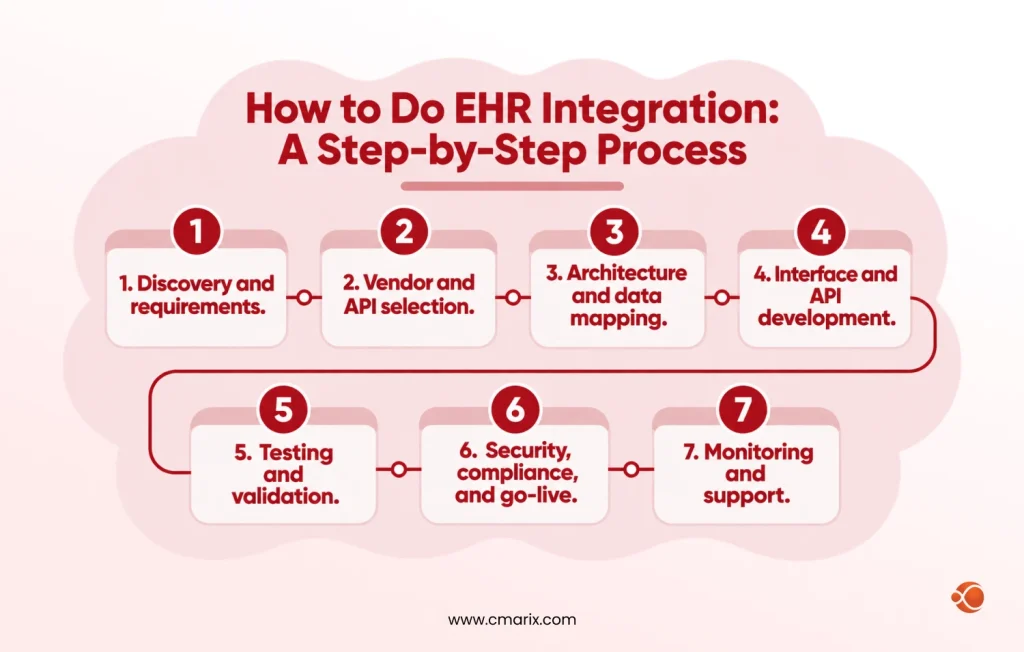
Here is how a typical EHR integration project runs from first call to live system.
1. Discovery and requirements.
Start by making a list of all the systems that you need to integrate, what goes through each system, and who is responsible for each process. Speak to the people who use this information daily, rather than IT specialists, since they know all about workarounds. Define what success means in this context, such as less manual input or faster result delivery.
Deliverable: a scoped requirements document and a list of interfaces.
2. Vendor and API selection.
Check what each EHR actually exposes currently, not what the sales page promises. Determine which resources and scopes of FHIR, sandbox, and approval time frame are present in each case. Some vendors do review their apps prior to release, and certain hospitals do license all interfaces. This is also the point where you choose between direct APIs and a middleware layer.
Deliverable: a vendor comparison and a realistic timeline.
3. Architecture and data mapping.
Determine how data will move, then map every field from the source system to the target. Pay close attention to code sets like LOINC for labs, SNOMED CT for conditions, and RxNorm for medications, because the same result can be coded three different ways. Decide how patient matching will take place in the process and what to do in case of missing or conflicting information. This step quietly determines most of your budget, so don’t rush it.
Deliverable: a data mapping specification and an architecture diagram.
4. Interface and API development.
Build the connections, authentication, error handling, and retry logic. Set up SMART on FHIR authorization for apps and secure credentials for backend services. Keep business logic out of the interface itself so a change in one workflow doesn’t break everything else. Record all the messages in sufficient detail to pinpoint an error to a particular patient record without disclosing additional information.
Deliverable: working interfaces running in a test environment.
5. Testing and validation.
First run unit tests, then end-to-end tests across the full flow. Use test data as close to reality as possible, including duplicates, missing entries, and other unusual data. Involve clinicians and front desk personnel in scenario testing, since they will detect workflow errors that automated testing may miss. Test the failure paths too, such as what happens when the EHR is down or a message arrives twice.
Deliverable: test results signed off by both technical and clinical users.
6. Security, compliance, and go-live.
Finish your security assessment, including access control, encryption, audit trail, and have all business associate agreements signed with anyone who accesses patient records. Test it in a pilot mode with one location or workflow and then move forward with rollout. Have a rollback plan and inform staff about all changes on go-live day.
Deliverable: a security sign-off and a staged rollout plan.
7. Monitoring and support.
After launch, keep an eye on message volumes, error rates, and processing times. Ensure that an alert is raised at the first sign of a problem, so that any broken interface can be fixed in minutes rather than days. Also review the interface each time the EHR provider releases a new version of its product, because changes to the API is by far the most frequent reason why interfaces break.
Deliverable: dashboards, an alert plan, and a support schedule.
CMARIX engineers can handle discovery, build, and testing end to end.
EHR Integration Cost in 2027: Complete Pricing Breakdown
Disclaimer: Figures below are approximate ranges based on published market data and typical project scopes. Treat them as planning numbers, not quotes.
Start with the tiers. Every other number in this section sits inside one of them.
| Tier | Cost Range | What You Get | Typical Timeline |
| Basic | $10,000 to $40,000 | One read-only FHIR connection or one one-way HL7 interface | 3 to 8 weeks |
| Mid-Market | $40,000 to $100,000 | Two-way connection with one major EHR or a small interface set | 2 to 4 months |
| Enterprise | $100,000 to $250,000+ | Multiple EHRs, middleware hub, 10+ interfaces | 5 to 9 months |
If EHR integration is one module inside a bigger product, the cost is usually smaller than the standalone numbers suggest. In a full healthcare app project, EHR integration typically adds $15,000 to $40,000, which falls inside our Basic tier. Our guide on the cost to build a healthcare app covers the rest of that budget.
EHR Integration Cost by Integration Type
| Integration Type | Cost Range | Tier |
| Single read-only FHIR connection | $10,000 to $30,000 | Basic |
| Single HL7 v2 interface | $10,000 to $40,000 | Basic |
| Bidirectional order and result interface | $25,000 to $60,000 | Basic to Mid-Market |
| Two-way integration with one major EHR | $40,000 to $80,000 | Mid-Market |
| Full two-way suite (FHIR plus HL7 v2 via middleware), per platform | $50,000 to $80,000 | Mid-Market |
| Multi-EHR platform with middleware hub and 10+ interfaces | $100,000 to $250,000+ | Enterprise |
EHR Integration Cost by Project Stage
This table shows where the money goes. The minimums add up to the $10,000 floor, and the maximums add up to the $250,000 ceiling used throughout this guide.
| Stage | Minimum | Maximum |
| Discovery and planning | $1,000 | $15,000 |
| Architecture and data mapping | $1,500 | $25,000 |
| Interface and API development | $4,000 | $100,000 |
| Testing and QA | $1,500 | $40,000 |
| Security and compliance | $1,000 | $30,000 |
| Deployment and go live | $1,000 | $40,000 |
| Total | $10,000 | $250,000+ |
EHR Integration Cost by Developer Region
| Region | Typical Hourly Rate | Best For |
| North America | $100 to $180 | Same timezone collaboration |
| Western Europe | $80 to $150 | Strong regulatory expertise |
| Eastern Europe | $40 to $80 | Balanced price and quality |
| India and South Asia | $20 to $50 | Lowest rates, large talent pool |
Rate is only part of the picture. A cheaper team that doesn’t know HL7 or FHIR will burn the savings on rework, so look for healthcare experience before you look at the hourly rate.
Factors That Affect the Cost of EHR Integration Services
When people ask what determines the cost of custom EHR integration services, the answer is almost always one of these.
- Number of EHRs: Each new vendor brings its own quirks, documentation, and approval process.
- Number of interfaces: Each interface is an individual build-test-maintenance cycle.
- Direction of data: Reading data is cheaper than writing it back. Two-way flows need conflict rules.
- Standards involved: Clean FHIR is easier than HL7v2 customized segments.
- Data mapping complexity: Complicated source data and custom field names can quietly consume your budget.
- Vendor fees and approvals: Marketplace evaluation and per-interface licensing costs time and money.
- Security and compliance scope: More sensitive data or wider regions mean greater complexity.
- Legacy systems: Older platforms can be difficult to handle, requiring workarounds and testing delays.
- Team location and experience: (See the rate table above), weigh it against healthcare expertise.
Hidden and Ongoing Costs of EHR Integrations
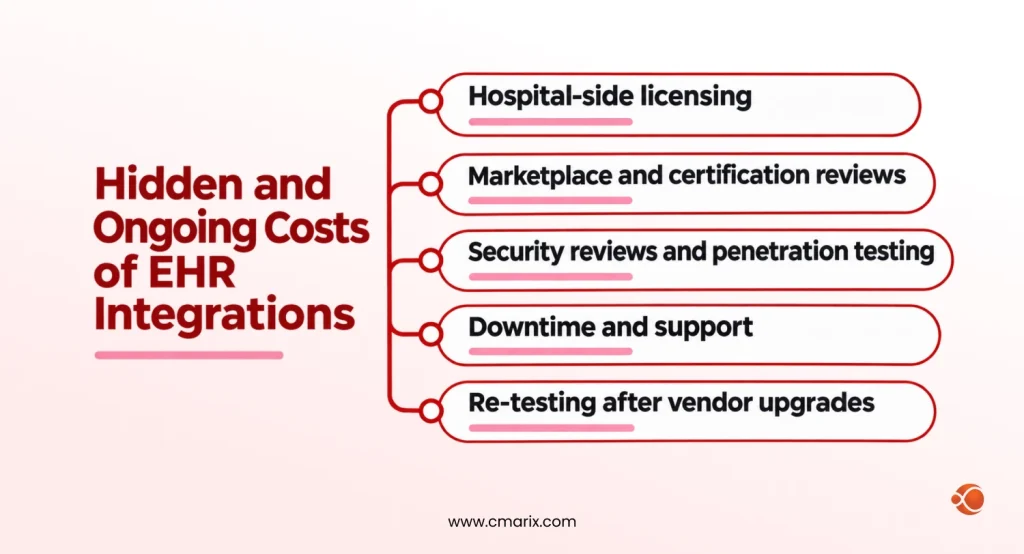
Most budgets cover the build and forget year two. Maintenance of an individual interface costs between $3,000 and $15,000 per year. Thus, a mid-market EHR integration project with four active interfaces will have to budget between $12,000 and $60,000 per year for maintaining the interfaces.
Other costs that surprise first-time buyers:
- Hospital side licensing: Few healthcare organizations have a cost per interface that they run.
- Marketplace and certification reviews: The more you wait in queue, the less your team gets to ship.
- Security reviews and penetration testing: Larger clients will demand those before releasing.
- Downtime and support: An interface that is broken at 2 a.m. still requires fixing.
- Re-testing after vendor upgrades: Each one means re-running through the regression process.
How to Reduce EHR Integration Cost Without Cutting Corners
Lowering the cost should not mean sacrificing the patient’s safety. These steps will lower costs without increasing future risk.
- Start with one EHR and one workflow: Prove value first, then expand.
- Choose FHIR wherever possible: It is cheaper to build and cheaper to maintain.
- Use middleware for multi-EHR plans: The upfront cost is higher, but every new connection gets cheaper.
- Reuse components: Create a map and logs once and use them for all interfaces.
- Clean your data before you connect: It is much more cost-effective to clean duplicates before going into production.
- Pick a partner with EHR experience: Existing vendor relationships shorten approvals.
Common EHR Integration Challenges and How to Solve Them
| Challenge | Why It Hurts | How to Fix It |
| Data silos and mismatched formats | Records do not line up between systems | Agree on a canonical data model and map everything to it |
| Patient matching errors | Wrong chart, real patient risk | Use strong matching rules and manual review for edge cases |
| Vendor lock-in | Hard to switch or expand later | Build on FHIR and keep logic outside vendor tools |
| Slow vendor approvals | Launch dates slip | Apply early and run development in parallel |
| Security gaps | Breach risk and failed audits | Encrypt, log, and review access from the start |
| Interface breakage after updates | Silent failures in production | Monitor message flow and version every interface |
Clean integrations also make everything built on top of them smarter. Most AI tools in healthcare, such as ambient scribes and risk scores, are only as effective as the data they can access.
In-House vs Outsourced EHR Integration Service Provider
There is no single right answer. It depends on how many integrations you need, how fast you need them, and whether healthcare interoperability is your core business.
| Factor | In-House Team | Integration Partner |
| Upfront cost | Higher (hiring, training) | Lower to start |
| Speed | Slower at first | Faster with existing experience |
| EHR vendor relationships | Built from scratch | Often already in place |
| Control | Full | Shared |
| Long-term maintenance | Your team owns it | Depends on contract |
A hybrid model works well for many companies. A partner builds the first integrations and sets up the architecture, then your team takes over day-to-day work. If you are weighing a larger platform build, our guide to EHR software development explains what that road looks like.
Why Choose CMARIX for EHR Integration Services
CMARIX builds healthcare software for clinics, hospitals, and digital health companies, so EHR integration work sits within a wider understanding of clinical workflows, compliance, and scale.
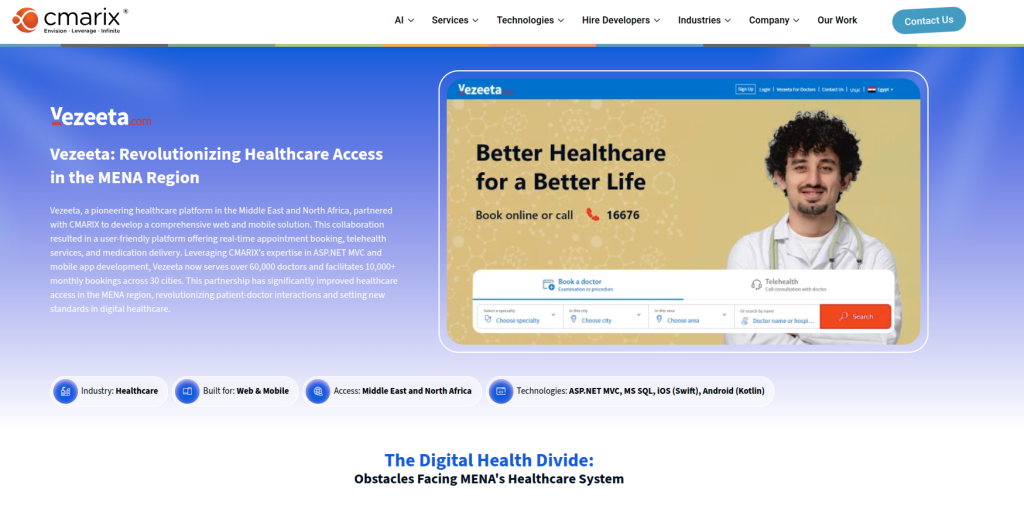
We have delivered Vezeeta, a smart healthcare solution for the Middle East and North Africa that pairs a patient-facing consultation app with a provider scheduling and records system. We are ISO 9001:2015 and ISO 27001 certified, and we have served clients across 40+ industries.
If you want a team that treats security and interoperability as part of the design, talk to a healthcare software development company that has done it before.
Need more than the integration layer? Our custom software development services cover everything from architecture to long-term support.
Final Thoughts
EHR integration is no longer a nice extra. It is how modern healthcare software earns its place in a clinic’s daily routine. Start with FHIR where possible, work with HL7 v2 where necessary, and develop a mapping before coding anything. Base your budgeting on the different tiers: $10,000 – $40,000 for Basic, $40,000 – $100,000 for Mid-Market and $100,000 – $250,000+ for Enterprise, plus $3,000 – $15,000 for every interface annually.
The teams that win here are not the ones with the longest feature lists. They are the ones whose products plug into the EHR cleanly, safely, and on time.
Abbreviations Used in Blog
| Abbreviation | Full Form |
| EHR | Electronic Health Record |
| EMR | Electronic Medical Record |
| FHIR | Fast Healthcare Interoperability Resources |
| HL7 | Health Level Seven |
| SMART | Substitutable Medical Applications, Reusable Technologies |
| C-CDA | Consolidated Clinical Document Architecture |
| TEFCA | Trusted Exchange Framework and Common Agreement |
| ONC | Office of the National Coordinator for Health Information Technology |
| CMS | Centers for Medicare & Medicaid Services |
| HIPAA | Health Insurance Portability and Accountability Act |
| LOINC | Logical Observation Identifiers Names and Codes |
| SNOMED CT | Systematized Nomenclature of Medicine Clinical Terms |
| RxNorm | Normalized Names for Clinical Drugs |
| API | Application Programming Interface |
| OAuth | Open Authorization |
| JSON | JavaScript Object Notation |
| XML | Extensible Markup Language |
| REST | Representational State Transfer |
| QA | Quality Assurance |
| ISO | International Organization for Standardization |
| MENA | Middle East and North Africa |
FAQs About EHR Integration
What is EHR integration and why is it important in healthcare?
EHR integration links EHR software with other software to ensure automatic data transfer between the two. This is significant because it reduces manual entry and errors, speeds up billing, and gives clinicians a complete view of the patient. Without EHR integration, duplicate efforts are required.
What is the difference between EHR and practice management software?
An EHR stores and manages a patient’s medical information, such as diagnoses, medications, laboratory results, and visit notes, while practice management software handles the business side, including appointment scheduling, billing, claims processing, and patient registration. While many vendors offer EHR and practice management software together, they address different issues and require separate integrations.
What is EHR compatibility and how does it affect clinical workflows?
EHR compatibility describes how effectively a system can exchange data with an EHR using standards such as FHIR and HL7. High EHR compatibility allows clinicians to access accurate, current data without switching between screens.
How does telehealth EHR integration improve remote patient care?
Telehealth EHR integration lets a clinician view the patient’s history, medications, and recent results during a video visit. It also writes the visit note, orders, and follow-ups straight back to the chart. That keeps remote care as complete and safe as an in-person visit.
How do you build a scalable EHR integration strategy?
Start with FHIR wherever the EHR supports it, and use a middleware layer when you expect more than a few connections. Standardize your data model and ensure every interface and message flow is versioned from the start. Integrate EHRs or one workflow at a time to maintain architectural integrity.
What EHR integration best practices ensure HIPAA compliance?
Encryption of data in transit and at rest, role-based access, logging of all activities, signing a business associate agreement with each vendor that has access to patient data, testing with realistic data, and periodic access reviews.
How do RESTful EHR integration APIs compare to legacy HL7 interfaces?
RESTful FHIR APIs use standard web technology and structured resources, so they are faster to build, easier to test, and simpler to scale. Legacy HL7 v2 interfaces rely on pipe-delimited messages that vary from site to site and need more custom mapping. HL7 v2 is still common for orders, results, and admissions, so many projects use both.
Can clinics extract patient data from EHR systems without API access?
Occasionally, yes; methods include standard exports, automated file transfers, or report downloads from your vendor, such as C-CDA. This is more difficult and less effective than an API connection. Remember to consider your vendor agreement and your HIPAA requirements before doing anything.
What factors determine the cost of custom EHR integration services?
The biggest drivers are the number of EHRs, the number of interfaces, whether data flows one way or both ways, the standards involved, and how messy the source data is. Vendor fees, security scope, legacy systems, and team location also matter. Projects generally fall between $10,000 and $250,000+, with $3,000 to $15,000 per interface each year in maintenance.