




Quick Summary: AI in software development is transforming how teams plan, code, test, debug, review, and deploy software. It helps developers work faster, automate repetitive tasks, improve code quality, and accelerate delivery while keeping human oversight essential for security and reliability
AI in software development now touches nearly every stage of the build, from planning and coding to testing and deployment. Gartner expects 90% of enterprise software engineers to use AI code assistants by 2028, up from under 14% in early 2024. This guide breaks down what AI in software development actually means, where it delivers real benefits, the use cases worth knowing across the SDLC, and the impact teams are seeing once the AI is put to work.
A developer sits down, explains what he or she wants in plain English, and sees live coding emerge before their very eyes before their coffee gets cold. This kind of thing used to be showmanship three years ago. Today, it’s Tuesday morning for an increasing number of engineering teams. The use of AI in software development has exited the hype phase and entered regular use, not as a substitute for developers, but rather as a layer applied across most aspects of the development process.
It is impossible to overestimate the speed of this change. According to Gartner, 90% of enterprise developers will be using AI-assisted coding tools by 2028 – from one in seven developers at present. That kind of growth doesn’t occur on the back of something popular; it results from solid productivity metrics.
Key Highlights:
- AI in software development refers to the use of machine learning models, generative AI, and code-aware assistants to develop, test, debug, and deploy software quicker.
- Core benefits: faster development cycles, fewer repetitive tasks, better test coverage, and lower onboarding time for new engineers
- Key use cases span the whole SDLC — requirements, coding, testing, code review, refactoring, and DevOps.
- McKinsey estimates generative AI could add $2.6 trillion to $4.4 trillion in annual value across the economy, with software engineering among the top four functions capturing that value.
- The impact isn’t automatic — teams that treat AI as a co-pilot rather than autopilot see the biggest gains.
This guide walks through what AI in software development actually covers, where the benefits hold up under scrutiny, the use cases worth knowing across the development life cycle, and the impact: good and complicated- that teams are seeing once the AI gets put to work.
What is AI in Software Development?
Artificial intelligence in software development refers to the use of machine learning models and generative AI tools to automate and accelerate various stages of the software development process. This includes a wide variety of tasks, such as an editor’s suggestion for further coding, a chatbot’s answer to a question like “how should I structure this API,” automatic generation of unit tests, or detection of potential security risks before code merge.
It is not just one tool. It is a layer that now encompasses the entire SDLC, and the tools used depend on where you are in the process. Some of them are very narrow, like a smarter linter. Other tools are wide and interactive, where you discuss the whole feature with the assistant. The common thread among them all is that they all bring you closer from “I know what I need to build” to “it’s done.”
The Benefits of AI in Software Development
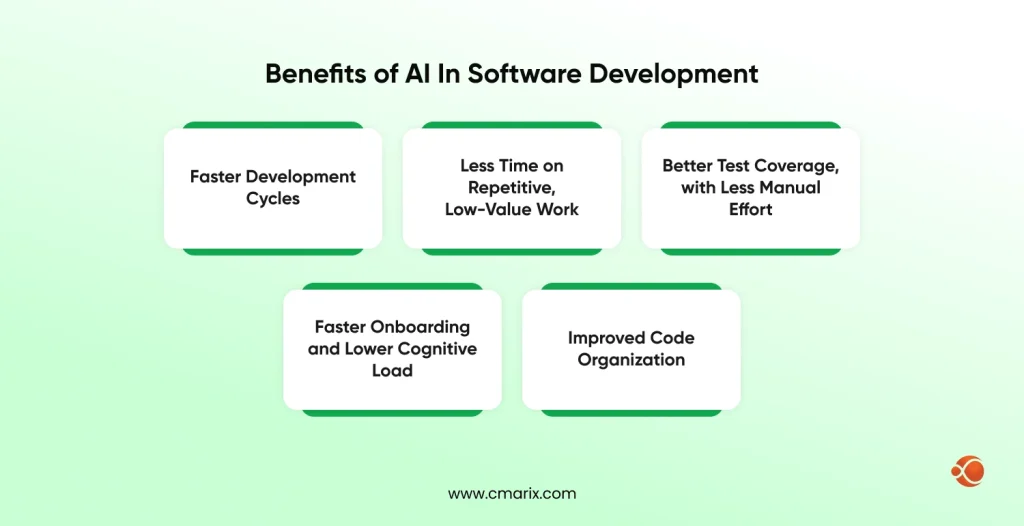
Faster Development Cycles
This is by far the most-cited benefit of working with an AI assistant, and for a good reason; it’s the easiest to quantify. The ability of coding with an AI assistant to save time has been demonstrated in study after study. Studies at the task level have shown productivity improvements ranging from 27% to 55%.
The gains are also inconsistent throughout the board. Languages that are simpler in nature and have patterns like Python tend to be faster than languages like C++, where human intervention is still required for memory management. The inconsistency is important as it shows that AI excels in some tasks and not all.
Less Time on Repetitive, Low-Value Work
Boilerplate, CRUD endpoints, standard configuration files, repetitive test scaffolding-this is where AI-augmented software development earns its keep day to day. Developers spend less time retyping patterns they’ve written a hundred times before and more time on the parts of the job that actually require judgment: system design, edge cases, and the business logic that makes a product different from its competitors.
Better Test Coverage, with Less Manual Effort
Unit tests created by AI technology, provided there is adequate guidance from docstrings and the prompting approach, have reached 96% of branches and nearly 100% of compilations in lab settings. This represents a major improvement for companies that have traditionally viewed test writing as something left undone due to time constraints.
Faster Onboarding and Lower Cognitive Load
New hires learn more quickly when they get to ask a computer “what does this function do” rather than hunt down the author who wrote it three years back. Cognitive load is reduced for both mental demands and time pressures when developers use AI tools – although, to be frank, it is not an entirely cost-free venture. The one thing that definitely increases is frustration, often stemming from AI recommendations that appear valid but are not.
Improved Code Organization
Strangely enough, the use of artificial intelligence for programming has proven superior in terms of maintainability index and cyclomatic complexity, mainly due to the assistants using standardized formatting and control flow. This does not mean the design is automatically better; it is still a definite structural advantage.
Get a practical roadmap based on use cases, AI capabilities, integrations, and development requirements.
Use Cases of AI Across the Software Development Life Cycle
AI in SDLC isn’t limited to writing code. Here’s where it shows up at each stage:
| SDLC Stage | AI Use Case | What It Looks Like in Practice |
| Requirements & planning | Drafting user stories, surfacing edge cases | AI reviews a spec and flags gaps or ambiguous requirements before sprint planning |
| Architecture & design | Proposing patterns, comparing trade-offs | AI suggests architectural options based on scale and constraints described in plain language |
| Coding | Code completion, full-function generation | Inline suggestions, chat-based code generation, boilerplate automation |
| Code review | Automated PR review, style enforcement | AI flags likely bugs, security issues, or convention violations before a human reviewer looks |
| Testing | Unit test generation, edge-case discovery | AI writes test cases from docstrings or function signatures, expanding coverage automatically |
| Documentation | Auto-generated comments and docs | Inline docstrings and README drafts generated alongside the code itself |
| Refactoring & modernization | Legacy code translation, structure cleanup | AI proposes modern equivalents for outdated frameworks or flags overly complex functions |
| DevOps & security | Infrastructure-as-code drafts, anomaly detection | AI drafts config files, correlates logs during incidents, and suggests patches for flagged vulnerabilities |
A few of these use cases deserve a closer look, because they’re where the gap between “AI helped” and “AI actually shipped something reliable” tends to show up.
- AI is not limited to autocompletion anymore. Programmers engage in full conversations with their assistants regarding how to develop a particular feature, and then their assistants write and comment on the code during the conversation. Pair programming with AI looks more like collaboration with a never-tiring junior engineer than advanced autocompletion.
- Vibe coding: describing what you want in plain language and letting an AI generate the implementation, often without reading every line, has become common enough to shape how early-stage products are built. It’s fast, and for prototypes and internal tools, that speed is a genuine advantage. Where it gets risky is production software, especially anything touching authentication, payments, or user data — the parts of an app that are worth reading closely regardless of how much time pressure you’re under. Our breakdown of vibe coding’s benefits, risks, and best use cases goes deeper into where that line sits.
- Refactoring legacy code is one of the quieter wins. AI tools are increasingly good at translating outdated frameworks into modern equivalents, which lets teams modernize gradually instead of committing to a risky full rewrite.
- Implementing AI within enterprise systems is a different ballgame from adding a coding aid to an editor used by developers on their team. This involves implementing AI features such as a recommendation engine, predictive analytics, and automation within existing enterprise software systems that were probably not designed with AI capabilities in mind.
The Impact of AI in Software: What’s Actually Changing
Economic impact
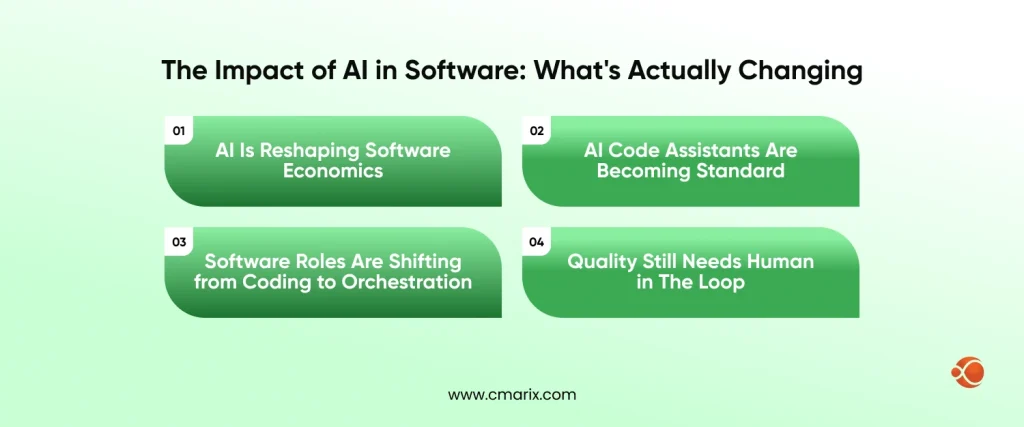
McKinsey’s widely cited estimate puts generative AI’s potential annual value at $2.6 trillion to $4.4 trillion across the economy, with software engineering named as one of the four functions capturing roughly three-quarters of that value, alongside customer operations, marketing, and R&D. That’s not abstract — it’s the reason enterprise software budgets are shifting toward AI-augmented development at the rate they are.
Adoption is close to universal, and moving fast
Gartner’s research shows the adoption curve for AI code assistants going from under 14% of enterprise engineers in early 2024 to a projected 90% by 2028. That’s not a niche tool anymore — it’s infrastructure. Teams that haven’t started integrating AI into enterprise systems and dev workflows are increasingly the exception rather than the rule.
The workforce is shifting, not shrinking
But a far more interesting effect is not the loss of jobs; it is the change in roles. This is how Gartner describes the shift as well, calling it a transition from “implementation to orchestration” and involving much more time spent on solving problems, designing systems, and ensuring that the AI-driven product is really doing its job. This change is evident in the job market dynamics, where more engineers capable of integrating AI are required despite decreasing coding time per feature.
The honest caveat: quality still needs a human in the loop
This is the piece that never makes it into the slides when AI service vendors pitch their capabilities. The studies have found evidence of increased security vulnerabilities in AI-generated code compared with code written by humans. Even more worrisome is that developers working with AI assistants are less concerned about security issues, while documentation improves at the cost of a significant portion of AI-generated content being nonspecific or incorrect.
All this does not imply that the use of AI in software development should be considered at all; productivity statistics clearly show that it should not even be discussed. What it implies is that for the “impact” of AI to be truly positive, it must be accompanied by proper review, security checks, and the technical expertise to recognize when to slow down.
Final Words
A lot of failed AI initiatives don’t fail because the model was bad — they fail because the data feeding it wasn’t ready, or the rollout skipped the planning work that agile teams normally do before committing to a sprint. If you’re integrating AI into enterprise systems at any real scale, it’s worth reading up on data readiness for AI before you start, and on how agile development adapts for AI-first SaaS products, where sprint planning has to account for experiments with uncertain outcomes instead of predetermined features.
Cost is the other question that comes up early in almost every AI initiative — our guide to AI app development cost covers the real budget factors, from data quality to infrastructure to post-launch maintenance.
CMARIX works across the full picture. As an artificial intelligence software development company, we build the AI-augmented systems themselves, run AI PoC development to validate an idea before committing to a full build, and handle generative AI integration into existing enterprise software, where the real complexity usually lies.
FAQs on AI in Software Development
What is AI in software development?
AI is the application of machine learning and generative AI to help write, test, review, and maintain software, from code completion through conversational code generation.
How is AI programmed?
An AI for development is usually built on pre-trained language models trained on extensive amounts of code and natural language data, then refined for specific development tasks such as code completion, testing, or documentation.
Is AI a computer program?
In general terms, yes, AI applications in development are computer programs (based on trained machine learning models) that analyze input and produce output in accordance with patterns learned during training, rather than through explicitly hand-coded rules.
What are the best AI tools for software developers?
There are various types of tasks – there are different types of AI tools, such as inline coding assistants for completing regular tasks, conversational assistants for discussing architecture and debugging, and various specialized solutions, for instance, for generating tests or performing security scans. In most cases, using several tools becomes inevitable.
How does AI help with code reliability?
AI contributes to increased software reliability mainly through improved test coverage and more consistent code structure. Nevertheless, the increased reliability relies on human reviews, since AI-generated code contains more specific types of bugs and security-related issues without human supervision.
How does AI change software engineering education?
It makes the learning process more about designing the system, reading prompts, understanding the output of AI, and evaluating the results – because AI could create the necessary code but wouldn’t be able to determine whether the architecture was good enough.
What is AI-augmented software development?
It is a software development process in which AI tools are used at all stages, but aren’t intended to replace the engineer working on the project, only to handle routine work for him/her.
How can AI help with code refactoring?
AI-based tools can spot overly complex functions, offer simpler alternatives, and rewrite legacy code to use modern frameworks. This approach makes gradual modernization possible and more realistic than a complete rewrite.
What is the impact of AI on software development jobs?
According to the numbers provided, there should be no reduction in employment due to AI – instead, developers need to shift their focus from writing code to overseeing it, with increasing need for specialists who can properly control AI-assisted processes.
How do you use AI in the software development life cycle (SDLC)?
AI can support every stage — requirements analysis, architecture, coding, code review, testing, documentation, refactoring, and DevOps — though the level of human oversight needed varies by stage, with security-sensitive and architectural work needing the most.