


Quick Summary: Vibe coding is the practice of describing what you want in plain language and allowing an AI tool to write the code for you. It has gone from a weekend experiment to a mainstream way of building software. This blog breaks down how it works, where it quietly creates risk, where it genuinely helps, and what it actually costs to fix a vibe-coded app once it needs to hold up in production.
Now every founder with an idea and a computer has a hack that wasn’t available just three years ago – you write one sentence of description of what you need, and in a matter of seconds you have a screen already in front of you. No configuration of environment, no learning of the syntax, no waiting until the developer is free. It really happened; that’s why vibe coding became not just a buzzword of the AI community on Twitter, but something that is discussed by everyone in product teams, agencies, and non-technical founders.
The part that gets skipped the most is that the app that works in a demo and the app that can stand real users are two different things. Here it goes: vibe coding explained like we wish to explain it to ourselves.
This guide is for: founders and non-technical builders exploring AI coding tools, product teams evaluating vibe coding for a real launch, and engineering leads trying to figure out how much oversight a vibe-coded project actually needs before it ships.
What Is Vibe Coding? Definition and Origin
Vibe coding refers to the technique of developing software by providing your intentions to the AI coding tool via plain English and allowing it to develop the implementation without your intervention in the process of typing the code. This technique received its name from AI researcher Andrej Karpathy, who noted how he was fully giving in to the vibes and stopped reading the code being shipped for the most part of the time. According to Collins Dictionary, it became a defining term of the year, and again it says much more about the popularity of the phenomenon than the technology itself.
The short version of vibe coding is over here. The long version means that the focus of efforts shifts from typing code at a decent speed to providing clear intentions and reviewing the output with care.
Who Coined the Term Vibe Coding?
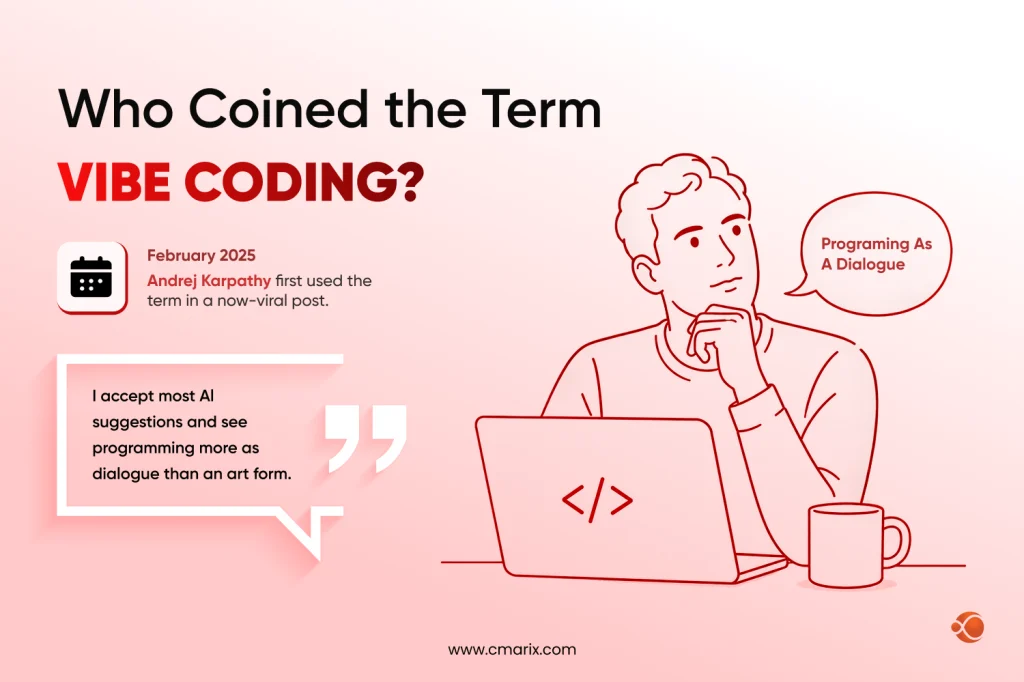
Karpathy first used the term in a February 2025 post where he explained how he can’t really read the distinction anymore, accepts most AI suggestions, and considers programming more of a dialogue than an art form. This was in reference to a side project of minor importance. This context is usually forgotten when the phrase makes it into a startup’s pitch deck.
How Does Vibe Coding Work? The 4-Step Process
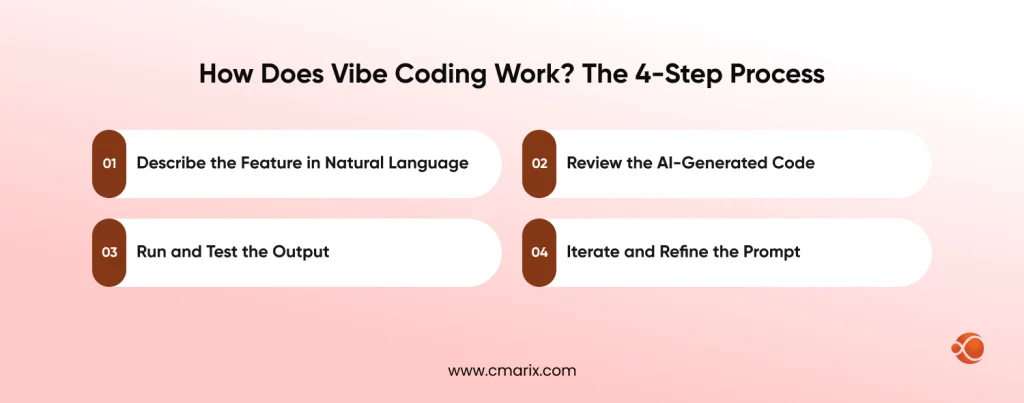
Most vibe coding sessions follow a loop, whether you’re using a chat-based tool or an IDE-integrated agent. It looks simple from the outside, but each step carries more weight than it first appears.
1. Describe the Feature in Natural Language
You explain what you want developed or fixed, in plain English, the way you’d brief a teammate rather than write a technical spec. This step depends entirely on natural language prompting done well; unpredictable code and vague instructions produce vague results, while a prompt that specifies the behavior, the edge cases, and the constraints tends to produce something usable on the first pass.
Experienced vibe coders often write a short spec before handing anything to the AI, treating the prompt itself as a lightweight design document rather than a one-line request. If your team is formalizing this step, our AI prompt engineering guide covers how to structure prompts that consistently produce usable output.
2. Review the AI-Generated Code
You scan what the AI generated. Experienced builders spot-check for logic, structure, and obvious red flags rather than reading every line, but they also know which parts of an application are worth reading closely regardless of time pressure; anything touching authentication, payments, or user data included. This is the step most beginners skip entirely, and it’s the single biggest predictor of whether the resulting code is safe to build on.
3. Run and Test the Output
You execute the code and test it manually, clicking through the actual behavior instead of just trusting that it is compiled. A screen that loads without errors is not the same as a feature that behaves correctly under real conditions, so this step means testing what happens with bad input, unexpected clicks, and empty fields, not just the happy path the prompt described.
4. Iterate and Refine the Prompt
You describe the next fix or feature and repeat the loop. Over many cycles, this is where codebases either stay coherent. Because each iteration builds on a clear understanding of what came before, or starts to drift, because each fix was made in isolation without anyone tracking how the pieces fit together.
This pattern is a genuine departure from how software has traditionally been planned and built, where design, implementation, and testing were distinct phases handled by different amounts of deliberate thought. In vibe coding, all four collapse into a single fast loop, which is exactly where the speed comes from and exactly where the risk hides. Teams that already run a structured AI software development process tend to treat this loop as one phase inside a larger discipline, not the whole discipline, wrapping it with the planning and review steps that keep the speed from turning into chaos.
Best Vibe Coding Tools in 2026
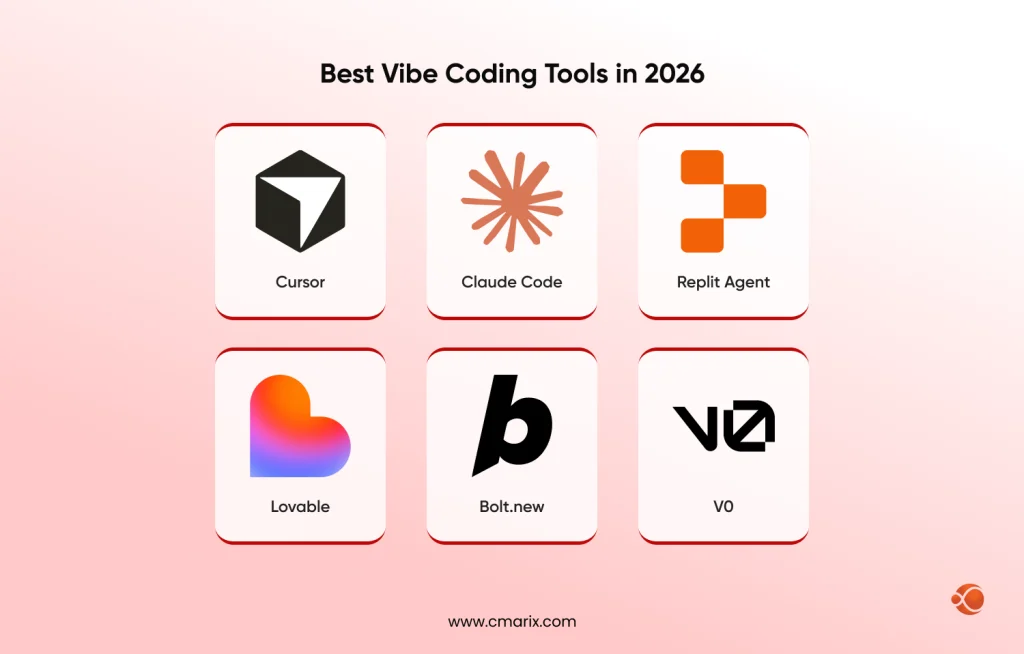
The tool landscape has matured fast, and each option leans toward a different kind of builder.
| AI Coding Tool | Best For | Ownership Model |
| Cursor | IDE-based development with deep codebase context | You own and host the generated code |
| Claude Code | Reasoning-heavy debugging, code refactoring, and multi-file changes | You own and host the generated code |
| Replit Agent | Browser-based full-stack app prototyping and development | Hosted platform with exportable code |
| Lovable | AI-generated, design-focused UI and frontend development | Hosted platform with exportable code |
| Bolt.new | Rapid prototyping across multiple frameworks | Hosted platform with exportable code |
| v0 | React and component generation within the Vercel ecosystem | You own and host the generated code |
- Cursor – an AI-native code editor that reads your whole codebase for context, so its suggestions fit the project instead of feeling bolted on.
- Claude Code – built for reasoning through complex, multi-file changes, which makes it a favorite once a project outgrows simple prompts.
- Replit Agent – runs entirely in the browser and can scaffold a full-stack app from one prompt, good for testing an idea with zero setup.
- Lovable – focused on producing clean, design-quality interfaces fast, popular with founders who care how the product looks and feels.
- Bolt.new – built for speed across multiple frameworks, useful when you want to try an idea in more than one stack before committing.
- v0 – generates UI components that plug directly into Vercel-based projects, a natural fit for teams already building on that stack.
Most of these fall under the broader category of AI coding agents, tools that plan, write, and test a feature with minimal supervision rather than just autocompleting a line.
Vibe Coding Statistics and Adoption Trends in 2026
This isn’t a fringe habit anymore. The numbers below cover developer adoption, daily usage, and market growth heading into 2026.
Vibe Coding and AI Tool Adoption Rates
- 84% of developers now use or plan to use AI coding tools, up from 76% in 2024; 51% of professional developers use AI tools daily.
- 85% of developers regularly use AI tools for coding and development, with 62% relying on at least one AI coding assistant, agent, or code editor.
- Nearly 80% of new GitHub developers used Copilot within their first week of joining the platform.
Vibe Coding Market Size and Growth
- $9.46 billion – the projected global size of the AI code tools market in 2026.
- $7.65 billion – the market size just one year earlier, in 2025.
Adoption isn’t limited to solo founders experimenting on weekends either. Enterprise teams working with modern stacks, including those developing AI applications with .NET and Azure, are folding AI-assisted programming into standard engineering workflows rather than treating it as a side experiment.
Benefits of Vibe Coding for Founders and Development Teams
- Speed to prototype – what used to take weeks of setup and scaffolding can now produce a clickable version of an idea in a day or two.
- Lower validation cost – founders can test whether an idea resonates before committing a serious budget to it.
- Accessibility – people without formal engineering backgrounds can build working tools, internal dashboards, and early-stage products on their own.
- Faster iteration – rapid prototyping cycles let teams test five directions in the time it used to take to build one.
These are real advantages, not hype. The problem is that the same qualities that make vibe coding fast also make it easy to skip the parts of engineering that don’t show up in a demo.
Our team reviews AI-generated codebases and tells you exactly where you stand.
Vibe Coding Risks: Where It Breaks Down in Production
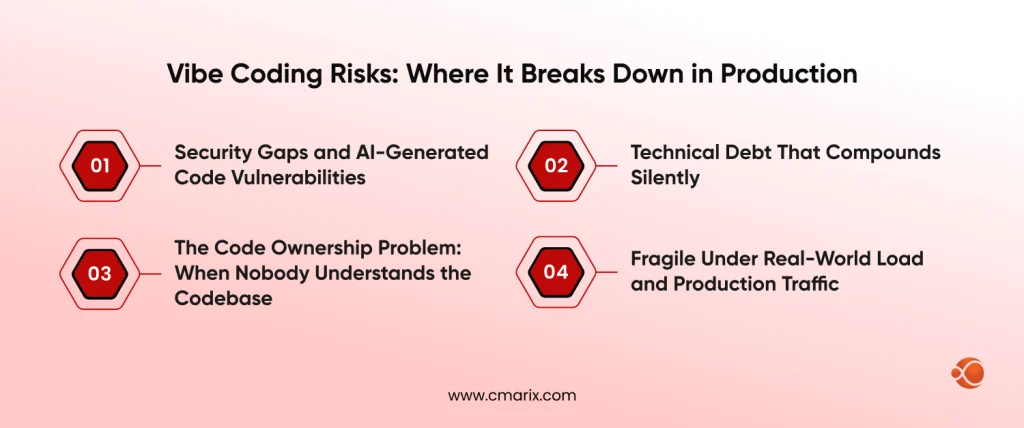
The gap between “it runs” and “it’s reliable” is where most of the real risk sits.
Security Gaps and AI-Generated Code Vulnerabilities
AI-generated code vulnerabilities are well documented at this point. Independent security testing has found that a meaningful share of AI-generated code samples fail standard security checks, and the failures tend to follow a predictable pattern rather than being random.
- SQL injection risk – AI tools frequently concatenate user input directly into database queries instead of using parameterized statements, because it’s the simplest way to make a query work in a demo.
- Broken authentication – session handling, token expiry, and password policies are often implemented at the minimum level needed to let a login screen function, not the level needed to resist real attempts to break in.
- Missing input validation – forms and API endpoints accept whatever is sent to them, because validating every field takes extra prompting most people skip.
- Exposed secrets – API keys, database credentials, and tokens sometimes end up hardcoded directly into the codebase or committed to a public repository, since the AI has no way of knowing which values are sensitive unless it’s told.
- Weak access control – permission checks get simplified or skipped entirely, so a user can sometimes reach data or actions they shouldn’t have access to.
None of these issues are visible in a working demo. A login screen that accepts a password looks identical whether the session handling behind it is solid or full of holes. They show up later, usually after real users, real data, and in the worst cases, real attackers are already involved.
Technical Debt That Compounds Silently
Every single shortcut in the process of vibe coding gets recorded on a balance sheet nobody is keeping track of. Every single architectural decision made by the artificial intelligence software but never documented, every single pattern discrepancy in the files, everything builds up until even the most basic request takes forever to accomplish.
This debt is different from the kind a human team accumulates on purpose to hit a deadline. A developer team usually knows what corner it cut and why. In a vibe-coded project, the shortcuts are invisible until someone goes looking for them, because each individual prompt produced code that looked reasonable on its own.
It is only when one gets to the level of systems architecture that it becomes clear that there is an issue since the three components each use a slightly different data model, or there are four occurrences of similar logic since nobody thought of instructing the AI to copy itself from something else it had done earlier. Once discovered, the remedy is not a quick fix but rather a restructuring effort that impacts most of the codebase.
The Code Ownership Problem: When Nobody Understands the Codebase
Ownership issues arise when a certain limit of growth in the codebase has been reached, and the majority of the code has been approved without ever being read. Ownership issues happen because for the new engineer to comprehend the decision made behind the lines of code, he must reverse engineer the intent behind the code since the code has no documentation and no explanation behind it because it was not written by someone who had made that decision. This is the main reason why vibe-coded MVPs fail once a team attempts to move forward with it. Every request requires some sort of investigation.
Fragile Under Real-World Load and Production Traffic
There’s a fourth failure mode that shows up less in the marketing around vibe coding but comes up constantly in practice. Code built and tested through a handful of manual clicks rarely gets exposed to the edge cases that show up once real traffic arrives, a slow network connection, a user submitting a form twice, an API that times out mid-request, or a value nobody thought to test for. AI tools generate code that handles the path someone described. They don’t reliably anticipate the paths nobody described, and production traffic finds those gaps quickly.
Vibe Coding Checklist: Questions to Ask Before You Ship
☐ Did the AI simplify it to make the demo work, or does the auth flow actually enforce permissions?
☐ Are there any hardcoded secrets, credentials, or keys sitting in the codebase?
☐ Are all user inputs sanitized before they go into the database query or the API call?
☐ Do you have any test coverage for anything other than “it worked when I clicked through it”?
☐ Are there any rate limiters for any endpoint that involves any financial or personal information
☐ Could someone other than you explain what this code does in six months?
☐ Has the app been tested with bad input, empty fields, and unexpected user behavior, not just the intended path?
☐ Is sensitive data encrypted in transit or at rest, not just assumed to be handled by default?
If more than one box goes unchecked, that’s a signal the project has outgrown agentic programming without oversight and needs a proper review before it goes further.
Vibe Coding Cost: What It Takes to Fix, Harden, or Scale Your App
This is the question most vibe coding content dances around. Here’s a straight answer, in ranges, based on the kind of work that actually goes into taking a vibe-coded build to production.
What Typically Needs Fixing
- Security remediation – closing the gaps around auth, input handling, and data storage before anything touches real users.
- Missing tests – building a test suite retroactively, which takes longer than writing tests alongside the original code would have.
- Documentation – reconstructing an understanding of what the AI actually built, so a team can maintain it.
- Architecture cleanup – refactoring pieces that were never designed to scale past a demo.
Vibe Coding Fix Costs by Project Size
| Project Type | Typical Fix Scope | Cost Band |
| Internal tool, low stakes | Light review, targeted fixes | Low, often a short audit engagement |
| Customer-facing MVP, no sensitive data | Security pass, partial refactor, test coverage | Moderate |
| Product handling payments, health, or personal data | Full audit, compliance review, significant refactor or partial rebuild | Higher, comparable to a fresh custom build phase |
Estimated Vibe Coding Cost Ranges by Engagement Type
The bands above translate roughly into the following, depending on codebase size, how much of it needs to be rewritten versus reviewed, and whether compliance work is involved.
| Engagement Type | What’s Included | Estimated Cost |
| Code audit only | Security review, architecture assessment, prioritized findings report, no code changes | $2,000–$6,000 |
| Security and stability fixes | Auth hardening, input validation, test coverage for critical paths, targeted refactor | $8,000–$25,000 |
| Partial refactor | Restructuring core modules, closing security gaps, adding documentation and test coverage across the app | $20,000–$60,000 |
| Full rebuild on validated concept | Rebuilding the product on solid architecture using the vibe-coded version as a proven spec | $50,000–$150,000+ |
| Compliance-driven rebuild | Full rebuild plus HIPAA, PCI DSS, or SOC 2 alignment for regulated data | $75,000–$200,000+ |
These are directional ranges, not quotes. The real number depends heavily on codebase size, how much of the original logic is worth keeping, and how quickly the project needs to move. A short audit is usually the right first step regardless of which band a project falls into, since it tells you which row of this table you’re actually looking at before you commit a budget to it.
For a fuller breakdown of what goes into this kind of engagement, our guide on AI product development cost covers the variables that actually move the number: team size, compliance needs, and how much of the existing codebase is salvageable.
Refactor vs Rebuild: How to Decide
If the main logic is sound and the problems are mostly in security and structure, a refactor usually makes sense. If the AI makes fundamental architecture decisions that don’t hold up, no test coverage exists anywhere, and nobody on the team can explain half the codebase, a rebuild is often faster and cheaper than trying to patch around a foundation that was never designed to hold weight.
When to Use Vibe Coding (and When You Shouldn’t)
Vibe coding earns its place when the stakes are low, and the goal is learning. It’s a poor fit the moment real users, real money, or regulated data enter the picture. Not every part of a stack needs the same answer either. Our generative AI integration services help teams figure out where AI-assisted building genuinely helps and where it needs a human in the loop, project by project rather than all or nothing.
- Low stakes, no sensitive data – internal tools, prototypes, personal projects. Vibe coding is a fine choice here.
- Customer-facing but unvalidated – fine for the first pass, but plan for a review before it becomes your actual product.
- Regulated or sensitive data involved – healthcare, fintech, or anything handling payments needs professional oversight from day one, not after a breach.
- Funded and facing investor diligence – technical debt and unreviewed AI code are now standard questions in unclear answers cost and due diligence conversations.
Comparing the long-term economics side by side often makes the decision clearer than gut instinct does. Our breakdown of AI vs traditional software ROI walks through how the total cost curve looks over a product’s life, not just its first month.
The Hybrid Approach: Vibe Code the Prototype, Engineer the Product
Neither “vibe code everything” nor “do not use any AI technology” seems to be the best approach. The best approach is actually an intentional transition. In cases when velocity is still important after validation of the idea, low code software development often becomes the connecting link between vibe coding and a full-fledged application.
- Validate with vibe coding. Use it to prove the idea works and get real feedback fast, with the understanding that this version is disposable.
- Hit a clear checkpoint. Once the idea has traction, stop adding additional features and start planning the real build.
- Harden what’s worth keeping. Bring in engineers to review, refactor, and secure the pieces that proved valuable.
- Scale with process. From here, teams running agile development for AI-first SaaS can layer in proper sprints, testing, and release discipline without throwing away the validated concept.
This is the version of vibe coding explained that actually holds up past the first six months: fast where speed matters, careful where it counts.
We help teams harden and scale what vibe coding got started.
Why Choose CMARIX for Vibe Coding Development
Vibe coding works best when someone with real engineering judgment is giving direction to it, not just accepting whatever the AI produces. That’s the role we play. As an enterprise AI software development company, our engineers use the same AI coding tools founders vibe code with, but pair every prompt with code review, architecture decisions, and security checks that hold up past the demo stage.
This is evident in two ways. In case you have not started yet, our AI MVP development services develop your initial product using the speed of vibe coding and the rigors of the development team who know where and how things will break eventually. Or in case you have vibe-coded a prototype on your own already, we come to you and start the process of auditing it and building on what is really worthwhile.
How to Decide Between Vibe Coding and Professional Development
| Situation | Recommendation |
| Validating an idea | Vibe coding |
| Building an MVP | Vibe coding + developer review |
| Launching publicly | Professional engineering |
| Handling payments or healthcare data | Custom development |
| Scaling to thousands of users | Engineering-led architecture |
Conclusion
Vibe coding explained honestly is neither the end of software engineering nor a shortcut that replaces it. It’s a genuinely useful way to move fast on ideas that haven’t been proven yet. The moment real users, real data, or real money enter the picture, the same speed that made vibe coding appealing starts working against you unless someone brings engineering discipline back into the process. Know which stage you’re in, and build accordingly.
FAQ on Rise of Vibe Coding
What exactly is vibe coding?
Vibe coding is building software by describing what you want in plain language and allowing an AI tool to generate the code, instead of writing it yourself. The term was given by Andrej Karpathy in early 2025 and has since become a mainstream way to build early-stage software.
Do I need to know how to code to do it?
No, that’s part of its appeal. Non-technical founders regularly use vibe coding to build working prototypes. That said, understanding basic concepts helps you review what the AI produces and catch problems before they become expensive.
What tools are used for vibe coding?
Common tools include Claude Code, Cursor, Replit Agent, Lovable, v0, and Bolt.new, each suited to slightly different use cases, from full IDE-based development to browser-based prototyping.
How is vibe coding different from traditional programming?
Traditional programming involves understanding and writing every line of code yourself. Vibe coding shifts the effort to describing intent clearly and reviewing AI output, with much less manual line-by-line writing.
Can vibe coding be used for professional software?
It can be part of a professional workflow when paired with proper review, security practices, and testing. Used alone, without oversight, it tends to produce software that works in a demo but carries real risk in production.
Does AI replace human software engineers?
Not currently; AI tools accelerate the process of writing code, but decisions around architecture, compliance, security, and long-term maintainability still depend on experienced engineers directing the work.