




Quick Summary: OTT app development costs in 2026 typically range from $20,000 for a basic MVP to $500,000 to $700,000 or more for an enterprise-grade platform with 4K streaming and global CDN coverage. This is where you can position yourself depending on the many factors involved; there are no arbitrary quotes here.
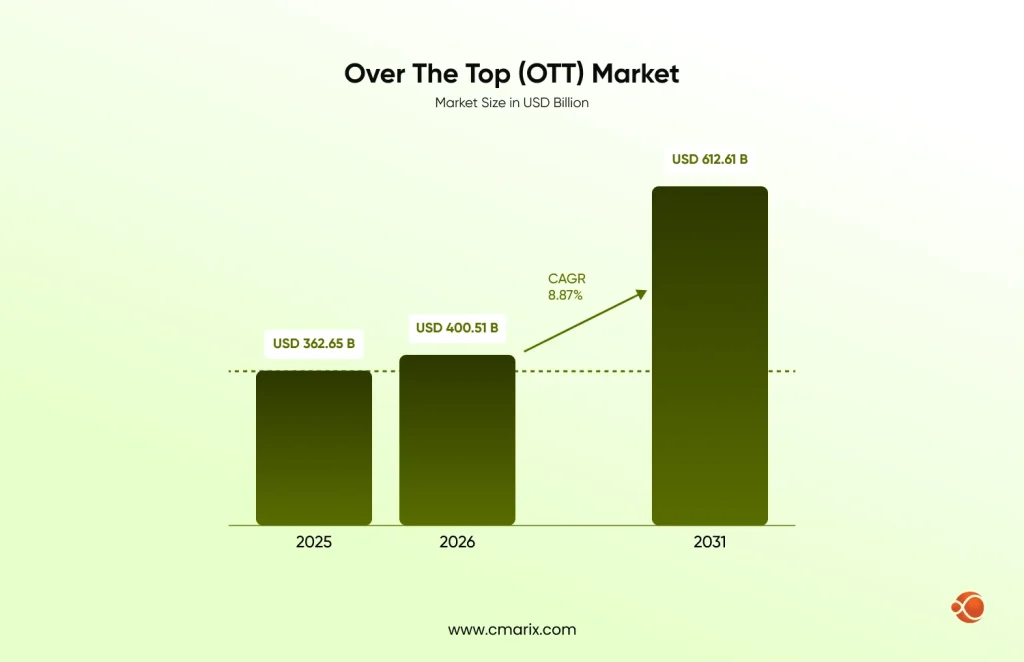
Streaming stopped being a backup option a while ago. It’s now the default way most people watch anything, from a two-minute trailer to a full season dropped at midnight. The audience is already there and paying for it: the global OTT market is projected to reach USD 612.61 billion by 2031. The real question for most businesses isn’t whether the market exists. It’s whether they can develop something people will open more than once.
This is where the whole cost discussion becomes tricky. The base app with video streaming capability is not difficult to define. But what really makes the difference between high and low is something that most quotations will ignore: DRM licensing, adaptive bitrate streaming, large-scale content delivery, and synchronization of playback across the phone, the smart TV, and the browser. Understand this, and the budget calculation becomes an exact science.
Why Are OTT Apps in High Demand in 2026?
Viewing habits have shifted in a way that favors apps specifically, not just streaming in general. Roughly 65% of video consumption now happens through mobile apps rather than browsers, which changes how OTT platforms need to prioritize their build. Within the OTT video market alone, the number of users worldwide is expected to hit 5.11 billion by 2030. That’s not a niche audience anymore. It’s most of the internet-connected population, and platforms that get the mobile experience right are the ones capturing it.
A few other forces are pushing that number higher:
- Connected TV adoption keeps climbing. Smart TVs are now the default in new households rather than the exception, which means OTT platforms need to feel as natural on a living room screen as they do on a phone.
- Ad-funded services have expanded the field of participants. Services that once necessitated a subscription for entry are now attracting viewers who seek freely available and advertisement-funded services, thus attracting an immensely wider pool of companies than subscription-only offerings ever did.
- Binging is the norm, not the occasional exception. This presents a very real challenge for recommendation systems and content offerings to maintain audience engagement beyond the first episode.
- Mobile-first is the way to go. With the majority of viewing taking place via applications rather than browsers, services that overlook mobile are doomed to failure from the start.
What Is an OTT App? Definition and Business Models
OTT applications provide videos to their users via the internet, bypassing cable broadcasting or satellite altogether. Examples include Hulu, Netflix, or even a specialized fitness streaming application; all of these belong to a specific category. It’s only the method of earning revenue from the app that differs, which in turn determines the features of the application and the price tag:
- SVOD (Subscription): Recurring(monthly) subscription fee for full access, like Netflix.
- AVOD (Advertising): Free to watch, revenue comes from ads, like Tubi.
- TVOD (Transactional): Pay-per-view or rental, common for new releases.
- Hybrid: A mix of two or more models, often subscription plus limited ads.
If you’re still working out the technical foundation before locking in a business model, it’s worth reading up on video streaming app development first, since the architectural choices there affect which monetization models are even feasible.
Worth clearing up one common confusion here: VOD, OTT, and IPTV get used a lot interchangeably, but they’re not the same thing.
- VOD(video on demand) describes the content delivery format, on-demand rather than scheduled, and it’s a feature within OTT rather than a separate category.
- In contrast, IPTV delivers television over a managed private network rather than the open internet, which is a fundamentally different infrastructure decision with its own cost profile.
Most businesses reading this guide are building OTT in the traditional sense: internet-delivered, device-agnostic, and outside any single provider’s managed network.
Key Factors That Influence OTT App Development Cost
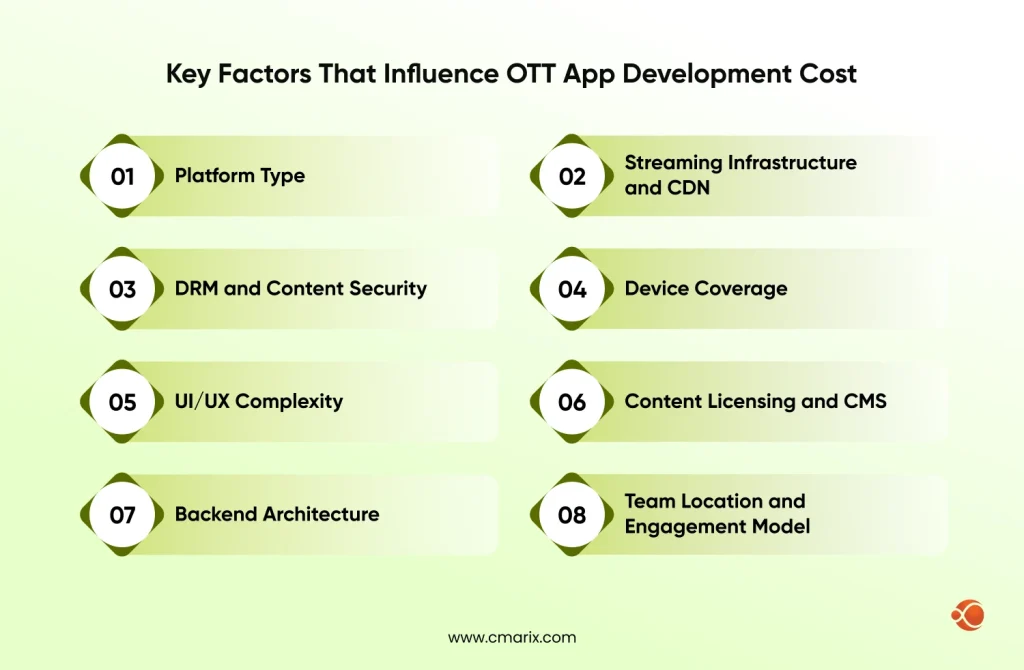
Before getting into the stage-by-stage numbers, it helps to know what’s actually moving the needle. These are the factors that separate a $20,000 build from a $300,000 one:
- Platform type – Whether you’re building SVOD, AVOD, TVOD, or a hybrid model changes what backend logic, ad-serving, and payment infrastructure you need.
- Streaming infrastructure and CDN – Delivering smooth playback to thousands of concurrent viewers requires a CDN built for video, not a generic hosting setup. This is also where the edge computing vs cloud computing decision comes in, since edge delivery cuts latency but adds architectural complexity.
- DRM and content security – Licensed content almost always requires digital rights management, and implementing it properly isn’t optional if you’re carrying studio or label content.
- Device coverage – Mobile, web, smart TV, and connected devices each need their own build and testing cycle, and that multiplies cost fast.
- UI/UX complexity – A browsing experience that keeps people scrolling and picking something to watch takes real design work, not a template.
- Content licensing and CMS – Managing a growing content library, metadata, and licensing agreements needs a backend built for it from day one.
- Backend architecture – Transcoding, adaptive bitrate streaming, and playback across varying network speeds are backend problems, not frontend ones, and they’re expensive to get wrong.
- Team location and engagement model – Where your developers are based significantly affects the hourly rate, which we’ll break down later in this guide.
We’ll walk through what your specific OTT platform needs before you commit to a number.
OTT Streaming App Features and Their Development Cost
Every feature you add to the spec adds to the bill, but not evenly. Some features are table stakes and cheap to build; others are what actually pushes a project from MVP territory into enterprise territory. Here’s a rough breakdown of where common OTT streaming app features land on cost:
| Feature | What It Does | Cost Impact | Approx. Cost Range |
| User registration & profiles | Account creation and multiple profiles per household | Low | $2,000–$5,000 |
| Content library & CMS | Backend for uploading, tagging, and managing video content | Medium | $8,000–$20,000 |
| Video streaming & adaptive bitrate | Playback that adjusts video quality based on network speed | High | $15,000–$40,000 |
| Search & AI recommendations | Content discovery and personalized recommendations | Medium–High | $10,000–$30,000 |
| Multi-device sync | Continue watching across mobile, web, and TV | Medium | $8,000–$18,000 |
| Offline downloads | Local storage for offline viewing | Medium | $6,000–$15,000 |
| Live streaming & live chat | Real-time broadcasting with audience interaction; may require Agora video streaming API integration for low-latency delivery | High | $12,000–$35,000 |
| Payment gateway & subscriptions | Billing, subscription plans, and recurring payments | Medium | $6,000–$15,000 |
| Push notifications | New-release alerts, reminders, and re-engagement messages | Low | $2,000–$5,000 |
| DRM & content protection | Encrypted streaming and content licensing compliance | High | $10,000–$25,000 |
| Multi-language subtitles/audio | Localized subtitles and audio tracks for broader reach | Medium | $5,000–$12,000 |
| Admin analytics dashboard | Viewership data and engagement metrics for administrators | Medium | $6,000–$15,000 |
OTT App Development Cost by Stage: How to Budget in 6 Steps
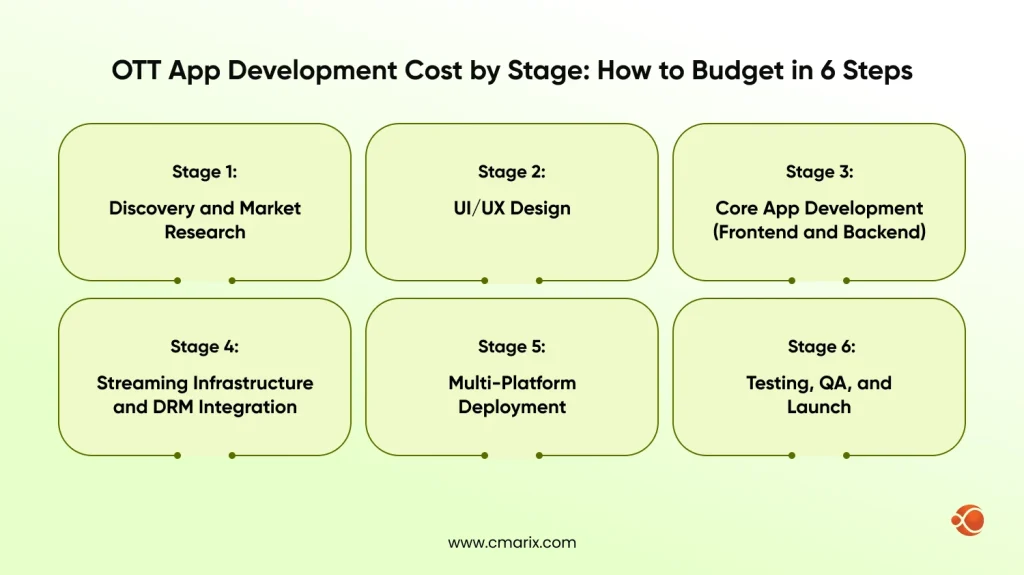
Rather than one lump number, it’s more useful to see video streaming app development cost broken down by the actual work involved. Here’s how a typical OTT build progresses, and what each stage tends to cost.
Stage 1: Discovery and Market Research
Before any code gets written, this stage includes competitor analysis, audience research, content strategy, and defining your core feature set. Skipping it is how projects end up rebuilding core architecture six months in. This stage generally runs $1,500 to $5,000 and takes one or two weeks, and it’s the same groundwork covered in a solid mobile app development process.
Stage 2: UI/UX Design
User flow, wireframe, and design of all screens across the target devices. OTT applications have their own conventions, such as a frictionless experience to get to play and browsing that focuses on content, which, when overlooked, negatively impacts retention more than anything else. You can budget somewhere between $5,000 and $20,000 depending on how many devices you will be designing for.
Stage 3: Core App Development (Frontend and Backend)
The largest portion of engineering time is spent building the logic, browsing functionality, user accounts, and the administrator panel for the application. The range will be anywhere from $20,000 to $80,000. Costs increase depending on the number of platforms you choose to build natively versus cross-platform.
Stage 4: Streaming Infrastructure and DRM Integration
Setting up adaptive bitrate streaming, CDN configuration, and DRM licensing (often through providers like Widevine or FairPlay). Frequently, this is where teams underestimate cost, since it’s less visible than UI work but just as critical. Runs $ 15,000 to $50,000 and overlaps closely with the groundwork needed to create a live-streaming website if live content is part of your offering.
Stage 5: Multi-Platform Deployment
Shipping to mobile (iOS and Android), smart TV, and web or connected devices each requires its own build, testing, and store submission process. Budget $10,000 to $40,000 depending on how many platforms you’re targeting simultaneously.
Stage 6: Testing, QA, and Launch
Testing for simultaneous streams, compatibility testing for the devices, and quality assurance tests before launching. It is always at this phase that deadlines force you to hurry, hence why streaming applications are slow on the day of their launch. Budget $5,000-$15,000.
Quick Overview: OTT App Cost in 2026
| Stage | Cost Range | Timeline |
| Discovery & Market Research | $1,500–$5,000 | 1–2 weeks |
| UI/UX Design | $5,000–$20,000 | 2–4 weeks |
| Core App Development | $20,000–$80,000 | 8–16 weeks |
| Streaming Infrastructure & DRM | $15,000–$50,000 | 4–10 weeks |
| Multi-Platform Deployment | $10,000–$40,000 | 4–8 weeks |
| Testing, QA & Launch | $5,000–$15,000 | 2–4 weeks |
Note:These stage figures assume a fuller build across every phase, including multi-platform deployment. A lean MVP that skips or trims stages like full multi-platform deployment will land toward the lower end of the platform-tier ranges below, rather than summing to the total of every stage’s high end.
Cost to Build an OTT App Like Netflix, Disney+, Hulu or Prime Video
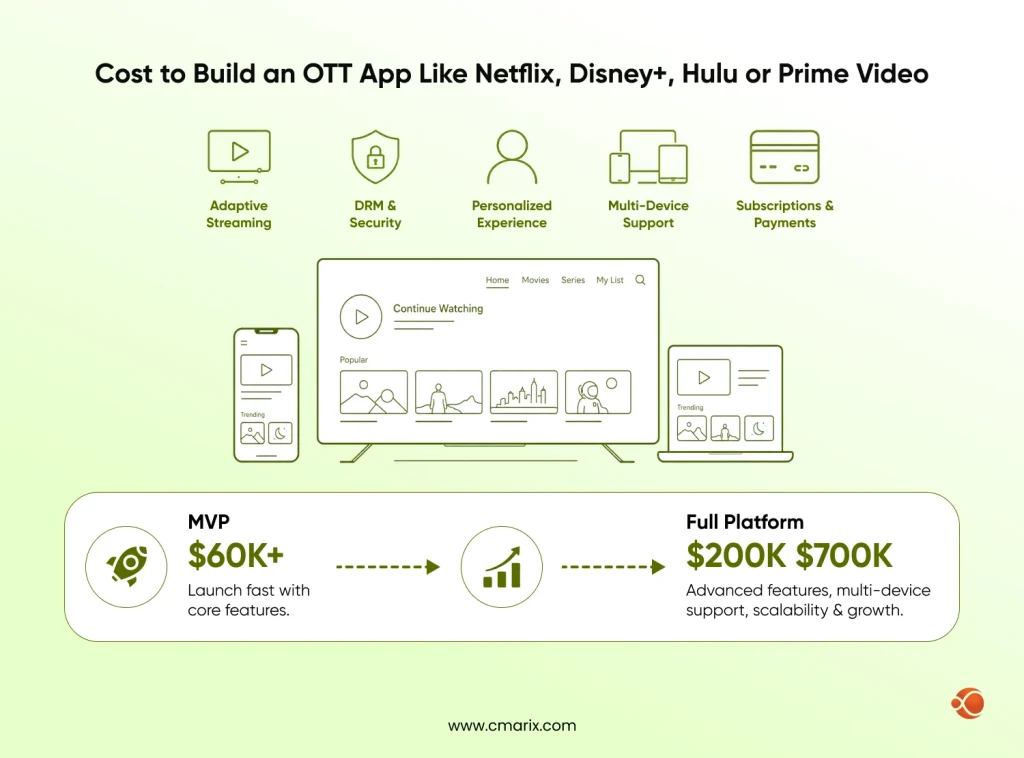
A lot of founders come in with one of these platforms as the reference point. That’s useful for setting expectations, but it’s also where budgets get unrealistic fast. Netflix and Disney+ run on years of infrastructure investment, proprietary recommendation engines, and content licensing budgets in the billions. You’re not competing with that on day one, and you don’t need to.
What you can realistically replicate is the functionality, not the scale: adaptive streaming, a personalized browsing experience, compatibility across multiple devices, and a smooth subscription process. Industry estimates put a genuinely competitive, full-featured platform (not a bare clone, but something with real production polish) at $200,000 to $700,000. Many projects start closer to $60,000 for an MVP, then scale up as traffic and features grow.
If building from scratch doesn’t fit your timeline, a white label OTT platform is worth considering instead. It’s a popular route for businesses that want to launch fast and layer in customization later, since most of the streaming infrastructure and DRM work is already handled. It pairs well with teams that also develop IPTV player software for smart TV distribution, since that’s often the missing piece in a white label setup.
Smart TV app development costs tend to run higher than mobile-only builds. Certified TV platforms like Roku, Apple TV, Fire TV, and Android TV each have their own submission requirements and design constraints, which add time and cost on top of the core build.
We’ll help you sequence the build so the budget and timeline actually line up.
OTT App Development Cost by Platform Type: Mobile, Web, and Smart TV
Not every OTT business needs the same tier of build. Here’s roughly where projects land based on scope:
| Tier | What’s Included | Cost Range |
| MVP | Single platform, core streaming, and basic subscription | $20,000–$50,000 |
| Mid-Tier | Multi-device support, basic recommendations, and standard monetization | $60,000–$150,000 |
| Enterprise | AI-driven personalization, 4K streaming, global CDN, multi-DRM, and smart TV apps | $150,000–$500,000+ |
Taking a cross-platform approach right away instead of going mobile-only initially, then developing for TV and web platforms afterward, will always be more economical despite the initial higher cost. Given that this is the approach you wish to take, consider evaluating the components of cross-platform app development solutions before locking in your architecture.
OTT App Development Cost by Monetization Model: SVOD, AVOD, TVOD and Custom VOD Platforms
The revenue model you choose isn’t just a business decision; it directly changes what you’re building on the backend.
No right choice exists, and many sites actually decide on the particular strategy based on their analysis of user activity after a couple of months into the operation. The SVOD strategy is the best when the site can provide a rich enough library of content to demand monthly subscriptions. On the other hand, the AVOD approach is suitable for those who want to focus on the growth of the user base rather than revenues.
The TVOD strategy is the best when the site can offer valuable products separately. Hybrid approaches become very popular nowadays because they allow getting the audience from both sides.
| Model | Backend Complexity | Cost Impact |
| SVOD (Subscription) | Payment gateway, subscription management, and tiered access | Medium |
| AVOD (Advertising) | Ad-serving infrastructure, ad targeting, and analytics | Medium–High |
| TVOD (Pay-per-view) | Transaction handling and rental expiration logic | Medium |
| Hybrid | Combination of the above, plus logic to manage overlapping models | High |
AVOD tends to surprise people on cost, since ad-serving and ad-targeting infrastructure isn’t trivial to build well. If you’re still deciding between models, it’s worth working through a proper mobile app business plan before committing engineering hours to one path.
What Your OTT App Budget May Not Include
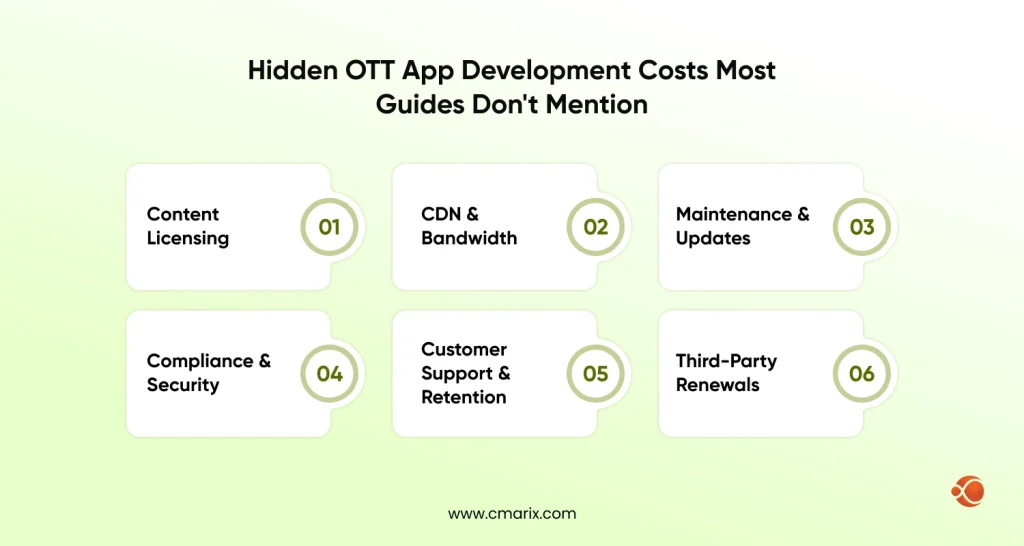
Most cost breakdowns stop at launch, which leaves out some of the biggest ongoing expenses that come with the actual cost to build a video streaming app long-term.
- Content licensing costs almost nothing to plan for and everything to actually pay for, ranging from a few thousand dollars for niche content to millions for major studio deals.
- CDN and bandwidth costs scale with your success, meaning the more popular your platform gets, the higher your delivery bill climbs, which catches a lot of founders off guard right after a growth spurt.
- Ongoing maintenance and updates will be about 15%-20% per year of your initial development expenses; this includes maintaining security, updating the app, and ensuring its compatibility with new devices.
- Compliance and security audits, especially if you’re handling payment data or licensed content, aren’t a one-time cost either.
Two more that rarely make it into a first-year budget:
- Customer support and retention tooling, which becomes necessary the moment your user base grows past a size your team can handle manually.
- Third-party licensing renewals, as the providers of DRM services, content distribution, and payments incur subscription charges which silently increase with the growth of your platform. None of the above is mentioned in the day one pricing but will appear on every bill thereafter.
Budgeting for these from the start is the difference between a platform that scales cleanly and one that runs into a funding gap right as it starts gaining traction.
OTT App Development Cost by Developer Region
Where your development team is based is one of the biggest levers on total cost, and it’s worth being deliberate about rather than defaulting to whichever region is cheapest on paper.
| Region | Hourly Rate Range |
| United States | $100–$200+ |
| Western Europe | $80–$160 |
| Eastern Europe | $40–$80 |
| India | $25–$60 |
| Southeast Asia | $20–$50 |
The gap between regions is significant, but rate alone doesn’t tell the full story. Communication overhead, time zone overlap, and how well a team understands streaming-specific architecture matter just as much as the hourly number. Teams offering mobile app development services with actual OTT and video streaming experience tend to close that gap in delivery speed, even at a mid-range rate.
How to Reduce OTT App Development Cost
A smaller budget doesn’t have to mean a weaker platform. That means being deliberate about sequencing.
- Start off with your MVP, and then scale it up using one streamer at a time.
- Leverage cross-platform solutions when appropriate. You don’t need native solutions to every single device from the start.
- Opt for a cloud-based solution for the streaming platform rather than creating a custom solution. Services such as AWS Elemental or Mux take care of all the hard work.
- Release features gradually. Recommendations, live streaming, and download capabilities all can be released later down the road.
- Think about the blended team approach. Having a senior architect in an expensive location combined with the right team elsewhere usually results in better quality and lower cost than focusing on just one location.
For a deeper comparison of how these decisions play out across app types generally, our guide on mobile app development cost breaks down similar tradeoffs outside the streaming-specific context.
OTT Platform Development Timeline: How Long Does It Take?
Cost and timeline move together, so it’s worth budgeting time the same way you budget dollars.
| Scope | Estimated Timeline |
| MVP (Single Platform) | 3–5 months |
| Mid-Tier (Multi-Device) | 5–8 months |
| Enterprise Platform | 9–14 months |
OTT platform development timeline estimates get thrown off most often by underestimating the streaming infrastructure and DRM stage, since that work tends to surface issues late rather than early. Building in buffer time there specifically is usually a better call than trimming it from testing.
A few other factors tend to extend the timeline more than teams expect going in. App store reviews for smart TV and iOS platforms (Roku, Apple TV, and Fire TV) can add one to three weeks per platform, and each has its own certification requirements that aren’t always documented clearly upfront.
Third-party integrations such as DRM services, analytics tools, and payment systems have their own onboarding and testing process, which is done in tandem with the development process but requires its own time. Team size also becomes important to consider for startups and is much bigger than one may think; doubling the development team does not cut the development process in half at all.
Why Choose CMARIX for OTT App Development
CMARIX has developed video-based apps and live streaming for a range of financial, healthcare, and media organizations that require platforms capable of handling high traffic and not just for demonstrations.
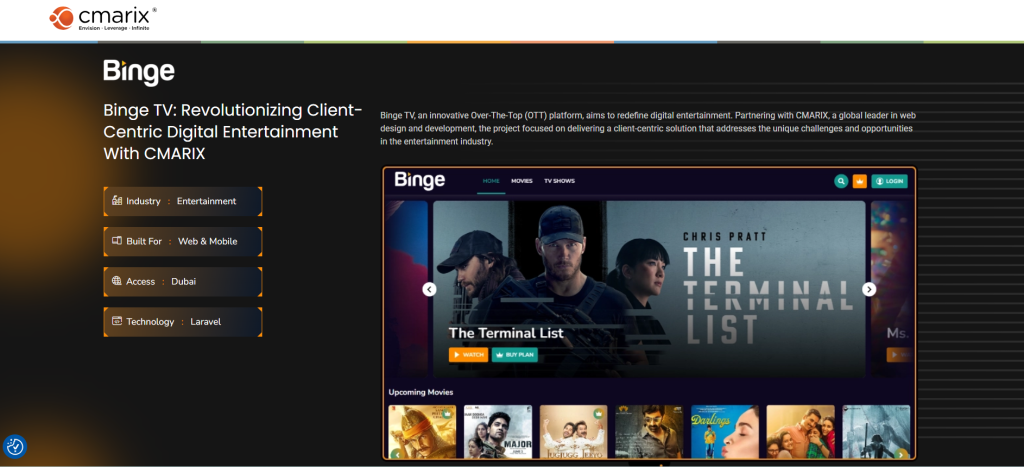
One example is BingeTV, a VOD OTT platform we built on a microservices architecture with a custom CMS for content management and secure multi-payment integration, designed to scale independently as user demand grows.
Our development team works on the whole stack, ranging from the CDN and DRM stack to the front-end work that will keep people glued through the first episode. When choosing us for a custom OTT platform development, we tailor our approach to suit your content strategy.
Final Thoughts
The simple fact is that there isn’t a specific number for “how much does an OTT app cost?” and any advice that gives you a number is simply overlooking the elements that count. It’s rather about picking a specific stage, choosing certain features, and picking a platform level that is suitable for your business now but leaves the option of growing to the rest later. Start with an MVP and be realistic about budgeting the work on the back-end infrastructure.
FAQs on OTT App Development Cost
What is an OTT app?
An OTT app delivers video content directly to viewers over the internet, bypassing cable and satellite entirely. Hulu, Netflix, and Disney+ are all OTT platforms, though the category also includes niche and industry-specific apps.
Why should businesses invest in OTT app development?
The audience has already shifted to streaming, with billions of users worldwide and most viewing now happening through apps rather than browsers. Companies with content, whether entertainment, industry-specific video or education, can reach that audience directly instead of depending on third-party platforms.
What features are essential for an OTT app?
At the very least, a content library integrated with a CMS, user profiles, adaptive bitrate video streaming, and a payment/subscription module. Search and recommendations, multi-device synchronization, and download capabilities may be crucial for retention but usually can wait until after launch.
How does development time affect the cost of building an OTT app?
Longer timelines require more engineering hours; however, rushed builds are more expensive in the end because of the cost of fixing them after launch. Realistic timelines, including testing, usually end up being cheaper than rushed timelines.
How do security measures impact the cost of OTT app development?
The cost of encrypted streaming, licensing, and DRM compliance is real and can range from $10,000 to $25,000, depending on the nature of the project. In addition, failure to implement proper security measures is not possible when dealing with licensed content.
How does CDN and video delivery setup affect OTT app development cost?
CDN expenses are not constant. They depend on how many viewers you have, meaning that the more your platform expands, the higher its delivery costs will rise. You won’t be caught off guard by these expenses, as they should be considered variable.
Why do OTT platforms become expensive after launch, not just during development?
Content licensing, CDN costs, maintenance, and audits are recurring expenses that do not decrease with time but increase as you progress. The annual cost of maintenance is usually 15% to 20% of your build cost.
What are the quick best practices to follow while developing an OTT app?
Begin by implementing an MVP first rather than all the features at once, use cloud streaming infrastructure when possible rather than developing custom infrastructure, and factor in the cost of CDN services and licensing fees as recurring costs right from the start. Concurrent testing will expose problems that would otherwise go undetected in an internal QA process.