


Quick Summary: Choosing the right stock market API shapes how fast, accurate, and scalable your financial product will be. This guide compares 12 verified, currently active stock market APIs across real-time coverage, historical data depth, pricing, and best-fit use cases, so you can match a provider to what you’re actually building instead of picking the first name that shows up in a search.
Every trading app, portfolio tracking tool, and investment platform operates based on the following: a reliable stream of market data. If there is none, no price can be displayed, no chart drawn, and no trade executed. This is the task of the stock market API. It provides you with real-time and historical market data in a format that can be used by your program.
The tricky part comes from selecting the appropriate API. Some API providers offer support exclusively for US stocks. Some providers even offer per call pricing beyond some basic usage that is free. Some even claim that they offer real-time prices but in reality, the prices have a 15 minute lag, which is acceptable for a research application but a no-go for any kind of a trading software. Choose wrongly and you will have to rewrite the whole data module six months after the product launch due to changing the tickers and mapping new field names as well as explaining to the users why the price stopped updating at some point, which is a rewrite that was never planned.
What makes things even trickier is the fact that everything changes very often. The API provider may get acquired, rebranded or even shut down, and there are quite many “best stock market API” guides online that recommend providers that do not even exist anymore. That’s why this guide includes only providers that are verified as working currently.
What Is a Stock Market API
A stock market API is an interface with endpoints that lets your software request stock market data without scraping websites or manually downloading spreadsheet files. Although most API providers send out data using REST in the form of JSON, some have introduced WebSocket support for real-time updates.
At a minimum, a stock market api for developers should cover:
- Current price – the latest trade price for a given ticker
- Daily high/low/open/close – the standard OHLC candle for the trading day
- Trading volume – how many shares changed hands
More complete providers go further, adding:
- Historical candles – price information for custom periods for charting and testing
- Company fundamentals – earnings, revenue, balance sheet data
- Corporate actions – stock splits, dividends, and similar events that affect historical price continuity
- Multi-exchange coverage – pricing beyond just NYSE and NASDAQ, into global markets
Our fintech developers can help you evaluate the right option.
How Stock Market APIs Actually Work
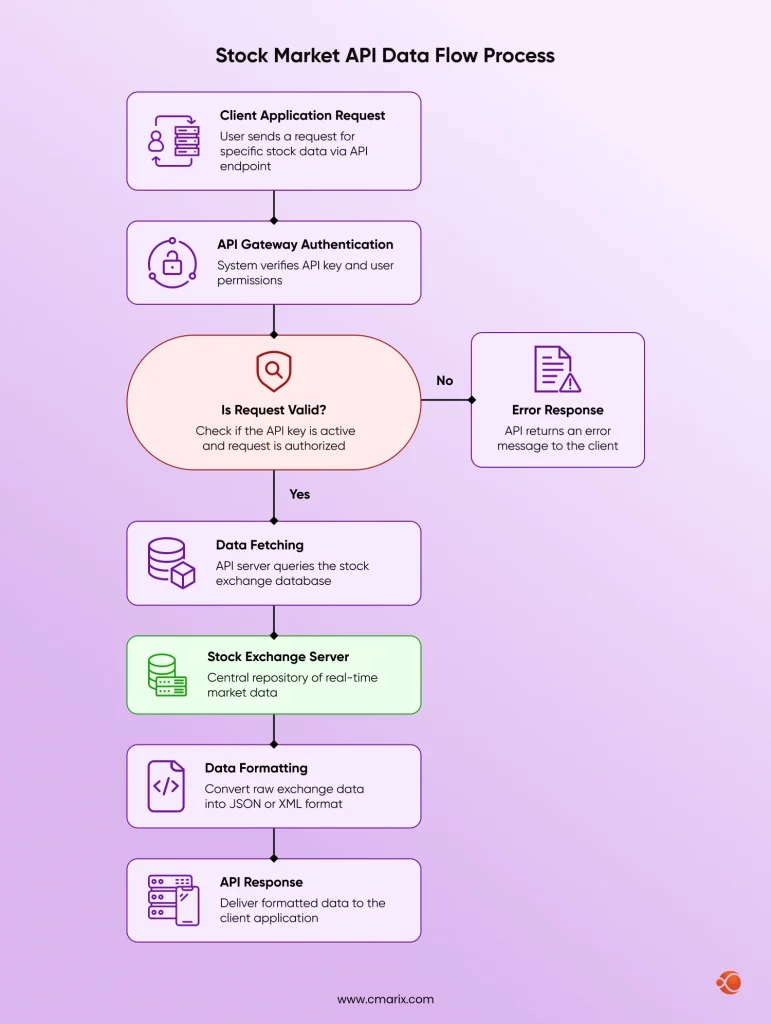
Most providers today use RESTful API integration as the default access method: you send a request to a specific endpoint (a ticker lookup, a historical range, a company profile) and get back a JSON-based data format response your code can parse directly. That’s what makes a real-time stock market data API manageable to work with even for a small team, since JSON is supported natively by nearly every programming language in use today.
Anything that requires frequent update polling becomes costly in terms of performance and introduces delay. Polling for live updates using the REST API becomes increasingly expensive since the app constantly asks “what is the current price” after every few seconds; this problem can be resolved with WebSocket, which sends data when the new trade or quotes occur.
| Factor | REST (Polling) | WebSocket (Streaming) |
| How it works | The app requests data at set intervals | A connection stays open and the server pushes updates |
| Best for | Dashboards, portfolio trackers, research tools | Live trading apps, real-time charts |
| Typical latency | Seconds, depending on the polling interval | Milliseconds |
| Cost impact | More requests can mean higher usage and costs | Usually priced per connection rather than per message |
| Used by | Nearly all stock market API providers | Massive, Alpaca, Finnhub, Tradier |
Two things separate a usable stock trading API from one that will frustrate you in production:
- API latency – how long it takes between a price changing on the exchange and your app receiving that update. For a stock exchange data feed covering NYSE/NASDAQ, even a few hundred milliseconds can matter if you’re building anything with algorithmic trading integration, where a stale price can mean a bad trade.
- Throughput – how many requests or messages the API can handle without dropping data or throttling you.
Some providers also offer financial data enrichment on top of raw prices, layering in company fundamentals, analyst ratings, or sentiment scores so your app doesn’t need a second data source just to add context to a number on a screen.
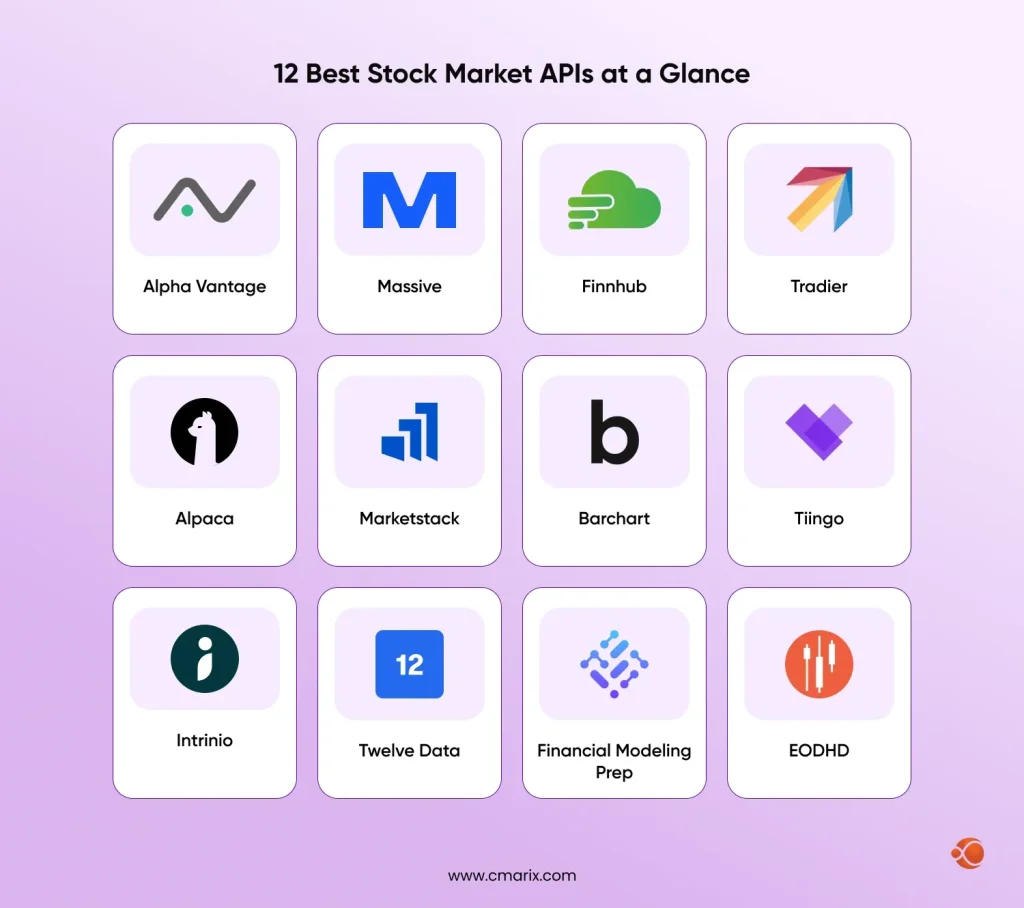
12 Best Stock Market APIs at a Glance
| API | Free Tier | Coverage | Real-Time or Delayed | Best For |
| Alpha Vantage | 25 requests/day (free) | US + global exchanges | Real-time (paid), delayed (free) | Prototyping, technical indicators |
| Massive (formerly Polygon.io) | Limited, delayed | US equities, options, forex, crypto | Real-time (paid) | Real-time trading apps |
| Finnhub | Generous free tier | Global, NASDAQ/Helsinki focus | Real-time | Fintech MVPs, news + sentiment |
| Tradier | Free w/ brokerage account | US equities and options | Real-time | Trading apps needing execution |
| Alpaca | Free, 200 req/min | US equities only | Real-time (IEX) | Commission-free trading apps |
| Marketstack | 100 requests/month | 70+ global exchanges | Delayed (free), real-time (paid) | Global equity coverage |
| Barchart OnDemand | Trial-based | Commodities, equities, futures | Real-time (paid) | Charting-heavy, media apps |
| Tiingo | Free tier available | US equities, crypto, forex | End-of-day (free) | Historical data, backtesting |
| Intrinio | Custom quote, free trial | US equities, fundamentals | Real-time and historical | Institutional-style fundamentals |
| Twelve Data | Free tier available | Multi-asset, global | Real-time (paid) | Multi-asset self-serve apps |
| Financial Modeling Prep | Free tier available | US + global equities, fundamentals | Real-time and historical | Fundamentals-heavy products |
| EODHD | Free tier available | Global exchanges, long history | End-of-day and real-time | Deep historical datasets |
Note: free tier limits and pricing change frequently. Confirm current terms directly on each provider’s site before committing.
The 12 APIs: Grouped by What You’re Building
Best for Real-Time Trading Apps
Massive (formerly Polygon.io)
- Coverage: stocks, options, indices, forex, crypto
- Access: REST, WebSocket streaming, flat files, SQL query
- Rebranded from Polygon.io in October 2025; existing API keys and endpoints still work unchanged
Massive is a good pick if you’re building a low latency trading platform development project where every millisecond of delay costs you, especially when you consider that Massive does not limit itself to equities only.
Tradier and Alpaca
- Both require market data along with your own trading account. You get the data and make the trades through one single integration.
- Tradier: requires a free brokerage account; charges inactivity fees if you just pull data
- Alpaca: commission-free, 200 requests/minute on the free tier, US equities only
Either is a natural starting point if you’re trying to build a trading app like Robinhood, though Alpaca won’t work if your product needs international markets.
Best for Global Market Coverage
Marketstack
- Coverage: 70+ global exchanges, 170,000+ tickers
- History: end-of-day data going back 30+ years
- Free tier: 100 requests/month
The U.S. stock data provided by Marketstack is obtained through Tiingo and is a well-structured, consistent REST API which can easily scale from a side-project level to a full-blown enterprise-level application.
Barchart OnDemand
- Coverage: commodities, futures, equities
- Strength: charting and visualization support
- Infrastructure: runs on AWS for redundancy
Not as good for trading applications but better for financial media/market widgets.
Best for Historical Data and Backtesting
Tiingo
- Coverage: Crypto, stock markets, intraday and historical data
- Strength: unique error-checking technique for closing prices
Matters most if you’re backtesting a strategy and can’t afford gaps or bad ticks in your historical data.
Intrinio
- Coverage: end-of-day, historical, intraday, and real time information
- Extras: valuation ratios, financial statements, ETFs’ portfolio composition
- Pricing: quote-based rather than flat published rate
It is designed more for those who require structured, institution-type access to data than just a weekend project.
EODHD (EOD Historical Data)
- Coverage: global exchanges with long historical datasets
- Plans: free tier for testing, paid plans that scale with usage
This is a great option if you need price data spanning several decades outside of the USA.
Best Free Tier to Start With
Alpha Vantage
- Free tier: 25 queries/day (by 2026)
- Strength: in-built technical indicators, straightforward setup
Great for educational purposes or a small project, but it will soon be too little if you plan on using it in anything remotely close to a production environment.
Finnhub
- Coverage: global, with a NASDAQ/Helsinki focus
- Extras: news, sentiment, and alternative datasets like insider transactions
- Tooling: API Explorer for making test requests before coding
Gives your financial technology applications an edge over and above the price feed.
Best for Fundamentals and Multi-Asset Coverage
Twelve Data
- Coverage: Stocks, Forex, and Crypto within a single integration
- Onboarding: self-serve, developer-friendly
Good for your roadmap if you go beyond equities.
Financial Modeling Prep
- Coverage: live pricing and balance sheets, income statements, and cash flow information
- Pricing: paid plans start at roughly $22/month, per current published pricing comparisons
A strong fit for products doing equity research or automated valuation work rather than pure price display.
CMARIX handles the integration work so your product just works.
How to Choose the Right Stock Market API in 6 Steps
Picking from a comparison table only gets you halfway there. The right choice depends on what you’re actually building.
- Define real-time vs. delayed needs – A trading app needs live prices down to the second. A research dashboard or portfolio tracker can usually work fine with 15-minute delayed data at a much lower cost.
- Check rate limits against expected usage – Even free plans that seem extremely generous in terms of limits can be used up very quickly when you consider all possible calls and users. Make sure to calculate your maximum number of calls before you choose the plan.
- Verify market and exchange coverage – If your users are trading in non-US exchanges, make sure that the provider is covering them. Many APIs claim “global coverage,” while only covering the largest exchanges.
- Compare free tier vs. cost at scale – The free plan is rarely what you’ll run in production. Look at what the paid tier costs once you’re past prototype stage, since that’s the number that actually matters for your budget.
- Check authentication and documentation quality – Very few APIs do not require any sign-up at all, making it easy to test but usually means there is no customer service when something goes wrong. Read the documentation first.
- Confirm data licensing for commercial use – Some APIs give free and cheap tiers of data, they may not be licensed for any commercial purposes. When you want to build a product for selling, it is better to read about data license terms directly.
Worth knowing: the Google Finance API doesn’t exist in 2026. It was decommissioned back in 2012 and hasn’t been brought back since then. While the GOOGLEFINANCE formula still exists in Google Sheets, it’s a spreadsheet function rather than an API for a backend application to invoke. The advice about using Google Finance as an API is already obsolete
Key Financial Metrics You Can Pull From a Stock Data API
Raw price feeds are only the starting point. Once a stock market API is wired into your product, the real value comes from what you build on top of it: trend analysis, volatility tracking, portfolio performance metrics, and predictive models that inform user decisions.
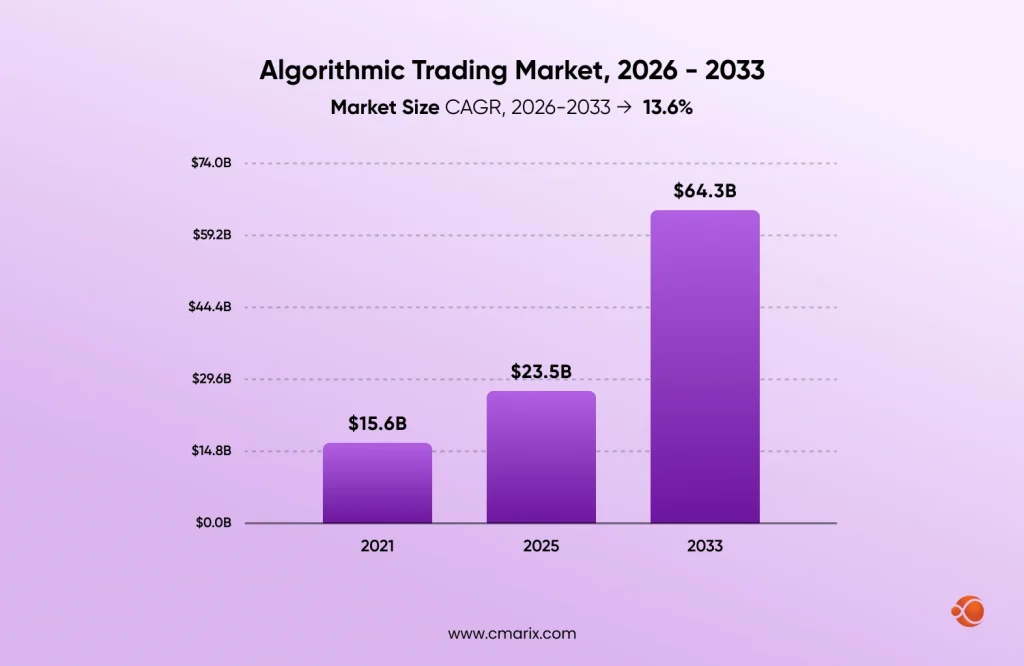
Demand for this kind of automation is growing fast. The global algorithmic trading market was valued at $23.5 billion in 2025 and is forecasted to grow from $26.3 billion in 2026 to $64.3 billion by 2033. A meaningful share of that growth is tied to products that combine real-time data feeds with automated decision-making, which is exactly where AI in stock trading is having the biggest impact right now.
For most products, the essentials worth tracking include:
- Most recent bid and ask – the current buy/sell price gap
- Trading volume – how much of an instrument is actively changing hands
- Exchange code and instrument identifiers – so your app knows exactly which security and venue a price belongs to
- Offer sizes – how much volume sits behind the current bid/ask
- Historical volatility – how much a price has swung over time, which helps investors and algorithms alike judge risk
None of this is optional if you’re building anything beyond a static price display, since users increasingly expect context around a number, not just the number itself.
This is the case with the AI trading platform market as well, as it was valued at $11.2 billion in 2024 and forecast to grow to $16.2 billion in 2026, as per Grand View Research. Products from this category usually combine predictive models, trend prediction, or portfolio rebalancing automation on top of the same price data feeds covered by this guide, reminding us once again that an API you pick not only provides you with the source of data but also serves as the base of the entire solution.

Build vs. Integrate: What Actually Goes Into Wiring an API Into Your Product
Picking an API is the easy part. Getting it working reliably inside a live product is where most teams underestimate the work included. It’s the difference between a demo that works fine on your laptop and a product that stays stable when real users are hammering it during a volatile trading session.
- Authentication and key management – Every provider handles this differently, and you’ll need a secure way to store and rotate API keys, especially if you’re running multiple environments (staging, production, testing).
- Rate limit handling – The production API traffic does not care about your free tier. It requires you to implement retry logic, exponential backoff, and even better, have a cache layer to avoid hitting your limit repeatedly on the same ticker.
- Failover planning – If your primary data provider goes down (and providers do go down), your app either needs a fallback source or a clear way to tell users data is temporarily stale, rather than showing wrong prices silently.
- Data normalization – Different providers structure their responses differently. If you ever plan to switch providers or blend two, you need a normalization layer so the rest of your app doesn’t care where the data came from.
This is where working with a team that’s done this before saves real time. CMARIX’s API integration services handle exactly this kind of integration work, from initial setup through the production hardening most teams don’t think about until something breaks in front of users.
Why Choose CAMRIX for Stock Market API Integration
CMARIX has built and shipped financial products where getting the data layer right wasn’t optional. Our trading web platform project involved building a live trading interface for active traders, which meant designing around exactly the concerns covered in this guide: real-time data accuracy, rate limit handling, and a UI that stays responsive even when the underlying market data is moving fast.
We work across the full stack that a serious financial product needs, from custom AI/ML trading platform development to the compliance and security work that any product touching real financial data has to get right from day one. That includes handling API failover, rate limit management, and data normalization as standard parts of the build rather than as an afterthought once something breaks in production.
If you’re also exploring the broader picture beyond trading tools, our work in fintech in wealth management covers the adjacent world of portfolio management and robo-advisory products that often share the same data infrastructure.
Final Thoughts
It’s not possible to talk about the best stock market API because it all depends on the specific use case. For real-time execution coupled with data, the APIs you want to consider are Alpaca and Tradier. In case the availability of the global markets is more important to you than speed, the options you should be considering are EODHD and Marketstack. Finally, when your solution is data-driven rather than trading-oriented, the APIs you might need are Financial Modeling Prep and Intrinio.
When you have decided on which API to use, don’t forget that the process of the integration will be as crucial as the API choice itself. The integration of even the best data provider will result in your product being unreliable otherwise. And remember also that the options you choose today may not be the same a year or two later. You’d better design the data layer in such a way as to make a change of providers easily possible.
FAQs on Stock Market API
Is there an API for the stock market?
Indeed, there are quite a few stock market APIs to choose from, ranging from freemium versions designed for prototyping to more advanced solutions suitable for high-frequency trading. The choice ultimately depends on what type of data is needed – real-time or delayed, what exchanges should be covered, and the product’s expected throughput.
Is there a free stock market API available?
Various providers offer usable free tiers, including Tiingo, Alpha Vantage, Finnhub, and Alpaca. Free tiers typically come with strict rate limits and delay rather than real-time data, so they’re best suited for development and testing rather than production traffic.
What is the best API for stock data?
Well, it depends on your use case. Massive is strong for real-time US trading data, EODHD and Marketstack lead on global exchange coverage and Financial Modeling Prep or Intrinio are better fits if fundamentals and financial statements matter more than live prices.
How do I get real-time stock market data?
Most will require you to get a paid plan as the free plan is delayed for at least 15 minutes. Real-time data is provided by providers such as Massive, Tradier, Alpaca, and Finnhub in the paid plans where WebSocket connections are used rather than the poll-and-poll process. As long as your application doesn’t necessarily require sub-second updates, then even a shorter polling time on the delayed feed might be considered real-time enough for users.
Is there a NYSE API?
NYSE does not have any API for consumers available on its own platform, but most of the stock market data sources, like Massive, Alpha Vantage, and Marketstack, provide data on securities listed on NYSE as well.
What is the difference between real-time and historical stock data APIs?
In real time API calls, current prices can be streamed or returned in real-time basis, usually with latency ranging between milliseconds and seconds in the case of premium subscriptions. Past prices will be retrieved using historical data APIs, often as daily and intraday candles, which is needed for strategy backtesting.
Which APIs are best for algorithmic trading?
Massive, Tradier, and Alpaca are commonly used for algorithmic trading since they combine low-latency real-time data with actual trade execution. For strategies that rely heavily on historical backtesting first, Tiingo and Intrinio offer the depth of historical data needed to validate a strategy before going live.
How do I choose the right financial data API for my application?
Begin by defining whether you need real-time or delayed data, then check exchange coverage, licensing terms for commercial use and rate limits against your expected usage. The six-step framework earlier in this guide walks through each of these in more detail.
Can I use a stock API for mobile app development?
Yes, all the APIs covered here work over standard REST or WebSocket connections, which any iOS or Android app can consume the same way a web app would. The bigger consideration for mobile is managing API calls efficiently to avoid draining a user’s data plan or battery with excessive polling.
What is a “Market Data Provider”?
A market data provider refers to an entity responsible for gathering and distributing financial market data such as stock prices, fundamental data about companies, and trading volumes using an API or data feed. This can either be a small platform targeting developers or a full-blown institution providing services to hedge funds and exchanges.