

Quick Summary:
- The global sports betting market was valued at USD 113.79 billion in 2025 and is projected to reach USD 295.29 billion by 2034, according to Fortune Business Insights.
- When developing a sports betting software application, consider licensing, live odds, payment security, fraud prevention, and responsible gambling from day one.
- White-label platforms enable quick deployment, while customized applications offer greater control over functionality and branding.
- An MVP helps validate market needs, test core features, and manage costs.
- CMARIX helps businesses build secure, scalable sports betting platforms tailored to their product goals and regulatory requirements.
Sports betting app development turns a fast-growing market into a product you can own. This guide covers market data, features, compliance, cost, and a seven-step build plan. Startups can use it to launch a secure, licensed platform with confidence.
Betting has been a popular recreational activity since the 17th century. Today, a phone is all a fan needs to place a wager. That shift has pushed more startups to develop online sports betting apps.
The market is booming, but competition is intense. Building a sports betting app that keeps users and passes regulatory checks is difficult. This blog covers the basics, from benefits and steps to features and costs.
Sports Betting Market Snapshot 2027
Numbers explain why founders keep entering this space. Here is what the latest research shows.
- Global market: Fortune Business Insights values the market at USD 113.79 billion in 2025. It expects USD 126.51 billion in 2026 and USD 295.29 billion by 2034, a CAGR of 11.18%.
- Second estimate: Precedence Research puts 2026 near USD 124.88 billion. It forecasts USD 325.71 billion by 2035.
- United States: IMARC Group reports a US market of USD 10.70 billion in 2025. It projects USD 27.42 billion by 2034.
- Legal footprint: About 39 US states plus Washington, D.C. now allow some form of sports betting. About 30 or more permit licensed mobile wagering.
- What changed the map: In 2018, the US Supreme Court struck down the federal ban in Murphy v. NCAA. States then wrote their own rules.
The takeaway is simple. Demand is growing, and rules differ by region. A sports betting app development company must plan for both.
7 Benefits of Sports Betting App Development
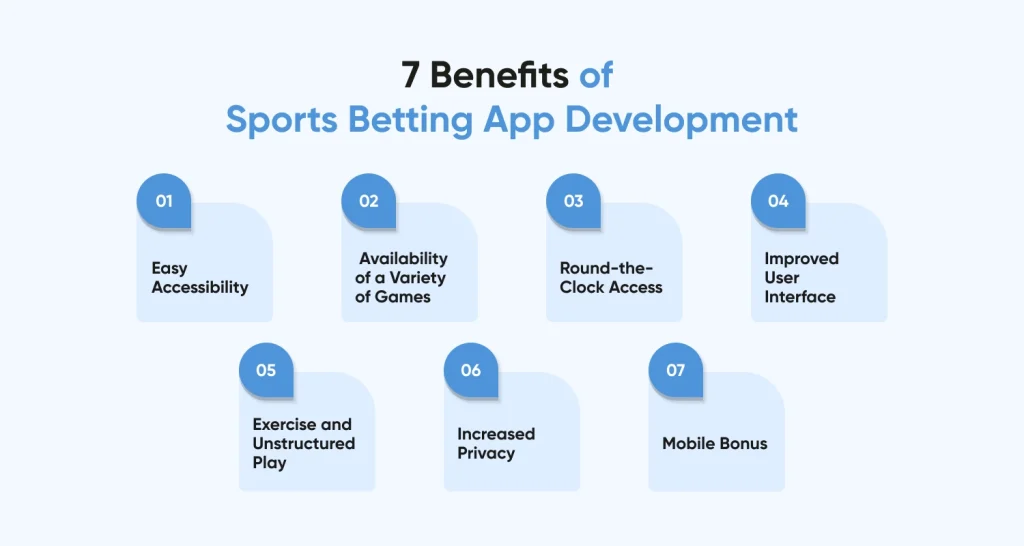
Mobile betting has changed how fans follow games. Here are the main reasons businesses invest in sports betting app development.
1. Easy Accessibility
Sports betting apps work on any smartphone. For most users, that means a wager takes seconds. A good app lets people bet from anywhere that local law allows.
2. Availability of a Variety of Games
The app can offer users access to different games, such as football, basketball, cricket, tennis, and esports, all in one place, depending on the game and market users choose.
3. Round-the-clock Access
Sports betting apps never shut down. You can place a bet in the middle of the night or during halftime.
4. Improved User Interface
Developers can design a clear, fast, and simple layout. Strong sports betting app design helps new users find markets quickly. It also helps them understand odds without confusion.
5. Exercise and Unstructured Play
Most sports betting apps offer features that let you try, learn, and understand the logic without risking real money.
6. Increased Privacy
You can bet discreetly on your mobile device. Secure logins, secure transactions, and secure account management are always important for any online betting website.
7. Mobile Bonus
Welcome offers, free bets, and loyalty bonuses can be delivered directly to users through their smartphones. Push notifications keep players engaged ahead of the match. Bonuses help differentiate you from other operators.
Step-by-Step Procedure for Sports Betting App Development
A clear plan saves time and budget. Follow these seven steps to start a sports betting app the right way.
Step 1: Develop Your Concept
Before asking how to build a sports betting app, define your app’s purpose, who you’re trying to reach, and what betting you’ll offer. A product differentiator is vital to ensure your sports betting app is built with purpose and designed for success. A solid mobile app business plan is the first step in any app development process.
Step 2: Examine Your Competitors
One of the best things about entering a popular market is the availability of existing case studies in the form of established competitors. Once you’re clear on the kind of sports betting app you want to build, look at market leaders: DraftKings Sportsbook, which dominates niche player props and same-game parlay depth. Or how FanDuel Sportsbook dominates the real-time live-betting user experience. Study their downfall too, where they seem to drop the ball, like live-odds app lag, rigid parlay engine restrictions, and so on.
Step 3: Obtain the Necessary Certifications
You should admit that compliance will be the most challenging part from a legal perspective. Betting platforms involve millions of dollars in deals and therefore require gambling licenses that depend on the jurisdiction. In case of the United States, you’ll have to deal with a complicated set of strict regulations state by state, similar to those provided by the UK Gambling Commission or Malta Gaming Authority.
Step 4: Choose a Technology Partner
A highly secure betting engine requires specialization. Look for developers with a history in fintech, transaction engines, or gaming. A professional sports betting app development company will not only follow your instructions but also explain the reasoning behind everything.
Step 5: Give UI/UX Design Top Priority
Gambling operates in a fast-paced environment where time affects payments. Your UI needs to be uncluttered, ultra-fast, and mobile-first. Excellent gambling app UI design helps prevent mistakes and helps to understand complicated bet sheets.
Step 6: Choose Your Backend Infrastructure
The backend has the odds, the wallet, the bets, and all the user information. Choose a technology stack that works even under peak loads. Enterprises often use microservices architecture because one part failing doesn’t mean the whole system collapses.
Step 7: Take Into Account Developing an MVP Application
First, the MVP launches with its core features. Then, you collect feedback from real users at low cost. This reduces risk and helps you launch your product sooner. Our MVP development services are ideal for this stage.
Sports Betting App Development: Custom Build vs White-Label Betting Platform
Every startup faces this choice early. Both paths work, but they suit different goals.
- A white-label product is an existing platform that a company can rebrand. The process is quick and requires less investment. However, you won’t have full control over the functionality, odds logic, or data.
- Custom builds start from scratch. You own the code, the design, and the roadmap. This kind of sports betting software development takes longer. It also gives you room to add unique features, such as a custom risk engine or niche markets.
| Factor | White-Label Solution | Custom Pre-Built Solutions |
| Time to launch | Weeks | Several months |
| Upfront cost | Lower | Higher |
| Control over features | Limited | Full |
| Brand differentiation | Low | High |
| Long-term scalability | Depends on vendor | Built to your needs |
A practical approach will serve well for many startups. Start with an MVP, then expand to a fully customized platform as your user base grows. A good sportsbook development company will advise you to do this.
Features of Sports Betting App
These apps keep growing in popularity. A strong sports betting mobile app includes the following features.
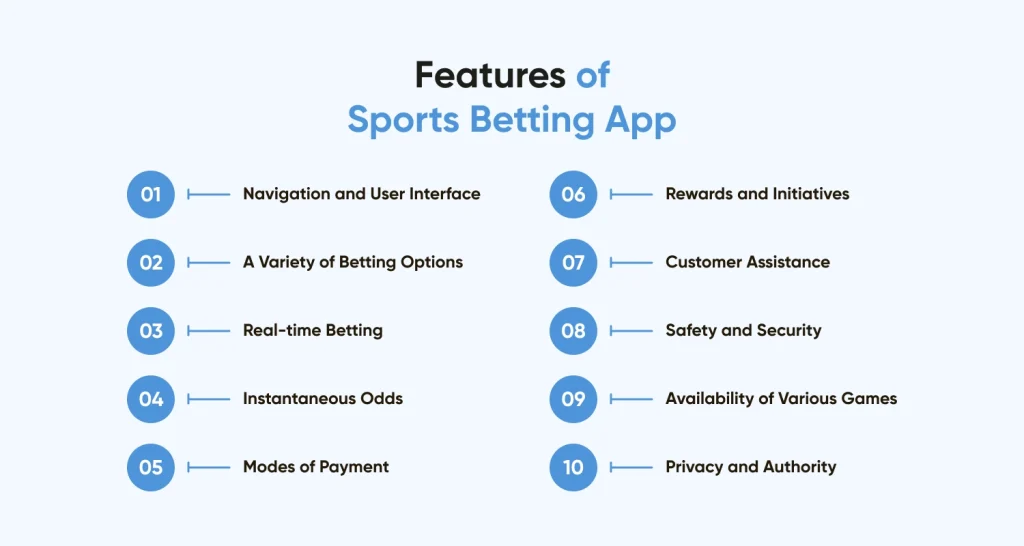
1. Navigation and User Interface
Simple menus help users move between sports, bets, and accounts. A clean layout makes live betting easier.
2. A Variety of Betting Options
The platform should offer parlays, over/Under, moneyline, and spread, among others.
3. Real-time Betting
In-play betting lets users wager as the match unfolds. This needs stable live data feeds and fast updates.
4. Instantaneous Odds
Odds must refresh within seconds. Connect the odds feed directly to your backend using APIs. The risk engine manages risk for each market.
5. Modes of Payment
Cards, E-wallets, money transfer, and local payment systems. Quick deposits and fast withdrawals keep users engaged.
6. Rewards and Initiatives
Sign-up bonuses, free bets, and loyalty schemes motivate players to participate. It is all fair because all the terms are well known.
7. Customer Assistance
Live chat, email, and a help center solve problems fast. Good support protects your reputation.
8. Safety and Security
Account protection features include encryption, two-factor logins, and fraud alerts.
9. Availability of Various Games
Add fantasy leagues, virtual sports, and esports to widen your audience. Sports betting game development can include these extras. See our guides to fantasy sports app development and horse racing app development for related models.
10. Privacy and Authority
The user should be allowed to manage his or her own information and limits on gambling. The privacy policy and license create trust for the future.
How CMARIX Handles Compliance, Licensing, and Security in Sports Betting App Development
Sports betting websites must comply with local regulations, keep user data and payments secure, and promote responsible gaming. Keep this in mind when designing the sports betting platform. CMARIX offers sports software development solutions for business needs.
Licensing and Regulatory Compliance
Requirements vary by country and state. Operators must obtain the appropriate licenses and implement the controls required in each market they serve.
| Regulatory Requirement | Description |
| Operator License | Obtain the required license before accepting bets. In the UK, operators are regulated by the UK Gambling Commission. |
| US State Rules | Follow each state’s licensing, tax, and minimum age requirements. |
| Geolocation Checks | Verify users are in a jurisdiction where betting is legal. |
| KYC and AML | Verify user identities and implement controls to detect suspicious financial activity. |
| Responsible Gambling | Offer deposit limits, cooling-off periods, and self-exclusion options. |
CMARIX can incorporate technical controls that support these requirements:
- Geofencing: Use location verification products such as GeoComply and conduct checks using GPS and network-based geolocation.
- KYC and AML: Integrate identity verification vendors such as Jumio and integrate backend monitoring of suspicious transactions.
- Data Residency: Create regional cloud infrastructure to meet data storage requirements and comply with laws such as the GDPR and CCPA.
- Fair Play and Data Integrity: Combine reliable data from sports feeds and build technical infrastructure that enables independent testing. Testing and certification agencies of relevance include GLI and eCOGRA.
- Responsible Gambling: Implement deposit and session limits, cooling-off periods, and self-exclusion integrations where required. In the UK, this may include GAMSTOP.
- Payment Security: Build payment solutions that meet PCI DSS requirements to protect card data and support secure card-based, e-wallet, and local payment transactions.
Security Protocols That Protect Users
Sports betting apps handle confidential information relating to identities, accounts, bet histories, and financial transactions. A security-driven development approach goes a long way toward ensuring the application’s safety.
Key safeguards include:
- Data encryption: Encrypt sensitive data during transfer and at rest.
- Multi-factor authentication: Include authentication for account access and sensitive operations like withdrawals.
- Mobile application security: Follow the OWASP Mobile Top 10 to address common mobile security risks.
- Penetration testing: Perform regular penetration tests and monitor for malicious activity.
- Audit logging: Maintain records of bets, transactions, account changes, and administrative actions to support investigations and audits.
CMARIX provides mobile app testing services to evaluate application functionality, performance, compatibility, and security. Its software testing and quality assurance services can also help identify defects and assess application reliability before release.
Compliance involves licensing, jurisdiction, operation, and implementation by the operator. Technical controls support compliance; however, they cannot replace required legal and regulatory approval or certification.
Conclusion
Sports betting software has its unique problems. We covered the full development process, from initial idea to post-development improvements. A well-built, legal software product can thrive in a developing market.
Planning to create a sports betting app? CMARIX can help. Our team has built secure, scalable platforms for startups worldwide. Share your idea, and our sports betting app developers will map the next steps. Talk to our mobile app developers for a free consultation.
FAQs About Sports Betting App Development
What is the typical process for modern sports betting app development?
The process has seven stages: concept, competitor analysis, licensing, choosing a technology partner, UI/UX design, back-end development, and finally, MVP launch. After that, the team tests, releases, and continues development. In most cases, the projects start with the discovery stage.
How do security protocols safeguard user records inside a sports betting mobile app development project?
Developers use encryption, multi-factor authentication, payment gateways, and role-based access. Penetration testing and prevention of fraud activities are also conducted by developers. This way, identity information, digital wallets, and betting activities are secured.
What are the core compliance and licensing requirements for a custom sports betting launch?
You will need an operator’s license for each geographical area you serve. You will also need KYC services, anti-money laundering mechanisms, age verification, geolocation, and responsible gaming services. Regulations vary by country or state.
How does a sports betting website development workflow integrate with live odds data feeds?
The team accesses the odds feed from a licensed API via WebSockets. The backend converts the data and passes it to the website within seconds.
What options exist for setting up real-time risk analytics inside a sportsbook software development backend?
You may develop a tailor-made risk engine or use an external trading application. ItIt will monitor your exposure by market, detect abnormal betting behavior, and adjust limits automatically. Traders are provided with dashboards to monitor event liabilities.
What are the absolute best UI/UX design considerations for high-volume mobile betting interfaces?
Designs must be clean, fast, and easy to navigate with thumbs. Display odds, the bet slip, and the balance without extra taps. Ensure enough contrast and fast load times. Have confirmations to prevent mistakes while gaming.
How can a sports startup systematically plan out how to start a sports betting app?
Start with market research and a legal audit. Define the sports you’ll include, the bets you’ll offer, and your geographic targets. Find a tech partner and build an MVP, then test with a limited user base.
What are the main feature differences when evaluating custom white-label setups versus scratch development?
White-label products offer standard features and a quick launch. Custom builds allow unique markets, branded design, and your own risk logic. Custom work costs more upfront but gives full control and easier scaling.
What baseline factors directly influence the final sports betting app development cost estimation?
Scope, platform, number of features, third-party integrations, and licensing affect the price. The development team’s location and the time frame also play an important role. Building an MVP will be much cheaper than developing a multi-sport platform with a custom risk engine.
How should a startup choose an experienced sports betting software development company?
Review the portfolio for real betting or gaming projects. Ask about compliance knowledge, security practices, and post-launch support. Speak with past clients. A good partner explains trade-offs plainly and offers a clear roadmap.