


Quick Summary: Peer-to-peer payment applications such as Venmo, Zelle, and Cash App have brought the money transfer process to just a few clicks, while the market continues to expand as even more customers decide to give up on cash payments altogether. Here is how these applications work, what makes for the necessary functionality, and all the compliance measures (KYC, AML, PCI-DSS, encryption, and tokenization) you will need to make sure your application will pass the due diligence process and will not be rejected before it is even launched. We will go through the development process and show how much P2P app development costs in 2026.
Sending money used to mean a bank branch, a wait, and a fee. Now it means a tap.
It didn’t occur by chance. The movement of money became as effortless as sending a text message. Dividing the rent, paying for a babysitter, and paying for a meal: all of these became mobile. Businesses behind the development of applications that made it all happen created a sustainable business model out of convenience. And what doesn’t get shown during a demo is all of what lies beneath.
In essence, a peer-to-peer money transfer app is a financial service application before being a mobile app; hence, each of its screens operates under financial services infrastructure that doesn’t tolerate compromises. If you make your application easy to use without taking care of compliance issues, your fintech app will be more of a burden than anything else. In other words, this article covers both of these aspects.
What Is a Peer-to-Peer (P2P) Payment App?
A peer-to-peer payment app moves money directly from one person’s bank account, card, or digital wallet to another’s, using a mobile app as the interface instead of a bank teller or a paper check.
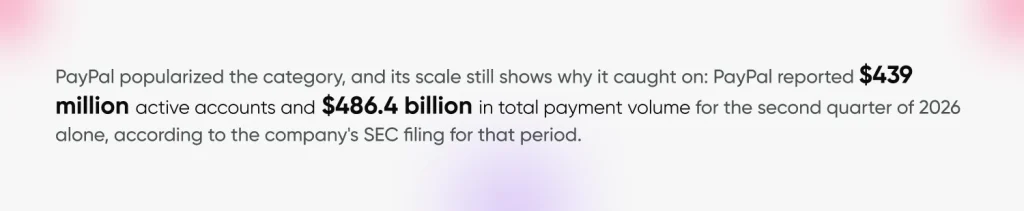
The apps built on top of this model now split into three general use cases: sending money to friends or family, splitting shared costs like rent or a group tab, and paying small businesses or independent contractors directly. Venmo, Zelle, Cash App, and PayPal’s own P2P features are the names most people recognize, but the underlying architecture- an account, a linked funding source, and a transfer engine in between- is what any new entrant has to build first.
Adoption supports why this classification should be built around. Data from a Federal Reserve survey demonstrates that 83% of American users use fintech payment apps or digital wallets at least once in a while, which is true even for the older generations. This is no longer an anomaly but the norm.
How Does a P2P Payment App Work?
Every transaction runs through the same basic sequence, even if the interface looks different from application to application.
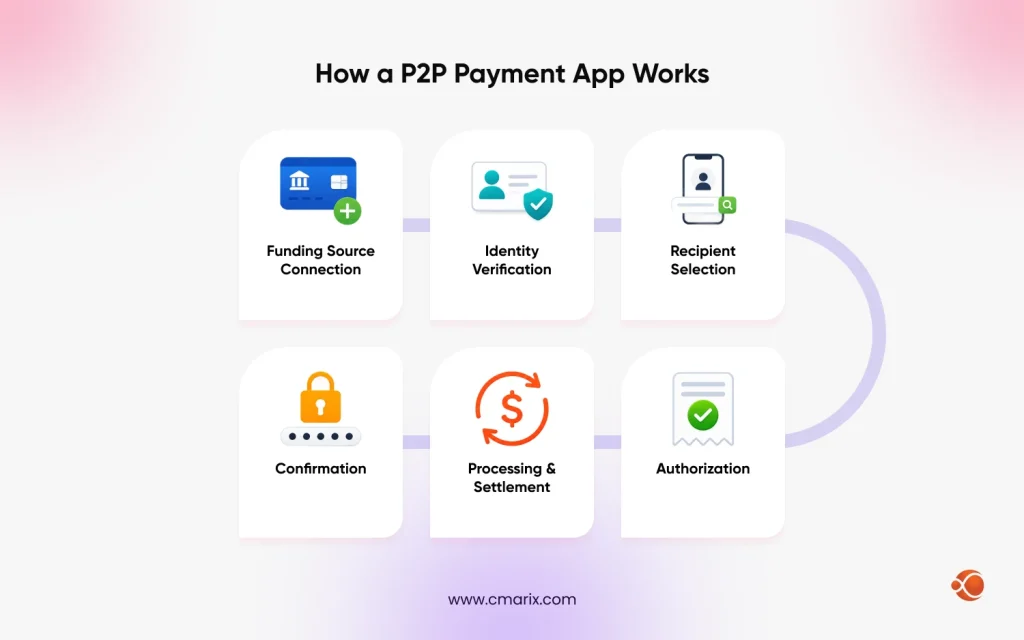
- Funding source connection: the user will link a debit card, bank account, or even an existing balance in the wallet during the onboarding process, and the app will verify their ownership before proceeding with any transfer.
- Identity verification: the app authenticates the identity of the user using a KYC process, phone and/or email verification, and in most cases PIN/password or biometric login.
- Recipient selection: the user specifies the amount to be transferred and the recipient’s contact information such as email address, username, phone number, or QR Code.
- Authorization: the sending individual verifies the transaction using a password, PIN, or biometric recognition, and may also use an OTP for large transactions.
- Processing and settlement: the application facilitates instant transfers between in-app wallets or processes the transaction in 1-3 days in case the transaction is linked with a bank account via the ACH method.
- Confirmation: both parties get a receipt and a transaction record they can access later.
The instant part is what users notice. The encryption, KYC, and fraud screening running behind it is what keeps the app legal and keeps their money safe, and also it is where most of the real engineering effort goes. Where the money actually sits during that sequence depends on the app’s architecture. Wallet-based apps like Venmo hold funds in an internal ledger the moment they’re received, so a transfer between two Venmo users is instant because it’s really just an update to two account balances on the same system.
Unlike wallet services like PayPal, bank-oriented apps like Zelle avoid this process and allow money transfer directly from one bank to another, which explains why money transfers through Zelle appear quicker at the recipient’s side but cannot be stored in an account as is possible with wallets. Neither of these approaches can be said to be superior; it all depends on your goal – a separate service or an integrated feature.
Let’s map out what a custom build actually gets you before you decide.
Types of P2P Payment Apps and Systems
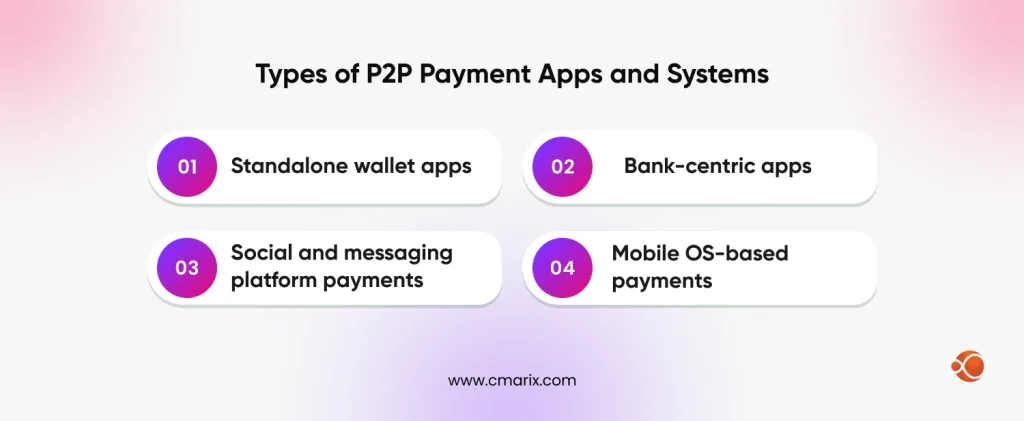
Not every P2P app is built the same way, and the type you choose shapes your entire tech stack, partnership list, and compliance scope.
| Type | How It Works | Examples |
| Standalone wallet apps | The provider holds a digital wallet balance; funds sit with the app before transfer or withdrawal. | Venmo, PayPal |
| Bank-centric apps | Transfers move directly between linked bank accounts with no wallet holding funds. | Zelle |
| Social and messaging platform payments | Payment features are built into an existing chat or social app. | WhatsApp Pay, Meta Pay |
The choice mostly comes down to how much of the money-holding infrastructure you want to own.
- Wallet vs. bank-centric – A stored balance (Venmo-style) provides you room to add features like compliance weight. Skipping the wallet(Zelle-style) keeps regulatory scope lighter since you never hold customer funds.
- Social and messaging payments – These succeed by piggybacking on an audience that already exists, which is why WhatsApp Pay caught on fast in markets like India and Brazil without asking anyone to download a new app. This model suits an established platform expanding into payments more than a payments-first startup.
- Mobile OS-based payments – The Google Pay and Apple Pay services fall under the category of infrastructure more than that of products due to the availability of biometric hardware by default. Most other P2P services integrate themselves with these two rather than competing with them.
Why Build a Custom P2P Payment App for Your Business?
Off-the-shelf payment SDKs can get a basic transfer feature live fast, but they also cap what you can build and who you can serve. A custom P2P payment app gives you control over the parts that actually differentiate a fintech product.
- Ownership of the user experience. You get to choose the onboarding process, the transaction time, and the features that make your customers loyal to you rather than your competitor’s app.
- Flexible monetization. You are not limited to the vendor’s revenue share model, but can choose between transaction fees, instant transfer premiums, merchant partnerships, or subscription plans.
- Direct compliance ownership. You have complete ownership of the process of how anti-money laundering, know your customer, and data processing will take place.
- Room to scale. A custom architecture can add features like bill splitting, small business payouts, or multi-currency support later without a rebuild.
For banks and other financial institutions, a custom P2P layer helps increase the efficiency of straight-through processing of invoices and merchant disbursements due to the transaction flow having been customized for the particular bank’s systems.
Must-Have Features for P2P Payment App Development
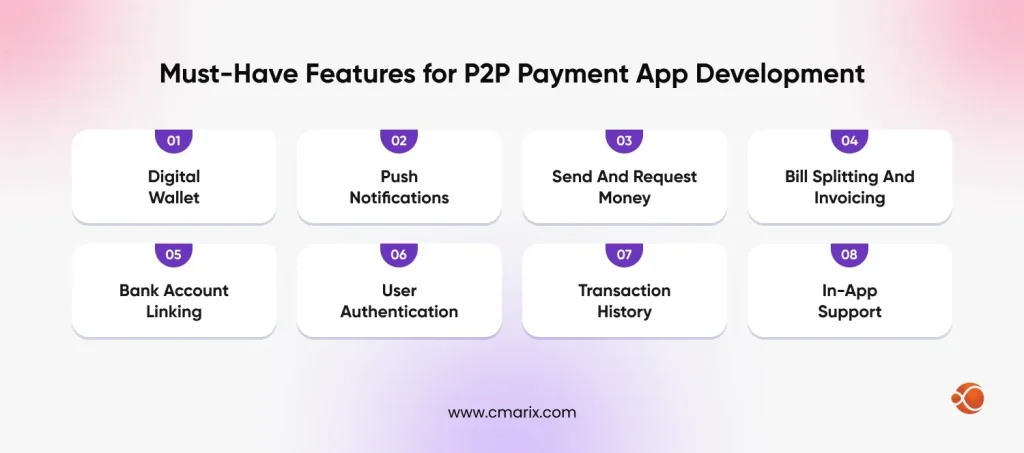
A P2P app earns trust through the features users interact with daily, not the ones under settings. Here’s what a competitive build needs at minimum.
- Digital wallet – Lets users manage linked payment methods and, where applicable, store funds in an in-app balance for sending, receiving, and withdrawing money.
- Push notifications- notify users the moment a payment is sent, received, or fails and extends to bill reminders and low-balance warnings; usually built on Firebase Cloud Messaging, Amazon SNS, or Apple’s APNS.
- Send and request money – the core function, letting users both push funds to another user and pull a request for funds owed to them.
- Bill splitting and invoicing – generates a shareable transaction record so both sender and receiver have a record they can reference later, useful for shared expenses or freelance invoicing.
- Bank account linking – moves funds out of the app wallet into a linked bank account, usually through ACH rails like Dwolla or Plaid.
- User authentication – biometric login, PIN, and multi-factor authentication that confirms identity before any transfer goes through; this is the single most important trust feature in the entire app.
- Transaction history – a searchable log of past transfers that users can reference for budgeting or dispute resolution.
- In-app support – live chat or a chatbot that can handle common questions about failed transfers, account issues, or unrecognized activity without forcing users to leave the app.
Advanced features worth considering. Having established the basics, some additional features might be what sets the P2P application apart in the highly competitive landscape: a cryptocurrency buy/sell function for those interested in storing cryptocurrency alongside their bank account balance and multi-currency capabilities in order to target applications that will deal with cross-border payments and budgets. This is not absolutely necessary for the first iteration, yet it would be wise to build these features into your architecture if you plan on adding them to your product roadmap at a later stage.
Get a security and compliance audit before writing a single line of code.
P2P Payment App Security and Compliance Requirements
This is where most P2P payment apps succeed or fail, and it’s non-negotiable regardless of how polished the interface is.
| Security / Compliance Area | Quick Requirement |
| KYC & AML | Verify user identity and monitor transactions for suspicious activity. |
| PCI-DSS | Follow card-data security requirements and complete the required compliance assessment. |
| Encryption | Use AES-256 for stored data and TLS/SSL for data in transit. |
| Tokenization | Replace card/bank details with tokens instead of storing raw payment data. |
| Authentication | Use MFA, biometrics, and device fingerprinting to prevent account takeover. |
| Fraud Detection | Monitor transactions in real time for unusual amounts, velocity, and recipient patterns. |
KYC and AML compliance
The KYC process ensures that the identity of the user is verified upon registration through identity verification and address verification. The AML system detects whether the transaction pattern shows any signs of structuring or layering. These are mandatory steps which have to be followed by all apps dealing in monetary transactions.
PCI-DSS compliance
Any app handling card data has to meet the Payment Card Industry Data Security Standard(PCI-DSS), a baseline framework of 12 requirements organized under 6 control objectives covering everything from network security to access control to ongoing monitoring. This isn’t a one-time certificate a company earns and displays; it’s an Attestation of Compliance that a Qualified Security Assessor issues after evaluating the app’s security controls, and it has to be renewed annually. Businesses processing a high volume of transactions typically need a full assessment from a QSA, while smaller processors can self-assess.
Encryption standards
Encryption must be used on sensitive data at rest (AES-256) and in transit (TLS 1.2+). All information, from the stored credit cards through the APIs that connect the app backend, should use appropriate security.
Tokenization
Rather than storing raw card or bank account numbers, a compliant app should replace that sensitive data with a randomly generated token at the point of capture, so that even if a database is breached, the exposed data is useless to an attacker without the separate token vault it maps back to.
Authentication layers
Fingerprinting devices, biometric authentication, and multifactor authentication techniques minimize the risk of account takeover, which is among the most common methods for attacking P2P payment systems. Specifically, fingerprinting devices help identify unknown devices and mark the beginning of an attack on an account.
Fraud detection
Real-time transaction monitoring to detect suspicious activity regarding amount, speed, and recipients stops fraud before the money is settled, not after a customer complains. Failing to implement even one of them will not just leave your application vulnerable. It will determine whether or not you have a product ready for market.
How to Build a P2P Payment App: Step-by-Step Guide
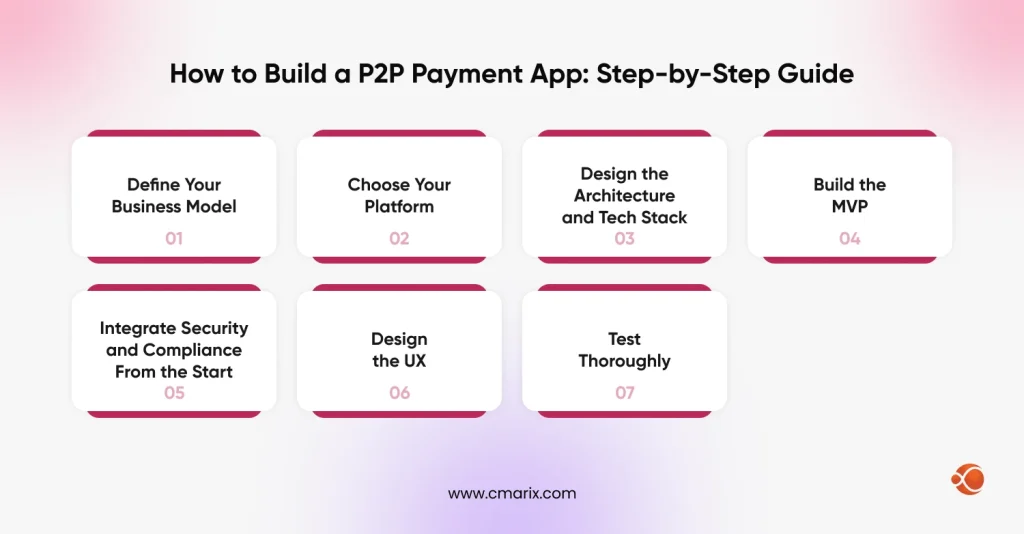
1. Define your business model
Figure out if you are building a separate wallet app, a bank-focused money transfer service, or adding the functionality to an already existing social networking site or a marketplace. Your compliance framework and your partner requirements will depend on this, and it is the hardest choice to change in the future because the wallet and the bank-focused model require different licenses and infrastructure.
2. Choose your platform
Choosing only one platform initially, either iOS or Android, is less expensive and helps you test the demand in order to make the decision about launching your application on both platforms. In choosing the platform, your target market becomes the deciding factor rather than personal preference. Compare iOS app development cost with Android app development cost.
3. Design the architecture and tech stack
Pick a backend that can handle real-time transaction processing at scale, along with the APIs you’ll need for banking rails, KYC verification, and payment gateway integration. This is also the stage to decide on your database structure for the transaction ledger, since payment apps need strong consistency guarantees that a standard eventually-consistent database won’t provide out of the box.
4. Build the MVP
Hire mobile app developers to build the minimum viable product around the primary features, including sending, requesting, and transaction history. If you’re weighing how to scope that build, it helps to look at MVP development as its own discipline rather than a stripped-down version of the full product. Do not feel the need to launch the app with all the features you have in mind; the narrow but more reliable MVP wins user confidence over the feature-filled but unstable application.
5. Integrate security and compliance from the start
Biometrics, KYC, encryption, and fraud prevention should be part of the architecture from the first sprint. The fact that retrofitting security into a payments app after writing its core logic is among the most frequent and costly errors committed by development teams in this domain.
6. Design the UX
It should be assumed that the user wants to send money in under three taps. Complexity here is a conversion killer, and in a category where trust is the whole value proposition, a confusing confirmation screen can cost you a user permanently after a single bad experience.
7. Test thoroughly
The QA engineer must perform functional, security, and load tests; ideally, this is done via a beta test with actual transactions. The reason for emphasizing load testing rather than just performing this test for other application categories is that a payment app slowdown or timeout will make the user wonder whether the money really went through.
8. Confirm regulatory compliance
The requirements will change depending on each jurisdiction. In the US, it can entail state money transfer license requirements as well as federal obligations. Other countries will have other license requirements, AML rules, data privacy, and payment regulation requirements.
P2P Payment App Development Cost in 2026
Cost will depend on the complexity of the features, compliance range, and whether you develop native applications for both operating systems or start with one. The following is an estimate based on build tiers.
| Tier | Scope | Estimated Software Dev Cost | Timeline |
| MVP | Core send/request, single platform, basic KYC | $40,000 – $80,000 | 3–5 months |
| Mid-complexity | Both platforms, bill splitting, bank linking, standard compliance | $80,000 – $150,000 | 5–8 months |
| Enterprise-grade | Multi-currency, advanced fraud detection, full compliance suite, high transaction volume | $150,000 – $300,000+ | 8–12 months |
Factors that push costs up include the number of supported payment methods, the complexity of your fraud detection system, whether you need multi-currency or cross-border support, and how much your compliance program has to cover beyond baseline KYC and AML.
A few specific line items are always under-budgeted. Third-party APIs used to facilitate ACH transfers, KYC validation, and fraud detection are normally charged on a per-transaction or per-user basis and not a flat development fee; therefore, they will be ongoing operational expenses and not a one-off development cost. Security tests and penetration testing, which typically occur at least once per year, are another cost on top of the primary development cost. In addition, app store fees and the additional engineering costs necessary to complete the app review process for financial apps by Apple and Google take more time than anticipated due to additional scrutiny of such applications.
Why Choose CMARIX for P2P Payment App Development?
CMARIX an ISO-certified, CMMi Level 3 fintech app development company. Our team has built fintech products across trading, banking, and lending, and we understand that a payment app lives or dies on the compliance work most vendors treat as an afterthought.
That philosophy drives the way we start our relationship with you. Prior to the design of any screen, we work out the same question that we would have you ask us: Are you creating a wallet application, a transfer mechanism for banks, or a platform add-on? The answer to that question influences everything from licensing to architecture to compliance and will be costly to undo.
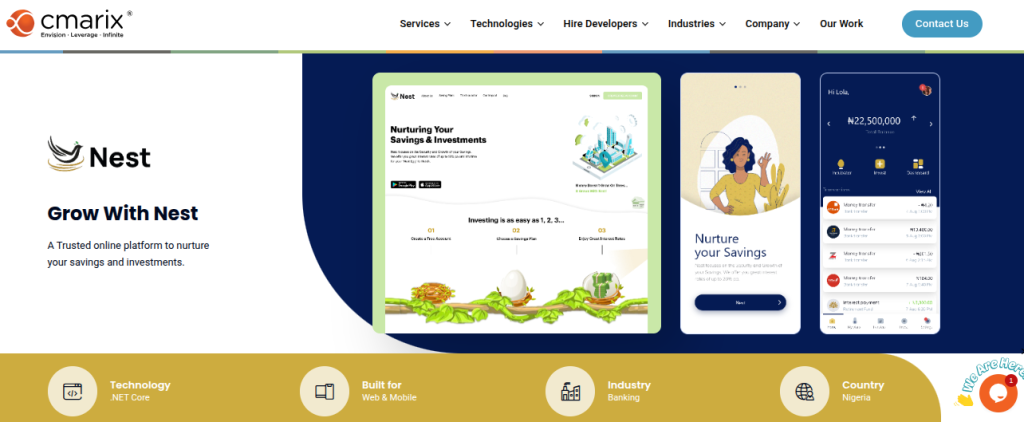
An example that fits here would be Nest Bank, an online banking solution licensed and developed for the web and mobile environment which focuses on secure login capabilities, transaction processing, and minimal features focused only on banking in order to get the client up and running without over-building before proving demand.
Conclusion
Peer-to-peer payment systems are not just a temporary fad; they are the de facto standard through which individuals exchange money, and there is no indication that this will change. To create an effective application, security and compliance must be embedded into the development process, and the core functionality must be streamlined to such a degree that the user does not have to question the actual process. If you’re ready to move from planning to building, build a fintech app that’s engineered for both trust and speed from the first line of code.
FAQs About P2P Payment App Development
How much does it cost to develop a P2P payment app?
Costs typically start at $40,000 for the minimal MVP that supports sending and receiving, and can reach $300,000 or more for the enterprise-level product that includes multi-currency and fraud detection features. The final cost will depend on the regulations you have to comply with, feature set, and your platform choice.
What are the essential features of a P2P payment app?
At minimum, a competitive app needs a digital wallet, biometric authentication, send and request functionality, push notifications, bank account linking, transaction history, and in-app support. Fraud detection and KYC verification need to be built in from the start rather than added later.
How do you set up a P2P payment account from a development perspective?
The process for setting up an account requires completing KYC, which entails obtaining identity information, linking an account (either a debit card or a bank account), and confirming the user’s identity via a password or biometric scan.
How do you ensure security in a P2P payment application?
Security is achieved by implementing several layers of security measures, such as data encryption using TLS/SSL or AES-256, biometric or multifactor authentication, a real-time fraud detection system that flags abnormal transaction patterns, and PCI-DSS compliance, attested through an Attestation of Compliance.
What role do APIs play in P2P payment development?
The APIs link the app to banking rails, KYC, payment gateways, and fraud protection without the need for the app to have its own dedicated backend infrastructure. The bank account linking service can be provided by companies like Plaid for account connectivity and Dwolla for ACH-based money movement.
How long does the development lifecycle for a P2P app take?
An MVP with basic functionalities will take about 3-5 months to develop. An application that is slightly complex, with bill-splitting and linking to banks, will require development from 5 to 8 months. Enterprise-level platforms, which have complete compliance and fraud detection capabilities, may need 8-12 months.
What regulatory compliances are required for a P2P fintech app?
In any case, at least one needs to comply with PCI-DSS when handling card data, KYC and AML when verifying identities and tracking transactions, and in the United States, state-level money transmitter licensing when the app stores or transfers user money directly. Compliance varies according to the country and whether there is cooperation with an authorized bank.
How can a P2P payment platform generate revenue?
Transaction fee models include those levied on premium fees for immediate payments, regular fees for normal payments, merchant integration fees for merchant payouts, interest on wallet balances, and subscription-based fees for additional services such as larger payment caps.
What is the difference between P2P payments and traditional bank transfers?
P2P payments move through a dedicated app using an email or phone number or username to identify the recipient, and often settle instantly through an in-app wallet balance. Traditional bank transfers usually require account and routing numbers, move directly between banks, and can take one to three business days to settle unless routed through a
real-time payment rail.