


Quick Summary: The cost to build AI-based accounting software typically ranges from $50,000 to $400,000+. The cost of software development varies with the complexity of the AI algorithms used. This article describes the cost of developing an AI-based accounting software application and its peculiarities.
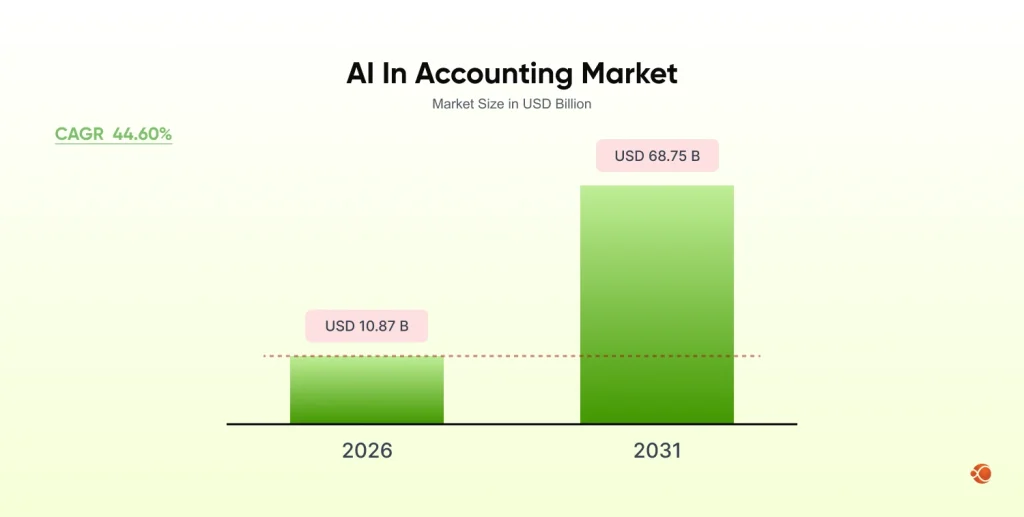
In the world of finance, efficiency isn’t just a goal; it is a necessity. Accounting has always been time-consuming and error-prone. But now, AI is transforming how businesses manage their numbers. From predicting cash flow trends to automating repetitive tasks, AI for accounting is changing the game. AI in the accounting market is estimated at USD 10.87 billion in 2026 and is projected to reach USD 68.75 billion in 2031, growing at a 44.60% CAGR over 2026-2031.
This isn’t just market hype. Gartner’s 2025 survey of finance leaders found that 59% of finance functions are already using AI in some form, following Gartner’s earlier prediction that 90% of finance functions would deploy at least one AI-enabled tool by 2026.
If you’ve ever wondered about the cost to build AI-based accounting software, then you’re not alone. Businesses are eager to invest in solutions that reduce errors, save time, and give them actionable insights. In this blog, we’ll break down everything from why AI matters in accounting to step-by-step costs, key AI-based accounting solution cost factors that influence development, and practical tools used in the industry. By the end, you’ll have a clear picture of custom AI-Driven accounting platform pricing and what it could mean for your firm.
Why AI Matters in Accounting Today
Accounting is continuously evolving; traditional workflows involve a lot of manual data entry, cross-checking numbers, and spreadsheet juggling. These processes are not just slow; they are also prone to mistakes. That’s where AI for accounting comes in. Many companies now explore AI software development services when planning future-ready accounting systems because AI helps them work smarter, faster, and with more confidence.
Challenges in Traditional Accounting
In today’s world, however, traditional accounting still relies on manual effort, which leads to delays, errors, and expenses. Too much time is spent on data entry, error correction, account reconciliation, and invoicing. It is not always easy to detect fraud or suspicious activity, and meeting deadlines can be really tough.
How AI Changes the Workflow
Artificial intelligence streamlines accounting by providing real-time insights and eliminating repetitive tasks. It automatically categorizes expenses, simplifies tax compliance, flags suspicious transactions, predicts cash flow trends, and generates instant financial reports. This means faster processes, fewer errors, stronger control, and more time for accountants to focus on meaningful financial strategy, thus making it a key benefit of AI accounting software development.
Real-World Use Cases of AI in Accounting
- Automated invoice processing
- AI-based audits and anomaly detection
- Predictive cash flow management
- Smart tax calculation and filing
- Spend analysis and forecasting
Businesses that implement AI accounting software can streamline operations, reduce errors, and enable accounting staff to prioritize strategy over calculations. Other businesses choose to retain the services of dedicated AI developers to build in-house AI capabilities within their financial systems, ensuring consistent growth.
The Role of Generative AI in Modern Accounting Software Development
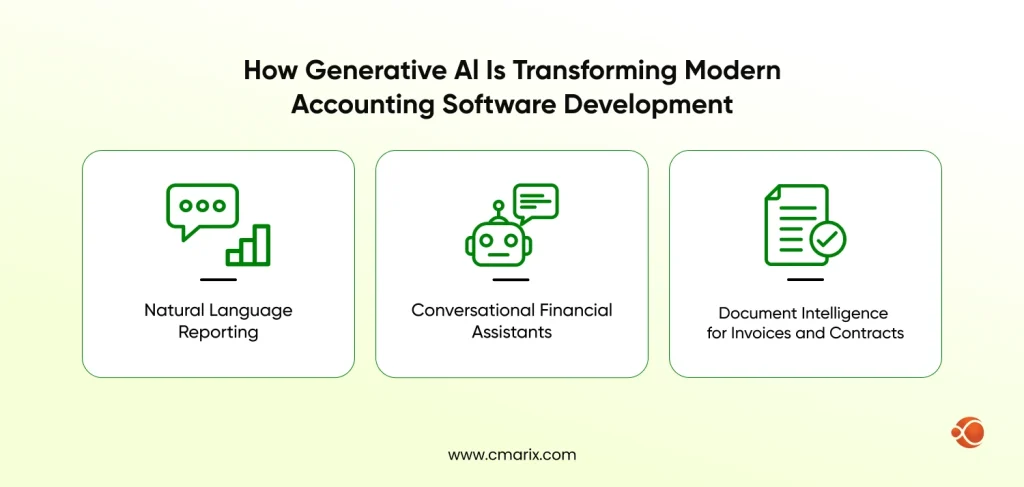
Generative AI has changed what “AI accounting software” even means. A few years ago, most AI accounting tools were rules-based automation with a thin layer of machine learning bolted on for categorization. In 2026, large language models sit at the core of the reporting and support layer, and that shift changes cost structures in a few specific ways.
Natural Language Reporting
Rather than simply seeing a dashboard, today’s financial analysts pose a question to a system, “Why was there such an increase in marketing expenditure in March?” and get a response that synthesizes information gathered from the general ledger, budget variance analysis, and the vendors. To create this solution, one needs to use LLMs, fine-tuning, and guardrails to avoid number hallucination.
Conversational Financial Assistants
Generative AI powers internal chatbots that walk an AP clerk through an exception or answer a CFO’s ad hoc question without a data analyst in the loop. CMARIX’s own generative AI development services use transformer- and LLM-based architectures for exactly this kind of use case, tailoring a base model to a company’s chart of accounts and internal terminology rather than shipping a generic chatbot.
Document Intelligence For Invoices And Contracts
Data extraction through NLP now regularly achieves precision rates above 95% for extracting structured information from PDFs, receipt scans, and supplier contracts. It requires more engineering effort than traditional OCR technology because it must handle a wide range of formatting issues, currencies, and even handwriting.
Cost implication: generative AI features typically add $15,000–$50,000+ to a project, depending on whether you’re fine-tuning an existing foundation model or building retrieval-augmented pipelines against proprietary financial data. It’s also where most of the 2026 differentiation lives — a system without a natural language layer is starting to look dated to finance teams who already use conversational tools elsewhere in their stack. CMARIX’s AI product development cost guide covers the infrastructure side of these features in more depth.
Step-by-Step Cost Breakdown of Building AI Accounting Software
When planning AI accounting software development, costs change widely depending on complexity, features and team location. Many enterprises, during planning, decide whether to customize existing tools or develop an accounting software from scratch, depending on data control, compliance requirements, and reporting complexity. Let’s break it down step by step.
AI Accounting Software Cost Breakdown Stage-wise
| Development Stage | Estimated Cost (USD) | Description |
| Planning & Requirement Analysis | $5,000 – $15,000 | Understanding business needs, defining workflows, and documenting requirements. |
| UI/UX Design | $4,000 – $12,000 | Designing intuitive interfaces for both accountants and managers. |
| Backend & Core Development | $20,000 – $60,000 | Database management, APIs, security, and core accounting functionalities. |
| AI Model Development & Training | $15,000 – $50,000 | Building AI models for predictive analytics, anomaly detection, and automation. |
| Integration (Banking, ERP, CRM, Payment) | $8,000 – $25,000 | Connecting existing systems for seamless operations. |
| Security, Compliance & Data Protection | $5,000 – $20,000 | Ensuring GDPR, SOX, and other compliance regulations are met. |
| Testing & Quality Assurance | $5,000 – $15,000 | Functional, performance, and security testing. |
| Deployment | $2,000 – $8,000 | Launching the software and configuring servers or cloud infrastructure. |
| Ongoing Maintenance & Support | $1,500 – $5,000 per month | Bug fixes, updates, and scaling support. |
Step-1 Planning & Requirement Analysis
This is where everything starts. Before even writing a single line of code, you need clarity on what the software should actually do and how it will support your accounting operations. All this planning is important to save on AI accounting software development costs.
- Understanding your business workflows and accounting processes
- Conducting workshops with finance and IT teams
- Identifying required AI features (automation, predictive analytics, fraud detection, reporting)
- Defining integrations with ERP, CRM, banking, or other systems
- Creating a detailed roadmap and development timeline
This step determines the direction for the project. This is where poor planning results in projects going over budget and timelines. This is where expectations do not match reality.
Step-2 UI/UX Design
Once the plan is clearly defined the next step is designing how the software will actually feel and look. Accounting users shouldn’t waste time figuring out complicated screens. Clean UI makes daily tasks faster and reduces mistakes.
- Designing user-friendly dashboards and simple navigation
- Creating visual financial insights like charts and summaries
- Designing mobile or cloud-based interfaces
- Running user testing and improving designs based on feedback
When UI/UX is done right, accountants feel confident using the system and productivity improves instantly.
Get cost-effective, enterprise-grade development.
Get StartedStep-3 Backend & Core Development
Now the real development work begins. This is where the foundation of the accounting system is built and all core features take shape.
- Creating and managing databases
- Developing APIs for integrations
- Building core accounting workflows (ledger, invoices, payroll, tax handling)
- Implementing user roles, permissions, and security controls
This stage builds the backbone of the solution, ensuring stability, performance, and reliability.
Step-4 AI Model Development & Training
Here’s where the software becomes “smart.” AI brings automation, predictions, and intelligence into accounting operations. The cost changes depending on how advanced you want it to be.
- Basic automation for routine tasks like invoice processing
- Moderate AI for predictive cash flow and budgeting
- Advanced AI for fraud detection, anomaly detection, forecasting, and decision support
- Data collection, cleaning, training, and accuracy testing
- Continuous AI model improvement
This stage impacts the custom AI accounting software cost.
Step-5 Integration (Banking, ERP, CRM, Payments)
AI accounting software rarely works alone. It usually needs to connect with existing company systems so that everything works smoothly together.
- Integrating banking systems for automated transaction import
- Connecting ERP and CRM for synchronized workflows
- Adding payment gateway integration
- Ensuring smooth, secure, real-time data flow
For businesses already running Xero, this step often means integrating with the Xero API — syncing invoices, bills, and bank transactions automatically rather than exporting spreadsheets by hand. Good integrations avoid manual imports and make finance data always current and accurate.
Step-6 Security, Compliance & Data Protection
This stage makes sure everything is protected and legally compliant. Financial data is highly sensitive, so security becomes the utmost important thing.
- Encrypting data and securing storage
- Applying role-based access controls
- Maintaining audit trails for compliance
- Meeting GDPR, SOC2, and local financial regulations
Strong security builds trust and keeps your system safe from risks.
Step-7 Testing & Quality Assurance
The software must be tested before launch to make sure it performs as expected in real-world conditions.
- Functional testing for accounting operations
- AI model validation
- Security and penetration testing
- Regression testing after fixes or updates
- User acceptance testing (UAT)
Good testing prevents failures and ensures the system runs smoothly when users start relying on it.
Step-8 Deployment
This is the moment the system goes live. Deployment should be handled carefully so operations are not disrupted.
- Cloud or on-premise setup
- Server configuration
- Migrating old accounting data
- Post-deployment monitoring
Successful deployment means your AI accounting system is officially ready for daily use.
Step-9 Ongoing Maintenance & Support
Development does not end with deployment. An AI system must develop with age, as it progresses, and requires nurturing.
- Frequent software updates/patches
- Revamping AI models for higher accuracy
- Correcting bugs or technical problems
- Performance and security monitoring
The system remains reliable, up-to-date, and useful for your company through continuous support
Key Factors That Influence Development Cost
The cost of developing AI-based accounting software is not just about features; it’s shaped by multiple subtle factors. Knowing these will help you plan realistically.
| Cost Factor | Typical Cost Impact |
| Business Size & Use Case |
|
| Feature Complexity |
|
| Level of AI Automation |
|
| Platform & Architecture |
|
| Compliance & Security |
|
| Team Location & Hiring Model |
|
Business Size & Use Case
Medium and large enterprises require multi-branch support, multi-currency transactions, complex reporting and integration with CRMs and ERPs. While small businesses often need simple dashboards and bookkeeping automation. Large firms also require AI-powered analytics for decision-making, which increases development time and cost.
Feature Complexity
Feature complexity is a major driver, you need to think whether your software will just automate invoices or also include:
- AI-powered fraud detection
- Predictive cash flow forecasting
- Advanced analytics dashboards
- Natural language processing for querying data
For every additional layer of AI accounting software development pricing. But sometimes a feature that seems simple on the surface can take weeks of work to implement.
Level of AI Automation
Not all AI is equal. Some solutions use simple rule-based automation to classify transactions. Others leverage machine learning models trained on historical data for predictive insights. Naturally, the more advanced the AI, the higher the AI accounting software development cost.
Platform & Architecture Choice
Here, the question is are you building a cloud-first solution, hybrid or on-premises software. Cloud systems may reduce upfront infrastructure costs but require ongoing subscription fees. On-premises deployments are more expensive initially but they provide full control and may be preferable for sensitive financial data.
Compliance & Security Needs
Accounting software deals with highly sensitive financial data. Meeting standards such as GDPR, SOX, PCI-DSS or regional encryption measures. This can add anywhere from 10-20% to your base development cost.
Team Location & Hiring Model
Large companies focus on scalability, deep analytics and enterprise controls, which is why they consider financial software development services to build solutions that fit their particular financial structure rather than depending on generic platforms only. Many businesses choose a hybrid model to balance cost and quality.
Types of AI Software Used in Finance & Accounting
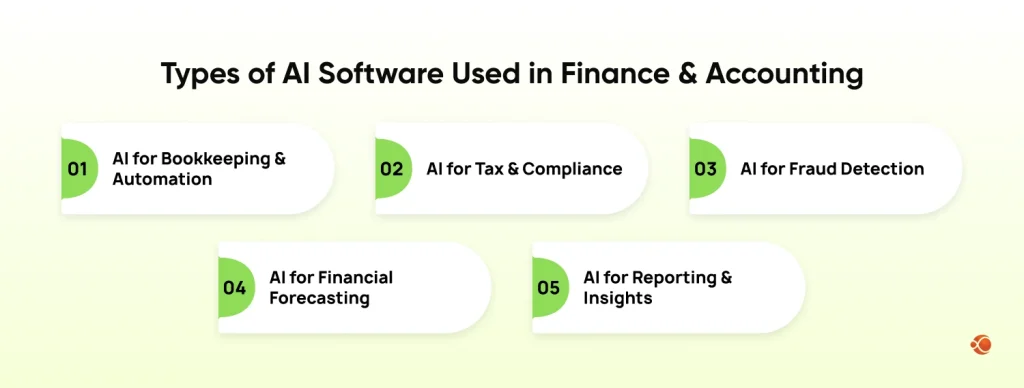
AI is no longer just a future concept; it is actively shaping how finance teams operate. Depending on your business needs, it can reduce errors, and different AI solutions can help smooth accounting and provide actionable insights. Many organisations hire AI developers at this stage to customize these solutions to their workflows.
1. AI for Bookkeeping & Automation
Many times this is the first step for businesses adopting AI. Bookkeeping automation software can:
- Generate recurring expense reports and journal entries
- Reconcile bank statements with invoices and ledgers
- Automatically categorize transactions based on rules or historical data.
2. AI for Tax & Compliance
Tax filing and compliance are labor-intensive and error-prone. AI tools can:
- Based on local regulations, tax liabilities are calculated automatically.
- Detect errors or missing information in filings before submission.
- Track changes in tax rules and alert users to compliance updates.
3. AI for Fraud Detection
Fraud is a constant risk in finance, and AI-based fraud detection can:
- Monitor transactions in real-time for unusual patterns.
- Flag high-risk activities and generate alerts.
- Learn from previous fraud cases to improve detection accuracy over time.
4. AI for Financial Forecasting
Predictive AI models are changing financial planning by:
- Cash flow, forecasting revenue and expenses based on historical data and market trends.
- Helping businesses prepare for potential shortfalls or surpluses.
- Allowing scenario analysis, “what if” predictions to guide strategic decisions.
5. AI for Reporting & Insights
Artificial intelligence can help process raw financial information into important information:
- Determine key performance indicators (KPI) & trends
- Automatic generation of dashboards and visual reports.
- Provides concrete recommendations for policymakers.
Why this is essential: Choosing the correct mix of AI solutions depends on your business goals. Some businesses focus on automation, while others on predictive analytics and strategic insights. And a combination of these tools often delivers the best results.

Build vs. Buy vs. Customize (SaaS): A Cost Comparison (New)
This is the decision most CFOs actually need help with, and it doesn’t have a universal right answer.
| Approach | Upfront Cost | Ongoing Cost | Best Fit |
| Buy (Off-the-shelf SaaS) | $0–$5,000 setup | $20–$500+/month per user | Small businesses, standard workflows, fast time-to-value |
| Customize existing SaaS | $10,000–$50,000 | Subscription + customization maintenance | Mid-size firms needing specific integrations or reporting |
| Build Custom | $50,000–$400,000+ | $1,500–$5,000+/month | Enterprises with unique compliance needs, proprietary workflows, or data control requirements |
Buy
Buy makes sense when your accounting workflows look like everyone else’s. Tools like QuickBooks AI or Xero AI cover 80% of standard SME needs at a fraction of custom development cost, and they ship new AI features on their own release cycle without you paying for R&D.
Customize
Customize is the middle path, layering integrations, custom reporting, or industry-specific rules on top of an existing platform. It costs more than pure SaaS accounting software pricing, but far less than building from scratch. Many growing businesses also choose AI-powered MVP development to quickly validate intelligent accounting features before committing to a full-scale custom platform, making it a practical way to reduce both risk and upfront investment.
Build
Tailored solutions where control over data, deep integration with an ERP system, or industry-specific regulation make a generic product a bad choice. Financial services organizations, businesses that operate finance units that touch the health care space, as well as those with proprietary trading or underwriting engines, typically fall into this category.
Outsourced vs. In-House AI Accounting Development
There’s a fourth option worth naming: outsourced vs. in-house build. While having an in-house team will give you full control, it will also entail the expense and difficulty of recruiting, retaining, and continually training AI staff, especially in the current labor market, where skilled machine learning engineers are both expensive and hard to come by. It is usually more economical to outsource to a dedicated AI development team experienced in building AI accounting software, which can save 20-40% on first-year ownership costs. CMARIX’s own breakdown of custom software development vs. SaaS walks through this trade-off for teams weighing the decision beyond accounting specifically.
Popular AI Tools Used by Accounting Firms
Here’s a snapshot of widely-used platforms and their practical applications:
| Tool Type | Platform / Tool | Best For |
| Widely Used AI Accounting Platforms | QuickBooks with AI | SMBs, automated bookkeeping |
| Xero AI | Cloud-based accounting, expense tracking | |
| FreshBooks AI | Freelancers, SMEs, invoicing | |
| Sage Intacct AI | Mid-market to enterprise, multi-currency and reporting | |
| AI Assistants & Analytics Tools | Vic.ai | Invoice automation, approval workflows |
| Botkeeper | Full-service bookkeeping for SMBs | |
| Docyt | Data extraction and tax compliance | |
| Datarails | Enterprise reporting, financial consolidation | |
| MindBridge AI | Audit, fraud detection, anomaly identification |
Tools Used by Enterprises vs SMBs
- SMBs → QuickBooks, Xero, FreshBooks, Botkeeper
- Enterprises → Oracle NetSuite, SAP Concur, Sage Intacct AI, MindBridge
This table shows that the tool choice depends on complexity, company size and reporting needs. Larger companies usually prefer platforms that integrate deeply with existing ERPs and provide predictive insights.
Benefits of AI-Based Accounting Software
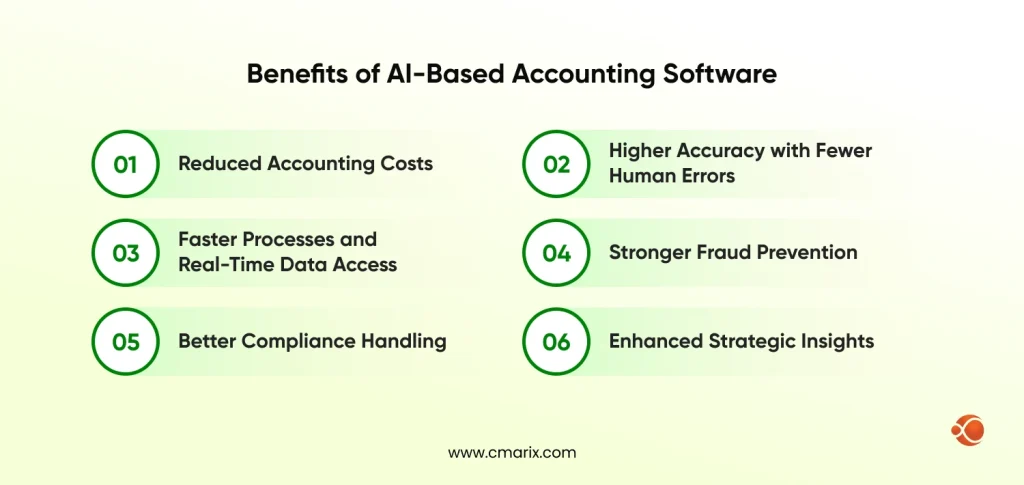
Adopting artificial intelligence in finance is not just about efficiency. It can fundamentally transform how businesses operate, especially with guidance from AI consulting services. Let’s explore the benefits:
1. Reduced Accounting Costs
The most important benefit of AI is it reduces repetitive manual tasks such as data entry, report generation and reconciliation. Businesses can often achieve the same output with fewer staff hours or redirect their teams to higher-value activities.
Example: A mid-sized e-commerce company can cut its monthly bookkeeping hours after implementing an AI-based accounting platform.
2. Higher Accuracy with Fewer Human Errors
Human errors are inevitable, specially when they are managing large volumes of data. An AI system consistently applies rules, validates data entries and cross-checks numbers. This reduces mistakes that could lead to financial misstatements, compliance issues and tax penalties.
Example: AI-based invoice processing tools like Vic.ai automatically flag mismatched amounts, preventing incorrect payments.
3. Faster Processes and Real-Time Data Access
Artificial intelligence enables real-time reporting, so a company can track its financial position at all times. There is no need for an accountant, as they do not need to wait until the month-end closes.
Example: Companies utilizing Xero AI or QuickBooks AI can immediately create their cash flow forecasts, providing their management with necessary insights on time.
4. Stronger Fraud Prevention
AI can detect the smallest issues that humans might miss. By learning patterns of normal transactions, AI flags suspicious activity early. This proactive approach helps in preventing financial loss and reputational damage.
Example: The financial services industry, MindBridge AI helps scan thousands of financial transactions in real time to ensure that fraud is prevented.
5. Better Compliance Handling
Accounting compliance is complex, with regulations changing frequently. AI tools track regulatory changes, audit trails, and ensure filings meet standards automatically.
Example: Large companies utilizing Sage Intact Artificial Intelligence can readily enable a comprehensive audit trail of either internal or external compliance.
6. Enhanced Strategic Insights
By analyzing historical data, AI can reveal spending patterns, profitability trends and growth opportunities that might not be obvious otherwise.
Example: Predictive analytics tools allow CFOs to model various financial scenarios, helping them make informed decisions about investments, hiring, and expansion.
Vertical Expertise: What Regulated Finance Actually Requires
General AI suggestions for accounting can go only up to that point. For instance, the AI system designed for the healthcare billing platform will require a different benchmark for detecting anomalies than the one required by the AI system designed for the fraud model in the financial technology platform.
In addition to this, CMARIX’s proprietary Eddbee Shares platform, a GDPR compliant algorithmic trading solution built for a Swedish fintech company, makes an excellent example of what “compliance-first AI architecture” means in practice: access to 60+ stock exchanges across the globe, CopyPortfolio functionality, and enterprise-level security based on regulatory requirements, not simply checklists. Those teams looking for financial software development services for their accounting project should be able to see such proof.
The pattern holds across fintech-specific engineering work more broadly: fraud models, credit scoring pipelines, and reconciliation engines all benefit from a team that has already solved the regulatory and latency problems specific to financial data, rather than learning them on your project’s budget.
Implementation Guide: How to Bring AI Into Your Accounting Firm
Even before the launch, businesses turn to AI consultancy in order to evaluate their readiness, data quality, ease of integration, ROI, and roadmap. The following steps should be followed.
Readiness Check
Identify issues that hinder the efficiency of business when preparing to integrate AI into accounting. In this case, it is important to evaluate the data you have been working with in the past to determine its quality. Additionally, you should confirm if you have the technical capacity to run AI software without disrupting business. This exercise will enable you to know where to undertake AI so that it can be successful.
Data Preparation
Artificial intelligence depends on structured, clean and accurate data. Ledgers, historical invoices and ledgers should be organized, standardized across departments and cleared duplicates or errors. In many cases, firms spend 30-40% of the project timeline preparing data before training AI models. This step is crucial because the quality of your data directly affects the accuracy and reliability of your AI-powered accounting system.
Integration Strategy
In order for AI to give the greatest benefit, it should be able to smoothly interface with existing systems, like banking systems for real-time monitoring, ERP and CRM systems for holistic financial information or payment/payroll systems for automatic workflows.
For instance, if a manufacturing enterprise integrated AI software with Oracle NetSuite and SAP, achieving fully automated end-to-end accounting workflows. Proper integration makes sure smooth data flow and prevents operational silos.
Change Management & Staff Training
Successful AI adoption requires cultural change. The staff must understand new workflows and trust artificial intelligence outputs. Some effective strategies include hands-on training sessions, clear documentation and appointing “AI champions” within the team to guide others. Slow adoption works best; start by giving employees time to adjust comfortably to the changes.
Continuous Monitoring & Optimization
AI for accounting is not just a one-time setup; it requires continuous monitoring to make sure models remain accurate as transaction patterns evolve, software stays compliant with user-adapted workflows and regulations to maximize value. For instance, a financial services firm schedules quarterly AI model reviews to revise predictive forecasts. With continuous optimization, AI reduces errors, boosts productivity, and provides actionable insights without disrupting daily accounting operations.
Why Choose CMARIX for AI-Based Accounting Software Development?
Custom AI solutions can be complex, which is why a trusted partner matters. CMARIX offers:
- Strong Experience in Finance & Enterprise Software
CMARIX has extensive experience in delivering software related to finances, banking, and large business houses. This will make sure that your accounting system is compatible with business requirements. - Secure and Compliance-ready Development
CMARIX develops software with best practices of security and compliance such as SOX, GDPR, and PCI-DSS. This safeguards the confidential financial information and keeps you audit-ready. - Flexible Engagement Models
Whether you want a dedicated development team or project-based collaboration or fully managed solution, CMARIX adapts to your preferred way of working. - Dedicated Support and Maintenance
Continuous support makes sure your AI accounting software remains up-to-date, fully functional and efficient. Any issues or updates are handled promptly to avoid disruption.
CMARIX brings domain expertise, flexible engagement models, secure development, and dedicated support to help businesses build successful AI-driven accounting platforms.
Along with strategy and delivery, software development services make sure that planning, engineering, deployment, testing, and maintenance are done reliably, keeping systems scalable, secure, and future-ready.
Conclusion
Investing in custom AI-based accounting software is a strategic move that increases efficiency, accuracy and insights. By giving predictive analytics, automating routine tasks, reducing errors and saving time while allowing smarter decision-making.
Understanding the artificial intelligence accounting software development cost and key influencing factors helps you plan effectively. With the ideal partner, AI for accounting becomes more than a tool; it transforms your accounting operations into a proactive, intelligent system that drives long-term growth.
FAQ on the Cost to Build AI-based Accounting Software
What factors influence the cost of AI accounting software development?
Feature complexity, business size, AI automation level, compliance requirements, system integrations and team location all affect development cost. Also, additional factors include integration challenges, ongoing maintenance, and data preparation needs.
Why choose custom AI accounting software over pre-built solutions?
Tailored solutions cater to your unique process workflow, scale according to your needs as your business expands, and are easily integrated into your current system, which is not the case with generic, ready-made software programs.
What is the typical cost to develop custom AI-based accounting software?
Depending on the features and complexity of the AI, costs usually range from $50,000 to $200,000 (approx.) or more. The final cost also depends on security requirements, integration needs, and the geographic location of your development team.
How does custom AI accounting software differ from off-the-shelf solutions?
Custom software can be designed to meet the needs of the business, whereas customized solutions may have limitations in workflow and flexibility. It can also provide the desired level of control over data and security.
How long does it take to develop an AI accounting solution from scratch?
While a full-scale solution may take longer than a few months to build, simpler systems can be built in a matter of months. The time frame depends on the AI’s complexity, the number of integrations, and the number of testing rounds.
Why is regulatory compliance a challenge for AI in accounting?
Accounting data is sensitive,, and thus AI systems must meet standards such as GDPR, SOX, or HIPAA, which require careful design and continuous monitoring. Making sure compliance often involves additional audits, process adjustments, and documentation. Browse CMARIX’s blog for more guides on how specific compliance requirements shape AI architecture decisions.
What is the typical cost to develop custom AI-based accounting software in 2026?
Custom AI-based accounting software typically costs between $50,000 and $400,000+. Final pricing depends on AI capabilities, integrations, security requirements, compliance standards, and the complexity of financial workflows the platform is designed to automate.
What are the key factors influencing the overall Cost to Build AI-Based Accounting Software?
The biggest cost drivers include feature complexity, AI model sophistication, third-party integrations, cloud infrastructure, regulatory compliance, data volume, security requirements, development team location, and whether the solution is built from scratch or customized from an existing platform.
What core AI features have the biggest impact on development costs?
Features such as predictive cash flow forecasting, fraud detection, anomaly detection, NLP-based invoice processing, generative financial reporting, and conversational AI assistants require extensive model training and validation, making them the most expensive AI capabilities to implement.
What is the estimated cost breakdown by development stage?
The cost of developing software applications is usually divided into the planning stage, design (UI/UX), back-end programming, AI models, integration, security, testing, deployment, and post-deployment support. Back-end engineering and AI model development usually account for the largest share of the total budget.
What are the ongoing maintenance costs after the AI accounting software is developed?
Most companies need to budget somewhere between $1,500 to $5,000 a month for upkeep. This will pay for bug fixing, security patching, cloud hosting, retraining AI models, performance monitoring, additional features, and compliance/financial data changes.
Is it better to build custom AI software or buy a pre-built solution (e.g., QuickBooks/Xero)?
Ready-made platforms suit well firms having traditional accounting procedures with tight budgets. Custom AI solutions are more appropriate for companies having unique requirements, integration needs, regulatory compliances, or using AI technology which provides them with an edge over competitors.